Listen to this Post
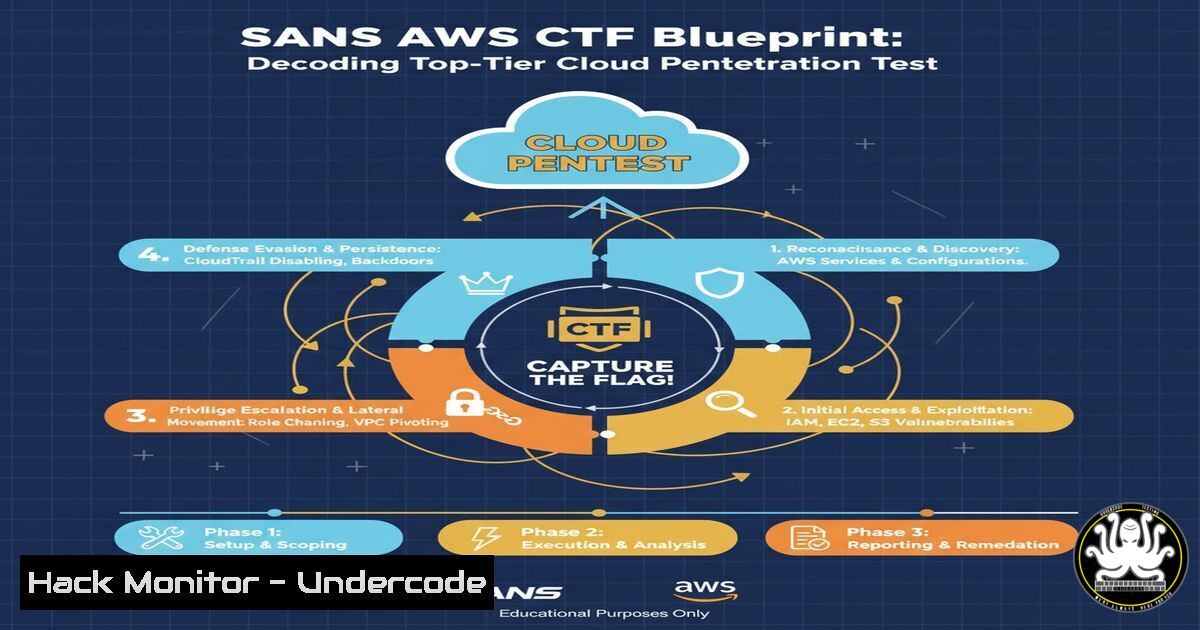
Introduction:
The recent SANS AWS Skills to Jobs CTF showcased the cutting-edge of cloud security, challenging nearly 3,000 global participants with real-world scenarios. This intense competition provides a unique blueprint for the multidisciplinary skills required by modern cybersecurity professionals, blending cloud misconfiguration hunting with traditional offensive security tactics. Mastering these techniques is no longer optional but essential for defending modern, ephemeral infrastructure.
Learning Objectives:
- Deconstruct critical AWS IAM misconfigurations and privilege escalation vectors.
- Master cloud-native forensics and log analysis using AWS CLI and native services.
- Integrate web application exploitation with subsequent cloud environment pivoting.
You Should Know:
1. IAM Privilege Escalation via `iam:PutRolePolicy`
Verified Command:
aws iam put-role-policy --role-name TargetRole --policy-name MaliciousPolicy --policy-document file://./malicious-policy.json
Step-by-step guide:
This command attaches an inline policy to an existing IAM role. If an attacker gains temporary credentials with the `iam:PutRolePolicy` permission, they can escalate privileges by attaching an administrative policy. First, create a `malicious-policy.json` file granting full administrator access. Then, execute the command to apply it. Always audit IAM roles for inline policies and monitor CloudTrail logs for `PutRolePolicy` events, as this is a common CTF escalation path and a critical real-world vulnerability.
2. Enumerating Public S3 Buckets via Automated Recon
Verified Command:
aws s3 ls s3://target-bucket/ --no-sign-request --region us-east-1
Step-by-step guide:
The `–no-sign-request` parameter allows you to interact with an S3 bucket without AWS credentials if the bucket has public read permissions. In a CTF or penetration test, use this to quickly enumerate buckets discovered through subdomain enumeration. If the bucket is misconfigured, you can list and download sensitive files. This command highlights the critical importance of proper S3 Bucket Policies, specifically avoiding `”Effect”: “Allow”, “Principal”: “”` for read actions.
3. Leveraging SSM for EC2 Instance Access
Verified Command:
aws ssm start-session --target i-1234567890abcdef0
Step-by-step guide:
AWS Systems Manager (SSM) Session Manager provides a secure way to manage EC2 instances without exposing SSH ports. In a CTF, if you discover an EC2 instance with the SSM Agent running and an attached instance profile with the `AmazonSSMManagedInstanceCore` policy, you can gain shell access through this method. This technique is often used post-initial compromise for lateral movement and is far stealthier than traditional SSH, as it operates over HTTPS.
4. Extracting EC2 Instance Metadata for Credentials
Verified Command:
curl http://169.254.169.254/latest/meta-data/iam/security-credentials/
Step-by-step guide:
The Instance Metadata Service (IMDS) provides temporary credentials for the IAM role attached to an EC2 instance. If you achieve command execution on a server (e.g., via web shell), query this endpoint. It will return the role name. Then, query `http://169.254.169.254/latest/meta-data/iam/security-credentials/ROLE-NAME` to get temporary access keys, secret keys, and a session token. Use these credentials with the AWS CLI to perform actions permitted by the instance role, a classic pivot in cloud CTF challenges.
5. CloudTrail Log Analysis for Anomalous API Calls
Verified Command:
aws cloudtrail lookup-events --start-time 2023-11-01T00:00:00Z --end-time 2023-11-02T00:00:00Z --lookup-attributes AttributeKey=EventName,AttributeValue=ConsoleLogin
Step-by-step guide:
CloudTrail is the central logging service for AWS API activity. This command filters events for a specific API call, ConsoleLogin, within a given time window. During CTF forensics challenges, you would use this to identify suspicious login behavior, such as logins from unfamiliar IP addresses. Correlate this with other events like `AssumeRole` or `PutRolePolicy` to trace an attacker’s steps through the environment.
6. Decrypting EBS Snapshots for Data Exfiltration
Verified Command:
aws ec2 create-volume --availability-zone us-east-1a --snapshot-id snap-0123456789abcdef --region us-east-1
Step-by-step guide:
If an attacker gains the `ec2:CreateVolume` permission and a snapshot exists that is encrypted with a manageable key, they can create a new volume from it in their controlled account (if the key is shared) or the same account. They then attach this volume to a compromised EC2 instance to mount and access the data. This is a common data exfiltration and CTF data recovery technique, emphasizing the need for strict key policies and snapshot sharing controls.
7. Lambda Function Code Extraction and Reverse Engineering
Verified Command:
aws lambda get-function --function-name TargetFunction --query 'Code.Location'
Step-by-step guide:
This command returns a pre-signed URL to download the deployment package (ZIP) of a Lambda function. In a malware analysis or reverse engineering CTF challenge, this allows you to download and unzip the function code. You can then analyze the code for hardcoded secrets, logic vulnerabilities, or malicious payloads, a critical skill for serverless application security.
What Undercode Say:
- The convergence of cloud, web, and forensics challenges in modern CTFs like the SANS event directly mirrors the blended attack surfaces security professionals must defend daily.
- Success is no longer about depth in a single domain but breadth across multiple disciplines, with the ability to pivot from a web shell to full cloud account compromise being the new benchmark for elite testers.
The SANS CTF serves as a perfect microcosm of the modern cybersecurity landscape. The challenges are no longer siloed; a web exploit leads to cloud credential theft, which enables lateral movement, culminating in a full-scale incident requiring digital forensics. This multidisciplinary approach, as demonstrated by the top competitors, is the future of both offensive and defensive security. Professionals must cultivate a T-shaped skill profile: deep expertise in one or two areas complemented by a working knowledge of adjacent fields. The tools and commands demonstrated are not just CTF tricks but are extracted from real-world incident response reports and penetration tests, validating their critical importance.
Prediction:
The sophistication of cloud-based attack chains will accelerate, moving beyond simple misconfigurations to complex, automated workflows that exploit serverless functions and container orchestration platforms like Kubernetes. We will see a rise in “cloud-native malware” designed specifically to operate within and exploit ephemeral, API-driven environments, making traditional perimeter-based defense entirely obsolete. CTFs will subsequently evolve to incorporate AI-driven security controls and the manipulation of machine learning models as a new attack vector.
🎯Let’s Practice For Free:
IT/Security Reporter URL:
Reported By: UgcPost 7386764098027319296 – Hackers Feeds
Extra Hub: Undercode MoN
Basic Verification: Pass ✅


