
Listen to this Post
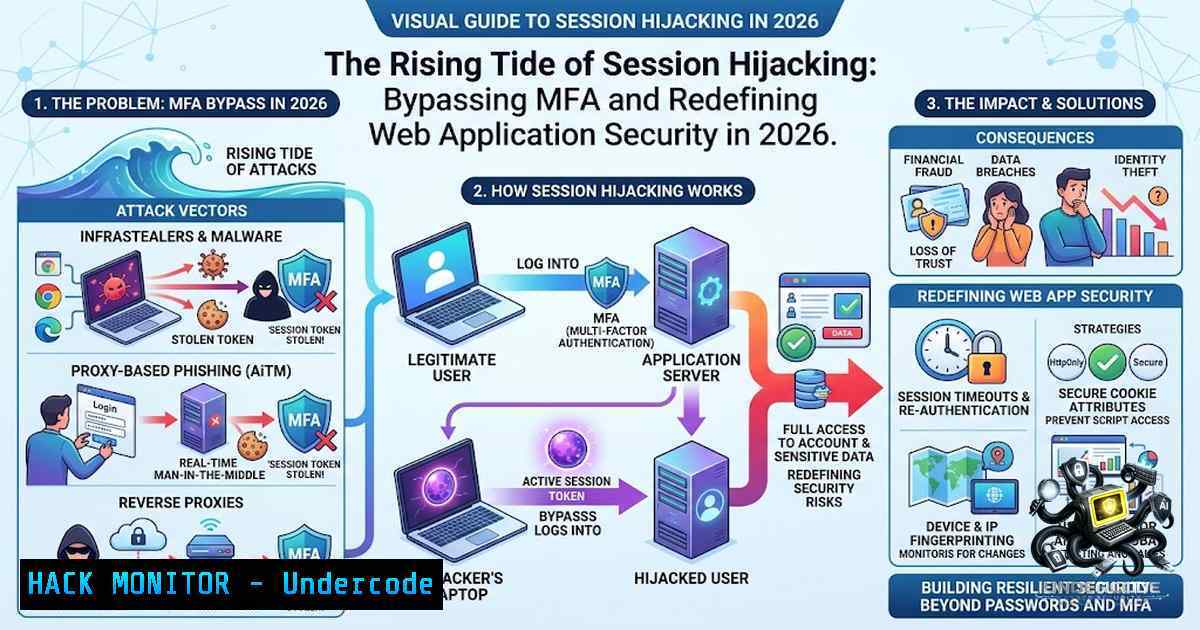
Introduction:
Session hijacking has emerged as one of the most formidable cybersecurity threats in 2026, representing a fundamental shift in how attackers compromise web applications. Unlike traditional credential theft, session hijacking occurs after successful authentication—attackers steal post-authentication session tokens, effectively bypassing multi-factor authentication (MFA) and password controls entirely. With a staggering 127% year-over-year increase and 87% of successful cyberattacks in 2024 involving session hijacking after valid MFA logins, this attack vector has become the preferred method for account takeover, data breaches, and unauthorized transactions.
Learning Objectives & Secrets:
- Objective 1: Master Session Token Acquisition Vectors — Understand the four primary methods attackers use to steal session identifiers: infostealer malware (Lumma, Vidar, RedLine), adversary-in-the-middle (AiTM) phishing, cross-site scripting (XSS) vulnerabilities, and unencrypted network interception. Secret tip: Infostealer malware remains the dominant vector, with SpyCloud recovering over 17 billion stolen credential records from the criminal underground in 2024 alone.
-
Objective 2: Implement Layered Defense Strategies — Deploy defense-in-depth using HTTPS with modern TLS, Secure/HttpOnly/SameSite cookie flags, session ID regeneration after login, and short absolute and idle timeouts. Secret tip: Session ID rotation after any privilege change is the direct countermeasure to session fixation—never let a pre-authentication session ID carry over into an authenticated session.
-
Objective 3: Leverage AI for Behavioral Detection — Deploy User and Entity Behavior Analytics (UEBA) and real-time monitoring to profile normal user activity and spot deviations that could signal a hijack. Secret tip: AI-powered systems can detect anomalous session activity that static security tools miss—behavioral detection provides the strongest defense against post-authentication token theft.
You Should Know:
1. Understanding Session Hijacking vs. Session Fixation
Session hijacking and session fixation are often confused but represent fundamentally different attack vectors. Session hijacking is the theft of an existing, valid session cookie after a user has already authenticated. The attacker captures the session token—typically an OAuth token, session cookie, or refresh token stored in the browser—and replays it from a different device. No MFA prompt fires because the server sees a valid, active session.
Session fixation, by contrast, occurs when an attacker tricks a user into authenticating with a session value the attacker already knows. The attacker sets a known session ID before the victim logs in, then waits for the victim to authenticate, after which the attacker uses that same predetermined session ID to access the victim’s account. The key difference: hijacking steals an existing session; fixation plants a session ID before authentication occurs.
Step-by-Step Guide to Identifying Session Vulnerabilities:
Linux Command – Checking for Session Cookie Security with cURL:
 Check if a site's session cookie has Secure and HttpOnly flags
curl -I https://example.com/login | grep -i "set-cookie"
 Look for: Secure; HttpOnly; SameSite=Lax or Strict

Test session fixation by attempting to set a custom session ID
curl -v -b "SESSIONID=attacker-controlled-value" https://example.com/dashboard
 If the server accepts the pre-set ID, the site is vulnerable to fixation
Windows Command – Using PowerShell to Inspect Cookie Security:
Invoke-WebRequest -Uri https://example.com/login -SessionVariable session
$session.Cookies.GetCookies("https://example.com") | Select-Object Name, Secure, HttpOnly
 Verify Secure and HttpOnly flags are set to True
- The Attack Chain: How Session Hijacking Works in Practice
Session hijacking follows a predictable attack pattern that exploits the gap between authentication and session management. The attack chain consists of four stages:
Stage 1: Token Acquisition — Attackers obtain session tokens through infostealer malware, phishing proxies, malicious scripts, or network sniffing. Infostealer families like Lumma, Vidar, and RedLine sweep the browser’s on-disk cookie store, extract session tokens for hundreds of sites, and transmit them to attacker-controlled servers within minutes of infection.
Stage 2: Token Exfiltration — Stolen session cookies reach Telegram markets within hours of a successful infection. Attackers can purchase these tokens and use them immediately.
Stage 3: Token Replay — From their own browser or a script, attackers set the stolen cookie and send a request to the target site. The server sees a valid session and grants access.
Stage 4: Lateral Movement — With a single authenticated session cookie, attackers can ride trusted connections from one compromised application into connected systems, potentially accessing financial platforms, internal tools, and single sign-on (SSO) ecosystems.
Step-by-Step Guide to Testing Session Security (Lab Environment Only):
Linux – Setting Up a Controlled Session Hijacking Lab with DVWA:
 Clone the DVWA Session Hijacking practice repository
git clone https://github.com/aqmal-ahamat/DVWA-Session-Hijacking-Practice.git
cd DVWA-Session-Hijacking-Practice

Install required tools
sudo apt install arpspoof wireshark

Start ARP spoofing to intercept traffic (lab environment only!)
sudo arpspoof -i eth0 -t [target-ip] [gateway-ip]

Use Wireshark to filter and capture HTTP cookies
wireshark -i eth0 -f "http.cookie" -k
Linux – Using Hamster for Cookie Sidejacking (Educational Use Only):
 Install hamster-sidejack
sudo apt install hamster-sidejack

Start hamster proxy
hamster
 Set browser proxy to http://127.0.0.1:1234
 Hamster replaces your cookies with session cookies stolen from somebody else
Hamster acts as a proxy server that replaces your cookies with session cookies stolen from somebody else, allowing you to hijack their sessions.
- Defensive Controls: Cookie Flags, Session Rotation, and Timeouts
Effective session hijacking prevention requires a layered security approach. The most critical controls include:
Cookie Security Flags:
- HttpOnly — Prevents JavaScript from reading the cookie, the single most effective mitigation against session theft via XSS
- Secure — Ensures the cookie is only transmitted over encrypted HTTPS connections
- SameSite — Restricts cookie sending to same-site requests, preventing CSRF-based session riding
Session Rotation:
- Regenerate session IDs immediately after login and after any privilege change
- Never switch a session between HTTP and HTTPS mid-flow, as this can expose the identifier in clear text
Session Timeouts:
- Enforce short absolute timeouts (maximum 24 hours for active sessions)
- Implement idle timeouts (1-4 hours of inactivity)
- Enforce server-side invalidation on logout
Step-by-Step Guide to Configuring Secure Session Cookies:
Linux – Nginx Configuration for Secure Session Cookies:
 In nginx.conf or site configuration
add_header Set-Cookie "SESSIONID=$session_id; Path=/; HttpOnly; Secure; SameSite=Strict; Max-Age=3600" always;

Force HTTPS for all sessions
server {
listen 443 ssl http2;
ssl_protocols TLSv1.2 TLSv1.3;
add_header Strict-Transport-Security "max-age=31536000; includeSubDomains" always;
}
Linux – Apache Configuration:
 In .htaccess or httpd.conf
Header always edit Set-Cookie ^(.)$ $1;HttpOnly;Secure;SameSite=Strict
- AI and Machine Learning in Session Hijacking Detection
Artificial intelligence is transforming both sides of the session hijacking battlefield. Attackers now use AI for reconnaissance, identity-based attacks, and silent data theft. Simultaneously, defenders are deploying AI-powered systems that detect and stop advanced adversary-in-the-middle attacks during the authentication process.
AI-Powered Detection Techniques:
- User and Entity Behavior Analytics (UEBA) — Profiles normal user activity with AI tools to spot deviations that could signal a hijack
- Real-time Monitoring — Detects anomalous behavior such as unusual tool usage or request volumes
- Agentic AI Systems — The first agentic AI systems can now detect and stop advanced adversary-in-the-middle attacks in real-time
Emerging Threat: Prompt Hijacking
Security researchers have identified a new AI-specific attack called prompt hijacking, an AI version of session hijacking where attackers inject malicious prompts into legitimate MCP (Model Context Protocol) communications. Tracked as CVE-2025-6515, this vulnerability enables attackers to hijack AI agent communications.
Step-by-Step Guide to Implementing AI-Powered Session Monitoring:
Linux – Setting Up Basic Session Anomaly Detection with Python:
import hashlib
import time
from collections import defaultdict

class SessionAnomalyDetector:
def <strong>init</strong>(self):
self.user_profiles = defaultdict(lambda: {"requests": [], "locations": []})

def log_activity(self, user_id, session_id, ip_address, user_agent):
profile = self.user_profiles[bash]
profile["requests"].append({
"timestamp": time.time(),
"session_id": session_id,
"ip": ip_address,
"user_agent": user_agent
})
 Detect anomalies: multiple IPs for same session, unusual user agents
if len(set([r["ip"] for r in profile["requests"][-10:]])) > 2:
print(f"[bash] Potential session hijacking detected for user {user_id}")
return True
return False
5. Bug Bounty Programs and Ethical Testing
Bug bounty programs have become essential for identifying session hijacking vulnerabilities before attackers exploit them. Organizations should consider opening bug bounty events either internally or to the public to test their own sites.
Real-World Examples:
- A reflected XSS vulnerability was discovered on a NASA subdomain via unsanitized User-Agent input, demonstrating a full exploit chain leading to session hijacking
- The U.S. Department of Defense disclosed a session handling vulnerability where weak email change logic failed to invalidate active sessions, enabling account takeover
- A session fixation vulnerability was discovered in a legal consultation platform through the Open Bug Bounty program, potentially leading to full account takeover
- A bug bounty hunter earned a bonus from HackerOne for reporting a session hijacking bug
Step-by-Step Guide to Testing for Session Vulnerabilities (Authorized Testing Only):
Linux – Using Burp Suite for Session Testing:
 Install and run Burp Suite Community Edition
java -jar burpsuite_community.jar

Configure browser proxy to 127.0.0.1:8080
 Use Repeater to replay session cookies
 Use Sequencer to test session ID randomness
Linux – Using OWASP ZAP for Automated Session Scanning:
 Install OWASP ZAP
sudo apt install zaproxy

Run automated scan
zap-cli quick-scan -r https://example.com

Check for session management issues
zap-cli active-scan https://example.com
6. Customer Protection and Best Practices
Users can protect themselves through several practical measures:
VPN Usage — Require VPN usage when accessing banking and other sensitive information via websites. VPNs encrypt all traffic between the user’s device and the VPN server, preventing session sniffing on insecure networks.
Wi-Fi Calling Safety — Wi-Fi calling uses SRTP (Secure Real-time Transport Protocol) encryption, making it generally safe when properly configured. However, users should ensure their Wi-Fi network uses WPA2 or WPA3 encryption.
Token Harvesting Awareness — Token harvesting occurs when attackers collect authentication tokens through various means including phishing, malware, and network interception. Users should:
– Never click on suspicious links
– Use phishing-resistant MFA
– Avoid unsecured public Wi-Fi
– Keep browsers and security software updated
What Undercode Say:
- Key Takeaway 1: Session hijacking is not just a technical vulnerability—it represents a fundamental failure in how we think about authentication. Traditional security controls like MFA protect the login event but provide zero protection after authentication. Organizations must shift from “authenticate once, trust forever” to continuous, contextual authentication that monitors session behavior in real-time.
-
Key Takeaway 2: The convergence of AI with session hijacking is creating new attack surfaces and defense capabilities. Attackers are using AI for reconnaissance and automated token harvesting, while defenders are deploying AI-powered behavioral analytics that can detect anomalies invisible to traditional security tools. The organizations that succeed will be those that embrace AI not just for defensive automation but for fundamentally reimagining how session integrity is verified.
Prediction:
-
-1: Session hijacking attacks are projected to continue their exponential growth trajectory, with infostealer malware becoming increasingly sophisticated and accessible to non-technical attackers through criminal marketplaces. The 127% year-over-year increase suggests this trend will accelerate, particularly as more organizations adopt passwordless authentication without corresponding session security improvements.
-
+1: AI-powered behavioral detection systems will mature rapidly, offering organizations the ability to detect and block session hijacking attempts in real-time with high accuracy. As these systems become more accessible through SaaS offerings, even small organizations will gain enterprise-grade session security capabilities.
-
-1: The emergence of prompt hijacking and AI agent session smuggling represents a dangerous new frontier. As organizations increasingly deploy AI agents for business-critical functions, the attack surface for session-based compromises will expand dramatically, potentially enabling attackers to hijack automated workflows and decision-making systems.
-
+1: Bug bounty programs and public vulnerability disclosure will drive significant improvements in session management security. The success of programs like NASA’s VDP and HackerOne private programs demonstrates that crowdsourced security testing effectively identifies session vulnerabilities that automated scanners miss.
-
-1: The 17 billion stolen credential records recovered from the criminal underground in 2024 represent only a fraction of actual token theft. As session tokens become the primary target for attackers, the underground economy for stolen sessions will continue to grow, making session hijacking the dominant attack vector for the foreseeable future.
▶️ Related Video (78% Match):
https://www.youtube.com/watch?v=3jMlfwSz7Lc
🎯Let’s Practice For Free:
🎓 Live Courses & Certifications:
Join Undercode Academy for Verified Certifications
🚀 Request a Custom Project:
Secure, high-velocity infrastructure and disruptive technological engineering. Contact our engineering team for high-tier development and proprietary systems:
[email protected]
💎 Smart Architecture | 🛡️ Secure by Design | ⭐ Trusted by Thousands
IT/Security Reporter URL:
Reported By: https://lnkd.in/p/e2anUjwj – Hackers Feeds
Extra Hub: Undercode MoN
Basic Verification: Pass ✅


