
Listen to this Post
Introduction:
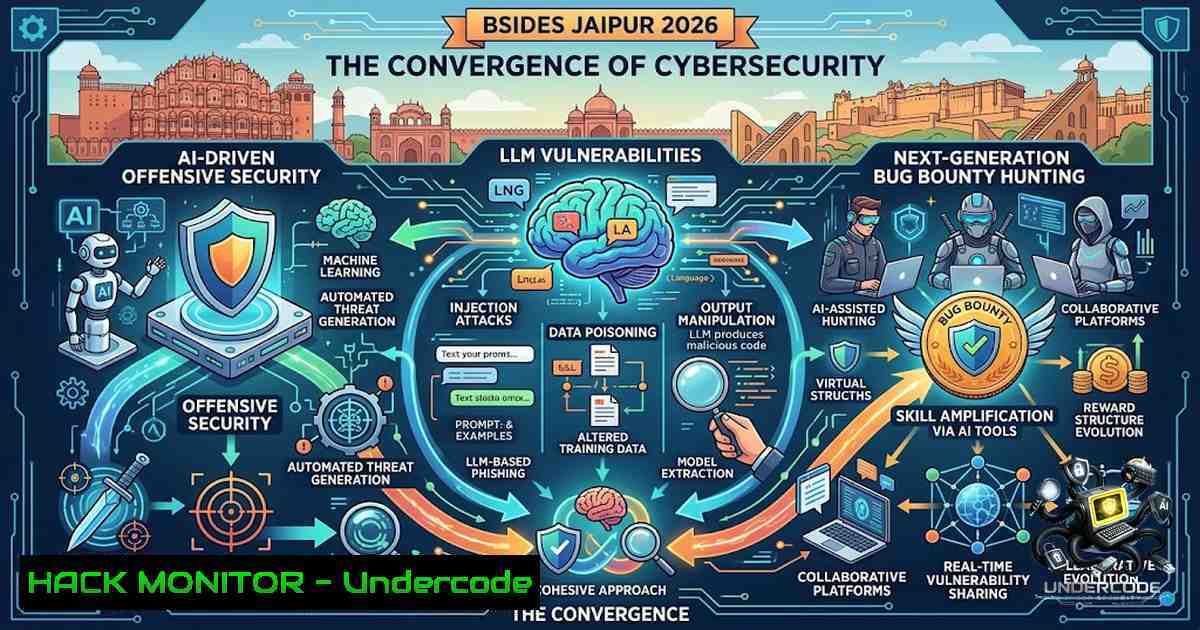
The cybersecurity landscape is undergoing a paradigm shift as artificial intelligence, large language models (LLMs), and traditional offensive security disciplines converge. BSides Jaipur 2026 brought together researchers, ethical hackers, and security professionals to explore this intersection — from LLM security and bug bounty hunting to IoT exploitation and real-world attack techniques. As organizations race to adopt AI, the attack surface expands exponentially, demanding that defenders understand not only traditional vulnerabilities but also emerging threats like prompt injection, agentic worms, and AI-driven malware generation. This article distills the technical insights from BSides Jaipur 2026 and related BSides events worldwide, providing actionable knowledge for security practitioners.
Learning Objectives & Secrets:
- Objective 1: Master LLM Security Assessment — Understand prompt injection, system prompt poisoning, and agentic exploitation techniques. Secret: Traditional content filtering fails against prompt injection because it is fundamentally an authentication problem, not a content problem — injected malicious instructions are structurally indistinguishable from legitimate ones.
- Objective 2: Evolve Bug Bounty Methodologies — Go beyond surface-level scanning to uncover hardcoded secrets, hidden endpoints, and cryptographic keys through JavaScript analysis. Secret: Use gau, waybackurls, and Burp Suite’s script extraction features to aggregate all JavaScript files, then grep for keywords like
api,v1,v2,reset,forgot,admin,super,encrypt,decrypt,encode, `decode` — this uncovered account takeovers, AWS secrets, and PII leaks. - Objective 3: Harden AI Infrastructure Against Emerging Threats — Secure AI coding agents, LLM pipelines, and cloud deployments against supply chain and configuration attacks. Secret: The ChainDrop worm compromised 400+ npm packages by injecting malicious code into `.claude/settings.json` and `.vscode/tasks.json` — AI agents execute attacker-controlled configuration without user interaction, making configuration file integrity monitoring critical.
You Should Know:
- LLM Benchmark Scores Are Misleading — Analyze Agent Behavior Instead
Research presented at BSides 2026 by Tarun Koyalwar evaluated open- and closed-weight LLMs against 54 black-box web application targets. The findings are sobering: traditional benchmark scores reveal little about how AI agents actually perform offensive security tasks. Many LLM failures stem from execution gaps rather than a lack of cybersecurity knowledge — models frequently identified the correct vulnerability, referenced the appropriate CVE, then failed due to malformed requests or targeting mistakes. Notably, leading open-weight models completed 52 of 54 targets while closed models completed 48, and execution costs varied by nearly two orders of magnitude.
Step‑by‑step guide for evaluating AI agents in security tasks:
- Define a black-box test environment with known vulnerable targets (e.g., OWASP WebGoat, DVWA, or custom CTF instances).
- Provide minimal prompts — avoid giving explicit attack instructions; simply instruct the agent to “identify and exploit vulnerabilities.”
- Log every action — capture requests, responses, reasoning steps, and errors using telemetry.
- Analyze failure modes — distinguish between knowledge gaps (model doesn’t know the vulnerability) and execution gaps (model knows but fails to execute).
- Compare open vs. closed models under identical conditions to evaluate cost-performance tradeoffs.
Linux command for logging agent HTTP traffic:
 Intercept and log all HTTP traffic from AI agent
mitmproxy -w agent_traffic.log --mode transparent --showhost
 Or use tcpdump for raw capture
sudo tcpdump -i any -w agent_capture.pcap port 80 or port 443
- Prompt Injection Is an Authentication Bug — Secure Agentic Workflows
Noelle Murata’s BSides Las Vegas 2026 talk, “Prompt Injection Is an Auth Bug: The Case Against Bearer Tokens in an Agentic World,” fundamentally reframed LLM security. An AI agent that processes instructions and data as identical token streams has no structural way to verify which principal issued an instruction. This was validated days later when the ChainDrop worm compromised 400+ npm packages, exploiting AI coding tools through configuration file injection.
Step‑by‑step guide for securing AI agent workflows:
- Implement instruction-data separation — use delimiters (e.g.,
<|im_start|>,<|im_end|>) to distinguish system prompts, user inputs, and tool outputs. - Validate all configuration files — monitor
.claude/settings.json,.vscode/tasks.json, and similar files for unauthorized changes using integrity checks. - Apply least-privilege principles — restrict what actions AI agents can perform, especially file system writes and network connections.
- Test against adaptive attacks — use frameworks like Promptfoo to automate prompt injection testing across multiple models.
- Implement system-prompt hardening — regularly audit and lock system prompts; consider using prompt hardening tools that automatically evaluate and secure LLM system prompts.
Code snippet for detecting configuration tampering (Linux):
 Monitor critical AI configuration files for changes
inotifywait -m -e modify,create,delete ~/.claude/settings.json ~/.vscode/tasks.json
 Create baseline hashes
sha256sum ~/.claude/settings.json > baseline_claude.sha256
 Verify integrity
sha256sum -c baseline_claude.sha256
Windows PowerShell equivalent:
 Monitor file changes
$watcher = New-Object System.IO.FileSystemWatcher
$watcher.Path = "$env:USERPROFILE.vscode"
$watcher.Filter = "tasks.json"
Register-ObjectEvent $watcher "Changed" -Action { Write-Host "Configuration changed!" }
- JavaScript Analysis for Bug Bounty Hunting — Uncover Hidden Attack Surface
A core technique highlighted at BSides Jaipur is systematic JavaScript analysis for web application assessments. Static analysis of JavaScript files reveals hardcoded sensitive data, hidden parameters, hidden functions, hidden endpoints, and encryption/decryption keys that are invisible to dynamic scanners.
Step‑by‑step guide for JavaScript analysis:
1. Collect all JavaScript URLs using OSINT tools:
 Collect URLs from historical data
gau target.com | grep ".js$" > js_urls.txt
waybackurls target.com | grep ".js$" >> js_urls.txt
2. Fetch and consolidate JavaScript files:
 Download all JS files
while read url; do curl -s "$url" >> all_scripts.js; done < js_urls.txt
- Alternatively, use Burp Suite — navigate to Target > scope URL > Right Click > Engagement Tools > Find Scripts > Export Scripts > Save to file.
4. Analyze for sensitive patterns:
 Search for API endpoints
grep -E "(api|v1|v2|/v[0-9]/|endpoint)" all_scripts.js
 Search for authentication-related functions
grep -E "(reset|forgot|forget|admin|super|verify)" all_scripts.js
 Search for cryptographic operations
grep -E "(encrypt|decrypt|encode|decode|AES|RSA|base64)" all_scripts.js
 Search for cloud credentials
grep -E "(AKIA|aws_access_key|secret|token|password|key)" all_scripts.js
- Test discovered endpoints for vulnerabilities like IDOR, privilege escalation, and information disclosure.
-
IoT Security — UART, Firmware Extraction, and Protocol Analysis
IoT security sessions at BSides events covered practical attack vectors including UART attack vectors, shell dumping, firmware extraction, and static analysis. Attackers now use automated AI tools to quickly identify and exploit unmanaged IoT devices as entry points for lateral movement into corporate environments.
Step‑by‑step guide for IoT security assessment:
- Identify UART interfaces on target devices — look for 4-pin headers (VCC, GND, TX, RX) and determine baud rate using logic analyzers or oscilloscopes.
2. Dump firmware using tools like Binwalk:
 Analyze firmware image
binwalk -Me firmware.bin
 Extract filesystem
binwalk -e firmware.bin
3. Perform static analysis using EMBA (Embedded Analyzer):
 Run EMBA on firmware
./emba.sh -l ./logs -f firmware.bin
- Analyze network protocols — modify Wireshark configuration for nrf packets and analyze Bluetooth Low Energy (BLE) attacks like SweynTooth.
-
Implement zero-trust micro-segmentation for IoT devices — place operational technology machinery into hard-blocked, non-routable VLANs with strong egress monitoring.
Linux command for UART communication:
 Connect to UART device (adjust baud rate as needed)
screen /dev/ttyUSB0 115200
 Or use minicom
minicom -D /dev/ttyUSB0 -b 115200
5. Cloud Infrastructure Hardening and IAM Security
With cloud adoption accelerating, securing cloud infrastructure and Identity and Access Management (IAM) is paramount. BSides events consistently emphasize the importance of least-privilege IAM policies, secret detection, and continuous monitoring.
Step‑by‑step guide for cloud security hardening:
1. Audit IAM policies for overprivileged roles:
 AWS - Check for unused permissions
aws iam generate-service-last-accessed-details --arn arn:aws:iam::account-id:role/role-1ame
 GCP - Review IAM policy
gcloud projects get-iam-policy project-id
 OCI - List policies
oci iam policy list --compartment-id compartment-id
- Implement secret detection using small language models trained for cybersecurity — these can identify hardcoded secrets in code repositories with higher accuracy than regex-based scanners.
3. Enable comprehensive logging:
 AWS CloudTrail
aws cloudtrail create-trail --1ame my-trail --s3-bucket-1ame my-bucket
 GCP Audit Logs
gcloud logging sinks create my-sink storage.googleapis.com/my-bucket
- Deploy moving target defense — consider reinforcement learning-based proactive mutation of access proxies and IP addresses to confound attackers.
-
Regularly rotate credentials and enforce MFA for all administrative access.
What Undercode Say:
-
Key Takeaway 1: AI Agents Are Powerful but Flawed Offensive Tools — LLMs demonstrate significant cybersecurity knowledge but suffer from execution gaps. Open-weight models perform competitively with closed models at a fraction of the cost, making them accessible for security automation. However, relying on benchmark scores alone is dangerous — behavioral telemetry provides deeper insight into AI security risks.
-
Key Takeaway 2: The Future of Cybersecurity Is AI-1ative — and AI-1ative Threats Are Already Here — The ChainDrop worm demonstrated that AI supply chain attacks are not theoretical. Prompt injection is not a content filtering problem but an authentication crisis. Organizations must treat AI agents as privileged principals requiring strict access controls, configuration integrity monitoring, and continuous behavioral analysis. The community-driven nature of BSides events — where practitioners share real-world attack techniques and mitigation strategies — is essential for staying ahead of these rapidly evolving threats.
Prediction:
-
-1 The commoditization of AI-powered offensive tools will democratize sophisticated attack capabilities, enabling less-skilled threat actors to execute complex exploits that previously required expert knowledge. The execution gap between knowing and doing will narrow as AI agents improve, increasing the volume and sophistication of automated attacks.
-
-1 Supply chain attacks targeting AI development workflows (like ChainDrop) will become more prevalent and damaging. The trust placed in AI coding assistants and their configuration files creates a new, highly attractive attack surface that traditional security controls do not adequately address.
-
+1 The open-weight AI model ecosystem will enable widespread adoption of AI-assisted security automation, allowing smaller organizations and individual researchers to access capabilities previously limited to well-funded teams. This democratization will improve overall security posture as more defenders gain access to advanced tools.
-
+1 Community-driven events like BSides will become increasingly critical as the pace of AI security research accelerates. The collaborative, peer-reviewed model enables rapid knowledge sharing that outpaces traditional conferences, helping practitioners stay current with emerging threats.
-
+1 The reframing of prompt injection as an authentication problem will drive architectural improvements in AI systems, leading to more robust instruction-data separation and principal verification mechanisms. This paradigm shift will fundamentally improve AI security beyond current content-filtering approaches.
▶️ Related Video (76% Match):
https://www.youtube.com/watch?v=8X7GuD4KC8k
🎯Let’s Practice For Free:
🎓 Live Courses & Certifications:
Join Undercode Academy for Verified Certifications
🚀 Request a Custom Project:
Secure, high-velocity infrastructure and disruptive technological engineering. Contact our engineering team for high-tier development and proprietary systems:
[email protected]
💎 Smart Architecture | 🛡️ Secure by Design | ⭐ Trusted by Thousands
IT/Security Reporter URL:
Reported By: https://lnkd.in/p/eDjJqzaZ – Hackers Feeds
Extra Hub: Undercode MoN
Basic Verification: Pass ✅


