Listen to this Post
Introduction:
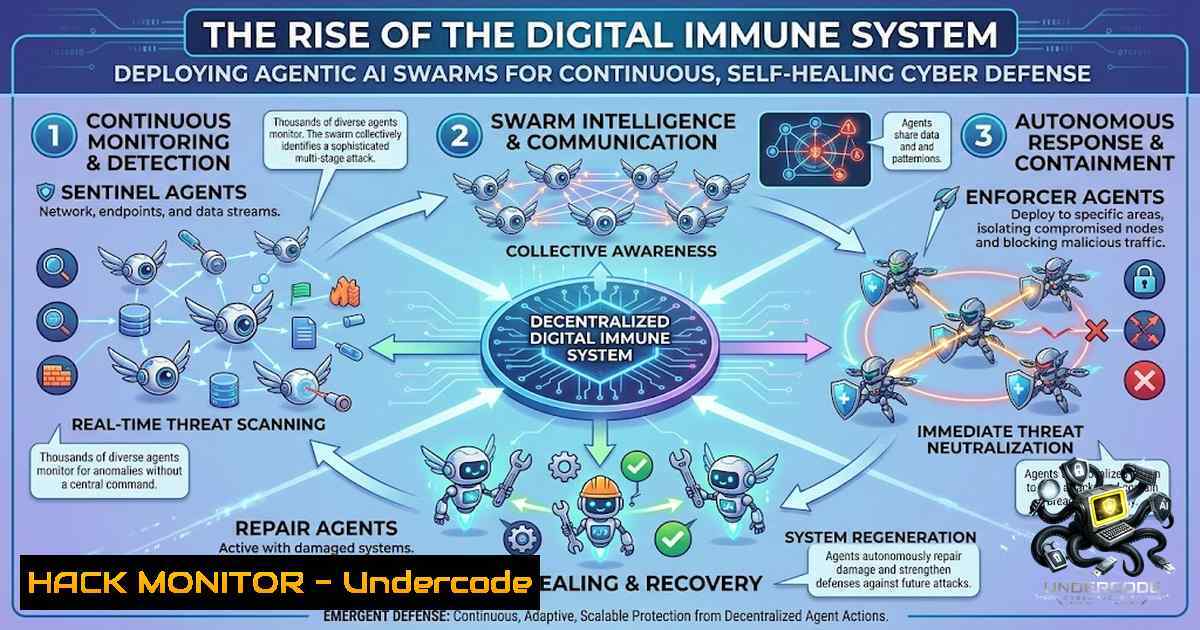
The cybersecurity industry is approaching a critical inflection point where the volume and velocity of threats have outpaced human-scale response capabilities. Traditional security models—reactive, periodic, and heavily reliant on manual intervention—are no longer sufficient in an era where attackers leverage frontier AI to discover and exploit vulnerabilities at machine speed. The emerging paradigm of autonomous cyber defense, powered by agentic AI swarms operating 24/7, promises to transform security from a reactive discipline into a proactive, self-healing digital immune system. This article explores the architecture, implementation, and strategic implications of deploying defensive AI models that continuously probe for weaknesses, validate exploitability, and autonomously remediate findings—closing the loop between detection and response.
Learning Objectives:
- Understand the multi-agent swarm architecture for autonomous vulnerability discovery, validation, and remediation
- Master the implementation of AI-driven security pipelines across Linux and Windows environments
- Learn to configure and deploy open-source agentic security frameworks for continuous assessment
- Develop skills in automated patch generation, verification, and rollback strategies
- Build competency in governing and red-teaming defensive AI agents
You Should Know:
- Multi-Agent Swarm Architecture: The Anatomy of Autonomous Defense
Modern autonomous defense systems operate through coordinated swarms of specialized AI agents, each with distinct roles that mirror a human penetration testing team. The architecture typically includes Reconnaissance Agents that map attack surfaces and fingerprint application stacks; Exploit Agents that assess severity and chain vulnerabilities; Red Team Agents that identify worst-case attack paths; and Blue Team Agents that write and verify code-level fixes. This collaborative approach enables complex workflows that traditional single-model systems cannot achieve.
The AWS Security Agent exemplifies this architecture in production, orchestrating specialized agents that perform reconnaissance, analyze business logic flaws, validate findings, and prioritize vulnerabilities based on actual exploitability. The system begins with baseline scanning, then dynamically generates focused test tasks tailored to the specific application context—reasoning about discovered endpoints and potential vulnerability chains.
Implementation Guide—Deploying a Multi-Agent Security Swarm:
Step 1: Environment Setup (Linux)
 Install Docker and required dependencies
sudo apt update && sudo apt install -y docker.io python3-pip git
sudo systemctl enable --1ow docker

Clone and configure an open-source agentic security framework
git clone https://github.com/CMUL8/spotlight.git
cd spotlight
cp .env.example .env
 Edit .env with your LLM API credentials
export SPOTLIGHT_LLM_API_KEY="sk-..."
export SPOTLIGHT_LLM_BASE_URL="https://api.openai.com/v1"
Step 2: Run a Full Security Sweep
 Execute a Deep profile scan against a target repository
python -m spotlight.cli --target /path/to/your/repo --profile deep --output report.json
Step 3: Windows PowerShell Alternative
 Windows deployment using WSL2 and Docker Desktop
wsl --install -d Ubuntu
 Then follow the Linux steps within the WSL environment
The framework runs seven stages: Recon (building code graphs and tracking untrusted input paths), Investigation (parallel agent analysis of source→sink paths), Reduction (deduplication and classification against 67 vulnerability types mapped to CWE and OWASP), Reproduction (isolated sandbox exploitation with network egress denied), Remediation (patch generation), Verification (independent re-testing), and Attestation (signed, auditable report generation).
2. Continuous Vulnerability Elimination: Closing the Find-Fix Loop
The shift from point-in-time scanning to continuous remediation represents a fundamental change in security operations. Lineaje’s Continuous Vulnerability Elimination Factory (CVEF) demonstrates this paradigm, operating on a 24-hour autonomous find-and-fix cycle that aims to eliminate all exploitable vulnerabilities within 90 days. The system continuously detects, validates, and remediates vulnerabilities across proprietary code, open-source software, AI-generated code, and containers.
Frontier AI has fundamentally compressed the vulnerability lifecycle. Unit 42’s NOVA (Network and Open-Source Vulnerability Analyzer) analyzed 3,915 open-source projects in just two months, uncovering 14,090 confirmed vulnerabilities—99.4% previously unreported and 40% designated as high or critical severity. This scale of discovery demands equally scaled remediation capabilities, collapsing the traditional 55-day patch window into near-zero exposure.
Implementation Guide—Automated Remediation Pipeline:
Step 1: Configure CI/CD Integration (GitLab Example)
 .gitlab-ci.yml - Agentic SAST Vulnerability Resolution
stages:
- security-scan
- auto-remediate

agentic-sast:
stage: security-scan
image: registry.gitlab.com/gitlab-org/security-products/analyzers/agentic-sast:latest
script:
- agentic-sast scan --output gl-sast-report.json
artifacts:
reports:
sast: gl-sast-report.json

auto-fix:
stage: auto-remediate
script:
- agentic-sast remediate --report gl-sast-report.json --create-mr
only:
- main
Step 2: Implement Virtual Patching for Immediate Protection
 Deploy virtual patches at the WAF layer while awaiting permanent fixes
 Example: ModSecurity rule generation from AI-discovered vulnerability
./generate_waf_rule.py --vulnerability-report findings.json --output modsec-rules.conf
 Apply to Nginx WAF
sudo cp modsec-rules.conf /etc/nginx/modsec/
sudo systemctl reload nginx
Step 3: Windows-Based Remediation Automation (PowerShell)
 Automate patch deployment via Windows Update or custom scripts
$vulnerabilities = Get-Content -Path ".\vulnerabilities.json" | ConvertFrom-Json
foreach ($vuln in $vulnerabilities) {
if ($vuln.severity -eq "Critical") {
 Trigger automated patch deployment via SCCM or custom script
Start-Process -FilePath ".\deploy_patch.ps1" -ArgumentList $vuln.patch_id
}
}
3. Zero-Day Discovery and Real-Time Patching
The capability to discover and patch zero-day vulnerabilities autonomously is rapidly moving from research to production. Leidos’ Parcata platform, built by the team behind DARPA’s AI Cyber Challenge evaluation framework, demonstrates model-agnostic vulnerability discovery that can patch zero-day vulnerabilities in real time—with internal pilots showing an average patch time of approximately 21 minutes. The platform can run within customer environments, including classified and air-gapped networks, addressing the control concerns that have historically slowed AI adoption in defense and intelligence markets.
Project Glasswing from Anthropic represents another milestone, with AI systems now capable of performing meaningful vulnerability discovery and exploitation tasks at scale and speed that outpace traditional human-led approaches. However, the dual-use nature of this technology means the same advancements enabling defenders also lower the barrier for attackers.
Implementation Guide—Zero-Day Response Workflow:
Step 1: Deploy Autonomous Detection Harness
 Using the NOVA-style approach for OSS projects
python nova_harness.py --target https://github.com/target/project \
--output-dir ./findings \
--models ensemble \
--max-depth 5
Step 2: Generate and Verify Patches
 Automated patch generation with verification
 The system writes patches and independently verifies them
python generate_patch.py --vulnerability ./findings/vuln_001.json \
--repo-path /path/to/repo \
--output-patch ./patches/vuln_001.patch

Apply patch and verify
git apply --check ./patches/vuln_001.patch
git apply ./patches/vuln_001.patch
python verify_fix.py --vulnerability ./findings/vuln_001.json --repo-path /path/to/repo
Step 3: Windows Zero-Day Response Automation
 Windows-based zero-day detection and response
 Integrate with Windows Defender ATP or custom EDR
$zeroDayAlert = Get-MpThreatDetection | Where-Object { $<em>.Category -eq "Exploit" -and $</em>.Severity -eq "Severe" }
if ($zeroDayAlert) {
 Trigger automated containment and patch deployment
Invoke-Command -ScriptBlock {
 Isolate affected endpoint
Set-MpPreference -DisableRealtimeMonitoring $false
 Deploy emergency patch from internal repository
Start-Process "msiexec.exe" -ArgumentList "/i \server\patches\emergency_patch.msi /quiet"
}
}
4. Governance, Red-Teaming, and Human Oversight
As defensive AI agents become an asset class requiring governance, organizations must implement robust control frameworks. The CISA/Five Eyes “Careful Adoption of Agentic AI Services” playbook provides a structured approach, beginning with inventorying every deployed agent and establishing capability tokens and access controls.
The primary constraint today is not what AI can do, but how safely it can be deployed. Human oversight remains critical, particularly when validating findings, making remediation decisions, and preventing unintended consequences from automated actions. The Spotlight framework implements this through a Consensus Kernel that prices agent agreement by independence and promotes disagreement to human review instead of averaging it away. Additionally, a Warden control plane provides prompt-injection detection, backdoor scanning, and capability tokens.
Implementation Guide—Agent Governance and Red-Teaming:
Step 1: Establish Agent Inventory and Controls (Linux)
 Deploy agent inventory and monitoring
./deploy_agent_governance.sh --inventory-file agents.json \
--capability-tokens ./tokens/ \
--audit-log /var/log/agent-audit.log

Configure Warden control plane for prompt injection detection
python warden.py --config warden_config.yaml --monitor-agent-traffic
Step 2: Continuous Red-Teaming
 Deploy adversarial agent swarm to test defensive agents
python redteam_swarm.py --target-agent http://localhost:8080 \
--attack-vectors ./attack_library/ \
--duration 3600 \
--report redteam_findings.json
Step 3: Windows Governance Implementation
 Windows-based agent governance and monitoring
 Deploy agent inventory via PowerShell DSC
Configuration AgentGovernance {
Node localhost {
Registry "AgentInventory" {
Ensure = "Present"
Key = "HKLM\SOFTWARE\SecurityAgents\Inventory"
ValueName = "RegisteredAgents"
ValueData = (Get-Content -Path ".\agents.json" | ConvertTo-Json -Compress)
}
 Configure Windows Defender to monitor agent activity
Set-MpPreference -EnableControlledFolderAccess Enabled
Set-MpPreference -ControlledFolderAccessAllowedApplications @("C:\Program Files\SecurityAgent\agent.exe")
}
}
5. The Asymmetric Challenge and Strategic Implications
The fundamental asymmetry of cybersecurity—attackers need to be right once, defenders need to be right all the time—persists even in an AI-driven defense paradigm. However, agentic AI defense fundamentally changes the calculus by enabling continuous, 24/7 operation at machine speed. When vulnerability discovery accelerates and the patch window collapses, organizations that cannot respond at AI speed face existential risk.
The emergence of autonomous defense systems also creates a new attack surface: the defensive AI agents themselves. These agents become targets for prompt injection, model poisoning, and adversarial manipulation. Organizations must therefore implement zero-trust agentic execution, dynamic intent verification, and cross-layer reasoning-action correlation.
What Undercode Say:
- The Future Is Autonomous, Not Automated: The distinction matters—automation follows predetermined rules, while autonomy involves reasoning, adaptation, and decision-making. Defensive AI swarms represent true autonomy, capable of complex, multi-step reasoning and planning without constant supervision.
-
Speed Is the New Security Perimeter: With frontier AI collapsing the vulnerability discovery-to-exploitation window from weeks to hours, the ability to detect and remediate at machine speed becomes the primary security differentiator.
Expected Output:
The deployment of agentic AI defense systems represents a paradigm shift from reactive security to proactive, self-healing infrastructure. Organizations that successfully implement these capabilities will achieve unprecedented resilience, while those that lag face accelerating risk as AI-powered attacks become the norm.
Prediction:
- +1 The commoditization of autonomous security swarms will democratize enterprise-grade security, enabling small organizations to access capabilities previously reserved for Fortune 500 companies.
-
+1 AI-driven defense will create a new class of security professionals focused on agent governance, red-teaming, and policy definition rather than manual vulnerability remediation.
-
-1 The dual-use nature of frontier AI vulnerability discovery will lead to a period of heightened risk as offensive capabilities outpace defensive deployment.
-
-1 Organizations that fail to adopt agentic defense will face an exponentially widening gap between attacker capability and defender readiness, potentially leading to catastrophic breaches.
-
+1 Regulatory frameworks and industry standards for agentic AI security will mature, creating a more structured and secure ecosystem for autonomous defense deployment.
▶️ Related Video (76% Match):
https://www.youtube.com/watch?v=-00eCQlxxMg
🎯Let’s Practice For Free:
🎓 Live Courses & Certifications:
Join Undercode Academy for Verified Certifications
🚀 Request a Custom Project:
Secure, high-velocity infrastructure and disruptive technological engineering. Contact our engineering team for high-tier development and proprietary systems:
[email protected]
💎 Smart Architecture | 🛡️ Secure by Design | ⭐ Trusted by Thousands
IT/Security Reporter URL:
Reported By: Aaronshaver I – Hackers Feeds
Extra Hub: Undercode MoN
Basic Verification: Pass ✅


