Listen to this Post
Introduction:
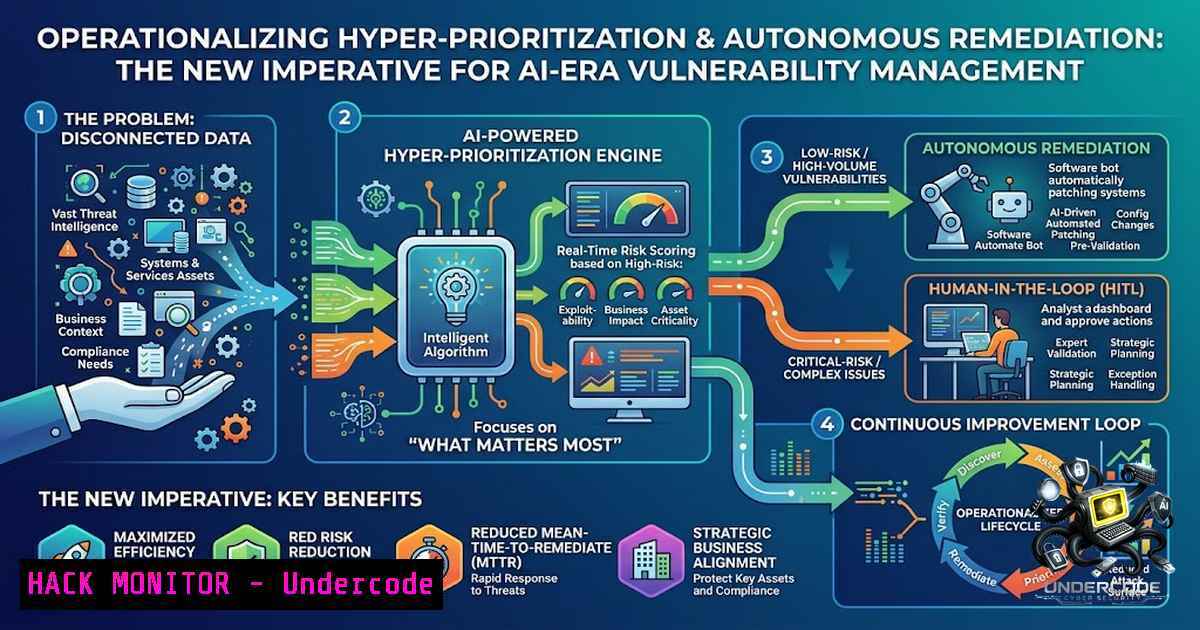
The cybersecurity industry is witnessing an unprecedented convergence of challenges: vulnerability discovery accelerated by artificial intelligence, attack surfaces expanding across cloud, on-premises, and IoT environments, and remediation timelines compressing to near-zero. According to Qualys, critical vulnerabilities have surged by 650% over the past four years, while the mean-time-to-exploit has collapsed to a negative window—meaning attackers are weaponizing flaws before patches are even released. In this landscape, traditional vulnerability management—reliant on CVSS scores and manual patch deployment—is no longer viable. Organizations must operationalize hyper-prioritization to filter out 99% of noise and autonomous remediation to respond at machine speed.
Learning Objectives:
- Understand the shift from traditional vulnerability management to risk-based prioritization leveraging AI and threat intelligence
- Master hyper-prioritization frameworks that incorporate exploitability, business impact, and asset criticality
- Implement autonomous remediation workflows to accelerate response and reduce manual engineering effort
- Deploy Continuous Exposure Management strategies for modern enterprise environments
- Build resilient security operations through automation and orchestration
You Should Know:
1. Hyper-Prioritization: Cutting Through the Vulnerability Noise
The fundamental problem with traditional vulnerability management is that it treats all vulnerabilities as equal. In 2025 alone, 48,172 CVEs were published, yet only 0.74% were actively weaponized. Attempting to patch everything is not only impractical—it creates a widening gap that attackers inevitably exploit.
Hyper-prioritization shrinks the problem set from “everything that looks scary” to “the specific exposures that can be exploited on your assets, right now”. The Qualys Enterprise TruRisk Management (ETM) platform operationalizes this through three layered filters: threat context, business context, and environmental context. This converts undifferentiated noise into ranked, business-relevant queues.
Step-by-Step Guide to Implementing Hyper-Prioritization:
Step 1: Establish Asset Criticality Scoring
Begin by classifying all assets based on their business value and sensitivity. The Qualys CyberSecurity Asset Management (CSAM) module uses AI to calculate criticality scores continuously, adapting to new threat intelligence and incident patterns.
 Example: Querying asset criticality via Qualys API
curl -X GET "https://qualysapi.qualys.com/api/2.0/fo/asset/host/" \
-u "username:password" \
-d "action=list&criticality=high"
Step 2: Apply Exploitability Intelligence
Incorporate exploitability data from multiple sources: CISA Known Exploited Vulnerabilities (KEV) catalog, Exploit Prediction Scoring System (EPSS), and threat intelligence feeds. The KEV catalog serves as the authoritative source of vulnerabilities actively exploited in the wild.
Step 3: Implement Multi-Factor Prioritization Scoring
Replace CVSS-only scoring with a composite risk score that factors in exploitability, exposure, business impact, and remediation ease:
Priority = (Exploitability × 0.35) + (Exposure × 0.30) + (Business Impact × 0.20) + (Remediation Ease × 0.15)
Step 4: Validate Exploitability with Safe Testing
Qualys Agent Val leverages real attacker techniques in a controlled environment to validate exploitability using modified benign payloads—production-safe interactions designed to confirm whether a vulnerable code path is reachable. Agent Val offers three payload types: Direct Response Payloads, Cryptographic Verification Payloads, and Out-of-Band Callbacks.
Step 5: Create Prioritized Remediation Queues
Use the validated findings to generate prioritized remediation plans ordered by exploitation likelihood, business impact, and industry relevance.
- Autonomous Remediation: Moving from Human-Speed to Machine-Speed Response
Manual remediation cannot keep pace with AI-accelerated vulnerability discovery. Microsoft’s July 2026 Patch Tuesday addressed a record 622 vulnerabilities—an early signal of what AI-accelerated discovery looks like at scale. The backlog isn’t just growing; it’s growing faster and becoming more dynamic.
Autonomous remediation doesn’t mean deploying every patch blindly. Qualys TruRisk Eliminate’s AI-Powered Patch Reliability Score assesses whether a patch is safe to deploy using crowd-sourced signals from patch deployments across the internet, continuously evaluated for signs of breakage.
Step-by-Step Guide to Implementing Autonomous Remediation:
Step 1: Deploy Cloud Agents Across Your Environment
Install Qualys Cloud Agents on all endpoints to enable continuous assessment and patch deployment.
 Linux agent installation
sudo rpm -ivh qualys-cloud-agent.x86_64.rpm
sudo /usr/local/qualys/cloud-agent/bin/qualys-cloud-agent.sh \
ServerUri=https://qagpublic.qg2.apps.qualys.eu/CloudAgent/
 Windows agent installation (PowerShell)
msiexec /i QualysCloudAgent.msi /quiet \
ACTIVATIONID="your_activation_id" \
CUSTOMERID="your_customer_id"
Step 2: Configure Automated Patch Deployment Jobs
Create QQL-based deployment jobs that automatically select and deploy patches based on vulnerability severity and asset criticality.
 Example: Creating a Windows deployment job via API
curl -X POST "https://qualysapi.qualys.com/api/2.0/fo/patch/deployment/" \
-u "username:password" \
-d "action=create&title=CriticalPatchJob&targets=windows_servers&qql=patchStatus:[bash] and severity:[bash]"
Step 3: Implement Pre-Actions and Post-Actions
Use PowerShell scripts as pre-actions (run before patching) or post-actions (run after patching) to ensure application compatibility and validate remediation success.
 Example: PowerShell pre-action script to stop services before patching
Stop-Service -1ame "IISAdmin" -Force
Write-Host "IIS stopped for patching"
 Example: PowerShell post-action script to validate patch installation
Get-HotFix | Where-Object {$_.InstalledOn -gt (Get-Date).AddDays(-1)}
Step 4: Enable Zero-Touch Automation for Low-Risk Applications
Low-risk applications such as browsers and standalone software with minimal blast radius are candidates for zero-touch automation. Set up the patching job once, and every new update deploys automatically with no manual intervention.
Step 5: Close the Remediation Loop with ITSM Integration
Integrate with ServiceNow or Jira to automatically create change tickets and track remediation actions. Automated ticket creation, assignment to rightful owners, and closure on remediation eliminate manual spreadsheet-based workflows.
 Example: Creating a ServiceNow change ticket via Qualys VMDR integration
 Configure detection event rules to automatically create change requests
 with vulnerability details and associated Configuration Items (CIs)
3. Continuous Exposure Management: The New Operating Model
The shift from periodic assessments to continuous, real-time visibility is fundamental to modern cybersecurity. Qualys ETM consolidates asset and identity inventories and aggregates risk signals from Qualys and third-party tools, shifting teams from periodic assessments to continuous, real-time visibility.
Step-by-Step Guide to Continuous Exposure Management:
Step 1: Discover Unknown Assets
Use External Attack Surface Management (EASM) to continuously discover unknown internet-facing assets and automatically assess their risk posture.
Step 2: Implement Continuous Monitoring
Deploy multiple sensors—cloud agents, network scanners, and passive sensors—to maintain continuous visibility across all environments.
Step 3: Automate Risk Operations
The Risk Operations Center (ROC) model unifies visibility, prioritization, remediation, and validation into a continuous loop using threat intelligence and business context to drive consistent action and measure real risk reduction.
Step 4: Measure and Report Risk Reduction
Use cyber risk quantification to demonstrate measurable risk reduction to stakeholders and boards.
4. Regulatory Compliance and CERT-In Guidelines
CERT-In’s new AI cybersecurity guidelines mandate accelerated patch management timelines: critical vulnerabilities (CVSS 9.0–10.0) affecting internet-facing core systems must be patched, mitigated, or isolated within 12 hours. High-severity vulnerabilities require remediation within 3–5 days depending on asset criticality.
Organizations are also required to adopt zero trust architecture, maintain evidence of AI-assisted security testing, and implement continuous vulnerability assessments.
Step-by-Step Guide to CERT-In Compliance:
Step 1: Establish 12-Hour Response Capability
Configure automated remediation workflows to prioritize and patch critical vulnerabilities affecting internet-facing assets within 12 hours of discovery.
Step 2: Implement Zero Trust Architecture
Segment networks and enforce least-privilege access to prevent lateral movement.
Step 3: Maintain Compliance Evidence
Document all remediation actions, including AI-assisted security testing and patch deployment logs.
5. Practical Commands for Vulnerability Management and Remediation
Linux Vulnerability Assessment:
 Check for missing security updates on Debian/Ubuntu
sudo apt-get update && sudo apt-get upgrade --dry-run | grep -i security

Check for missing security updates on RHEL/CentOS
sudo yum check-update --security

Audit installed packages against CVE database
sudo rpm -qa --last | head -20
Windows Vulnerability Assessment:
 List installed updates
Get-HotFix | Sort-Object InstalledOn -Descending

Check for missing security updates
Get-WindowsUpdate -Category "Security Updates"

Export vulnerability assessment results
Get-WindowsUpdate -Category "Security Updates" -1otInstalled | Export-Csv -Path "missing_updates.csv"
Network Vulnerability Scanning:
 Launch a basic Nessus scan from command line (Linux)
sudo systemctl start nessusd
nessus -m -q 127.0.0.1 1241 username password
Qualys API Automation Examples:
 Launch a vulnerability scan via Qualys API
curl -X POST "https://qualysapi.qualys.com/api/2.0/fo/scan/" \
-u "username:password" \
-d "action=launch&title=AutomatedScan&ip=192.168.1.0/24"

Retrieve vulnerability findings
curl -X GET "https://qualysapi.qualys.com/api/2.0/fo/knowledge_base/vuln/" \
-u "username:password" \
-d "action=list&severity=5"
What Undercode Say:
- Key Takeaway 1: Focus on What Matters Most. With only 0.74% of published CVEs actively weaponized, organizations must prioritize ruthlessly. Hyper-prioritization based on exploitability, business impact, and asset criticality is the only scalable approach.
-
Key Takeaway 2: Automation is No Longer Optional. Manual remediation cannot keep pace with AI-accelerated vulnerability discovery. Organizations that adopt autonomous remediation will avoid chasing a backlog growing faster than they can patch it.
The session at the National Cyber Security Conference 2026, organized by NCSRC in association with AICTE and CERT-In, underscored a fundamental shift in cybersecurity philosophy: effective security is not about fixing every vulnerability—it is about prioritizing the right risks and responding with speed, intelligence, and automation. The Qualys Enterprise TruRisk Platform, with its AI-1ative ROC, hyper-prioritization capabilities, and autonomous remediation agents, represents a new operating model for security operations.
The integration of Agent Val for safe exploit validation, TruRisk Eliminate for AI-powered patch reliability scoring, and CSAM for continuous asset discovery creates a comprehensive Continuous Exposure Management framework. Combined with CERT-In’s regulatory mandates for 12-hour critical vulnerability remediation, organizations have both the technical capability and regulatory imperative to transform their vulnerability management programs.
Prediction:
- +1 Organizations that operationalize hyper-prioritization and autonomous remediation will achieve 60-70% faster mean-time-to-remediation and demonstrable risk reduction, as evidenced by early adopters like Cintas achieving 61% cyber risk reduction.
-
+1 Agentic AI capabilities will become standard in vulnerability management, with autonomous agents handling discovery, prioritization, validation, and remediation as a continuous loop, freeing human analysts for strategic threat hunting.
-
-1 Organizations that fail to adopt AI-driven prioritization and automation will face increasing breach risk as the gap between vulnerability discovery and remediation widens, with the mean-time-to-exploit continuing to trend negative.
-
-1 Regulatory pressure will intensify globally, with mandates similar to CERT-In’s 12-hour patch requirement becoming the norm, forcing organizations to invest in automation or face compliance penalties.
-
+1 The convergence of vulnerability management, patch management, and risk operations into unified platforms like Qualys ETM will eliminate siloed workflows and enable security teams to demonstrate business-aligned risk reduction.
▶️ Related Video (84% Match):
https://www.youtube.com/watch?v=7Y8djMP5Cxg
🎯Let’s Practice For Free:
🎓 Live Courses & Certifications:
Join Undercode Academy for Verified Certifications
🚀 Request a Custom Project:
Secure, high-velocity infrastructure and disruptive technological engineering. Contact our engineering team for high-tier development and proprietary systems:
[email protected]
💎 Smart Architecture | 🛡️ Secure by Design | ⭐ Trusted by Thousands
IT/Security Reporter URL:
Reported By: Ncsrc Nationalcybersecurityconference – Hackers Feeds
Extra Hub: Undercode MoN
Basic Verification: Pass ✅


