Listen to this Post
Introduction:
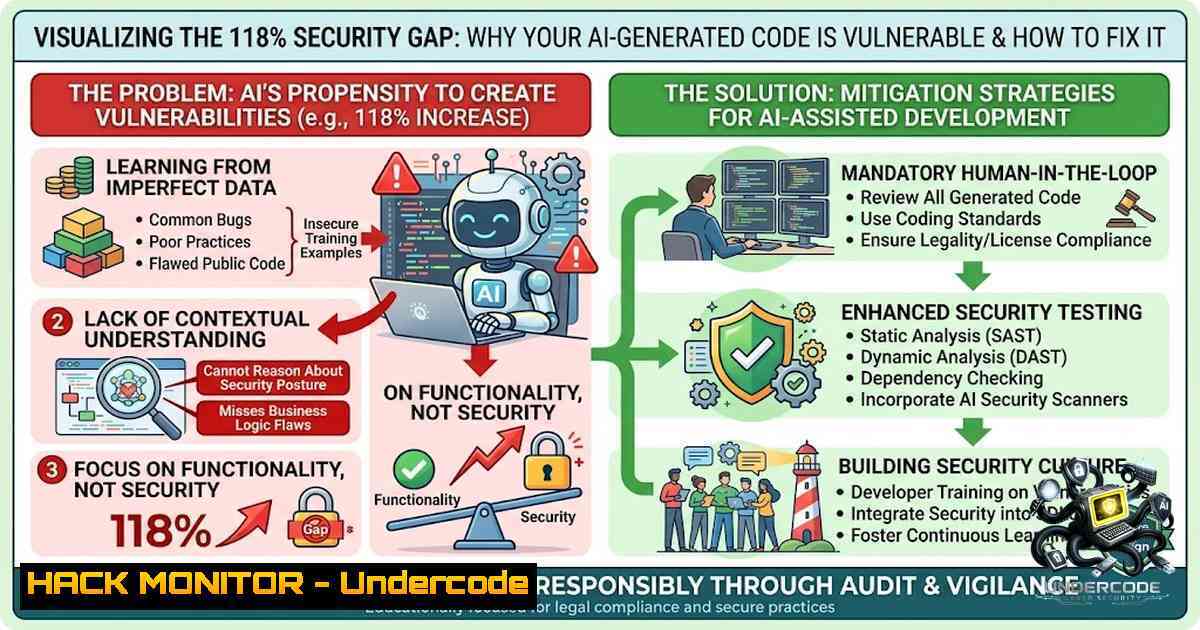
The software development landscape has undergone a seismic shift with the rise of “vibe coding”—the practice of describing intent in natural language and letting AI agents generate the implementation with minimal oversight. While this paradigm accelerates prototyping and innovation, it introduces a critical security paradox: working code is not safe code. Research from ICML 2026 reveals that even the best-performing AI agent produces functionally correct code only 57% of the time, yet a mere 11.8% of those solutions are actually secure. With Veracode’s 2025 GenAI Code Security Report finding that 45% of AI-generated code contains at least one exploitable OWASP Top 10 vulnerability, organizations must fundamentally rethink how they govern, review, and deploy AI-assisted code before it becomes their next incident vector.
Learning Objectives:
- Understand the three primary failure modes of AI-generated code: injection flaws, insecure defaults, and hallucinated dependencies
- Implement a multi-layered security review framework combining automated scanning, dependency verification, and mandatory human oversight
- Master practical commands and configurations to detect, prevent, and remediate vulnerabilities in AI-authored codebases
You Should Know:
- The Anatomy of AI-Generated Vulnerabilities: Injection, Insecure Defaults, and Hallucinated Dependencies
AI coding assistants are trained to generate output that looks correct and satisfies the prompt, not output that resists attack. This fundamental mismatch manifests in three recurring failure modes that dominate AI-generated pull requests.
Injection Flaws: Models frequently concatenate user input directly into SQL queries, OS commands, or log statements because their training data contains countless examples of this insecure pattern. Veracode found that AI-generated code failed to prevent cross-site scripting (CWE-80) in 86% of relevant tasks and failed to prevent log injection (CWE-117) in 88%.
Insecure Defaults: AI outputs default to whatever pattern is statistically most common—disabled TLS verification, overly permissive CORS policies, weak password hashing, and `eval()` on request data all appear because they are prevalent in the wild, not because they are correct.
Hallucinated Dependencies (Slopsquatting): A USENIX Security 2025 study analyzing 576,000 code samples found that 19.7% of recommended packages did not exist in real registries. Attackers exploit this by pre-registering these hallucinated names—a technique called “slopsquatting”—creating direct pathways for malicious code injection.
Step-by-Step Guide: Auditing AI-Generated Code for These Failure Modes
Step 1: Identify AI-authored changes. Label AI-assisted commits using commit trailers or CI-detected patterns so they route to mandatory scanning. If attribution is unavailable, assume every diff may be AI-assisted.
Step 2: Run static analysis (SAST) as a blocking gate. AI-generated code must pass the same SAST rules as everything else. Run these commands in CI:
 Linux/macOS - Run SAST on Python code
bandit -r ./src -f json -o bandit-report.json

JavaScript/TypeScript with ESLint security plugin
npm install eslint-plugin-security --save-dev
npx eslint . --ext .js,.ts --rule 'security/detect-object-injection: error'

Generic SAST with Semgrep
semgrep --config=p/owasp-top-ten --config=p/security-audit ./src
Step 3: Verify every new dependency before installation. Before approving any package a diff introduces, confirm it exists on the actual registry:
 Python - verify package exists
pip index versions <package-1ame>

Node.js - check npm registry
npm view <package-1ame> version

Go - verify module exists
go mod download <module>@<version>

Generic - check publish date and maintainer history
 Flag anything published in the last 30 days with no repository URL
Step 4: Scan for hardcoded secrets. AI models frequently generate code with embedded credentials:
 Install and run truffleHog for secrets scanning
trufflehog filesystem ./src --json --only-verified

GitLeaks for repository-wide secrets detection
gitleaks detect --source . --verbose
Step 5: Run Software Composition Analysis (SCA) on every build:
 npm audit for JavaScript
npm audit --production --json

pip-audit for Python
pip-audit --requirement requirements.txt --json

govulncheck for Go
govulncheck ./...
- The Human-in-the-Loop Mandate: Why Review Alone Isn’t Enough
The Stanford study presented at ACM CCS 2023 delivered a sobering finding: developers using AI assistants wrote significantly less secure code than a control group—and were simultaneously more likely to believe, incorrectly, that their code was secure. This false confidence creates a dangerous dynamic where AI-generated code invites less scrutiny precisely when it needs more.
Step-by-Step Guide: Building a Robust Human-AI Review Pipeline
Step 1: Treat AI-generated code as untrusted until verified. Apply the same scrutiny you would to a pull request from an unknown contributor.
Step 2: Implement mandatory security-focused code review for AI-authored PRs. Use branch protection rules requiring at least one approval combined with automated gates:
 GitHub branch protection rule example (in .github/settings.yml)
branch_protection_rules:
- pattern: main
required_pull_request_reviews:
required_approving_review_count: 2  Higher scrutiny for AI-assisted code
required_status_checks:
checks:
- context: "SAST Scan"
- context: "SCA Audit"
- context: "Secrets Detection"
Step 3: Use security-focused prompting. Give clear, explicit prompts that include security requirements from the start:
Prompt template: "Implement a user authentication endpoint using parameterized queries,
bcrypt for password hashing, rate limiting on login attempts, and JWT with short
expiration. Include input validation for all fields. Do NOT use string concatenation
for SQL queries or hardcode any credentials."
Step 4: Adopt the SRR framework—Small, Reversible, Reviewable. Apply incremental version control and review checkpoints so every AI-generated change can be audited.
Step 5: Add security-focused test cases. Ask the AI to write tests covering what the code should do AND what it should reject—malformed input, boundary conditions, and authentication bypass attempts:
 Example security test case for a file upload endpoint
def test_path_traversal_prevention():
response = client.post('/upload', files={
'file': ('../../../etc/passwd', b'test')
})
assert response.status_code == 400
assert 'path traversal' in response.json()['error'].lower()
- Securing the Supply Chain: Slopsquatting and Ghost Dependencies
AI coding agents now autonomously select dependencies, generate manifest files, and execute installation commands. This transfer of control from humans to AI introduces a new attack surface: attackers can exploit predictable LLM behavior to inject malicious code through hallucinated package names (“ghost dependencies”).
Step-by-Step Guide: Defending Against AI-Induced Supply Chain Attacks
Step 1: Generate and maintain a Software Bill of Materials (SBOM):
 Generate SBOM for Node.js
npx @cyclonedx/cyclonedx-1pm --output-file bom.json

Generate SBOM for Python
pip install cyclonedx-bom
cyclonedx-py requirements.txt --format json > bom.json

Validate SBOM against known vulnerabilities
grype sbom:bom.json
Step 2: Verify package authenticity before installation. Use the Pre-Execution Hooks approach to intercept AI-generated installation commands:
 Create a pre-install hook that verifies package existence
 ~/.npmrc or ~/.pip/pip.conf with registry verification
npm config set registry https://registry.npmjs.org/
 Enable integrity checking
npm config set strict-ssl true

For Python, use pip's --require-hashes flag
pip install --require-hashes -r requirements.txt
Step 3: Implement behavioral analysis for dependency anomalies. Flag packages with:
– Names within edit distance of 1-2 from a top-1000 package
– Publication dates in the last 30 days with no repository URL
– Sparse version history or suspicious maintainer patterns
Step 4: Use AI-specific supply chain security tools. Tencent’s Xuanwu Lab developed Atuin, a plugin-based solution that intercepts AI supply chain decisions before execution. Consider integrating similar guardrails into your CI/CD pipeline.
4. Runtime Verification: Confirming Exploitability, Not Just Compilation
Code that compiles and passes unit tests can still be catastrophically insecure. Runtime verification—testing the actual behavior of deployed code against attack patterns—is the final line of defense.
Step-by-Step Guide: Runtime Security Testing for AI-Generated Code
Step 1: Test for injection vulnerabilities dynamically:
 Using OWASP ZAP for DAST
zap-cli quick-scan --spider -r -t http://localhost:3000

Using Nikto for web server scanning
nikto -h http://localhost:3000 -Format json -o nikto-scan.json

SQLMap for SQL injection testing
sqlmap -u "http://localhost:3000/api/users?id=1" --batch --level=2
Step 2: Test authentication and authorization logic:
 Test for IDOR (Insecure Direct Object References)
 Example: Attempt to access another user's data by modifying ID parameter
curl -X GET "http://localhost:3000/api/users/2" -H "Authorization: Bearer $TOKEN_USER1"
 Should return 403 or 404, not user 2's data

Test for unprotected API routes
curl -X GET "http://localhost:3000/api/admin/users"  Should require authentication
Step 3: Verify security headers and CORS configuration:
 Check security headers
curl -I http://localhost:3000 | grep -E "X-Frame-Options|Content-Security-Policy|Strict-Transport-Security"

Test CORS configuration
curl -H "Origin: https://attacker.com" -H "Access-Control-Request-Method: GET" \
-X OPTIONS http://localhost:3000/api/data -v
Step 4: Perform fuzzing on input endpoints:
 Using ffuf for fuzzing
ffuf -u http://localhost:3000/api/search?q=FUZZ -w /usr/share/wordlists/fuzzing/special-characters.txt

Using AFL for binary fuzzing (if applicable)
afl-fuzz -i input_dir -o findings_dir ./target_binary @@
5. Governance and Accountability: Making AI-Generated Code Auditable
The true risk of vibe coding is not using AI to code—it’s deploying something nobody truly understands. Organizations must establish governance frameworks that treat AI-generated code as a distinct, higher-risk category requiring differentiated scrutiny.
Step-by-Step Guide: Establishing AI Code Governance
Step 1: Create mandatory AI code review checklists. Use the 17-point checklist from benavlabs/vibe-check covering critical vulnerabilities: misconfigured databases (no RLS), unprotected API routes (no auth middleware), committed secrets (.env on GitHub), broken access control (IDOR), and secret API keys in frontend code.
Step 2: Implement provenance tracking. Use SLSA (Supply-chain Levels for Software Artifacts) and in-toto attestations to prove what build system produced an artifact from what source and materials—extended to include “this diff was AI-assisted”.
Step 3: Apply least-privilege principles to AI agents. Never run AI agents with auto-accept enabled; require explicit approval for shell commands, package installations, and file system modifications.
Step 4: Mandate security training for AI-assisted development. Teams need formal training on how to prompt AI for secure code, identify vulnerabilities in AI output, and fix issues properly.
Step 5: Treat model registries like package registries. Document AI-specific components: model versions, training data lineage, inference-time libraries, and agent decision logs.
What Undercode Say:
- Speed Without Understanding Is a Liability: AI can generate functional code in seconds, but that code’s security posture is often abysmal. The 11.8% security rate from ICML’s benchmark is not an outlier—it’s the norm. Organizations racing to adopt vibe coding must recognize that generative speed amplifies risk at the same velocity.
-
The False Confidence Trap Is the Real Threat: The Stanford study’s finding that AI users rated their insecure code as secure more often than the control group is the most dangerous aspect of this paradigm. AI-generated code reads fluently, includes reassuring comments, and follows conventional patterns—all of which invite less scrutiny from reviewers who should be applying more.
Analysis:
The cybersecurity community is witnessing a perfect storm: AI coding tools are being adopted at unprecedented scale (GitHub reports over 97% of developers have used AI coding tools) while the security community struggles to catch up. The Veracode report’s finding that 45% of AI-generated code contains OWASP Top 10 vulnerabilities, combined with the Stanford study’s false confidence effect, creates a compounding risk surface that traditional security controls were never designed to address.
The emergence of slopsquatting—attackers pre-registering hallucinated package names—represents a new class of supply chain attack that bypasses traditional SBOM and vulnerability scanning. With AI now writing up to 40%+ of new code in many organizations, the attack surface is expanding at machine speed.
What’s particularly concerning is that model size and recency haven’t improved security outcomes—newer, larger models performed no better on security benchmarks than smaller, older ones. This suggests the security gap is architectural, not a training-data-freshness problem. The implication is clear: we cannot wait for better AI models; we must build better processes around the models we have.
The path forward requires a fundamental shift in how we govern AI-generated code: treating it as untrusted until verified, implementing multi-layered automated gates (SAST, SCA, secrets scanning, dependency verification), mandating human review with differentiated scrutiny, and building provenance tracking into the development pipeline. Organizations that fail to implement these controls are not just accepting technical debt—they are accepting predictable, exploitable vulnerabilities in production.
Prediction:
+N The security industry will develop specialized AI code review platforms that combine SAST, SCA, and behavioral analysis into unified pipelines, creating a new market segment projected to exceed $5 billion by 2028.
+N Regulatory frameworks (NIST, ISO, SEC) will formalize AI code governance requirements, forcing organizations to implement provenance tracking and mandatory security reviews for AI-generated code—ultimately raising the baseline security posture across the industry.
-1 The false confidence effect will lead to a wave of high-profile breaches originating from vibe-coded applications, with researchers already identifying over 5,000 publicly accessible vibe-coded web apps with “virtually no security”.
-1 Organizations that fail to implement AI code governance will experience 3-5x higher vulnerability density in AI-generated codebases compared to human-written code, leading to increased remediation costs and reputational damage.
-1 The slopsquatting attack vector will mature into a systematic exploitation framework, with attackers using LLM behavior analysis to predict and pre-register hallucinated dependencies at scale—creating supply chain attacks that are difficult to detect with traditional tools.
The bottom line: AI can accelerate development, but it should never replace understanding, review, governance, and accountability. The organizations that thrive in this new paradigm will be those that treat AI-generated code with the skepticism it deserves—not those that blindly trust the vibes.
▶️ Related Video (76% Match):
🎯Let’s Practice For Free:
🎓 Live Courses & Certifications:
Join Undercode Academy for Verified Certifications
🚀 Request a Custom Project:
Secure, high-velocity infrastructure and disruptive technological engineering. Contact our engineering team for high-tier development and proprietary systems:
[email protected]
💎 Smart Architecture | 🛡️ Secure by Design | ⭐ Trusted by Thousands
IT/Security Reporter URL:
Reported By: Mohamed Hedi – Hackers Feeds
Extra Hub: Undercode MoN
Basic Verification: Pass ✅


