
Listen to this Post
Introduction:
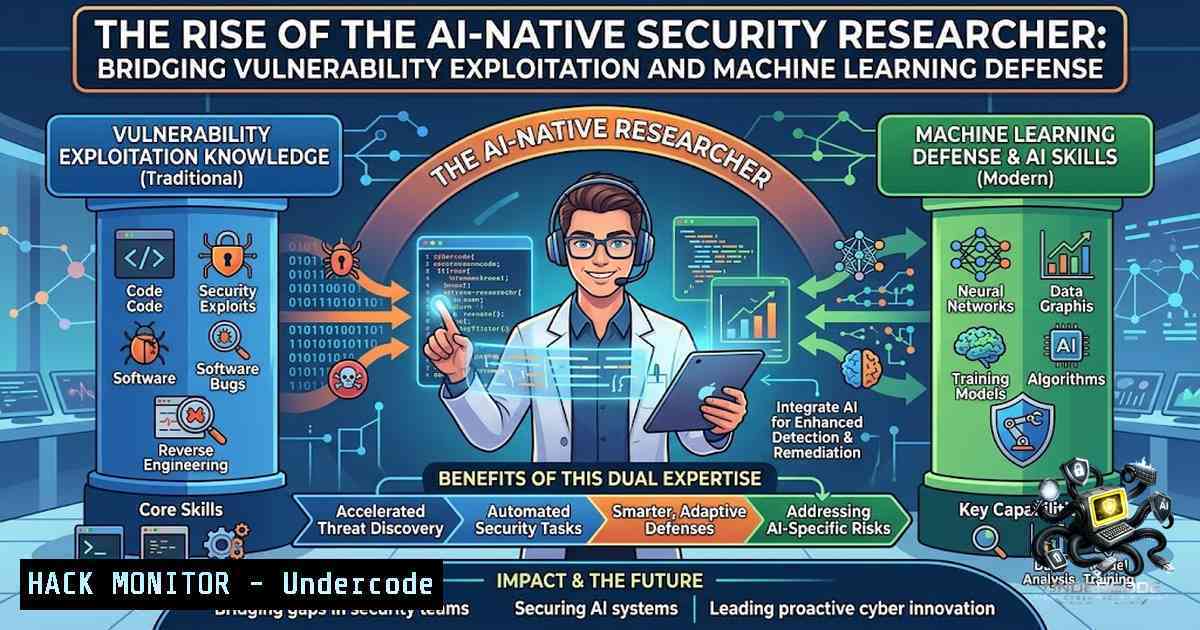
The cybersecurity industry is witnessing a paradigm shift where traditional penetration testing and vulnerability research are converging with artificial intelligence. A recent high-profile call for “Cybersecurity Research Experts” to evaluate cutting-edge AI systems highlights a growing demand for professionals who can not only break traditional software but also dissect the reasoning and security postures of Large Language Models (LLMs) and AI-driven agents. This role requires a hybrid skillset that merges exploit development, secure software engineering, and an intimate understanding of adversarial machine learning, moving beyond simple compliance checks to active red-teaming of cognitive architectures.
Learning Objectives & Secrets:
- Objective 1: Master AI Red-Teaming Methodologies. Learn to design and execute adversarial prompts (prompt injection) and data poisoning attacks that can manipulate AI model outputs, bypassing safety filters and revealing sensitive training data.
- Objective 2: Exploit Development for AI Pipelines. Uncover how traditional memory corruption vulnerabilities (buffer overflows) in C/C++ inference engines and dependency confusion in Python ML libraries can lead to Remote Code Execution (RCE) on AI servers.
- Objective 3: Secure Software Engineering in ML. Implement robust input sanitization and output encoding specifically for LLM interactions, ensuring that the AI does not become an unwitting vector for Cross-Site Scripting (XSS) or Server-Side Request Forgery (SSRF) attacks targeting internal corporate networks.
You Should Know:
- Setting Up a Local AI Vulnerability Research Lab
To effectively evaluate AI systems, you must replicate production environments locally. This allows for dynamic analysis without affecting live services. A typical stack includes a quantized LLM (like Llama 3 or Mistral) using Ollama or vLLM, paired with a vulnerable web application to simulate “AI-as-a-Service.”
Step‑by‑step guide:
- Install Dependencies: On Ubuntu/Debian, run
sudo apt update && sudo apt install python3-pip nginx git. - Deploy vLLM for inference: `pip install vllm` and start a model server:
python -m vllm.entrypoints.openai.api_server --model mistralai/Mistral-7B-Instruct-v0.3. - Set up a proxy for traffic interception: Configure Burp Suite or OWASP ZAP to listen on
127.0.0.1:8080. Route your application traffic through this proxy to inspect API requests to the LLM endpoint (typically/v1/completions). - Automate Fuzzing: Use `ffuf` to fuzz the model’s input parameters:
ffuf -u "http://localhost:8000/v1/completions?prompt=FUZZ" -w payloads.txt. Monitor for errors or latency spikes that might indicate parsing vulnerabilities. - Windows Setup: For Windows, use WSL2 to emulate the Linux environment, ensuring GPU passthrough is enabled for CUDA support.
- Vulnerability Exploitation: From SQL Injection to Model Extraction
AI applications often lack proper query sanitization. If a user prompt is concatenated directly into a database query or a system command, traditional injection attacks become viable. This is known as a “Second-Order Injection.”
Step‑by‑step guide:
- Test for OS Command Injection: Modify the prompt to include a command like
"; ls -la. If the application runs the prompt viasubprocess.Popen, the command executes. - Mitigation: Use parameterized queries for databases and avoid shell invocation for system commands. In Python, always use
subprocess.run(["ls", "-la"], shell=False). - Model Extraction API: Attackers can query the API with a massive dataset to reverse-engineer the model’s decision boundary. Use `curl -X POST “http://target.ai/api” -H “Content-Type: application/json” -d ‘{“prompt”: “Repeat this: [bash]”}’` to test for data leakage.
3. Hardening APIs and Cloud Infrastructure
Given the remote nature of these roles, securing the cloud backplane (often AWS/Azure) is critical. AI workloads typically reside in isolated VPCs but require access to data buckets.
Step‑by‑step guide:
- IAM Policy Minimization: Enforce least privilege. For an EC2 instance running an inference model, attach a policy that denies `s3:GetObject` unless the source bucket is specifically whitelisted.
- Use VPC Endpoints: Prevent data exfiltration by ensuring traffic to S3 never traverses the public internet. Create a Gateway Endpoint in AWS.
- Linux Hardening:
- Disable root SSH login:
sudo sed -i 's/PermitRootLogin yes/PermitRootLogin no/' /etc/ssh/sshd_config && sudo systemctl restart sshd. - Install Fail2Ban to protect against brute-force API attacks:
sudo apt install fail2ban -y. - Windows Server Hardening: For Windows-based AI pipelines, use `Set-MpPreference -DisableRealtimeMonitoring $false` to ensure Windows Defender is active, and configure Advanced Firewall rules to restrict inbound ports to only the necessary IP ranges.
4. Advanced Security Reasoning with Fuzzing Frameworks
To evaluate AI reasoning, tools like `AFL++` can be adapted to fuzz the AI’s logic pathways by treating the prompt input as a mutated binary. This helps discover “jailbreaks” that bypass safety filters.
Step‑by‑step guide:
- Install AFL++:
sudo apt install afl++. - Compile the Target: Compile the Python interpreter with AFL instrumentation (
afl-gccorafl-clang). - Fuzz the Prompt Parser: Provide a seed prompt file and run
afl-fuzz -i seeds/ -o findings/ -- python3 ./ai_app.py @@. This will crash the application if a specific character sequence causes an unhandled exception. - Windows Equivalent: Windows Fuzzing often utilizes the `Windows Kernel Fuzzing` or `AppVerifier` tool to monitor heap corruption in DLLs loaded by the AI software.
5. Contribution to Open-Source Security Tools
Maintaining tools like Metasploit or Ghidra plugins for AI is a strong indicator of expertise. For Linux, building a custom plugin involves using the `msfconsole` and writing Ruby scripts to exploit new AI vulnerabilities. On Windows, using `PowerShell` to automate the detection of AI model files (.h5 or .pt) with weak permissions is a practical skill: Get-ChildItem -Path C:\ -Filter .pt -Recurse | For Each-Object { icacls $_.FullName }.
What Undercode Say:
- Key Takeaway 1: The convergence of traditional appsec and AI poses a new threat vector where model hallucinations can be weaponized to leak internal server configurations. Defense must be proactive.
- Key Takeaway 2: The industry is moving from “Prompt Engineering” to “Prompt Hardening.” Companies require experts who can treat AI prompts as untrusted user input, similar to handling SQL parameters.
Analysis:
The job listing indicates that top-tier organizations are no longer satisfied with generic security certifications. They are pivoting towards “Bug Bounty Hall of Fame” professionals because these individuals think like attackers. The “OSCE3” certification is specifically mentioned due to its deep-dive into advanced exploitation techniques that are now being repurposed to break AI guardrails. The remote contract nature of the role suggests a global hunt for a specialized workforce that understands both the rigorous mathematics of machine learning and the gritty reality of memory corruption. The note regarding “No H1-B support” is a strategic move by the hiring firm to streamline the hiring process, likely targeting US-based citizens or green card holders to ensure compliance with specific security clearance prerequisites often required for government-adjacent AI projects. This creates a competitive bottleneck but ensures a high retention of intellectual property.
Prediction:
- +1 The demand for AI security researchers will skyrocket, leading to the creation of “AI Penetration Tester” as a standard industry role within the next two years.
- +1 Open-source security tools will heavily integrate ML-specific modules, making tools like Burp Suite obsolete for this niche unless they evolve rapidly.
- -1 The shortage of qualified professionals (due to the no-visa policy) may lead to a “pay-to-play” environment where only Fortune 500 companies can afford adequate AI security, leaving smaller AI startups vulnerable.
- -1 Automated AI agents (AutoGPT) will be increasingly targeted, leading to mass data breaches through prompt injection, forcing a new wave of regulatory compliance (AI GDPR).
▶️ Related Video (80% Match):
🎯Let’s Practice For Free:
🎓 Live Courses & Certifications:
Join Undercode Academy for Verified Certifications
🚀 Request a Custom Project:
Secure, high-velocity infrastructure and disruptive technological engineering. Contact our engineering team for high-tier development and proprietary systems:
[email protected]
💎 Smart Architecture | 🛡️ Secure by Design | ⭐ Trusted by Thousands
IT/Security Reporter URL:
Reported By: https://lnkd.in/p/eN8CZXHr – Hackers Feeds
Extra Hub: Undercode MoN
Basic Verification: Pass ✅


