
Listen to this Post
Introduction:
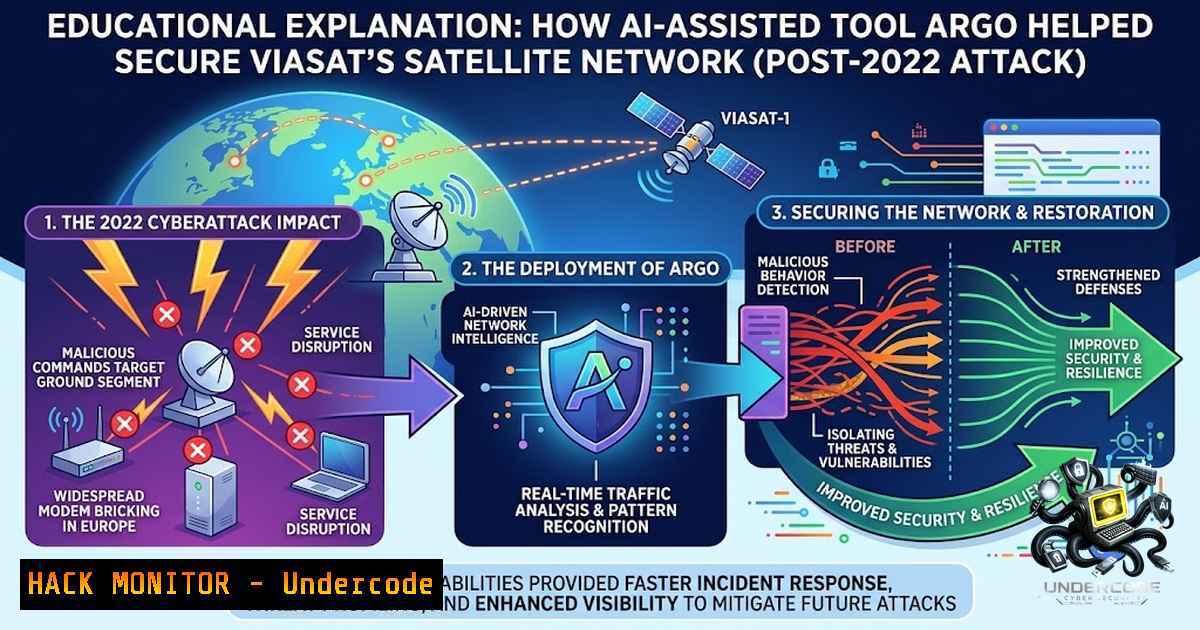
On February 24, 2022, the same day Russia launched its full-scale invasion of Ukraine, Russian state-aligned hackers executed a devastating cyberattack against Viasat’s KA-SAT satellite communications network, disabling thousands of satellite modems across Ukraine and Europe. The attack disrupted military communications, critical infrastructure, and civilian internet access, underscoring the vulnerability of space-based systems to modern cyberwarfare. In response, the cybersecurity company Atalanta deployed its AI-assisted tool, “Argo,” which combines complex mathematics with artificial intelligence to analyze software and network configurations for vulnerabilities. After a year-long collaboration with Viasat, Argo helped harden the network, producing mathematical proofs that verify the system’s resilience against future attacks. Now commercially released, Argo represents a paradigm shift in how critical infrastructure can be secured.
Learning Objectives & Secrets:
- Objective 1: Understand the Viasat Cyberattack and Its Implications – Learn how the 2022 Russian hack disabled thousands of satellite modems and the geopolitical and operational consequences of such attacks on critical infrastructure.
- Objective 2 Secret Tip: Leverage “Software Understanding” for Comprehensive Vulnerability Assessment – Discover how Atalanta’s Argo uses a combination of mathematical formal methods and AI to scan code, configurations, and network connections, providing a more thorough analysis than traditional scanning tools.
- Objective 3 Secret Tip: Use Mathematical Proofs to Validate Security Hardening – Understand how Argo generates verifiable mathematical evidence that demonstrates a system has been effectively hardened, moving beyond subjective compliance checklists to objective, provable security.
You Should Know:
- The Viasat KA-SAT Attack: A Wake-Up Call for Satellite Security
The attack on Viasat’s KA-SAT network was a watershed moment in cyberwarfare. Occurring on the same day as the invasion, the hack disabled modems across Ukraine and several European countries, effectively severing communications for military units, government agencies, and civilians. The attackers used a wiper malware to destroy systems without demanding ransom, highlighting the destructive intent behind state-sponsored cyber operations. This incident demonstrated that satellite communication systems—often considered secure due to their physical inaccessibility—are vulnerable to sophisticated remote attacks.
Step‑by‑Step Guide: Securing a Satellite Network Post-Attack
- Incident Response and Isolation: Immediately disconnect affected modems and segments of the network to prevent lateral movement of the malware.
- Forensic Analysis: Conduct a thorough forensic investigation to identify the entry point and the specific malware used (e.g., wiper variants).
- Vulnerability Assessment: Deploy an AI-assisted tool like Argo to perform a comprehensive scan of all software, firmware, and network configurations.
- Patch and Remediate: Apply patches to identified vulnerabilities and reconfigure systems based on the tool’s recommendations.
- Verification: Run the AI tool again to generate mathematical proofs that confirm the vulnerabilities have been successfully mitigated.
- Continuous Monitoring: Establish ongoing monitoring with the AI tool to detect new vulnerabilities as the system evolves.
2. Understanding Argo’s “Software Understanding” Technology
Atalanta’s Argo is built on a concept called “software understanding,” which integrates complex mathematics (formal methods) with artificial intelligence. Unlike traditional vulnerability scanners that rely on signature databases or heuristic rules, Argo analyzes the actual code and logic of a system to identify potential weaknesses. This approach allows it to find zero-day vulnerabilities and complex configuration errors that conventional tools might miss. As Atalanta CEO Anjana Rajan stated, “The tools and techniques of yesterday do not scale for today”. Argo represents a new generation of cybersecurity tools that can handle the complexity of modern, interconnected systems.
Step‑by‑Step Guide: How to Deploy an AI-Assisted Vulnerability Assessment
1. Define the Scope: Identify the specific systems, networks, and applications to be analyzed.
2. Install the AI Tool: Deploy the Argo software within your secure environment, ensuring it has necessary access permissions.
3. Configure Scan Parameters: Set the tool to scan for specific types of vulnerabilities relevant to your infrastructure (e.g., satellite communication protocols, IoT devices, or cloud APIs).
4. Execute the Scan: Run the AI-assisted scan, which may take hours or days depending on the system’s complexity.
5. Analyze the Output: Review the tool’s findings, which should include a prioritized list of vulnerabilities and recommended fixes.
6. Implement Fixes: Apply patches, reconfigure systems, or rewrite code as recommended.
7. Re-scan for Verification: Run a follow-up scan to generate mathematical proofs that the vulnerabilities have been resolved.
3. Verifiable Security: The Power of Mathematical Proofs
One of Argo’s most innovative features is its ability to produce mathematical proofs that confirm a system’s resilience. This moves cybersecurity from a qualitative assessment (“we think we are secure”) to a quantitative, verifiable one (“we can prove we are secure”). Viasat’s Chief of Cyber Strategy, Nick Saunders, emphasized that the technology “produces the math that backs up that claim”. For government agencies and critical infrastructure operators, this capability is invaluable, as it provides auditable evidence of security posture.
Step‑by‑Step Guide: Generating and Using Mathematical Proofs for Security
1. Run a Baseline Scan: Use Argo to scan your system and generate a baseline report of all vulnerabilities.
2. Remediate Vulnerabilities: Fix all identified issues based on the tool’s recommendations.
3. Run a Verification Scan: Perform a second scan to confirm that the vulnerabilities are no longer present.
4. Generate Proofs: The tool will produce mathematical proofs—formal logic statements that demonstrate the absence of specific vulnerabilities.
5. Archive Proofs: Store these proofs as part of your compliance and audit documentation.
6. Share with Stakeholders: Provide the proofs to regulators, partners, or customers to demonstrate your security posture objectively.
4. Linux and Windows Commands for Network Hardening
Based on the lessons from the Viasat attack and Argo’s methodology, here are some practical commands for hardening network infrastructure:
Linux Commands:
- Check for Open Ports: `sudo netstat -tulpn` – Identify all listening ports and associated services.
- Audit Firewall Rules: `sudo iptables -L -1 -v` – Review current firewall rules to ensure unnecessary ports are blocked.
- Scan for Vulnerabilities with Nmap: `nmap -sV -p-
` – Perform a comprehensive port and service scan. - Check for Rootkits: `sudo rkhunter –check` – Scan for known rootkits and malware.
- Harden SSH Configuration: Edit `/etc/ssh/sshd_config` to disable root login (
PermitRootLogin no) and use key-based authentication.
Windows Commands (PowerShell):
- Check Open Ports: `netstat -an | findstr LISTENING` – View all listening ports.
- Review Firewall Rules: `Get-1etFirewallRule | Where-Object {$_.Enabled -eq “True”}` – List all active firewall rules.
- Scan for Vulnerabilities: Use the built-in `Test-1etConnection` cmdlet to test connectivity to specific ports.
- Check for Suspicious Processes: `Get-Process | Where-Object {$_.CPU -gt 10}` – Identify processes consuming high CPU.
- Enable Windows Defender Real-Time Protection: `Set-MpPreference -DisableRealtimeMonitoring $false`
- The Future of AI in Critical Infrastructure Security
The successful deployment of Argo on Viasat’s network has far-reaching implications. Greg Shannon, chief cybersecurity scientist at Idaho National Laboratory, predicts that such AI-assisted tools will become standard in development toolkits within a decade. The Defense Advanced Research Projects Agency (DARPA) has invested over $2 billion in formal methods research over two decades, and Argo represents the commercial fruition of that investment. Emil Michael, the Pentagon’s chief technology officer, has called for these mathematical approaches to “become the DoD’s gold standard” for cybersecurity. As threats from state-backed hackers—including Russian and Iranian actors—continue to grow, AI-assisted verification will be essential for protecting satellites, power grids, water systems, and other critical infrastructure.
What Undercode Say:
- Key Takeaway 1: The 2022 Viasat attack was a turning point, proving that satellite systems are not immune to sophisticated cyberattacks and requiring a new approach to security.
- Key Takeaway 2: Atalanta’s Argo demonstrates that combining AI with formal mathematical methods can provide verifiable, provable security—moving beyond guesswork to objective assurance.
Analysis: The Viasat incident exposed a critical gap in satellite cybersecurity: traditional perimeter defenses and signature-based antivirus are insufficient against state-sponsored, zero-day attacks. Argo’s “software understanding” approach addresses this gap by analyzing the underlying logic of systems, not just their surface-level configurations. This represents a fundamental shift from reactive to proactive security. However, the technology is still nascent and requires significant expertise to deploy effectively. The fact that DARPA and the Pentagon are championing this approach suggests that AI-assisted formal verification will become a mandatory component for all critical infrastructure in the coming decade. Organizations that adopt these tools early will have a significant advantage in securing their systems against the next wave of cyberattacks.
Prediction:
- +1 AI-assisted formal verification will become a mandatory compliance requirement for critical infrastructure operators within 5–7 years, driven by government mandates and insurance requirements.
- +1 The commercial success of Argo will spur a wave of investment in AI-based cybersecurity startups, leading to rapid innovation and lower costs for these tools.
- -1 Adversaries will inevitably develop countermeasures to AI-assisted defenses, leading to an arms race between AI-powered attacks and AI-powered defenses.
- -1 The high cost and complexity of deploying tools like Argo may create a security divide, where only well-funded organizations can achieve provable security, leaving smaller entities vulnerable.
▶️ Related Video (82% Match):
🎯Let’s Practice For Free:
🎓 Live Courses & Certifications:
Join Undercode Academy for Verified Certifications
🚀 Request a Custom Project:
Secure, high-velocity infrastructure and disruptive technological engineering. Contact our engineering team for high-tier development and proprietary systems:
[email protected]
💎 Smart Architecture | 🛡️ Secure by Design | ⭐ Trusted by Thousands
IT/Security Reporter URL:
Reported By: https://lnkd.in/p/esAECr89 – Hackers Feeds
Extra Hub: Undercode MoN
Basic Verification: Pass ✅


