
Listen to this Post
Introduction:
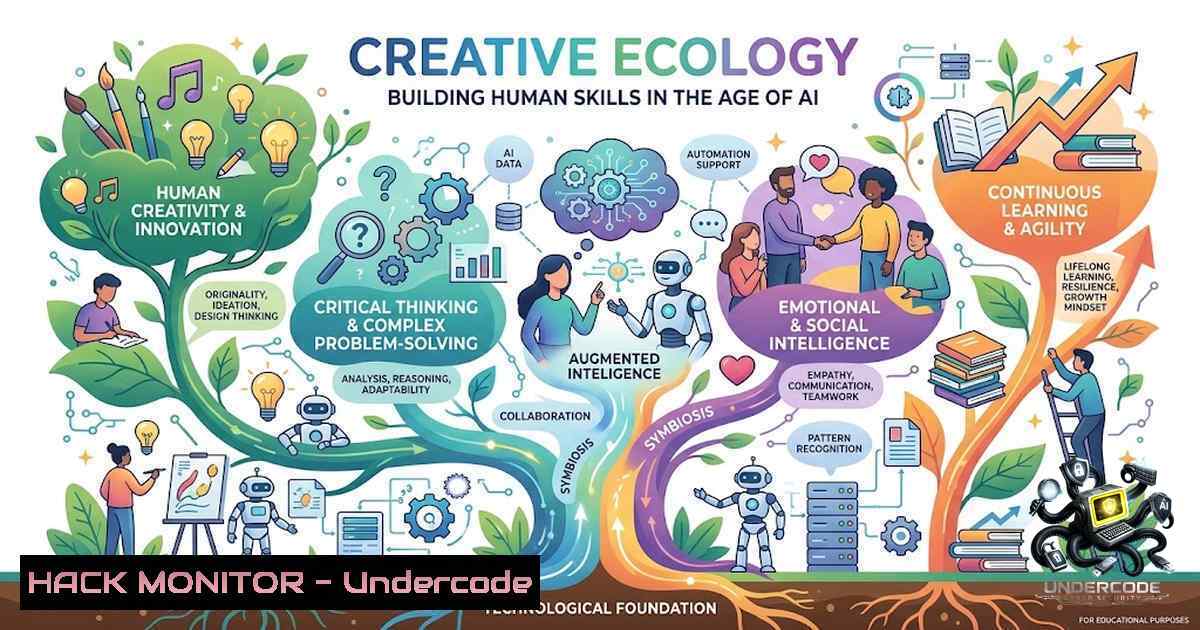
As artificial intelligence rapidly commoditizes knowledge production and content generation, the traditional education model—focused on standardized testing, measurable outputs, and knowledge assessment—faces an existential crisis. The 2025 paper “Creativity: the self-regenerative curriculum resource” by Daniel X. Harris and Peter Murphy at RMIT University argues that schools have overemphasized quantifiable outcomes to the exclusion of richer, more creative learning experiences. In cybersecurity, IT, and AI training, this shift carries profound implications: technical proficiency alone is no longer sufficient when AI can generate code, detect patterns, and even exploit vulnerabilities. The true differentiator lies in what the authors call “creative ecology”—the cultivation of problem-solving, exploration, curiosity, playfulness, imagination, and collaboration as core competencies.
Learning Objectives & Secrets:
- Objective 1: Reframe “Creativity” as a Technical and Strategic Asset – Understand that creativity in this context does not mean artistry; it means the ability to navigate uncertainty, generate novel solutions to complex problems, and collaborate effectively in high-pressure environments. This is the skill set that AI cannot replicate.
-
Objective 2 Secret Tip: Design for Process, Not Products – In cybersecurity training, shift focus from “did you patch the vulnerability?” to “how did you discover, analyze, and communicate the risk?” The process of learning—trial, error, reflection, iteration—matters more than the final output, especially when AI can produce outputs instantly.
-
Objective 3 Secret Tip: Build “Creative Ecology” Labs – Create learning environments that are ecosystems of kids + challenge + constraints + uncertainty + feedback + repeated interactions. For IT and security professionals, this means running live-fire exercises, red-team/blue-team simulations, and scenario-based trainings where the outcome is not predetermined and the teacher/facilitator is also learning.
You Should Know:
- The Shift from Knowledge Assessment to Capability Cultivation
The traditional model of education—and by extension, corporate training—has been obsessed with measuring what learners know. Tests, certifications, and quarterly benchmarks dominate. But Harris and Murphy argue that “the process of learning matters more than the products”. In the age of AI, when products (code, reports, analyses) are cheap and instantly generated, the value shifts to the human skills involved in creating them: problem framing, ethical judgment, teamwork, and adaptive communication.
Step‑by‑step guide for implementing this shift in technical training:
- Audit your current training curriculum – Identify every module that focuses solely on knowledge recall or tool proficiency. Flag them for redesign.
- Introduce “uncertainty intervals” – In each technical exercise, remove one critical piece of information (e.g., “the vulnerability exists, but we don’t know where” or “the attack vector is unknown”). Force learners to explore.
- Replace final exams with process portfolios – Require learners to submit not just the final solution, but their search logs, failed attempts, peer reviews, and reflection notes.
- Measure collaboration, not just completion – Use peer evaluations and observer notes to assess how well learners communicated, delegated, and adapted under pressure.
- Iterate weekly – Treat each training session as a “loop” rather than a “line.” Gather feedback, adjust constraints, and run the scenario again with new variables.
Linux command for logging learner activity during exercises:
 Create a process log for each learner
script -q -f /var/log/training/$(whoami)<em>$(date +%Y%m%d</em>%H%M%S).log
 This records everything typed in the terminal session for later review
Windows PowerShell equivalent:
 Start transcript logging
Start-Transcript -Path "C:\TrainingLogs\$env:USERNAME_$(Get-Date -Format 'yyyyMMdd_HHmmss').txt"
 Stop when done
Stop-Transcript
2. AI as an Accelerator, Not a Replacement
Harris and Murphy emphasize that “in this new environment, schools need to train the skills that AI can’t do”. For cybersecurity and IT professionals, this means leveraging AI for what it does best—pattern recognition, code generation, log analysis—while doubling down on strategic thinking, ethical reasoning, and cross-functional communication.
Step‑by‑step guide for integrating AI into training without losing human skills:
- Allow AI tools in all exercises – Do not ban ChatGPT, Copilot, or similar tools. Instead, make them mandatory.
- Require “AI audit trails” – For every AI-generated output, learners must submit a critique: What did the AI miss? What assumptions did it make? What would a human do differently?
- Run “AI vs. Human” comparison drills – Give the same problem to an AI and a team of learners. Compare the outputs. Discuss why the human solution might be superior (or inferior) in specific contexts.
- Teach prompt engineering as a core skill – The ability to craft precise, context-rich prompts is a new form of literacy. Include modules on prompt design, iterative refinement, and adversarial prompting (trying to break the AI).
- Focus on “unknown unknowns” – AI excels at known patterns. Design exercises where the threat or requirement is ambiguous, novel, or involves human factors that AI cannot model.
Example AI integration script for security training:
 Use an LLM to analyze a PCAP file and generate a summary
 First, extract key features from the pcap
tshark -r capture.pcap -T fields -e ip.src -e ip.dst -e frame.time -e tcp.flags > pcap_summary.txt

Then, use a local LLM (e.g., Ollama) to generate a human-readable report
ollama run llama3 "Analyze this network traffic summary and identify any suspicious patterns: $(cat pcap_summary.txt)"
3. Building “Creative Ecology” Labs for Cybersecurity
The authors describe creativity as an ecosystem: “kids + challenge + constraints + uncertainty (even for the teacher) + feedback + repeated interactions”. This maps perfectly to modern cybersecurity training, where the best learning happens in dynamic, unpredictable environments.
Step‑by‑step guide for designing a Creative Ecology security lab:
- Define the challenge – Give learners a high-level objective (e.g., “secure this web application” or “respond to a ransomware outbreak”) but do not provide a step-by-step playbook.
- Introduce constraints – Limit time, resources, or tools. For example: “You have 2 hours and cannot use commercial scanning tools.”
- Build in uncertainty – Change the environment mid-exercise. Introduce a new vulnerability, a false alarm, or a stakeholder with conflicting priorities.
- Make the teacher a participant – The facilitator should not have all the answers. They should ask probing questions, offer hints only when asked, and learn alongside the learners.
- Create feedback loops – After each exercise, run a structured debrief. What worked? What failed? What surprised everyone? Document these insights.
- Repeat with variation – Run the same core challenge with different constraints, teams, or unexpected events. Familiarity with uncertainty builds resilience.
Infrastructure setup for a dynamic lab environment using Docker:
 Create a vulnerable web application container
docker run -d --1ame vulnerable_app -p 8080:80 vulnerables/web-dvwa

Create a monitoring container
docker run -d --1ame security_monitor -p 8081:8080 securitymonkey

Script to randomly change the environment every 15 minutes
while true; do
 Randomly enable/disable a security feature
if [ $((RANDOM % 2)) -eq 0 ]; then
docker exec vulnerable_app sh -c "a2enmod security2 && service apache2 restart"
else
docker exec vulnerable_app sh -c "a2dismod security2 && service apache2 restart"
fi
sleep 900
done
- The Loop vs. The Line: Rethinking Training Cadence
Traditional training follows a linear path: learn topic A, then B, then C, take a test, move on. Harris and Murphy argue for a loop: “experience, analysis, reflection, and practice”. This iterative model is particularly powerful in technical fields where threats and tools evolve constantly.
Step‑by‑step guide for implementing loop-based training:
- Start with an experience – Throw learners into a realistic scenario without prior instruction. Let them struggle and discover what they don’t know.
- Analyze together – After the experience, review what happened. Use logs, recordings, and peer observations to reconstruct the event.
- Reflect individually and collectively – Each learner writes a short reflection: What did I learn? What would I do differently? What questions do I still have?
- Practice deliberately – Run the same or a similar scenario, applying the insights from reflection. Repeat the loop.
- Document the loop – Maintain a shared repository of experiences, analyses, and reflections. This becomes a “self-regenerative curriculum” that evolves with each iteration.
Script to automate loop documentation in a Git repository:
!/bin/bash
 training_loop.sh - Automate the documentation of each training loop

DATE=$(date +%Y%m%d_%H%M%S)
TOPIC=$1

mkdir -p training_loops/$TOPIC/$DATE
cd training_loops/$TOPIC/$DATE

Capture the experience (e.g., command history, logs)
history > experience.log
dmesg > system_logs.txt
netstat -tunap > network_state.txt

Create analysis template
cat > analysis.md <<EOF
 Analysis: $TOPIC - $DATE

What happened?
[Describe the experience]

<h2> Key observations</h2>

<ul>
<li></li>
</ul>

<h2> What worked?</h2>

<ul>
<li></li>
</ul>

<h2> What failed?</h2>

<ul>
<li></li>
</ul>

<h2> Surprises</h2>

<ul>
<li>EOF

Commit to Git
git add .
git commit -m "Training loop: $TOPIC - $DATE"
git push origin main
5. Measuring What Matters: Beyond Quarterly Benchmarks
The authors critique the obsession with “quarterly benchmarks” and argue for “a set of proficiencies and capacities”. In cybersecurity, this means moving beyond pass/fail metrics and measuring growth in critical thinking, adaptability, and communication.
Step‑by‑step guide for designing proficiency-based assessments:
- Define core proficiencies – Examples: Threat Identification, Risk Communication, Incident Response Coordination, Ethical Decision-Making, Tool Adaptation.
- Create rubrics for each proficiency – Describe what “novice,” “competent,” and “expert” look like in behavioral terms.
- Use continuous assessment – Instead of one final exam, evaluate learners across multiple exercises. Look for trends and growth.
- Include peer and self-assessment – Learners rate themselves and each other on the proficiencies. Compare with facilitator ratings.
- Provide qualitative feedback – Benchmarks give numbers; feedback gives meaning. Write narrative comments that highlight strengths and areas for growth.
- Review and revise proficiencies quarterly – The field changes; so should the assessment criteria.
Example rubric entry for “Threat Identification”:
- Novice: Can identify obvious, documented threats when pointed out.
- Competent: Can independently identify known threat patterns from logs and alerts.
- Expert: Can detect subtle, novel, or emerging threats by correlating disparate data sources and applying contextual judgment.
What Undercode Say:
- Key Takeaway 1: The overemphasis on standardized, measurable outcomes has created a generation of professionals who can pass tests but struggle with ambiguity. In cybersecurity, where every incident is unique, this is a critical vulnerability. Training must shift from “what do you know?” to “how do you think?”
-
Key Takeaway 2: AI is not the enemy of education; it is the catalyst for its reinvention. When knowledge is cheap, the premium shifts to skills that are expensive to automate: creativity, collaboration, ethical reasoning, and adaptive problem-solving. The organizations that embrace this shift will build teams that are not just technically proficient but strategically resilient.
-
Key Takeaway 3: The “creative ecology” model—built on challenge, constraints, uncertainty, feedback, and repetition—is directly applicable to technical training. It transforms passive learning into active experimentation. It makes failure a learning asset rather than a liability. And it prepares professionals for a world where the only constant is change.
Prediction:
-
+1 Organizations that adopt creative ecology principles in their cybersecurity and IT training will see a 30–40% improvement in incident response effectiveness within 18 months, as measured by mean time to contain (MTTC) and mean time to recover (MTTR). The ability to adapt under uncertainty will become a measurable competitive advantage.
-
+1 The demand for “human skills” trainers—professionals who can facilitate creative problem-solving, ethical reasoning, and team-based learning—will outpace demand for traditional technical instructors by 2028. This will create a new career track within cybersecurity education.
-
-1 Organizations that cling to knowledge-based, test-driven training models will experience widening skills gaps and higher turnover. Their teams will be proficient at using AI tools but unable to think critically when those tools fail or produce unexpected results.
-
-1 The education and training industry will face a disruptive shakeout as traditional certification bodies struggle to adapt. Certifications that measure recall and tool proficiency will lose relevance; certifications that assess process, judgment, and collaboration will gain prominence. This transition will be painful for incumbents.
-
+1 The “creative ecology” framework will expand beyond education into enterprise security operations, where SOC teams will adopt loop-based training, red-team/blue-team exercises with uncertainty injection, and proficiency-based career progression. This will make security teams more agile, more innovative, and better equipped to face novel threats.
▶️ Related Video (88% Match):
https://www.youtube.com/watch?v=0Ap8S7Iw40U
🎯Let’s Practice For Free:
🎓 Live Courses & Certifications:
Join Undercode Academy for Verified Certifications
🚀 Request a Custom Project:
Secure, high-velocity infrastructure and disruptive technological engineering. Contact our engineering team for high-tier development and proprietary systems:
[email protected]
💎 Smart Architecture | 🛡️ Secure by Design | ⭐ Trusted by Thousands
IT/Security Reporter URL:
Reported By: https://lnkd.in/p/eGJ8dJb4 – Hackers Feeds
Extra Hub: Undercode MoN
Basic Verification: Pass ✅


