Listen to this Post
Introduction:
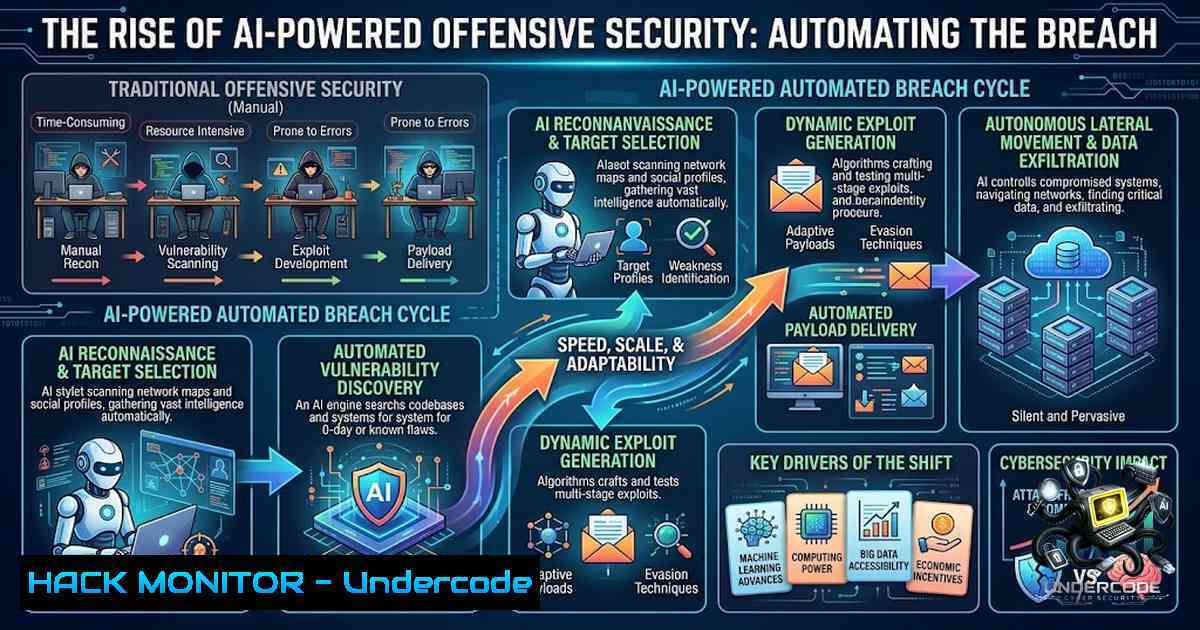
The cyber threat landscape is undergoing a paradigm shift as artificial intelligence transitions from a defensive tool to an offensive accelerator. The democratization of AI lowers the technical barrier to entry, enabling both novice threat actors and seasoned red teams to automate reconnaissance, social engineering, and vulnerability discovery. By 2026, AI is no longer just processing data; it is actively executing multi-stage attacks with minimal human oversight, fundamentally altering the speed and sophistication of cyber warfare.
Learning Objectives & Secrets:
- Objective 1: Understand AI Exploitation Vectors – Learn how uncensored Large Language Models (LLMs) generate convincing Business Email Compromise (BEC) campaigns and evade traditional spam filters.
- Objective 2 Secret Tips: Use automated prompts to chain reconnaissance tools (e.g., Shodan + Auto-GPT) to map attack surfaces faster than manual enumeration.
- Objective 3 Secret Tips: Identify “Hallucination Injection” flaws in AI code generation where models suggest insecure code dependencies, leading to supply chain vulnerabilities.
You Should Know:
1. Automated Phishing & Social Engineering with WormGPT/VulnGPT
WormGPT and its variants exemplify the “malicious-as-a-service” trend. These models bypass standard content filters like Moderation APIs, allowing attackers to generate thousands of unique phishing templates per minute.
Step‑by‑step guide to mitigate AI-generated phishing:
- Implement Email Authentication: Enforce SPF, DKIM, and DMARC policies (Linux). Check a domain’s DMARC record: `dig TXT _dmarc.example.com`
– Train ML Classifiers: Use Python (Scikit-learn) to fine-tune a text classifier to detect AI-generated syntactic patterns. Example command to install required libraries: `pip install scikit-learn pandas`
– Windows Header Analysis: In PowerShell, analyze email headers to find originating IPs: `Get-MessageTrackingLog -Server “Exch01” -Start “08/19/2026 09:00:00” | Where-Object {$_.EventId -eq “RECEIVE”}`
2. Autonomous Penetration Testing (PentestGPT & Auto-GPT)
PentestGPT automates the exploitation pathfinding by ingesting Nmap output and suggesting Metasploit modules. Auto-GPT acts as a “Task Master” that creates sub-agents to scrape GitHub for exposed API keys.
Step‑by‑step guide for ethical deployment:
- Installation (Linux): Ensure you have the latest Python environment. `sudo apt update && sudo apt install python3-pip`
– Run a Diagnostic Scan: Use Nmap to enumerate services.nmap -sV -p- -T4 <target_IP>. - API Security Check: Use `curl` to test for verb tampering on an API endpoint. `curl -X TRACE
` to check for Cross-Site Tracing vulnerability. - Windows Firewall Hardening: Block suspicious inbound connections with `netsh advfirewall firewall add rule name=”BlockMalicious” dir=in action=block remoteip=
`
3. Vulnerability Discovery via AI Fuzzing (VulnGPT)
VulnGPT analyzes CVE databases and code repositories to identify zero-day patterns. It prioritizes the most likely vulnerable functions in a codebase, drastically reducing manual reverse engineering time.
Step‑by‑step guide for secure code review:
- Static Analysis (SonarQube): Integrate SonarQube into your CI/CD pipeline to scan for AI-suggested vulnerabilities.
- Use OWASP Dependency Check: Scan for known vulnerable libraries. `dependency-check –scan .`
– Linux Command for Running a Python Fuzzer: `python3 -m pip install atheris` (Google’s fuzzing engine). Execute withpython3 fuzz.py. - Windows PowerShell Execution Policy: Ensure scripts are signed to prevent malicious code injections. `Set-ExecutionPolicy RemoteSigned`
- Cloud Hardening Against AI Scraping (ChaosGPT & ThreatGPT)
Autonomous agents leverage cloud misconfigurations to exfiltrate data. ThreatGPT monitors these patterns, but attackers use the same tech to find misconfigured S3 buckets.
Step‑by‑step guide for Cloud Security Posture Management:
- AWS CLI Configuration: Install AWS CLI and verify permissions. `aws configure` (Linux/Windows).
- Bucket Policy Enforcement: Enforce encryption by default using a bucket policy: `aws s3api put-bucket-encryption –bucket
–server-side-encryption-configuration ‘{“Rules”: [{“ApplyServerSideEncryptionByDefault”: {“SSEAlgorithm”: “AES256”}}]}’`
– Linux Firewall Restriction: Use `iptables` to limit API access traffic to known IP ranges. `iptables -A INPUT -p tcp –dport 443 -s-j ACCEPT`
5. Mitigating API Automation (Auto-GPT)
Since Auto-GPT can chain APIs, securing RESTful interfaces is critical. Attackers use AI to brute-force endpoints and parse JSON responses for sensitive data.
Step‑by‑step guide to API Rate Limiting & Hardening:
- Nginx Rate Limiting (Linux): Edit `/etc/nginx/nginx.conf` to add `limit_req_zone $binary_remote_addr zone=mylimit:10m rate=5r/s;`
– Windows IIS Throttling: Use `appcmd` to set request limits. `appcmd set config /section:system.webServer/security/requestFiltering /requestLimits.maxAllowedContentLength:30000000`
– Validate JWT Tokens: Use `pyjwt` in Python to verify tokens on the server-side before any logic execution.
6. Threat Intelligence Integration (ThreatGPT)
ThreatGPT assists in parsing threat feeds, but defenders must ensure the feeds are not poisoned.
Step‑by‑step guide to setting up an Intel Feed:
- Linux MISP Installation: Install MISP (Malware Information Sharing Platform) for local threat sharing.
- Windows Sysmon Setup: Use Sysmon to log process creations. `Sysmon64.exe -accepteula -i`
– Log Analysis Command: Combine `grep` and `awk` on Linux to isolate anomalies in/var/log/auth.log. `grep “Failed password” /var/log/auth.log | awk ‘{print $9}’ | sort | uniq -c`
What Undercode Say:
- Key Takeaway 1: AI does not invent new attack vectors; it merely accelerates the existing kill chain, reducing the time from reconnaissance to exfiltration by over 80%.
- Key Takeaway 2: Defenders must adopt “Red Teaming” for their AI models to prevent prompt injection attacks that could lead to source code leakage in internal copilot tools.
Analysis:
The core issue lies in the “Frictionless Attack Surface.” While AI lowers the skill floor for hacking, it paradoxically raises the skill ceiling for defenders who must now analyze logs at machine speed. The primary vulnerability is not the AI itself but the Identity and Access Management (IAM) policies that autonomous agents can exploit. Organizations must shift from “Prevention-Only” to “Detection-Response” because AI attacks are inevitable. Embracing GPU-accelerated log analysis and behavioral analytics (User and Entity Behavior Analytics – UEBA) is mandatory. Furthermore, training employees on “Deepfake BEC” and “Vishing” is more critical than ever, as the human element remains the weakest link. It is a state of perpetual cyber asymmetry where the defender must be correct 100% of the time, while the attacker only needs to be right once. A strict Zero-Trust architecture, combined with AI-driven SOAR (Security Orchestration, Automation, and Response), forms the last line of defense against this automated menace.
Prediction:
- +1: The automation of penetration testing will force vendors to patch vulnerabilities in hours rather than months, leading to a more resilient global software supply chain.
- -1: The proliferation of “FakeGPT” tools will increase ransomware incidents by 35% in the next fiscal year as script kiddies weaponize automation.
- -1: Regulatory compliance (GDPR/SOC2) will face challenges as “Shadow AI” leaves unlogged traces in SIEM systems, potentially leading to multi-million dollar penalties for data breaches caused by autonomous scraping.
▶️ Related Video (90% Match):
🎯Let’s Practice For Free:
🎓 Live Courses & Certifications:
Join Undercode Academy for Verified Certifications
🚀 Request a Custom Project:
Secure, high-velocity infrastructure and disruptive technological engineering. Contact our engineering team for high-tier development and proprietary systems:
[email protected]
💎 Smart Architecture | 🛡️ Secure by Design | ⭐ Trusted by Thousands
IT/Security Reporter URL:
Reported By: https://lnkd.in/p/eNgmdHhR – Hackers Feeds
Extra Hub: Undercode MoN
Basic Verification: Pass ✅


