Listen to this Post
Introduction:
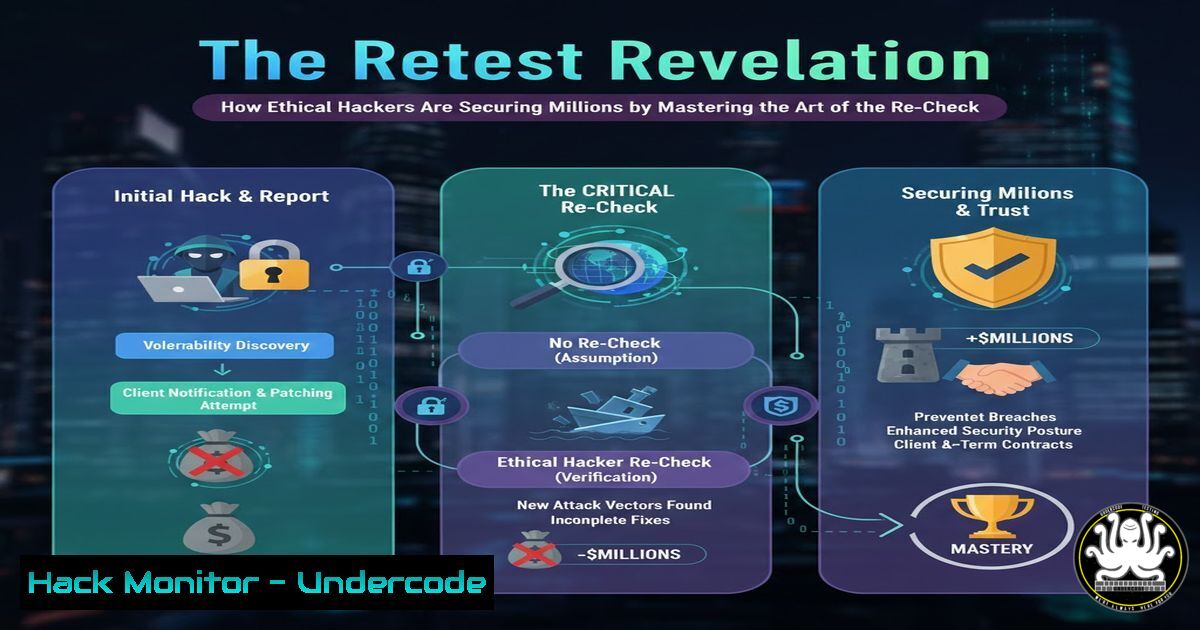
In the high-stakes arena of bug bounty hunting, the initial discovery of a vulnerability is only the first act. The final payout and, more importantly, the assurance of a secured application, hinge on a critical yet often overlooked phase: the retest. As highlighted by a researcher’s successful Intigriti bounty retest, this process is where proof-of-concepts meet production patches, and where hunters truly prove an application’s resilience. This deep dive explores the systematic methodology behind effective vulnerability retesting, transforming a simple validation step into a cornerstone of professional security assurance.
Learning Objectives:
- Understand the critical importance of the retest phase in the bug bounty lifecycle and secure development.
- Master a step-by-step methodology for retesting common web application vulnerabilities, from reconfirmation to regression testing.
- Learn to document retest results effectively to ensure clear communication with security teams and guarantee issue resolution.
You Should Know:
- The Retest Mandate: Beyond the Initial “PoC Exploit”
The core purpose of a retest is to verify that the remediation deployed by the development team effectively neutralizes the reported vulnerability without introducing new flaws or side-effects. It’s not merely running your original exploit script again; it’s a methodical investigation.
Step-by-step guide:
- Receive Fix Notification: Await official communication (e.g., from Intigriti, HackerOne, or internal team) that a fix is deployed in a specific environment (staging, production).
- Environment Verification: Confirm you are testing against the correct, patched version. Use browser dev tools, review source code comments, or check API response headers for version identifiers.
- Re-run Original Proof-of-Concept (PoC): Execute your original exploit. It should now fail. Document the exact error message or behavior (e.g., “403 Forbidden,” “Input sanitized,” “CSRF token invalid”).
- Initial Analysis: A failure is good, but not conclusive. Begin analyzing why it failed.
2. Black-Box Retesting Techniques for Common Vulnerabilities
Different vulnerabilities require tailored retest approaches. Here’s how to verify fixes for common flaws:
SQL Injection (SQLi):
Original PoC: `’ OR ‘1’=’1′–`
Retest Actions: Submit the payload again. Then, try variations like `’` (single quote) to test for error-based SQLi, or time-based payloads like `’ OR SLEEP(5)–` to test for blind SQLi. The application should now handle these as plain text or return generic errors.
Linux Command Example (using `curl` for API testing):
 Test original payload
curl -X GET "https://target.com/api/user?id=' OR '1'='1'"
 Expected new response: Generic error or empty dataset, NOT a full database dump.
Cross-Site Scripting (XSS):
Original PoC: ``
Retest Actions: Input the payload. Check if it’s HTML-encoded in the output (e.g., <script>...). Test event handlers (onmouseover=alert()), SVG tags, and alternative encoding. Use browser console to check if any JavaScript executes.
Cross-Site Request Forgery (CSRF):
Original PoC: A standalone HTML file that submits a form to the target.
Retest Actions: Attempt to submit the form from your PoC page. It should be rejected. Manually inspect the legitimate application form for a new, unpredictable CSRF token tied to your session. Verify the token is validated on the server-side.
3. The Grey-Box Advantage: Leveraging Provided Information
In some programs, you may receive details about the fix (e.g., “implemented input validation using library X”). Use this!
1. Research the Fix: If they mention a specific library (e.g., OWASP ESAPI, DOMPurify), understand its default security posture and known bypasses.
2. Test for Library-Specific Bypasses: Search for edge cases in the version they likely implemented. For example, older `DOMPurify` versions might have specific SVG bypasses.
3. Verify Scope: Ensure the fix was applied universally. If you found an XSS in /search, check `/advanced-search` and similar endpoints.
4. Regression and Side-Effect Testing
A proper fix shouldn’t break legitimate functionality or leave related holes.
1. Test Normal Functionality: Perform the intended action with legitimate, clean data. Ensure the feature still works.
2. Test Adjacent Parameters/Vectors: If you injected via the `email` parameter, test email[, user_email, and other similar fields in the same request.
3. Check for Information Disclosure: Did the fix inadvertently reveal stack traces, server paths, or internal error messages in the new response?
5. Advanced Retesting: Automation and Fuzzing
For complex issues or to be thorough, incorporate semi-automated testing.
Using `ffuf` for Parameter Re-discovery:
 Fuzz for new parameters after a fix, which might be unprotected
ffuf -w /path/to/parameter-wordlist.txt -u "https://target.com/endpoint?FUZZ=test_value" -fr "error_message"
Custom Python Script for Retesting: Automate the retest of multiple endpoints/payloads.
import requests
import time

s = requests.Session()
 ... (login logic) ...

endpoints = ["/api/user", "/api/profile"]
payloads = ["' OR '1'", "<img src=x onerror=alert(1)>"]

for endpoint in endpoints:
for payload in payloads:
resp = s.get(f"https://target.com{endpoint}?q={payload}")
if payload in resp.text and "alert" not in resp.headers.get('X-Content-Type-Options', ''):
print(f"POSSIBLE REGRESSION at {endpoint} with {payload[:20]}...")
time.sleep(1)  Rate limiting
6. Documentation: The Final, Critical Step
Your retest report closes the loop. It should include:
1. Vulnerability ID: Reference the original report.
2. Date & Environment Retested: Be specific.
- Methodology: Brief description of steps taken (e.g., “Re-submitted original PoC, tested 3 variant payloads, verified normal functionality”).
- Result: “VULNERABILITY RESOLVED” or “ISSUE PERSISTS (with new PoC).”
- Evidence: New screenshots, curl commands, and responses showing the mitigated behavior.
What Undercode Say:
- The Retest is the True Proof of Security: A successful retest is the only point where a vulnerability transitions from “reported” to “remediated.” It is the quality assurance gate for security fixes.
- Professionalism in Retesting Builds Reputation: Hunters who conduct thorough, documented retests become trusted assets to programs, often leading to private invites, higher bounty multipliers, and a standout professional profile.
The retest phase elevates bug bounty hunting from a hobby to a professional security audit role. It demands a mindset shift from “breaker” to “validator,” requiring meticulous attention to detail, an understanding of defensive coding practices, and exceptional communication. The researcher’s success on Intigriti underscores this evolution. As programs mature, the ability to reliably and thoroughly verify fixes will become as valued as the initial discovery, shaping the future of collaborative cybersecurity.
Prediction:
The future of bug bounties will see the “retest” phase become increasingly formalized and incentivized. Platforms will develop integrated retest environments (snapshots of the pre- and post-fix application state) to aid hunters. Automated retest pipelines, where hunters can submit validation scripts that run in a safe sandbox, will emerge. Bounty structures will more prominently feature “retest bonuses” for critical issues, and a hunter’s “Retest Reliability Score” will become a visible metric on profiles, influencing their access to high-value private programs. This formalization will further bridge the gap between ethical hacking and professional security assurance, making the ecosystem more robust and efficient.
▶️ Related Video (76% Match):
🎯Let’s Practice For Free:
IT/Security Reporter URL:
Reported By: Awais0x1 First – Hackers Feeds
Extra Hub: Undercode MoN
Basic Verification: Pass ✅


