Listen to this Post
Introduction:
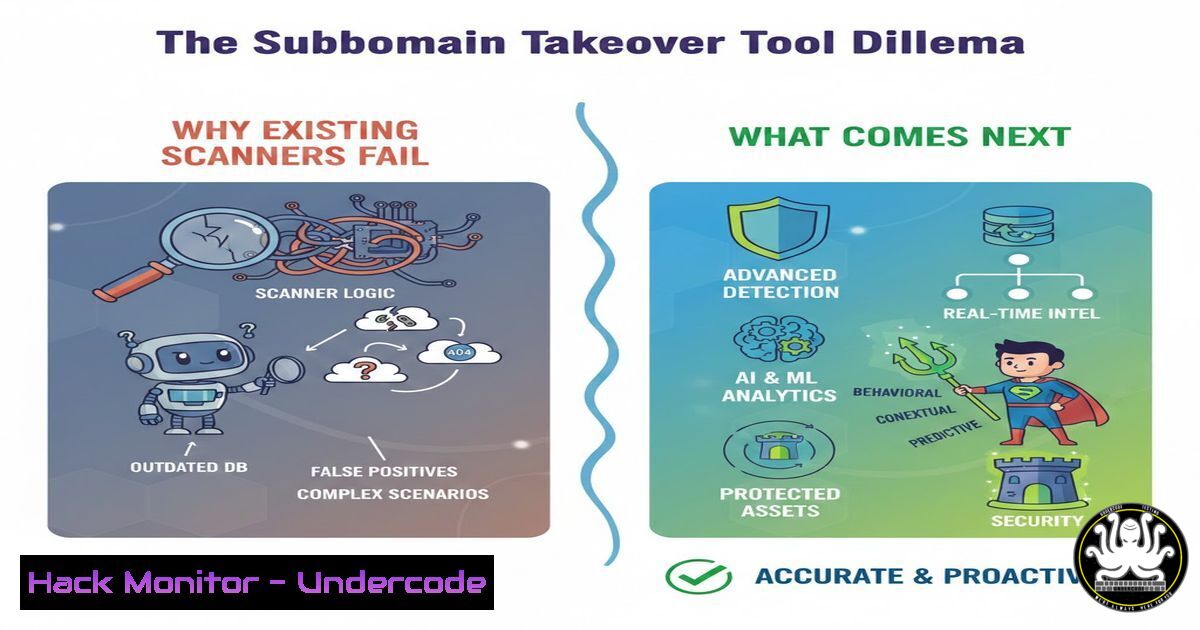
In the high-stakes world of bug bounty hunting, efficiency is currency. Security researchers like Bhagirath Saxena spend their days automating reconnaissance to uncover critical vulnerabilities, but their tools can betray them. A recent critique highlights a pervasive industry pain point: popular subdomain takeover scanners, including subzy and Nuclei templates, are plagued by excessive false positives and significant blind spots, wasting valuable time and missing real threats. This unreliability has sparked a new wave of tool development aimed at achieving precision in automation, pushing the field toward more intelligent and accurate security testing.
Learning Objectives:
- Understand the technical mechanism and severe business impact of a subdomain takeover vulnerability.
- Analyze the historical limitations and performance trade-offs of established open-source takeover detection tools.
- Learn a proven, multi-tool methodology for accurately identifying and validating subdomain takeovers.
You Should Know:
- What is a Subdomain Takeover, and Why Should Organizations Fear It?
A subdomain takeover occurs when a company’s DNS record (like a CNAME) points to a third-party service—such as GitHub Pages, AWS S3, or a Heroku app—that has been deleted or decommissioned. If the service provider does not validate domain ownership upon registration, an attacker can claim the abandoned service and effectively “hijack” that subdomain. This isn’t just a theoretical misconfiguration; it’s a critical vulnerability with a wide attack surface.
Once controlled, the subdomain becomes a powerful beachhead. An attacker can serve malicious content, steal user session cookies set on the parent domain, phish users with legitimate-looking URLs, and even exploit trust relationships to bypass security policies like CORS or Content Security Policy (CSP). The severity escalates dramatically if the hijacked subdomain is whitelisted by the main application for scripts or authentication redirects, potentially leading to full account compromise.
- The Evolution of Takeover Tools: A History of Speed vs. Accuracy
For years, the security community has relied on a suite of open-source tools, each with different strengths and weaknesses. A comprehensive 2023 benchmark by Stratus Security tested three popular tools—Subjack, Subdover, and their own Subdominator—against over 100,000 subdomains. The results were revealing: Subjack found 276 potential takeovers, Subdover found 514, and Subdominator found 654. This discrepancy isn’t just about volume; it’s about fingerprint coverage and verification logic.Subjack: A fast, Go-based tool that helped pioneer automation but uses a conservative fingerprint list (around 35 services), leading to potential false negatives.
Nuclei Templates: Powered by a community-driven repository, these templates are versatile but can trigger false positives, especially when scanning IP addresses directly instead of domain names.
The Modern Benchmark: Tools like Subdominator achieve higher speed and accuracy by using a larger, vetted fingerprint list (97 services) and implementing intelligent checks—such as validating DNS CNAME records before making HTTP requests—to drastically reduce false positives. -
Why New Tools Like SubHijack Are Necessary: The False Positive Problem
Bhagirath Saxena’s frustration with existing tools is a common refrain among professional hunters. A tool that floods a researcher with false alarms is worse than useless; it erodes trust and burns time. The core issue often lies in how fingerprints are designed and verified. For example, a simple HTTP `404` page from a cloud provider is a common fingerprint, but not every `404` means the service can be claimed. Some providers have implemented domain verification steps that prevent actual takeover.
Furthermore, as noted in a Nuclei-templates GitHub issue, some detection logic fails to distinguish between a subdomain and a bare IP address, leading to invalid alerts. A next-generation tool must therefore go beyond static fingerprint matching. It needs to incorporate logic that understands context—checking WHOIS data for domain availability, understanding provider-specific registration flows, and validating DNS status—to separate true vulnerabilities from dead ends.
- A Practical Methodology: From Subdomain Discovery to Proof-of-Concept
Relying on a single tool is a flawed strategy. A robust methodology uses multiple stages to gather, filter, and validate data.
Step 1: Subdomain Enumeration
Use passive and active tools to build a comprehensive list. Start with a passive enumerator to quickly gather subdomains from public sources.
subfinder -d target.com -o subdomains.txt
For more in-depth discovery, use a tool like `amass` in passive mode to map the attack surface without direct interaction.
Step 2: Probing and Filtering
Resolve your subdomains to identify live hosts and gather HTTP data. This step filters out non-responsive targets.
cat subdomains.txt | httpx -silent -o live_subdomains.txt
Step 3: Takeover Scanning
Run your preferred takeover scanner against the live list. Use flags to increase accuracy, such as enforcing SSL checks.
 Example using a tool like Subjack
subjack -w live_subdomains.txt -ssl -t 50 -o potential_takeovers.json -v
Step 4: Manual Verification (Crucial)
This is where you defeat false positives. For every potential finding:
1. Check the DNS CNAME record: dig CNAME vulnerable.target.com.
2. Verify the pointed-to service (e.g., `xxxx.herokuapp.com`).
- Manually attempt to sign up for or claim that service on the provider’s platform. Only if you can successfully claim it and host your own content is the vulnerability confirmed.
5. Beyond the Takeover: Exploitation and Escalation
Simply proving you can host a text file on a subdomain is often a medium-severity finding. To demonstrate critical impact, you must investigate escalation paths.
Cookie Theft: Check if the main site sets cookies with a broad scope (e.g., Domain=.target.com). These would be sent to your hijacked subdomain.
OAuth/SSO Redirects: If the main site allows OAuth redirects to any `.target.com` subdomain, you could intercept authorization codes or tokens.
CSP/Script Whitelisting: Inspect the main site’s Content Security Policy headers. If your hijacked subdomain is whitelisted as a script source (script-src), you can execute arbitrary JavaScript in the context of the main application.
What Undercode Say:
- Precision Over Volume: The next evolution in offensive security tools is not about finding more, but about reporting accurately. Tools that integrate multi-layered validation (DNS, HTTP, WHOIS, provider logic) will save researchers time and increase the signal-to-noise ratio in vulnerability reports.
- Defense is Straightforward: Remediation is simple but requires diligence. Organizations must implement a rigorous decommissioning process: remove the DNS record before deleting the cloud service instance. Continuous monitoring of DNS configurations against asset inventories is the most effective defensive control.
Prediction:
The frustration with false positives will drive a significant shift toward AI-assisted validation in reconnaissance tools. Future tools will likely employ lightweight local models to analyze HTTP responses, DNS patterns, and certificate data in real-time, scoring potential vulnerabilities based on contextual likelihood rather than static matching. This will move the industry from “possible” takeover lists to “high-confidence, exploitable” alerts, fundamentally changing the efficiency of both attackers and defenders. Furthermore, as major cloud providers increasingly implement mandatory domain verification, the low-hanging fruit will disappear, pushing attackers toward more complex, chained exploits that leverage takeovers as one link in a broader attack chain.
▶️ Related Video (82% Match):
🎯Let’s Practice For Free:
IT/Security Reporter URL:
Reported By: Rix4uni Bugbounty – Hackers Feeds
Extra Hub: Undercode MoN
Basic Verification: Pass ✅


