Listen to this Post
Introduction:
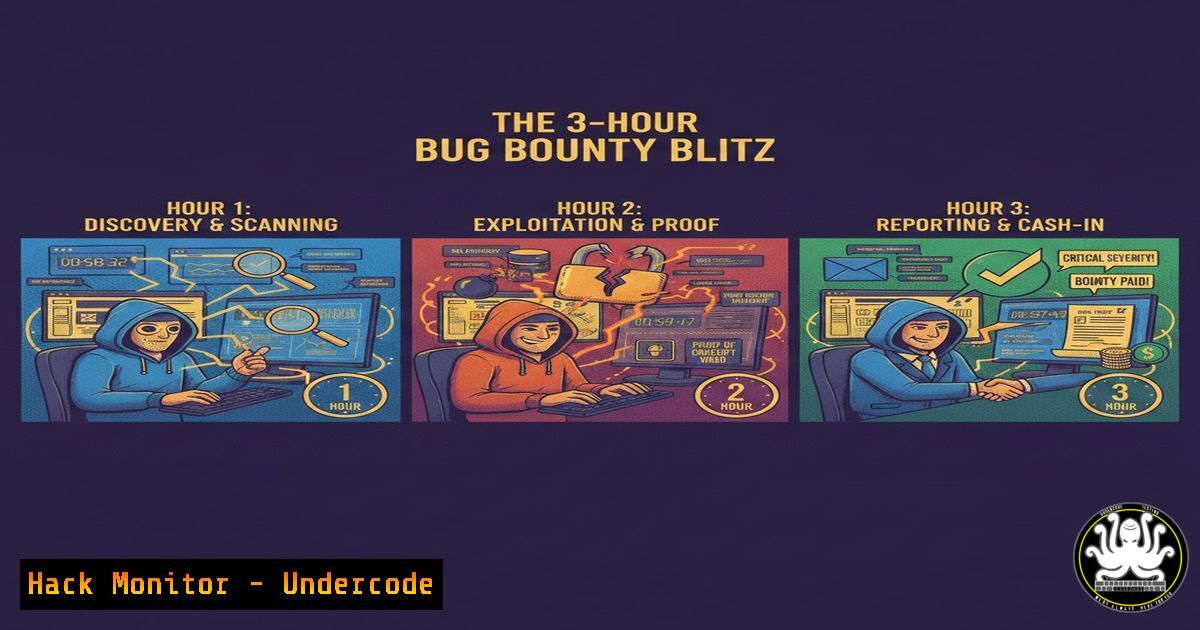
In the competitive world of bug bounty hunting, speed and methodology are everything. A recent showcase by a security researcher, who triggered and resolved a critical report in mere hours, underscores the elite operational tempo achieved by combining automated reconnaissance with deep manual testing. This article deconstructs the layered approach—from initial asset discovery to proof-of-concept creation and professional reporting—that turns a routine scan into a validated payout.
Learning Objectives:
- Master a hybrid reconnaissance strategy using both passive OSINT and active scanning tools.
- Understand how to triage results and manually test for common high-impact web vulnerabilities.
- Learn the structure and components of a compelling, action-ready bug bounty report that speeds up triage and resolution.
You Should Know:
- The Reconnaissance Engine: Mapping the Attack Surface in Minutes
The first hour of a successful hunt is dominated by systematic reconnaissance. Top hunters cast a wide net to identify all associated subdomains, services, and technologies before narrowing their focus.
Step-by-Step Guide:
- Passive Enumeration: Use tools like `amass` and `subfinder` to gather subdomains without directly touching the target.
amass enum -passive -d target.com -o passive_subs.txt
subfinder -d target.com -o subfinder_subs.txt
sort -u passive_subs.txt subfinder_subs.txt > all_subs.txt
- Active Probing & Resolution: Use `httpx` and `nmap` to filter live hosts and identify running services.
cat all_subs.txt | httpx -silent -ports 80,443,8080,8443 -o live_hosts.txt
nmap -sV --top-ports 1000 -iL live_hosts.txt -oA nmap_scan
- Technology Fingerprinting: Use `wappalyzer` (via CLI or browser extension) on each live host to identify frameworks (React, Angular), servers (Nginx, Apache), and components (jQuery, WordPress). This primes you for technology-specific exploits.
2. Automated Vulnerability Scanning: The First Filter
While noisy, automated scanners are excellent for initial triage, quickly flagging low-hanging fruit like exposed admin panels, default credentials, or outdated software versions.
Step-by-Step Guide:
- Run a targeted `nuclei` scan using templates for common CVEs and misconfigurations.
nuclei -l live_hosts.txt -t ~/nuclei-templates/http/cves/ -t ~/nuclei-templates/http/misconfiguration/ -o nuclei_findings.txt
- Manually verify every finding. False positives waste time. A scanner might flag a `/admin` endpoint; your job is to visit it, see if it’s accessible, and test for authentication bypass.
-
Manual Testing & Business Logic Flaws: Where the Real Money Lies
Automated tools miss complex business logic vulnerabilities. This phase involves interacting with the application as a user and an attacker.
Step-by-Step Guide:
- Parameter Tampering: Use Burp Suite or OWASP ZAP to intercept requests. Test every parameter (e.g.,
user_id=123,amount=100) by changing values to another user’s ID or a negative amount. - Authorization Testing: If you have two test accounts (e.g., `user` and
premium_user), log in as the lower-privileged user, capture a function call (likePOST /api/upgrade), and attempt to replay it using the higher-privileged user’s session token. - Stateful Sequence Breaking: For flows like “Add Item -> Enter Address -> Confirm Purchase,” try skipping directly to the “Confirm Purchase” step with a manipulated total price parameter.
4. Crafting the Weaponized Proof-of-Concept (PoC)
A valid bug report requires a reproducible, harmless PoC. For a critical IDOR (Insecure Direct Object Reference) flaw, this means constructing a standalone script or curl command.
Step-by-Step Guide (Example IDOR):
1. Identify the vulnerable endpoint: `GET /api/v1/user/orders/123`.
- Craft a PoC using `curl` that demonstrates accessing another user’s data by changing the order ID.
PoC for IDOR vulnerability
curl -H "Authorization: Bearer YOUR_VALID_TOKEN_HERE" https://target.com/api/v1/user/orders/124
Returns order details for order 124, which belongs to a different user.
- Ensure your PoC clearly shows the unauthorized access by annotating which ID belongs to which user.
5. The Professional Report: Fast-Tracking Triage and Payout
A clear, concise, and comprehensive report is what transforms a finding into a resolved bounty. It must enable the security team to understand, reproduce, and prioritize the issue immediately.
Step-by-Step Guide:
- Clear and specific. “IDOR in `/api/v1/user/orders/{id}` Allows Unauthenticated Access to Any User’s Order Details.”
2. Summary: One-paragraph overview of the impact.
- Steps to Reproduce: Numbered, detailed list. Include every click, input, and observed output. Embed your PoC commands here.
- Impact Assessment: Explain the worst-case scenario (e.g., “Full account takeover leading to PII exposure and financial fraud”).
- Remediation Recommendation: Suggest a fix (e.g., “Implement proper authorization checks using the session context, not user-supplied object IDs.”).
6. Post-Report Hygiene: Avoiding Burnout and Scaling Up
After submission, successful hunters don’t idle. They document their findings, update their tools, and prepare for the next target.
Step-by-Step Guide:
- Log Keeping: Use a structured notes system (like Obsidian or a simple markdown file) to record the target, tools run, vulnerabilities found, and report ID. This prevents duplicate work.
- Tool Updates: Update your core toolset daily to catch new CVEs.
nuclei -update-templates
sudo apt update && sudo apt upgrade -y
- Skill Sharpening: Dedicate time to studying new vulnerability classes (e.g., Server-Side Request Forgery – SSRF, GraphQL injections) through platforms like PortSwigger’s Web Security Academy.
What Undercode Say:
- Methodology Over Luck: The “few-hour” resolution is not serendipity; it’s the result of a drilled, repeatable process that efficiently moves from broad recon to targeted exploitation. The hunter’s consistency, as highlighted, is a systematized workflow.
- The Human-AI Symbiosis: While AI-powered scanners (like LinkedIn’s mentioned analysis of video ads) are advancing, this case highlights the irreplaceable role of the human hunter in interpreting context, chaining flaws, and exploiting nuanced business logic—areas where AI still falls short.
Prediction:
The bug bounty ecosystem will accelerate towards an “intelligent augmentation” model. We predict the near-future integration of AI co-pilots that do more than just scan; they will learn from a hunter’s methodology, automatically prioritize assets based on historical yield, and even draft preliminary reports from validated findings. However, this will raise the barrier for entry-level hunters while amplifying the output of top performers, creating a starker divide. Platforms will increasingly favor hunters who can partner with these AI tools to conduct hyper-efficient, multi-faceted audits, turning the “few-hour blitz” from an exception into the expected standard for critical flaw discovery.
▶️ Related Video (74% Match):
🎯Let’s Practice For Free:
IT/Security Reporter URL:
Reported By: Piyush Vishwakarma – Hackers Feeds
Extra Hub: Undercode MoN
Basic Verification: Pass ✅


