
Listen to this Post
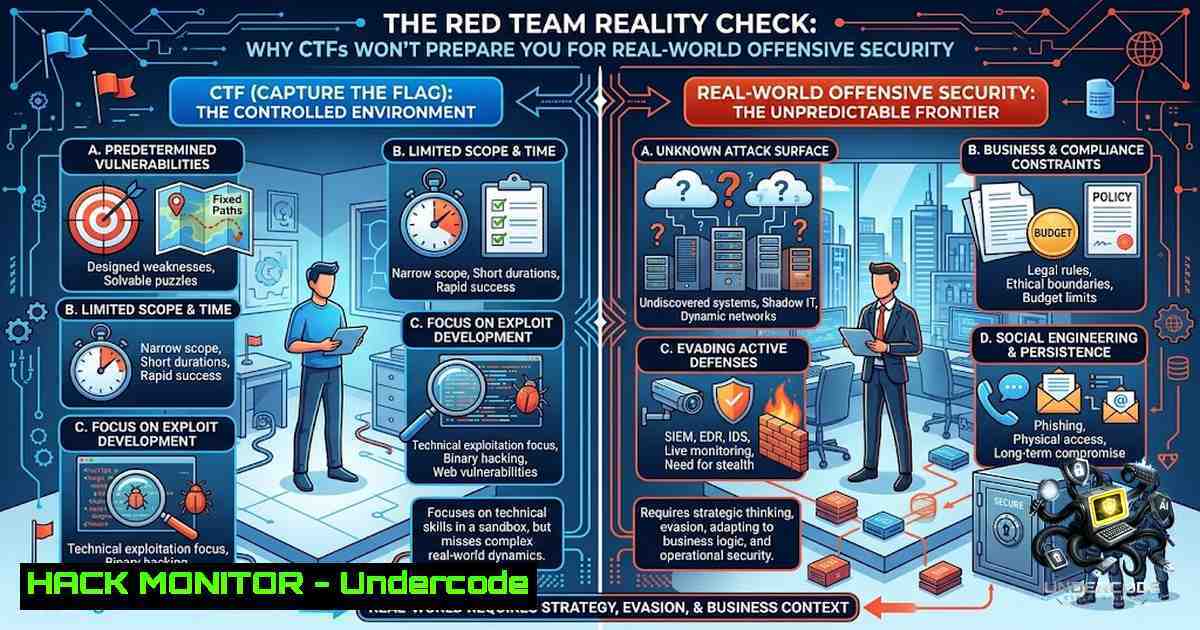
Introduction:
The cybersecurity industry is witnessing a surge of professionals transitioning into offensive security, often driven by the gamified appeal of Capture The Flag (CTF) challenges and platform like Hack The Box. However, a critical disconnect exists between the isolated, flag-centric environment of these platforms and the ambiguous, high-stakes reality of professional Red Team engagements. While CTFs are excellent for developing technical familiarity, they fundamentally fail to cultivate the analytical rigor, business acumen, and systemic understanding required to operate effectively within a corporate network under the watchful eye of a Blue Team.
Learning Objectives & Secrets:
- Objective 1: Shift from Tool-Execution to Process-Understanding. The goal is not to run an exploit but to comprehend the underlying vulnerability, the protocol it abuses, and the system’s failure to enforce security controls.
- Objective 2 (Secret Tip): Master the “Manual Enumerators” Mindset. Avoid relying on automated scanners initially. Learn to query a Windows domain controller using `nltest` or enumerate SMB shares with `net view` and `smbclient` to understand the data flow before using tools like BloodHound. This builds a mental map of the network.
- Objective 3 (Secret Tip): Prioritize Reporting and Remediation. The most technically complex exploit is worthless if you cannot articulate the business impact. Practice writing executive summaries that translate technical findings into risk-based language, explaining the “so what” of a compromised Domain Admin account.
You Should Know:
1. Mastering the Fundamentals: Network, OS, and Scripting
Before touching a single exploit, the professional Red Teamer must possess an intimate knowledge of how networks and operating systems function. This is the foundation that allows an operator to “enumerate without firing blindly.”
- Step 1: Network Analysis: Understand the OSI model, specifically Layers 3 (Network), 4 (Transport), and 7 (Application). Learn to read and manipulate routing tables.
- Command (Linux): `ip route show` to visualize the network topology and identify potential pivot points.
- Command (Windows): `route PRINT` to achieve the same on a Windows target.
- Step 2: Process & Service Enumeration: Learn to identify running processes and their associated network connections to spot misconfigurations or vulnerable services.
- Command (Linux): `ss -tulpn` to list all listening and established sockets with process IDs.
- Command (Windows): `netstat -ano` to achieve the same and `tasklist /svc` to match process IDs to services.
- Step 3: Scripting for Automation: Learn Python or PowerShell to automate basic enumeration tasks. For example, writing a Python script to parse `nmap` XML output to automatically check for common default credentials in a large subnet.
2. Web Application Reconnaissance: The Attack Surface
HTTP is the primary communication protocol for modern enterprise applications. Professionals do not run a scanner and wait for results; they actively inspect the application’s logic.
- Step 1: Manual Parameter Discovery: Use Burp Suite or OWASP ZAP, but focus on the Repeater and Intruder functionalities. Understand the request/response cycle.
- Step 2: Analyzing Headers: Look for misconfigured CORS, HSTS, or missing X-Frame-Options headers.
- Command (Linux): Use `curl -I https://target.com` to quickly inspect response headers from the terminal.
- Step 3: API Security Checks: Test for IDOR (Insecure Direct Object References) by modifying a user ID in a GET request from `user_id=1001` to
user_id=1002. - Mitigation: Ensure proper session management and access control checks on the server-side, never relying on client-side obfuscation.
3. Active Directory: The Heart of the Enterprise
Active Directory (AD) is the primary target for any Red Team. Understanding its authentication protocols (Kerberos, NTLM) is non-1egotiable.
- Step 1: Initial Enumeration: Use `BloodHound` to map the AD environment. Run the SharpHound collector on a Windows workstation.
- Step 2: Abusing Kerberos: Identify users with Kerberos pre-authentication disabled. A successful AS-REP Roasting attack can yield crackable password hashes.
- Command (Linux): `impacket-GetNPUsers -dc-ip
/ -usersfile users.txt` to request TGTs for users without pre-auth. - Step 3: Lateral Movement: Once a foothold is established, use techniques like Pass-the-Hash (PtH).
- Command (Linux): `impacket-psexec -hashes
: / @ ` to execute commands remotely.
4. Post-Exploitation and Pivoting
This is where the real work begins. Achieving SYSTEM or root access is the initiation of the adversary simulation.
- Step 1: Establishing Persistence: Create a scheduled task or service that calls back to a C2 server.
- Command (Windows): `schtasks /create /tn “UpdateService” /tr “C:\path\to\payload.exe” /sc daily /st 09:00`
– Step 2: Pivoting via SSH Tunneling: Use the compromised Linux host as a jump box to access internal networks. - Command (Linux): `ssh -D 1080 user@compromised-host` to create a SOCKS proxy, allowing tools on your Kali machine to route traffic through the host.
- Step 3: Credential Dumping: Extract hashes from the memory of the Local Security Authority Subsystem Service (LSASS).
- Command (Windows): Use `mimikatz` or the built-in `procdump` to capture `lsass.dmp` and extract secrets offline.
5. Reporting and Communication: The “Less Sexy” Part
The final deliverable is a report, not a shell. A professional report must guide the client from discovery to remediation.
- Step 1: Find Cloning and Documentation: For every action taken, log the exact command and output.
- Step 2: Risk Rating: Assign a severity (Critical, High, Medium, Low) based on the CVSS score or a business-contextual risk matrix.
- Step 3: Remediation Steps: Provide clear, actionable steps. For example, instead of “patch the server,” state “Apply Microsoft Security Update KB5012345 to mitigate CVE-2023-1234 on all domain controllers.”
6. OPSEC and Evading Detection
Understanding the Blue Team’s tools is crucial. A professional operates with “low and slow” tactics.
- Step 1: Avoiding Default Tools: Prefer living-off-the-land binaries (LOLBins) like `powershell.exe` or `wmic` over uploading custom malware.
- Step 2: Log Obfuscation: Be aware of what events are logged (Event ID 4624 for logons, 4688 for process creation) and craft commands that are less suspicious.
What Undercode Say:
- Key Takeaway 1: The path to professional Red Team is horizontal, not vertical. Breadth of knowledge in networking, OS internals, and scripting is more important than depth in a single exploit tool.
- Key Takeaway 2: The true differentiator in the job market is the ability to report. A candidate who can clearly articulate the risk, impact, and remediation path is infinitely more valuable than one who can merely “get the flag.”
The industry’s obsession with CTF scores fosters a “CTF player” mentality, which is often misaligned with the consultative, risk-averse nature of corporate security. The transition from a CTF environment to a professional one requires a paradigm shift: from “I have to root this machine” to “I have to demonstrate how a threat actor could cause a $1M data breach and why the current controls failed.”
Prediction:
- +1 The demand for Red Teamers who possess strong soft skills and network fundamentals will increase, leading to higher salaries and better job security compared to purely technical operators.
- -1 The current “CTF culture” is diluting the talent pool with candidates who lack foundational knowledge, leading to a hiring paradox where organizations struggle to find “battle-ready” operators.
- +1 A “New School” of training emerges, focusing on AD logic, reporting, and “blue-purple” team collaboration, driven by the realization that attack simulation is a business service, not a game.
- -1 Many CTF-centric bootcamps may fail to adapt quickly enough, producing graduates who are unable to pass professional-level interviews and ultimately abandoning the field.
- +1 Companies will begin to recognize the criticality of these roles, integrating Red Team findings directly into CI/CD pipelines, thereby elevating the profession’s importance.
- -1 There will be a continued rise in “unbreachable” systems confidently claimed by CTF holders, only to be breached by advanced persistent threats (APTs) using simple, overlooked misconfigurations.
- +1 The emphasis on manual verification will lead to the development of new, more intelligent semi-automated tools that assist analysts in the reporting process.
- -1 The “Red Team Roadmap” and similar resources might become commoditized, leading to a superficial adherence to the checklist without internalizing the principles.
- +1 A new generation of cybersecurity leaders emerges, prioritizing “security mindset” over technical shortcut proficiency.
- -1 The gap between the “CTF Player” and “Red Team Professional” could widen, potentially creating a two-tiered system in the offensive security job market.
▶️ Related Video (80% Match):
🎯Let’s Practice For Free:
🎓 Live Courses & Certifications:
Join Undercode Academy for Verified Certifications
🚀 Request a Custom Project:
Secure, high-velocity infrastructure and disruptive technological engineering. Contact our engineering team for high-tier development and proprietary systems:
[email protected]
💎 Smart Architecture | 🛡️ Secure by Design | ⭐ Trusted by Thousands
IT/Security Reporter URL:
Reported By: https://lnkd.in/p/ewpEEgx5 – Hackers Feeds
Extra Hub: Undercode MoN
Basic Verification: Pass ✅


