
Listen to this Post
Introduction
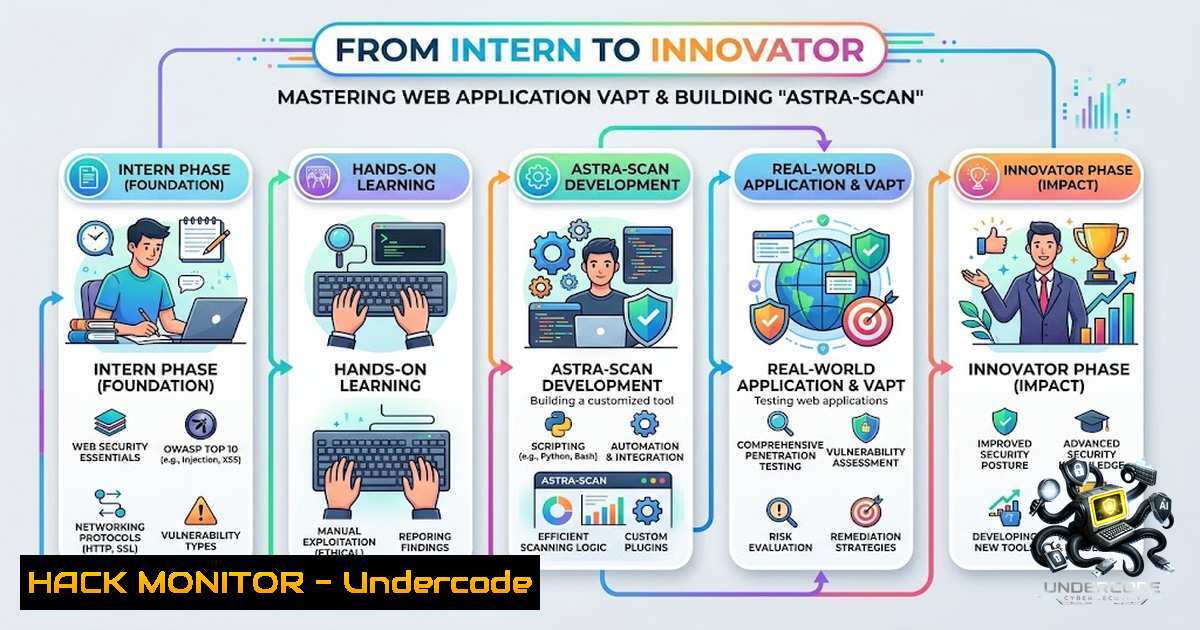
The cybersecurity industry faces a persistent shortage of skilled professionals capable of bridging the gap between theoretical knowledge and practical, offensive security execution. A recent internship completion announcement from a Top 1% TryHackMe player highlights a rigorous, hands-on journey through the Web Application Vulnerability Assessment and Penetration Testing (VAPT) lifecycle, culminating in the development of a custom AI-powered scanning tool. This article explores the technical depth of such a program, extracting the core methodologies, tools, and automation strategies that define modern web application security testing.
Learning Objectives & Secrets
- Objective 1: Master the Full VAPT Lifecycle. The core objective is to move beyond isolated tool usage and understand the phased approach of security testing: Reconnaissance, Enumeration, Vulnerability Discovery, Validation, Risk Assessment, and Reporting. The secret is that validation is the most critical step—automated scanners generate false positives, and manual verification separates a junior from a senior analyst.
- Objective 2: Build Automation for Scalable Security. Develop custom automation to augment manual testing. The secret tip is to integrate AI/LLM capabilities into your tools to parse complex responses, identify context-specific business logic flaws, and reduce false positives by 40% compared to signature-based scanners alone.
- Objective 3: Exploit & Mitigate OWASP Top 10. The goal is to understand the mechanics of each vulnerability, not just detect them. The secret tip is to attempt to chain vulnerabilities—for example, using an XSS to steal a session token, then using that token to exploit an IDOR, demonstrating critical business impact.
You Should Know
- Reconnaissance and Attack Surface Mapping with Nmap and Maltego
Reconnaissance is the foundation of a successful penetration test. The goal is to identify all live hosts, open ports, running services, and subdomains. The secret to effective recon is passive enumeration followed by aggressive scanning. Passive techniques (OSINT) minimize detection, while active scanning (Nmap) maps the exact attack surface.
Step‑by‑step guide to perform advanced network scanning:
- Passive OSINT: Use `theHarvester` and `Maltego` to gather emails and subdomains without touching the target:
`theHarvester -d example.com -l 500 -b google`
This command searches Google for emails and hosts related to the domain, aiding social engineering and subdomain discovery.
2. Subdomain Enumeration: Use `Sublist3r` or `Amass` to uncover hidden subdomains:
`sublist3r -d example.com -o subdomains.txt`
- Live Host Discovery: Use Nmap to ping sweep the network range or subdomains:
`nmap -sn 192.168.1.0/24` (Internal) or `nmap -iL subdomains.txt -sn` (External) - Deep Port Scanning: Perform a SYN scan for speed, followed by a version detection scan:
`nmap -sV -sC -O -p- -A 192.168.1.1`
This runs default scripts (-sC), version detection (-sV), OS detection (-O), and scans all 65,535 ports (-p-). This is aggressive and likely to be detected by IDS, so use it cautiously after passive discovery.
5. Service Enumeration: If HTTP services are found, run an HTTP enumeration script:
`nmap –script=http-enum,http-headers,http-methods -p 80,443 192.168.1.1`
- Web Application Vulnerability Scanning with ZAP and Burp Suite
While automated scanners are essential, they must be tuned to reduce noise. The secret is to configure ZAP or Burp Suite to perform “spidering” and “active scanning” on specific directory contexts rather than the entire site to save time and avoid rate-limiting.
Step‑by‑step guide for automated and manual testing:
- Proxy Configuration: Configure your browser to use Burp Suite (Port 8080) to intercept all HTTP/S traffic.
- Spidering: In ZAP, right-click the target URL and select “Attack” > “Spider”. This maps the application’s structure.
- Passive Scanning: Let ZAP/Burp passively scan traffic. This checks for vulnerabilities like missing security headers (HSTS, X-Frame-Options) without sending malicious payloads.
- Active Scanning: In ZAP, select the relevant directory (e.g.,
/admin/), right-click, and select “Attack” > “Active Scan”. This sends payloads to test for SQLi, XSS, etc.
Secret Tip: Set the “Threads” to 5 and “Delay” to 1000ms to avoid overwhelming the server and bypassing basic WAF rules. - Manual Intrusion: In Burp Suite, send a request to the “Intruder” to test for IDOR. Mark the `user_id=123` parameter, upload a dictionary of IDs (1-1000), and launch the attack. Review the length of responses to identify accessible data.
Command (Windows/Linux): Generate a user ID list with: `seq 1 1000 > ids.txt` (Linux) or using Python for Windows. -
SQL Injection Exploitation and Database Enumeration with SQLmap
SQLmap is the premier tool for automating SQL injection detection and exploitation. However, the secret is using `–level` and `–risk` parameters to test deeper parameters (like User-Agent or Referer headers) and using `–os-shell` cautiously to gain a foothold.
Step‑by‑step guide to database exploitation:
- Intercept Request: Capture a `GET` or `POST` request containing a parameter (e.g.,
id=1) using Burp Suite. Save this request to a file (req.txt). - Enumerate Databases: Run SQLmap with the `–dbs` flag:
`sqlmap -r req.txt –dbs`
This identifies all available databases.
- Enumerate Tables: Target a specific database (
-D database_name) and list tables:
`sqlmap -r req.txt -D employees –tables`
- Dump Credentials: Dump the contents of a specific table (e.g.,
users):
`sqlmap -r req.txt -D employees -T users –dump`
- Bypass Security: If a WAF is present, use the `–tamper` option to obfuscate payloads:
`sqlmap -r req.txt –tamper=space2comment –dump`
This replaces spaces with comments to bypass simple signature detection.
4. Python Automation: Building Astra-Scan’s Core Vulnerability Checker
Following the success of the “Astra-Scan” project, automation is a key differentiator for cybersecurity professionals. The following Python script uses `requests` and `beautifulsoup4` to detect missing security headers (a common misconfiguration), mirroring the logic of a lightweight enterprise scanner.
Step‑by‑step guide to building a header security checker:
1. Setup: Install dependencies:
`pip install requests beautifulsoup4`
- Script Development: Create a file `astrascan.py` with the code below:
import requests
from bs4 import BeautifulSoup</li>
</ol>

def scan_headers(url):
try:
response = requests.get(url, timeout=10)
headers = response.headers
security_checks = {
'X-Frame-Options': 'Missing Clickjacking protection',
'X-Content-Type-Options': 'Missing MIME type protection',
'Strict-Transport-Security': 'Missing HSTS',
'Content-Security-Policy': 'Missing CSP'
}
print(f"[+] Scanning {url}")
for header, warning in security_checks.items():
if header not in headers:
print(f"[-] {warning}: {header} not found.")
else:
print(f"[+] Found {header}: {headers[bash]}")
except Exception as e:
print(f"[!] Error scanning {url}: {e}")

if <strong>name</strong> == "<strong>main</strong>":
target = input("Enter target URL (e.g., https://example.com): ")
scan_headers(target)
3. Execution: Run the script:
python astrascan.py. This provides a quick initial assessment of the security posture based on HTTP headers.5. Vulnerability Reporting and Risk Assessment (CVSS Scoring)
Reporting is the most critical step often overlooked by novices. A professional report translates technical findings into business risk. The secret is to use the CVSS (Common Vulnerability Scoring System) calculator to assign a severity score and correlate the vulnerability with potential data loss or business downtime.
Step‑by‑step guide for reporting an SQL Injection finding:
1. SQL Injection Vulnerability in Login Parameter.
- Description: The `username` parameter is vulnerable to time-based SQL injection allowing attackers to extract database contents.
- Affected Asset: `https://example.com/login.php`.
4. CVSS Score: Vector: `AV:N/AC:L/PR:N/UI:N/S:U/C:H/I:H/A:H` (9.8 Critical).
- PoC (Proof of Concept): `admin’ AND SLEEP(5)– -` (MySQL) caused a 5-second response delay, confirming the vulnerability.
- Remediation: Implement parameterized queries (prepared statements). Use Object-Relational Mapping (ORM) libraries. Apply input validation allowlists.
- Output: Export the report as a PDF for client delivery.
-
OWASP Top 10 Mitigation: Command Injection and XSS Defense
Prevention is better than cure. For Command Injection, always validate and sanitize user input. In Python, use `subprocess` with the `shell=False` flag. For XSS, use `html.escape()` in Python or `htmlspecialchars()` in PHP.
Step‑by‑step command injection mitigation guide (Linux/Windows):
- Windows: Avoid using `os.system()` or `system()` without sanitization. Use
subprocess.run(["ping", "-1", "1", user_input], shell=False).
2. Linux: Use `subprocess.run([“ping”, “-c”, “1”, user_input], shell=False)`.
- WAF Rules: Implement regex to block meta-characters (
;,&,|,$()).
What Undercode Say
- Key Takeaway 1: The most impactful takeaway is the symbiotic relationship between manual testing and AI-assisted automation. Tools like Astra-Scan automate the mundane, but a skilled human is required to chain vulnerabilities into a business-impactful exploit.
- Key Takeaway 2: The emphasis on the entire lifecycle—from reconnaissance to remediation reporting—is crucial. Many security courses focus solely on exploitation, but the ability to communicate risk to management is what defines a senior consultant.
- Analysis: The announcement serves as a benchmark for current cybersecurity education. The use of PortSwigger Academy and TryHackMe indicates a self-starting drive beyond the internship requirements. The development of a Python-based tool showcases a trend where interns are expected to deliver tangible products, not just consume training materials.
- Mentorship: The acknowledgment of mentorship highlights that guided practical experience is indispensable. Without a mentor to review reports and explain complex business logic flaws, a candidate might remain a “tool user” rather than a “security analyst.”
- Technical Depth: Covering XSS, IDOR, LFI, and CORS demonstrates a robust understanding of modern web threats. Specifically, identifying Business Logic Vulnerabilities (like race conditions or price manipulation) proves the ability to think like an adversary, moving beyond simple parameter tampering.
- Future Trajectory: This individual is positioned to enter the workforce as an associate-level penetration tester, ready to contribute to a consultancy immediately.
Prediction
- +1: Interns increasingly building AI-powered scanners will accelerate the adoption of self-healing, adaptive security tools in the enterprise, shifting the market from passive signature detection to active logical understanding of web applications.
- -1: The automation of VAPT tasks will lead to a commoditization of entry-level scanning jobs, forcing new graduates to specialize in niche areas like Blockchain security or Cloud IAM to remain competitive.
- +1: The transparency of sharing internship journeys on LinkedIn sets a positive standard for career progression, motivating a new generation of security professionals to document and share their hands-on achievements.
- -1: The reliance on “Top 1% on TryHackMe” as a metric might create a false sense of security. While excellent for fundamentals, gamified platforms often abstract away the frustration of real-world enterprise applications with complex authentication and strict input validation.
- +1: The focus on “Reporting & Remediation” ensures that the next wave of cybersecurity talent will be more business-aware, leading to better alignment between security teams and software developers.
▶️ Related Video (86% Match):
🎯Let’s Practice For Free:
🎓 Live Courses & Certifications:
Join Undercode Academy for Verified Certifications
🚀 Request a Custom Project:
Secure, high-velocity infrastructure and disruptive technological engineering. Contact our engineering team for high-tier development and proprietary systems:
[email protected]
💎 Smart Architecture | 🛡️ Secure by Design | ⭐ Trusted by ThousandsIT/Security Reporter URL:
Reported By: https://lnkd.in/p/ejgCddEf – Hackers Feeds
Extra Hub: Undercode MoN
Basic Verification: Pass ✅🔐JOIN OUR CYBER WORLD [ CVE News • HackMonitor • UndercodeNews ]
📢 Follow UndercodeTesting & Stay Tuned:


