
Listen to this Post
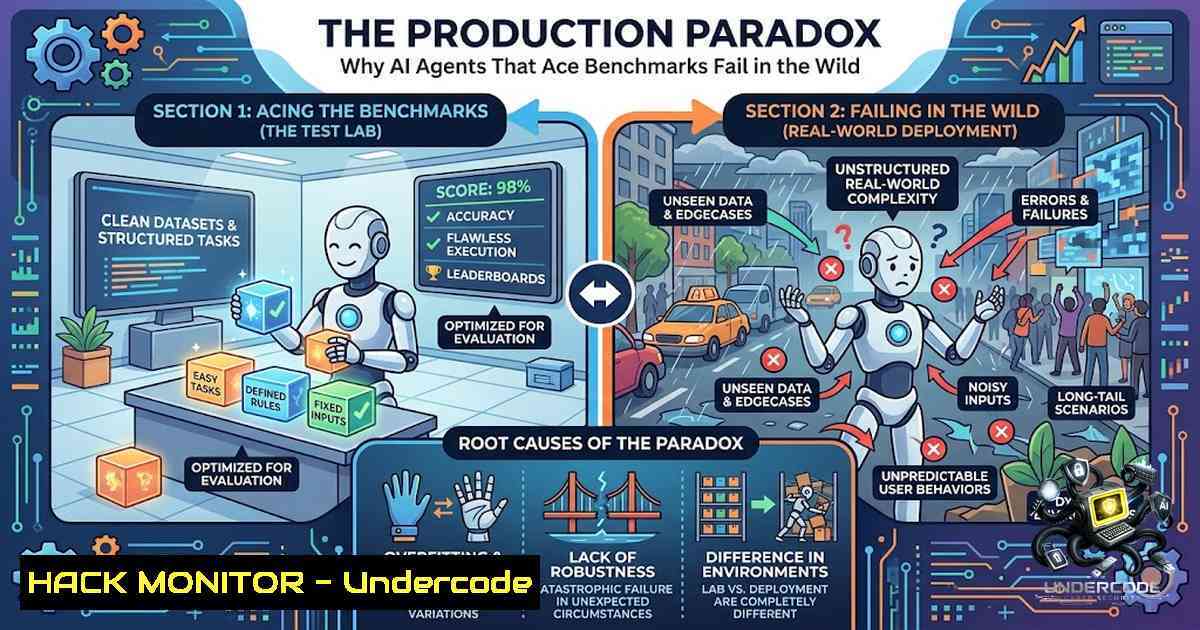
Introduction:
The cybersecurity and AI communities are increasingly observing a dangerous disconnect between controlled testing environments and real-world operational resilience. While an AI agent might achieve a 90% success rate on static leaderboards, these metrics are fundamentally flawed when applied to production systems, where dynamic data, unreliable APIs, and unpredictable user behavior create a chaos that benchmarks fail to simulate. In the context of IT and cybersecurity, this evaluation gap represents a critical vulnerability, as a “smart” but brittle agent can introduce severe financial and data integrity risks through improper error handling and goal drift.
Learning Objectives & Secrets:
- Objective 1: Master the implementation of Shadow Mode to validate agent behavior against live production traffic without executing destructive actions.
- Objective 2 (Secret Tip): Develop a comprehensive Failure Case Test Suite that simulates API timeouts, null returns, and malformed JSON to stress-test agent logic.
- Objective 3 (Secret Tip): Enforce strict Output Validation Contracts using schema validation tools like Pydantic to sanitize all data passing between the LLM and external tools.
You Should Know:
1. Building a Production-Ready Resilience Layer
The core failure of production agents lies in their inability to handle non-deterministic outputs. To combat this, engineers must move beyond simple API calls and implement a resilience wrapper. This involves intercepting every tool call, validating the response structure, and implementing retry logic with exponential backoff.
Step‑by‑step guide:
- Step 1: Implement a retry decorator in Python. Use the `tenacity` library to manage retries for transient API errors.
from tenacity import retry, stop_after_attempt, wait_exponential
import requests</li>
</ul>

@retry(stop=stop_after_attempt(3), wait=wait_exponential(multiplier=1, min=2, max=10))
def call_external_api(url, headers):
response = requests.get(url, headers=headers, timeout=5)
response.raise_for_status()  Raises HTTPError for 4xx/5xx
return response.json()
– Step 2: Validate the JSON schema using Pydantic. Never pass raw text back to the LLM.
from pydantic import BaseModel, ValidationError

class ApiResponseSchema(BaseModel):
status: str
data: dict

try:
validated_data = ApiResponseSchema(raw_json)
except ValidationError as e:
 Log error and prompt LLM for clarification instead of failing silently
logger.error(f"Schema mismatch: {e}")
return {"error": "Invalid data structure received"}
– Step 3: Implement a circuit breaker. If a tool consistently fails, temporarily halt requests to prevent system overload. For Linux systems, monitor service health using `systemctl status service_name` and restart failed services automatically.
2. Mitigating “Goal Drift” and Unauthorized Actions
In cybersecurity, “goal drift” often manifests as a model prioritizing user satisfaction over security protocols, potentially leading to privilege escalation or unauthorized refunds. To prevent this, implement a strict policy layer that sits between the agent’s decision and the execution of the action.
Step‑by‑step guide for implementing a policy enforcement point (PEP):
– Step 1: Define a permissions matrix. Create a configuration file (e.g., YAML) that defines which actions require manual approval.policies: - action: "refund_user" requires_approval: true max_amount: 100 - action: "delete_record" requires_approval: true allowed_roles: ["admin"]
– Step 2: In the agent’s execution loop, add a middleware that intercepts the tool call before execution. Use Python to parse the agent’s intent.
– Step 3: Log all decisions and compare them against a baseline. For Windows environments, you can monitor agent logs using PowerShell’s `Get-WinEvent` to track anomalous actions. If an agent attempts a policy violation, halt execution and flag for security review.3. Tool Failure Validation and API Security
Benchmarks use perfect mocking; production uses HTTP 500 errors and expired tokens. Implementing robust validation prevents the LLM from hallucinating when tools return errors.
Command and Configuration Guide:
- Linux (Curl testing): Before deploying your agent, test API endpoints for failure modes.
curl -X GET "https://api.example.com/data" -H "Authorization: Bearer $TOKEN" -w "%{http_code}" -o /dev/null -s - Windows (PowerShell): For Windows-based deployments, use `Test-1etConnection` and custom scripts to validate connectivity.
- Agent Logic: Wrap all tool calls in try/except blocks. If a tool returns a 401 (Unauthorized), trigger a token refresh flow automatically rather than letting the agent guess a fix.
if response.status_code == 401:
refresh_token()
return call_external_api(url, headers)  Retry with new token
4. Implementing Defensive Engineering with Strict Contracts
A “defensive” agent treats all external data as hostile. This requires strict input sanitization and output constraints.
Step‑by‑step guide for securing the LLM pipeline:
- Step 1: Use Pydantic to define the exact JSON structure the agent must output before it calls a tool.
- Step 2: In a Kubernetes or cloud environment, configure a sidecar proxy to validate requests. For example, using NGINX to reject malformed JSON payloads.
location /api/agent { if ($request_body ~ "null") { return 400; Reject requests with null values if unexpected } proxy_pass http://agent-service; } - Step 3: Integrate logging to a SIEM (Security Information and Event Management) system to monitor JSON parsing errors, which could indicate an attack or a failing agent.
5. Shadow Mode vs. Active Mode Evaluation
Shadow mode is the safest way to evaluate an agent’s behavior in production. It involves replicating production traffic to the agent while the existing system handles the real transactions.
Step‑by‑step guide to running shadow mode:
- Step 1: Create a Kafka or RabbitMQ queue that duplicates incoming user requests.
- Step 2: Send a copy of the traffic to your new agent while the primary legacy system processes the actual transaction.
- Step 3: Compare the agent’s decisions against the legacy system’s actions.
Python script to compare logs import json with open('legacy_log.json') as f1, open('agent_log.json') as f2: legacy = json.load(f1) agent = json.load(f2) if legacy['action'] != agent['action']: print("Mismatch detected, flagging for human review") - Step 4: Monitor resource usage on Linux using `htop` and `vmstat` to ensure the shadow agent doesn’t degrade production performance.
What Undercode Say:
- Key Takeaway 1: Benchmarks are designed to measure intelligence, not reliability. In cybersecurity, a failure to handle a malformed API response can be as dangerous as a zero-day exploit, as it opens the door to logical vulnerabilities and business logic abuse.
- Key Takeaway 2: Human-in-the-loop is not just a compliance checkbox; it is a critical fallback mechanism. For actions that modify data, requiring manual approval acts as the ultimate firewall against “goal drift,” where an agent misunderstands the context and performs irreversible actions.
- Analysis: The core issue is the “Contextual Gap.” LLMs trained on clean internet text do not understand the entropy of enterprise systems. Defensive engineering, often used in traditional software, must be adapted for AI. This means applying principles of Chaos Engineering—specifically, injecting failures during testing to ensure the agent degrades gracefully. The future of MLOps will likely involve “Resilience Score” metrics alongside standard accuracy metrics. Furthermore, these agents must be integrated with Identity and Access Management (IAM) systems to enforce zero-trust principles, ensuring that even if the agent goes rogue, its permissions are restricted.
Expected Output:
Introduction:
[2–3 sentence cybersecurity‑angle introduction]
The allure of high-performing AI agents on static leaderboards often masks a catastrophic vulnerability: their inability to cope with the stochastic nature of live production environments. For security professionals, this brittleness is a primary attack surface, as erroneous agent decisions due to API errors or “goal drift” can bypass critical access controls and lead to unauthorized system modifications or data leaks. Defensive engineering, utilizing strict data validation and human-in-the-loop protocols, is now essential to bridge the gap between benchmark intelligence and production security.
What Undercode Say:
- Key Takeaway 1: Treat every API response as potentially corrupted. Implement strict schema validation to prevent injection attacks or logic errors caused by malformed data.
- Key Takeaway 2: Shadow mode is the only safe way to measure real-world performance without causing financial or operational damage.
Prediction:
- +1 The industry will shift focus from “Model Accuracy” to “Operational Resilience,” leading to new certification standards for AI agents in highly regulated sectors like finance and healthcare.
- -1 Without a radical shift toward robust error handling, the number of high-profile AI “meltdowns” involving unauthorized transactions or data deletions will increase, eroding trust in autonomous systems.
- +1 Open-source tooling for failure testing, such as agent-specific chaos monkeys, will become the norm in CI/CD pipelines for AI deployments.
- -1 The complexity of enforcing strict contracts via Pydantic or similar tools will be overlooked by many startups, leading to a wave of security breaches where agents are tricked into performing malicious actions via prompt injection alongside API errors.
- +1 Integration of LLM agents with existing SIEM and SOAR platforms will mature, allowing security teams to treat agent logs as critical security telemetry.
▶️ Related Video (82% Match):
🎯Let’s Practice For Free:
🎓 Live Courses & Certifications:
Join Undercode Academy for Verified Certifications
🚀 Request a Custom Project:
Secure, high-velocity infrastructure and disruptive technological engineering. Contact our engineering team for high-tier development and proprietary systems:
[email protected]
💎 Smart Architecture | 🛡️ Secure by Design | ⭐ Trusted by ThousandsIT/Security Reporter URL:
Reported By: https://lnkd.in/p/eUyBC7eP – Hackers Feeds
Extra Hub: Undercode MoN
Basic Verification: Pass ✅🔐JOIN OUR CYBER WORLD [ CVE News • HackMonitor • UndercodeNews ]
📢 Follow UndercodeTesting & Stay Tuned:
- Linux (Curl testing): Before deploying your agent, test API endpoints for failure modes.


