
Listen to this Post
Introduction:
A decade after the rise of viral content re-uploaders, one of the internet’s most infamous figures has resurfaced—not as a prankster, but as the alleged mastermind behind an $8 million ad credit fraud and a sprawling e-commerce subscription trap network. The SoFlo Antonio case, now the subject of a major Meta lawsuit and FTC scrutiny, exposes a sophisticated playbook where shell companies, deceptive “dark patterns,” and multi-layered business manager accounts are weaponized to drain millions from unsuspecting consumers. As the Federal Trade Commission (FTC) continues its aggressive crackdown on deceptive negative-option marketing—securing a historic $2.5 billion settlement against Amazon in September 2025—this case serves as a critical warning for digital marketers, platform trust and safety teams, and payment processors alike.
Learning Objectives & Secrets:
- Objective 1: Map the Multi-Layered Shell Company Infrastructure. Understand how fraudsters use dozens of business manager accounts, shell corporations, and virtual office addresses to obscure ownership and bypass platform Know Your Business (KYB) checks.
-
Objective 2 Secret Tip: Detect and Mitigate “Dark Pattern” Subscription Traps. Learn to identify the UX/UI design tactics—such as buried fine print, confusing cancellation flows, and guilt-inducing retention screens—that secretly enroll customers into recurring $49/month subscriptions.
-
Objective 3 Secret Tip: Harden Payment Gateways Against Transaction Laundering. Implement technical controls to flag abnormal merchant behavior, excessive chargeback ratios, and vague billing descriptors that often precede large-scale subscription fraud.
You Should Know:
- The Anatomy of a Dark Pattern Subscription Network
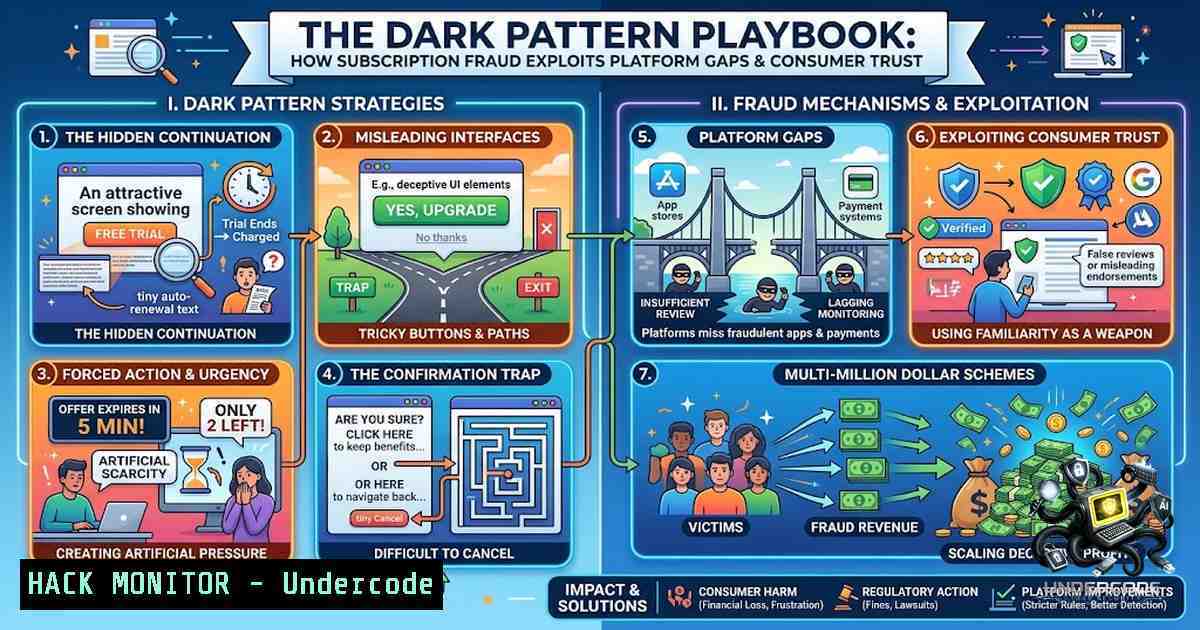
The SoFlo Antonio operation, operating through fronts like Shop at Mars and Dawn or Dusk, employed a classic “loss-leader” strategy. Consumers were lured with low-cost impulse items—such as Bibles or phone cases for under $20—only to be secretly enrolled in recurring $49/month subscriptions hidden in the fine print and made incredibly difficult to cancel. Trustpilot reviews for Shop at Mars echo this pattern, with hundreds of consumers reporting unauthorized charges, unfulfilled orders, and unresponsive customer service.
Step-by-Step Guide to Identify Dark Pattern E-Commerce Fronts:
- Analyze the Checkout Flow: Look for pre-checked boxes, ambiguous language (e.g., “Free shipping with free membership”), or additional offers that are auto-selected.
- Audit the Cancellation Process: As the FTC’s enforcement actions have highlighted, a legitimate subscription must be as easy to cancel as it was to sign up. If cancellation requires navigating multiple menus, making a phone call, or enduring a “retention” flow, it’s a red flag.
- Monitor Billing Descriptors: Fraudulent networks often use vague descriptors like “PMT SERVICES” or “DIGITAL SOLUTIONS” to avoid cardholder suspicion. Encourage consumers to scrutinize their statements for unrecognized charges.
- The Meta Lawsuit and the $8 Million Ad Credit Scheme
Court filings in Meta’s lawsuit against SoFlo Antonio (Antonio Lievano) allege that fraudulent financial records were used to secure an $8 million line of credit for advertising. This credit was then used to flood Meta’s platforms with deceptive e-commerce ads, funneling consumers into the subscription trap network. The case highlights a systemic vulnerability: ad networks often lack the rigorous oversight needed to detect multi-layered shell-company schemes that use synthetic data to bypass basic risk checks.
Step-by-Step Guide to Strengthen Ad Platform KYB Checks:
- Verify Legal Entities: Use KYB (Know Your Business) tools that go beyond registry matches to detect nominee directors, shared addresses, and template websites.
- Monitor Ad Spend Patterns: Flag accounts that rapidly scale ad spend using newly created lines of credit, especially those linked to recently incorporated entities.
- Cross-Reference with Consumer Complaints: Integrate real-time consumer complaint data (e.g., from BBB or Trustpilot) into risk scoring models for merchant accounts.
3. FTC Enforcement and the “Click-to-Cancel” Landscape
The FTC has made clear that subscription services are a core focus of its fraud program. In September 2025, Amazon agreed to pay $2.5 billion to settle allegations that it used dark patterns to enroll consumers into Prime subscriptions and make cancellation difficult. While the Eighth Circuit vacated the FTC’s “Click-to-Cancel” rule on procedural grounds in mid-2025, the agency continues to aggressively enforce the Restore Online Shoppers’ Confidence Act (ROSCA). The Chegg case, which resulted in a $7.5 million settlement, demonstrates that companies must provide a simple cancellation mechanism that is at least as easy to use as the enrollment process.
Step-by-Step Guide for Subscription Compliance:
- Implement “Click-to-Cancel”: Even without a specific rule, ensure that users can cancel subscriptions through the same medium they used to sign up, with no more than one or two clicks.
- Avoid Retention Friction: Do not force users through multi-screen “save” sequences or hide the cancel button.
- Test on Mobile: The FTC has specifically cited mobile UX as a vector for dark patterns. Ensure your mobile cancellation flow is as straightforward as the desktop version.
4. Payment Processor Vulnerabilities and Transaction Laundering
The SoFlo Antonio case underscores how shell companies and transaction laundering enable large-scale subscription fraud. By operating across dozens of business manager accounts and thousands of deceptive ads, the network evaded detection while accumulating massive consumer complaints. Payment processors must fundamentally rethink how they police dark patterns and hidden recurring subscriptions.
Step-by-Step Guide to Detect Transaction Laundering:
- Monitor Chargeback Ratios: Card networks operate chargeback monitoring programs designed to flag merchant accounts with excessive chargeback ratios. Implement automated alerts for merchants exceeding industry thresholds.
- Analyze Transaction Patterns: Look for a mismatch between a merchant’s declared business model and actual payment activity. For example, a site selling low-cost items that generates high volumes of recurring $49 charges is a red flag.
- Track Corporate Entity Rotation: Fraudulent networks often rotate corporate entities every 6-12 months to avoid detection. Monitor for merchants that frequently change their legal name or registered address.
5. Insider Threats and Compliance Complicity
The “Operation Chargeback” case, recently dismantled by Europol, revealed a sophisticated scheme where insiders—including company executives and compliance officers—deliberately provided payment infrastructure access to criminal networks. These insiders modified merchant account risk scoring parameters and disabled fraud detection rules.
Step-by-Step Guide to Mitigate Insider Threats:
- Implement Dual-Control: Ensure that critical changes to fraud detection rules and risk scoring parameters require approval from at least two individuals.
- Audit Access Logs: Regularly review logs for unauthorized modifications to merchant account settings.
- Conduct Background Checks: Perform enhanced due diligence on employees with access to payment infrastructure and fraud detection systems.
6. Linux/Windows Commands for Fraud Investigation
For security analysts and fraud investigators, the following commands can aid in tracing suspicious domains and analyzing network traffic:
- Linux – WHOIS Lookup: `whois shopatmars.com` – Retrieve domain registration details to identify potential shell company patterns.
- Linux – DNS Enumeration: `dig shopatmars.com ANY` – Enumerate all DNS records to uncover associated subdomains or hosting providers.
- Linux – Network Traffic Analysis: `tcpdump -i eth0 -w capture.pcap` – Capture network traffic for forensic analysis of payment gateway communications.
- Windows – PowerShell Domain Analysis: `Resolve-DnsName shopatmars.com -Type A` – Resolve the IP address of a suspicious domain.
- Windows – PowerShell Certificate Check: `Get-PfxCertificate -FilePath .\certificate.cer` – Examine SSL certificates for anomalies or mismatched issuers.
- API Security and Cloud Hardening for E-Commerce Platforms
To prevent dark pattern abuse, e-commerce platforms should harden their APIs and cloud infrastructure:
- Implement Rate Limiting: Use API gateways to limit the number of subscription enrollment requests per IP address to prevent automated abuse.
- Enforce Strong Authentication: Require OAuth 2.0 with PKCE for all API calls that modify user subscription status.
- Conduct Regular Security Audits: Use tools like AWS Inspector or Azure Security Center to scan for misconfigurations in cloud environments that could be exploited by fraudsters.
What Undercode Say:
- Key Takeaway 1: The SoFlo Antonio case is not an isolated incident—it represents a systemic failure in platform governance, ad network oversight, and payment processor due diligence. The use of shell companies, synthetic data, and dark patterns is a scalable playbook that will continue to evolve unless countermeasures are aggressively implemented.
- Key Takeaway 2: Regulatory momentum is on the side of consumer protection. The FTC’s $2.5 billion Amazon settlement and its continued enforcement of ROSCA signal that deceptive subscription practices will face severe financial penalties. However, the vacating of the “Click-to-Cancel” rule creates a regulatory gap that fraudsters will exploit.
Analysis: The convergence of ad credit fraud, dark pattern e-commerce, and transaction laundering represents a new frontier in cybercrime. Unlike traditional hacking, these schemes exploit human psychology and platform trust mechanisms rather than technical vulnerabilities. The multi-layered shell company structure makes them difficult to trace, while the use of emotional appeals—such as religious devotionals—weaponizes consumer trust. For digital leaders, the lesson is clear: transparency is not just an ethical choice but a compliance necessity. Payment gateways, ad networks, and consumer review platforms must fundamentally rethink how they police hidden recurring subscriptions before everyday consumers pay the price.
Prediction:
- +1 Increased regulatory pressure and high-profile settlements will drive innovation in KYB and fraud detection technologies, creating a new market for AI-powered risk scoring and real-time transaction monitoring.
- -1 Fraudsters will pivot to emerging platforms (e.g., decentralized finance, Web3) where oversight is weaker, replicating the dark pattern playbook in less regulated environments.
- -1 The vacating of the “Click-to-Cancel” rule may create a regulatory vacuum, emboldening less scrupulous operators to deploy aggressive retention tactics until new legislation or rulemaking closes the gap.
- +1 Consumer awareness and class-action lawsuits will force greater transparency in subscription billing, with platforms like Trustpilot and BBB playing an increasingly critical role in exposing fraudulent merchants.
▶️ Related Video (78% Match):
🎯Let’s Practice For Free:
🎓 Live Courses & Certifications:
Join Undercode Academy for Verified Certifications
🚀 Request a Custom Project:
Secure, high-velocity infrastructure and disruptive technological engineering. Contact our engineering team for high-tier development and proprietary systems:
[email protected]
💎 Smart Architecture | 🛡️ Secure by Design | ⭐ Trusted by Thousands
IT/Security Reporter URL:
Reported By: https://lnkd.in/p/eF2mmSP6 – Hackers Feeds
Extra Hub: Undercode MoN
Basic Verification: Pass ✅


