Listen to this Post
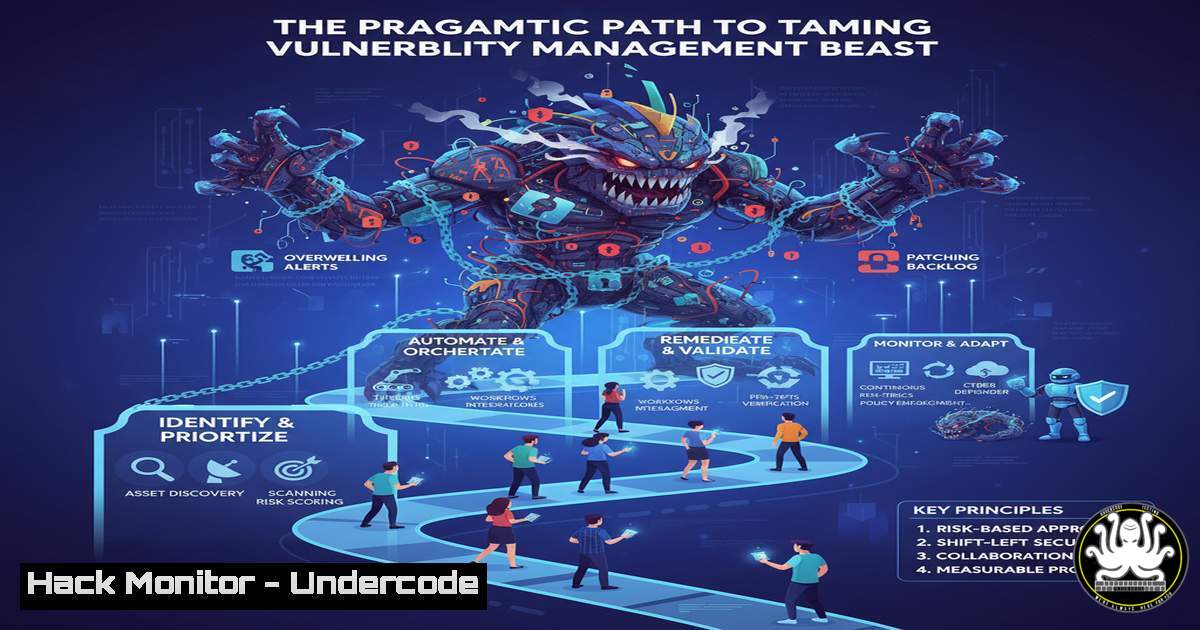
Introduction:
Vulnerability management remains one of the most persistent and challenging disciplines in cybersecurity. While often plagued by organizational silos, weak governance, and an overwhelming volume of threats, a pragmatic approach that prioritizes process and context over pure technology can finally illuminate a path forward. This guide moves beyond theoretical ideals to provide actionable, command-level strategies for security architects and operators.
Learning Objectives:
- Understand how to leverage core system commands for efficient asset discovery and vulnerability assessment.
- Implement command-line and tool-based techniques to prioritize risks based on real-world exploitability.
- Develop scripts and automated checks to maintain continuous visibility and hardening across your environment.
You Should Know:
1. Foundational Asset Discovery with Nmap
Before vulnerabilities can be managed, they must be found. Asset discovery is the critical first step. Nmap is the industry-standard tool for network exploration and security auditing.
 Basic TCP SYN scan of a network range
nmap -sS 192.168.1.0/24

Service version detection and OS fingerprinting
nmap -sV -O 192.168.1.10

Script scanning using the default set of NSE scripts for vulnerability discovery
nmap -sC -sV --script vuln <target_ip>
Step-by-step guide: The `-sS` flag initiates a SYN scan, the most common and efficient TCP scan. It quickly identifies live hosts. Following this, the `-sV` probe determines service versions (e.g., Apache 2.4.52, OpenSSH 8.2p1), which is essential for matching against known vulnerabilities. The `–script vuln` option runs a suite of scripts designed to check for specific known weaknesses, providing immediate, actionable data.
- Prioritizing with the CVSS v3.1 Calculator via cURL
Not all vulnerabilities are created equal. The Common Vulnerability Scoring System (CVSS) provides a standardized method for assessing severity. We can interact with this programmatically.
 Query the NVD API for a specific CVE's CVSS v3.1 data
curl -s "https://services.nvd.nist.gov/rest/json/cves/2.0?cveId=CVE-2021-44228" | jq '.vulnerabilities[bash].cve.metrics.cvssMetricV31[bash].cvssData.baseScore'
Step-by-step guide: This command uses `cURL` to make a silent (-s) API request to the National Vulnerability Database (NVD) for the Log4Shell CVE. The response is piped to jq, a powerful JSON processor, which extracts the baseScore from the CVSS v3.1 metrics. A score of 9.0 or above (Critical) should be prioritized for immediate remediation over lower-scored vulnerabilities.
3. Windows System Hardening with PowerShell
Weak configurations are a primary source of risk. PowerShell allows for rapid assessment and hardening of Windows endpoints.
 Check the status of SMBv1, an outdated and vulnerable protocol
Get-WindowsOptionalFeature -Online -FeatureName SMB1Protocol

Disable SMBv1
Disable-WindowsOptionalFeature -Online -FeatureName SMB1Protocol

Audit PowerShell script block logging (a critical security control)
Get-ItemProperty -Path "HKLM:\SOFTWARE\Policies\Microsoft\Windows\PowerShell\ScriptBlockLogging" -Name "EnableScriptBlockLogging"
Step-by-step guide: The `Get-WindowsOptionalFeature` cmdlet queries the state of the SMBv1 feature. If it returns “Enabled,” the `Disable-WindowsOptionalFeature` cmdlet should be executed to remove this attack vector. The registry check for Script Block Logging verifies that command-line activity is being captured, which is essential for threat detection and forensics.
4. Linux Patch Audit with dpkg and apt
Maintaining an accurate inventory of installed software and their versions is fundamental. On Debian-based systems, the package manager provides this capability.
 List all installed packages and their versions
dpkg -l

Check for available upgrades for security-related packages
apt list --upgradable | grep -i security

Perform an unattended upgrade of security patches only
sudo unattended-upgrade -d
Step-by-step guide: The `dpkg -l` command provides a snapshot of every installed package. This list should be regularly compared against vulnerability databases. The `apt list –upgradable` command, filtered for “security,” shows only patches that address security flaws. For automated maintenance, `unattended-upgrade` can be configured to apply these patches without manual intervention, drastically reducing the window of exposure.
5. Container Vulnerability Scanning with Trivy
Modern applications run in containers, which introduce their own set of vulnerabilities. Trivy is a simple yet comprehensive scanner for containers and other artifacts.
 Scan a local Docker image for vulnerabilities
trivy image <your_image_name:tag>

Scan a container image for misconfigurations using a compliance benchmark
trivy conf --compliance=docker-cis-benchmark /path/to/Dockerfile

Output results as a JSON for integration with other tools
trivy image --format json -o results.json <image_name>
Step-by-step guide: Running `trivy image` against a Docker image will generate a detailed report of known CVEs within the container’s software stack. The `conf` sub-command checks the Dockerfile itself against the CIS benchmark, ensuring the container is built according to security best practices. The JSON output is ideal for feeding into a SIEM or vulnerability management platform.
6. API Security Testing with OWASP Amass
APIs are a critical and often overlooked attack surface. OWASP Amass is a tool that helps discover and map an organization’s external API endpoints.
 Perform passive reconnaissance to discover subdomains and APIs
amass enum -passive -d example.com

Actively enumerate to discover more endpoints (use with caution and permission)
amass enum -active -d example.com -src

Visualize the results in a network graph
amass viz -d3 -dir /path/to/amass_workspace
Step-by-step guide: The `-passive` flag gathers information from open sources without sending traffic directly to the target, making it a safe first step. The `-active` option involves more direct interaction and should only be performed on assets you own or have explicit permission to test. The visualization step (amass viz) helps identify the scope and interconnectedness of the discovered attack surface.
7. Cloud Infrastructure Hardening with AWS CLI
Misconfigured cloud storage services like S3 are a leading cause of data breaches. The AWS Command Line Interface allows for programmatic security checks.
 Check the ACL (Access Control List) of an S3 bucket
aws s3api get-bucket-acl --bucket my-bucket-name

Apply a bucket policy that denies non-SSL (HTTP) requests
aws s3api put-bucket-policy --bucket my-bucket-name --policy file://deny-http-policy.json

Enable default encryption on an S3 bucket
aws s3api put-bucket-encryption --bucket my-bucket-name --server-side-encryption-configuration '{"Rules": [{"ApplyServerSideEncryptionByDefault": {"SSEAlgorithm": "AES256"}}]}'
Step-by-step guide: The `get-bucket-acl` command reveals who has access to your data. The `put-bucket-policy` command is used to enforce a policy that requires encrypted transit (SSL/TLS). The `put-bucket-encryption` command ensures all objects are encrypted at rest by default. These three commands form a baseline for S3 security.
What Undercode Say:
- Process Precedes Technology: The most advanced vulnerability scanner is useless without a clear, accountable process for triage, assignment, and remediation. Technology is an enabler, not a solution.
- Context is King: A critical vulnerability on an isolated test server is less urgent than a medium flaw on an internet-facing database. Effective management requires blending CVSS scores with asset criticality and threat intelligence.
The central thesis of a pragmatic approach is that the “people and process” elements are the true differentiators. While the technical commands provided are essential for execution, they are the “how.” The “why” and “what” must be driven by a governance model that breaks down silos, establishes clear accountability, and focuses metrics on risk reduction rather than mere scan completion. The endless cycle of scanning and reporting without effective action is what has made vulnerability management a “thorn in the side” for so long. The light at the end of the tunnel is a strategy that values operational effectiveness over comprehensive perfection.
Prediction:
The future of vulnerability management will be dominated by AI-driven prioritization engines that integrate real-time threat feeds, asset context, and business criticality to present a continuously updated “critical few” list for remediation. This will shift the focus from overwhelming data volume to actionable intelligence, allowing human analysts to concentrate on complex exception handling and strategic improvement. The role of the security professional will evolve from a scanner operator to a risk advisor, leveraging automation to make nuanced decisions that genuinely reduce organizational risk.
🎯Let’s Practice For Free:
IT/Security Reporter URL:
Reported By: Steveyre Navigating – Hackers Feeds
Extra Hub: Undercode MoN
Basic Verification: Pass ✅


