Listen to this Post
Introduction:
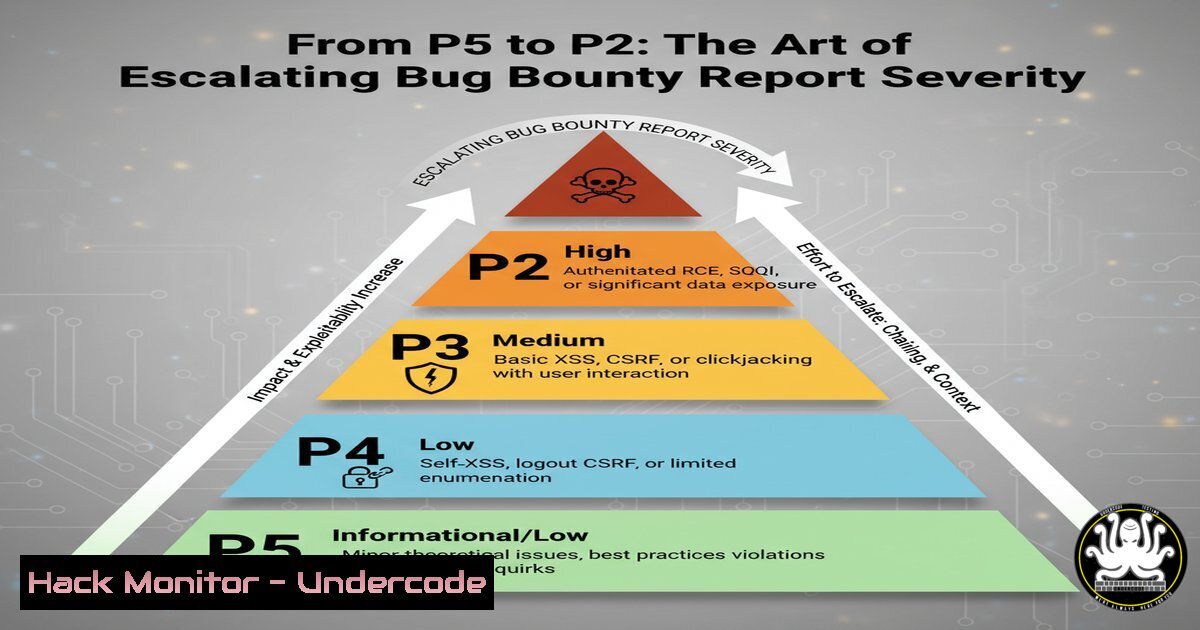
In the competitive world of bug bounty hunting, finding a vulnerability is only half the battle. The true challenge lies in effectively demonstrating its potential impact to a security team inundated with reports. Many valid bugs are classified as low-severity P5 (Informational) not because they are inherently harmless, but because the proof-of-concept fails to articulate a clear and compelling path to exploitation. This article provides a tactical guide for hunters to transform their findings from overlooked notes into high-priority tickets.
Learning Objectives:
- Understand the key criteria security teams use to assess vulnerability severity.
- Learn how to weaponize informational findings through attack chaining and realistic exploit scenarios.
- Master the art of writing evidence-rich reports that clearly demonstrate business impact.
You Should Know:
- Chaining for Impact: Turning Multiple P5s into a Single P2
The most powerful technique for severity escalation is vulnerability chaining. A single P5, like a verbose error message revealing a path, might be low risk. But when combined with another P5, like a weak password policy, it can lead to full system compromise.
Step-by-step guide:
- Map the Attack Surface: Use tools like `Burp Suite` or `Nmap` to catalog every endpoint and service. Don’t ignore “minor” information leaks.
- Identify Chaining Points: Look for P5 findings that can be used as stepping stones. For example:
P5 A: An endpoint exposing system usernames via a subtle timing difference in response times.
P5 B: A login page with no account lockout mechanism. - Construct the Narrative: Write a single report that documents the chain. The title should reflect the end result, e.g., “Chaining Username Enumeration and Bruteforce Vulnerability to Gain Unauthorized User Account Access.”
2. Weaponizing Information Disclosure
Error messages and system information are goldmines for attackers. Your goal is to show exactly how this data can be used in a real-world attack.
Verified Command/Tool Snippet:
`curl -i -H “X-Forwarded-For: 127.0.0.1” https://target.com/api/v1/user/12345`
This command might trigger a different error message that reveals internal system paths or database structure when the application tries to handle a localhost request differently.
Step-by-step guide:
- Trigger Verbose Errors: Manipulate parameters, headers, and endpoints to force the application to reveal information.
- Extract Actionable Data: Show how the disclosed information can be used. For instance, a full path disclosure (
/var/www/html/app/uploads/) can be combined with a file upload flaw to write a web shell. - Demonstrate in the Report: Include screenshots of the error and a clear explanation: “The exposed server path allows an attacker to precisely target subsequent directory traversal attacks.”
3. Proving Business Logic Abuse
“Working as intended” is a common dismissal for logic flaws. You must prove the business impact.
Step-by-step guide:
- Understand the Workflow: Diagram the intended user journey (e.g., Add item to cart -> Apply coupon -> Checkout -> Pay).
- Identify the Flaw: Find where you can manipulate the sequence. Can you apply a coupon after checkout? Can you modify the final price parameter?
- Quantify the Impact: Don’t just say “I can change the price.” Calculate the exact financial loss. “By intercepting the `POST /checkout/confirm` request and modifying the `total_amount` parameter from $100 to $1, an attacker can purchase any item at a 99% discount. This directly impacts revenue.”
4. Demonstrating Priviledge Escalation
Show, don’t tell. A finding that “might lead to privilege escalation” is a P5. A finding that demonstrates it is a P3 or P2.
Verified Command/Tool Snippet (JWT Tampering):
`python3 -c “import jwt; encoded = jwt.encode({‘user’: ‘admin’, ‘id’: ‘123’}, ”, algorithm=’HS256′); print(encoded)”`
This generates a JWT token using a blank secret (‘none’ algorithm vulnerability). If the app accepts this, it’s a critical flaw.
Step-by-step guide:
- Gain Low-Privilege Access: Start with a standard user account.
- Find the Escalation Vector: This could be a JWT you can tamper with, a hidden API endpoint like `GET /api/admin/users` accessible to any authenticated user, or a parameter like
&is_admin=true. - Provide Conclusive Proof: Include two sets of screenshots: one showing your normal user permissions, and a second set taken immediately after exploitation, showing access to admin functions.
5. Crafting the Compelling Proof-of-Concept (PoC)
A video is worth a thousand words. A well-made PoC video leaves no room for doubt.
Step-by-step guide:
- Script the Attack: Write a brief script. “Step 1: Login as user ‘test123’. Step 2: Navigate to vulnerable endpoint. Step 3: Intercept request with Burp. Step 4: Modify parameter X to Y. Step 5: Show successful admin panel access.”
- Record the Flow: Use a tool like OBS Studio. Ensure the video is clear and your actions are deliberate.
- Narrate the Impact: Use a voiceover or on-screen text to explain what is happening at each step, focusing on the impact: “I am now modifying the `user_id` parameter, which bypasses authorization checks and allows me to view any user’s private data.”
6. The Importance of a Clear Impact Statement
Security teams are busy. Summarize the “so what?” in one powerful sentence.
Step-by-step guide:
- Avoid Technical Jargon: Instead of “XSS via unsanitized `name` parameter,” say “Allows an attacker to steal session cookies from any user who views my profile, leading to full account takeover.”
- Tie it to Business Assets: Connect the vulnerability to what the company cares about: customer data, money, reputation. “This vulnerability could be used to deface the company’s public homepage, causing significant reputational damage.”
- Place it Prominently: Put this impact statement at the very top of your report, right after the title.
What Undercode Say:
- Context is King: A vulnerability’s severity is not absolute; it is defined by its environment and exploitability. An open S3 bucket with no data is a P5. The same bucket containing customer PII is a P2 or P1.
- Tell a Story: The most successful bug bounty reports read like a short story. They introduce the vulnerability, build tension by demonstrating its components, and climax with a clear, impactful exploitation scenario that the triager cannot ignore.
The difference between a P5 and a P2 finding often boils down to the hunter’s ability to bridge the gap between a theoretical flaw and a practical, damaging attack. By shifting your mindset from “what is broken” to “what can an attacker achieve,” you provide immense value to the security team. This proactive approach not only increases your payout but also helps companies fix the flaws that matter most, making the digital ecosystem safer for everyone.
Prediction:
The future of bug bounties will increasingly favor hunters who can perform mini penetration tests rather than those who simply identify isolated flaws. As automated scanning becomes more prevalent, the low-hanging fruit will be automated away. The premium will shift to ethical hackers who possess the creativity and analytical skill to chain subtle vulnerabilities, understand complex business logic, and articulate risk in the language of business impact. This evolution will professionalize the field, leading to higher rewards for top-tier hunters and more robust security for organizations.
🎯Let’s Practice For Free:
IT/Security Reporter URL:
Reported By: Ibnu Mustova – Hackers Feeds
Extra Hub: Undercode MoN
Basic Verification: Pass ✅


