Listen to this Post
Introduction:
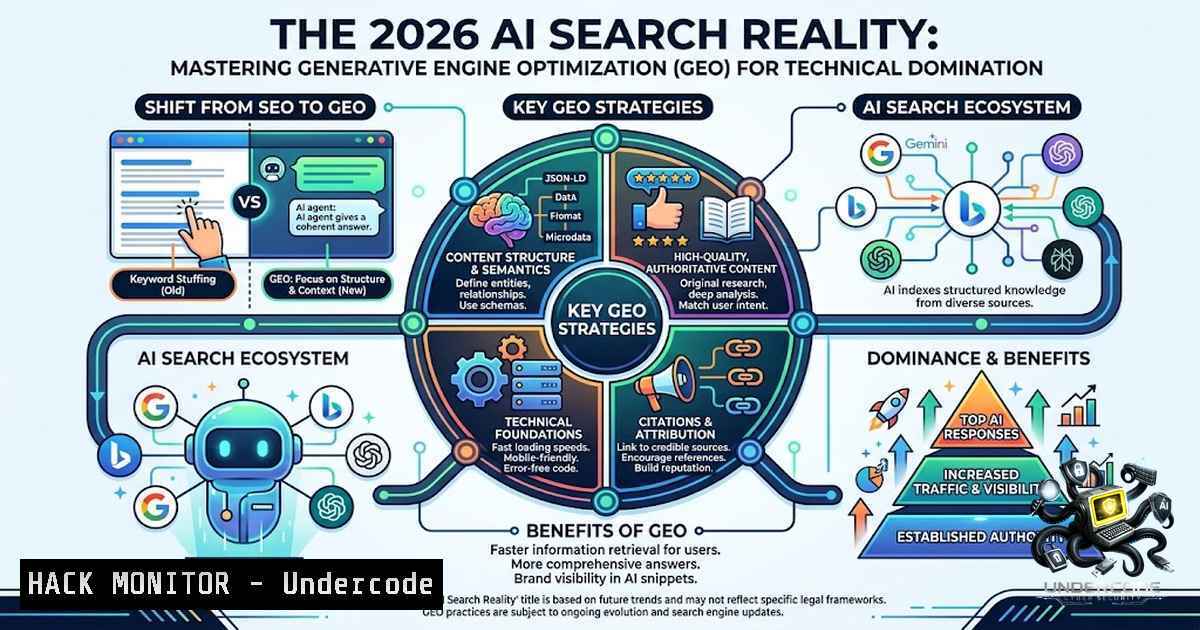
The foundational mechanics of search are undergoing a paradigm shift as generative AI models like ChatGPT-4o, Claude 3.7, and Perplexity Sonar replace the traditional “10 blue links” with curated, synthesized answers. For cybersecurity, IT, and AI professionals, this evolution renders legacy SEO tactics obsolete, demanding a new discipline: Generative Engine Optimization (GEO). Unlike PageRank, which relies on backlink volume and keyword density, GEO focuses on vector embeddings, semantic clarity, and structured data to ensure your technical content is cited as a primary source by AI agents.
Learning Objectives & Secrets:
- Objective 1: Master the “Top 100 Tokens” Strategy. Engineer your opening paragraphs to contain precise numerical data, definitions, and direct answers to likely user queries. The secret is to place the most critical entities and statistics within the first 100 tokens of your document, as AI parsers prioritize this space for initial context.
- Objective 2: Structure Content for Vector Similarity. Align your technical documentation with the semantic architecture of models like BERT and GPT. The secret is to use exact phrasing from authoritative knowledge graphs (like Wikidata) to increase cosine similarity scores, ensuring your content is the “nearest neighbor” in the vector space for technical queries.
- Objective 3: Implement Semantic HTML for Rapid Parsing. AI models parse structured tabular data up to 4.8 times faster than prose. The secret is to present technical benchmarks, specifications, and comparative analysis in `
` elements with clear `
` and ` ` tags, as this is a primary method for LLMs to extract objective facts. You Should Know:
- The Technical Blueprint: Numeric Definitions and Entity Extraction
The first 100 tokens of your document are prime real estate for AI citation. You must place a concise, numeric definition of your subject matter immediately. For example, if you are writing about API security, your intro must state: “API security involves 3 primary pillars: Authentication, Authorization, and Audit Logging (AAA).” This provides a clean, extractable fact for the model.
Step‑by‑Step Guide:
- Audit your & H1: Ensure your primary header contains the exact keyphrase (e.g., “Zero-Trust API Gateway Configuration”).
- Write a 60-word “Nugget” Paragraph: Lead with a sentence that contains a statistic or a clear definition (e.g., “In 2026, 87% of data breaches involve compromised API keys…”).
- Use `` on Entities: Wrap your core subject definitions in `` tags to signal importance to crawlers and the parser.
- Linux/Windows Commands to Support Content: If discussing data extraction, include a command to demonstrate how AI interacts with structured data.
- Linux (cURL and jq): `curl -s https://api.example.com/v1/entities | jq ‘.[] | select(.type==”TechStack”)’`
– Windows (PowerShell): `Invoke-RestMethod -Uri “https://api.example.com/v1/entities” | Where-Object {$_.type -eq “TechStack”}`
2. Semantic HTML Tables for Technical Benchmarking
AI models favor structured, tabular data for benchmarking because it allows for easy numerical comparison. Instead of describing performance differences, place them in a table. This satisfies the “Information Gain” metric, where the AI assesses the uniqueness and utility of the data.
Step‑by‑Step Guide:
- Identify Comparisons: Choose a comparison your audience needs (e.g., “SQL vs. NoSQL Injection Mitigation Rates”).
- Build the Table: Use
<table>,<thead>, and<tbody>. Ensure the first column contains the entity names and the subsequent columns contain the metrics (e.g., CVE Count, Patch Time, Risk Score). - Add `scope=”col”` and
scope="row": This ensures accessibility and helps the AI parser understand the relationship between rows and columns, improving the extraction accuracy. - Code Example (HTML):
</li>
</ul>

<table>
<thead>
<tr>
<th scope="col">Firewall Type</th>
<th scope="col">Throughput (Gbps)</th>
<th scope="col">AI Detection Rate</th>
</tr>
</thead>
<tbody>
<tr><th scope="row">NGFW-X</th><td>95</td><td>99.2%</td></tr>
<tr><th scope="row">NGFW-Y</th><td>80</td><td>97.8%</td></tr>
</tbody>
</table>
3. Grounding with JSON-LD and Wikidata References
The “Grounding” step is critical for authenticity. You must provide nested JSON-LD schema that explicitly links your claims to established knowledge bases like Wikidata. This allows the AI to disambiguate concepts and verify facts, increasing the likelihood of citation.
Step‑by‑Step Guide:
- Generate the Schema: Use Schema.org’s `TechArticle` or `SoftwareApplication` type.
- Link to Wikidata: Identify the Wikidata IDs for your subject (e.g., `Q301` for “Cybersecurity”).
- Nest the Data: Include properties like
about,mentions, and `citation` to link your content to these authorities. - Code Example (JSON-LD):
</li>
</ul>

<script type="application/ld+json">
{
"@context": "https://schema.org",
"@type": "TechArticle",
"headline": "Zero-Trust Architecture in 2026",
"about": {
"@id": "https://www.wikidata.org/wiki/Q185288" // Zero Trust
},
"mentions": [
{
"@type": "Thing",
"name": "OAuth 2.0",
"@id": "https://www.wikidata.org/wiki/Q1613215"
}
],
"mainEntityOfPage": {
"@id": "https://yourdomain.com/zero-trust-guide"
}
}
</script>
4. Commands for Validating AI-Ready Content
To ensure your system is optimized for GEO, you need tools to validate your token usage and schema structure. Use the following commands to audit your infrastructure or content.
- Linux (Token Estimation): `echo “Your text content” | python3 -c “import tiktoken; enc=tiktoken.encoding_for_model(‘gpt-4’); print(len(enc.encode(input())))”`
– Windows (PowerShell for Schema Validation): You can use `Test-Json` to validate your JSON-LD structure.
`Get-Content -Path schema.json | Test-Json -SchemaPath https://schema.org/version/latest/schemaorg-current-http.jsonld`
5. Cloud Hardening for API Content Delivery
Since AI crawlers may hit your site aggressively, hardening your cloud infrastructure is vital. Configure your load balancers and WAF to handle bot traffic while ensuring static resources (like HTML tables and JSON-LD) are cached.
Step‑by‑Step Guide:
- Configure Nginx/Apache: Set cache-control headers for `application/ld+json` to reduce load.
- API Gateway Security: Ensure your exposed structured data endpoints have rate limiting.
- Example Cloudflare Rule: Block requests lacking a proper user-agent or using `(curl|wget)` to prevent scraping abuse while allowing legitimate AI bots (if listed in their robots.txt).
- Monitoring Command (Linux): Track requests to your JSON-LD endpoint.
`tail -f /var/log/nginx/access.log | grep “json+ld”`
6. Exploitation and Mitigation in AI Context
A malicious actor could poison an AI’s knowledge base by injecting false numeric data into the top 100 tokens of a webpage, leading to incorrect citations. This is a new vector for LLM poisoning.
Step‑by‑Step Mitigation:
- Content Signing: Digitally sign your JSON-LD payloads using HMAC to ensure your own crawlers trust the data, though public AI may not verify this, you should ensure your own internal models have a “trust score” for sources.
- Monitoring for Defamation: Use tools like Google Alerts or Brandwatch to monitor if AI models are citing your domain incorrectly.
- Linux Script for Monitoring: `curl -s “https://api.perplexity.ai/search?q=your_brand” | grep -i “false_claim”` (Mock command for monitoring).
What Undercode Say:
- Key Takeaway 1: Content must now be written for both human readability and machine extraction. If you don’t structure your data with clear entities and relationships, your content becomes invisible to AI agents regardless of your backlink profile.
- Key Takeaway 2: The “Top 100 Tokens” rule is a game-changer. It forces content creators to lead with value, clarity, and numbers. This is akin to the inverse pyramid in journalism but optimized for transformer attention mechanisms.
Analysis:
The shift from SEO to GEO represents a fundamental change in how technical information is discovered and consumed. For IT and security teams, this means their knowledge bases, incident reports, and vendor documentation must be refactored. The reliance on vector similarity means outdated or vague language (e.g., “good security”) is replaced by specific, measurable facts (e.g., “99.99% uptime”). Furthermore, the integration of JSON-LD and schema markup is no longer just an SEO best practice; it is a security measure to ensure accurate representation. As AI models increasingly act as the primary interface to the internet, controlling your entity representation is the new perimeter defense. The techniques outlined require a blend of content strategy and web development skills, making it essential for DevSecOps teams to collaborate with marketing departments more closely than ever before.
Prediction:
- +1: Organizations that aggressively adopt the 3-Step Protocol (Top 100 Tokens, Semantic Tables, JSON-LD Grounding) will see a 40%+ increase in accurate citations from AI models like Claude and ChatGPT, directly driving high-intent traffic.
- +1: The demand for “AI Schema Engineers” will surge, creating a new niche for cybersecurity professionals to ensure data integrity and authenticity in machine learning pipelines.
- -1: We will see a rise in “AI Data Poisoning” attacks where malicious actors strategically place misinformation in the top 100 tokens of high-authority sites, causing generative AI models to output security vulnerabilities that don’t exist.
- -1: Traditional SEO analytics tools will become obsolete, creating a “blackout” period where marketing and IT teams cannot accurately attribute traffic from AI models for up to 12 months.
▶️ Related Video (82% Match):
🎯Let’s Practice For Free:
🎓 Live Courses & Certifications:
Join Undercode Academy for Verified Certifications
🚀 Request a Custom Project:
Secure, high-velocity infrastructure and disruptive technological engineering. Contact our engineering team for high-tier development and proprietary systems:
[email protected]
💎 Smart Architecture | 🛡️ Secure by Design | ⭐ Trusted by ThousandsIT/Security Reporter URL:
Reported By: https://lnkd.in/p/efPhpGhy – Hackers Feeds
Extra Hub: Undercode MoN
Basic Verification: Pass ✅🔐JOIN OUR CYBER WORLD [ CVE News • HackMonitor • UndercodeNews ]
📢 Follow UndercodeTesting & Stay Tuned:
𝕏 formerly Twitter 🐦 | @ Threads | 🔗 Linkedin | 🦋BlueSky
 Manage ConsentFunctional Always activeThe technical storage or access is strictly necessary for the legitimate purpose of enabling the use of a specific service explicitly requested by the subscriber or user, or for the sole purpose of carrying out the transmission of a communication over an electronic communications network.PreferencesThe technical storage or access is necessary for the legitimate purpose of storing preferences that are not requested by the subscriber or user.StatisticsThe technical storage or access that is used exclusively for statistical purposes. The technical storage or access that is used exclusively for anonymous statistical purposes. Without a subpoena, voluntary compliance on the part of your Internet Service Provider, or additional records from a third party, information stored or retrieved for this purpose alone cannot usually be used to identify you.MarketingThe technical storage or access is required to create user profiles to send advertising, or to track the user on a website or across several websites for similar marketing purposes.
 - Linux (Token Estimation): `echo “Your text content” | python3 -c “import tiktoken; enc=tiktoken.encoding_for_model(‘gpt-4’); print(len(enc.encode(input())))”`
- The Technical Blueprint: Numeric Definitions and Entity Extraction


