
Listen to this Post
Introduction:
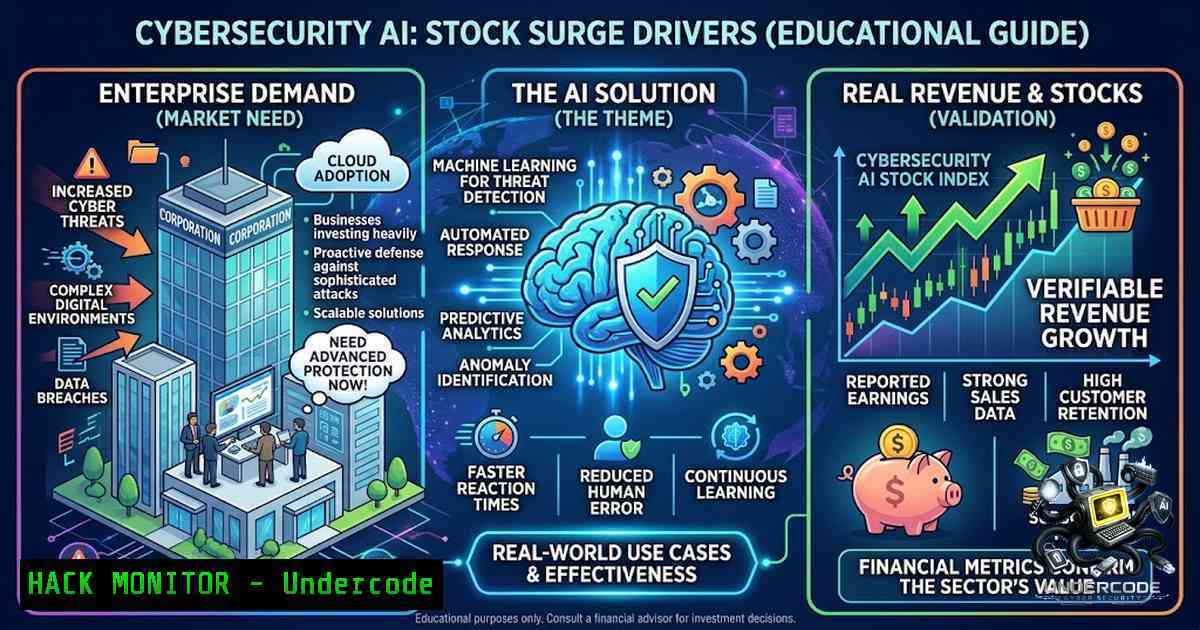
The convergence of artificial intelligence and cybersecurity has evolved from a speculative narrative into a tangible revenue driver for enterprise software vendors. As global services activity remains resilient and manufacturing softens, demand for computing power, automation, and AI-driven security solutions continues to accelerate. With AI agents fundamentally reshaping both the attack surface and defense infrastructure, cybersecurity companies integrating AI into their core offerings are reporting substantial revenue growth, validated by recent earnings reports and analyst upgrades following major industry events like the Black Hat conference.
Learning Objectives & Secrets:
- Objective 1: Identify AI Cybersecurity Stocks with Verifiable Revenue Streams – Learn to differentiate between speculative AI plays and companies generating real enterprise revenue from AI-powered security solutions, including CrowdStrike, Palo Alto Networks, Zscaler, and Qualys.
-
Objective 2 Secret Tip: Leverage AI Threat Intelligence for Investment Decisions – Monitor conference-driven catalysts (e.g., Black Hat) and CEO commentary on AI security demand. As seen in June 2026, Anthropic’s Mythos-related security initiative triggered “a deluge of customer, prospect and partner inquiries” for CrowdStrike, signaling demand long before quarterly earnings reflect it.
-
Objective 3 Secret Tip: Understand Platformization and AI Agent Security – Companies with integrated platforms (network, cloud, identity, and AI security) are better positioned to capture enterprise spending. Zscaler’s expansion to protect AI agents and Palo Alto’s platformization strategy are key differentiators in this evolving landscape.
You Should Know:
1. The AI Security Revenue Landscape: Who’s Delivering?
The cybersecurity sector is experiencing a fundamental shift as AI becomes both a threat vector and a defense mechanism. Enterprise customers are prioritizing cybersecurity spending given recent breakthroughs in AI hacking capabilities. Companies with proven AI integrations are reporting substantial revenue growth:
- Palo Alto Networks (PANW): Raised fiscal 2026 revenue forecast to $11.415–$11.425 billion, up from $11.28–$11.31 billion, with Q3 revenue growing 31% year-over-year to $3 billion. Next-generation security ARR exceeded $8 billion.
-
CrowdStrike (CRWD): Q1 fiscal 2027 revenues grew 26% year-over-year to $1.39 billion, with ARR jumping 24% to $5.51 billion. The company has beaten EPS estimates for eight consecutive quarters.
-
Zscaler (ZS): Q3 fiscal 2026 ARR rose 25% year-over-year to $3.53 billion, with revenues increasing 25% to $850 million. Its AI Protect solution generated over $100 million in bookings over the past 12 months.
-
Qualys (QLYS): Q1 2026 revenues increased 10% to $175.6 million, with management raising full-year 2026 revenue guidance to $732–$738 million.
-
Trend Micro: Enterprise AI cybersecurity business (TrendAI) delivered 50% year-over-year Vision One ARR growth, contributing to total enterprise ARR surpassing $1.7 billion.
-
Varonis (VRNS): Q1 2026 sales up 26.9% year-over-year to $173.1 million, beating estimates by 4.6%.
-
SentinelOne (S): Fiscal 2026 revenue reached $1.00 billion, up 21.89% year-over-year.
Linux/Windows Commands for AI Security Monitoring:
For security professionals and IT administrators monitoring AI-related threats, the following commands can help detect and analyze suspicious activity:
 Linux: Monitor for unauthorized AI model access
sudo auditctl -w /opt/ai-models/ -p rwxa -k ai_model_access

Linux: Check for unusual outbound connections from AI services
sudo netstat -tunap | grep -E ":(443|8080|8443)" | grep ESTABLISHED

Linux: Scan for AI-related processes consuming abnormal resources
ps aux --sort=-%cpu | head -20 | grep -E "python|tensorflow|pytorch|llm"

Windows: Monitor AI application logs for anomalies
Get-WinEvent -LogName "Application" | Where-Object { $_.Message -match "AI|model|inference" }

Windows: Check for unauthorized AI tool installations
Get-ChildItem -Path "C:\Program Files" -Recurse -Include ai,model,tensor -ErrorAction SilentlyContinue

Cross-platform: Verify API endpoint security for AI services
curl -X GET https://your-ai-api.com/health -H "Authorization: Bearer $API_KEY" -v
- AI Agents: The New Attack Surface and Defense Opportunity
According to BTIG analysts at the Black Hat conference, “AI agents have fundamentally changed the threat landscape”. This shift creates a dual-edged dynamic: AI agents have become the leading new attack method, while simultaneously driving fresh demand for defensive tools. Enterprises are increasingly deploying AI-powered tools and autonomous agents to access applications and data, creating new security challenges that traditional solutions cannot address.
Step-by-Step Guide to Securing AI Agent Deployments:
- Discover and Inventory AI Assets: Use Zscaler’s AI Protect or similar solutions to identify all AI applications, models, and agents across your enterprise environment.
-
Enforce Security Controls: Implement Zero Trust architecture principles for AI agent communications, ensuring authentication and authorization for every machine-to-machine interaction.
-
Prevent Data Leaks: Configure data loss prevention (DLP) policies specifically for AI model inputs and outputs, monitoring for sensitive data exfiltration through AI APIs.
-
Monitor AI Agent Behavior: Deploy behavioral analytics to detect anomalous agent activities, such as unusual data access patterns or excessive resource consumption.
-
Integrate Threat Intelligence: Leverage AI-powered threat detection platforms (e.g., CrowdStrike Falcon, Palo Alto XSIAM) that use machine learning to identify emerging attack patterns targeting AI infrastructure.
-
Platformization: The Key to Capturing Enterprise AI Security Spend
Industry analysts are increasingly favoring platform-based vendors over point solutions. TD Cowen identified CrowdStrike, Fortinet, Cloudflare, Palo Alto Networks, and SentinelOne as top AI cybersecurity picks. The rationale is straightforward: enterprises prefer integrated security platforms that can address network, cloud, identity, and AI security from a single vendor.
Practical Implementation: Hardening Cloud AI Workloads
For organizations deploying AI workloads in the cloud, consider these security measures:
 AWS: Enable GuardDuty for AI workload threat detection
aws guardduty create-detector --enable

AWS: Monitor S3 buckets containing AI training data
aws s3api put-bucket-versioning --bucket ai-training-data --versioning-configuration Status=Enabled

Azure: Enable Defender for Cloud for AI services
az security pricing create -1 VirtualMachines --tier Standard

GCP: Enable security command center for AI workloads
gcloud scc settings create --organization=YOUR_ORG_ID --enable-security-center

Kubernetes: Deploy network policies for AI microservices
kubectl apply -f - <<EOF
apiVersion: networking.k8s.io/v1
kind: NetworkPolicy
metadata:
name: ai-agent-1etwork-policy
spec:
podSelector:
matchLabels:
app: ai-agent
policyTypes:
- Ingress
- Egress
ingress:
- from:
- podSelector:
matchLabels:
app: api-gateway
egress:
- to:
- podSelector:
matchLabels:
app: model-registry
EOF
- Vulnerability Exploitation and Mitigation in the AI Era
Anthropic’s advanced Mythos model has demonstrated the ability to expose flaws in existing software and encryption systems, pushing companies to ramp up cybersecurity spending. This represents a paradigm shift where AI is not just a defense tool but also an offensive weapon.
Critical Mitigation Strategies:
- Implement AI-Powered Vulnerability Scanning: Use platforms like Qualys that bring “autonomous exploit validation, risk quantification, and remediation together within a single AI-driven risk fabric”.
-
Adopt Zero Trust for All AI Interactions: Zscaler’s Zero Trust architecture, combined with its focus on securing AI agents and machine-to-machine interactions, provides a robust framework.
-
Monitor for AI-Generated Attacks: Deploy AI-1ative threat detection that can identify patterns indicative of AI-assisted attacks, including automated phishing, credential stuffing, and vulnerability exploitation.
Linux Command for AI-Assisted Attack Detection:
 Monitor for unusual login patterns (potential AI-driven credential attacks)
sudo journalctl -u sshd | grep "Failed password" | awk '{print $11}' | sort | uniq -c | sort -1r | head -10

Detect rapid-fire API requests (potential AI bot activity)
sudo tail -f /var/log/nginx/access.log | awk '{print $1, $7}' | uniq -c | sort -1r | head -20
5. API Security: The Frontline of AI Defense
As AI agents increasingly interact via APIs, securing these interfaces becomes paramount. Zscaler’s planned acquisition of Symmetry Systems aims to improve visibility into how users, applications, data, and AI agents interact across enterprise environments.
API Security Checklist for AI Deployments:
- Authenticate All API Calls: Implement OAuth 2.0 or API keys with proper rotation policies.
- Rate Limit AI API Endpoints: Prevent abuse and denial-of-service attacks.
- Validate Inputs and Outputs: Sanitize all data passed to and from AI models.
- Encrypt Data in Transit: Enforce TLS 1.3 for all AI API communications.
- Log and Monitor API Activity: Implement comprehensive logging for forensic analysis.
Sample API Security Configuration (Nginx):
location /api/v1/ai/ {
 Rate limiting
limit_req zone=ai_api_limit burst=20 nodelay;

Authentication
auth_request /auth;

Input validation
if ($request_body ~ "(DROP|DELETE|INSERT|UPDATE|SELECT)") {
return 403;
}

proxy_pass http://ai-backend;
proxy_set_header Host $host;
proxy_set_header X-Real-IP $remote_addr;
}
What Undercode Say:
- Key Takeaway 1: AI cybersecurity is no longer speculative—companies are generating billions in revenue from AI-powered security solutions. Palo Alto Networks alone expects $11.4 billion in fiscal 2026 revenue, while CrowdStrike’s ARR has reached $5.51 billion.
-
Key Takeaway 2: The Black Hat conference served as a catalyst, demonstrating that AI agents have fundamentally changed the threat landscape. This creates a sustained demand cycle—as AI attacks increase, so does spending on AI defense, benefiting platform vendors with comprehensive security portfolios.
Analysis: The convergence of AI and cybersecurity represents one of the most significant technological shifts since the advent of cloud computing. What makes this theme particularly compelling is the tangible revenue validation—these are not speculative penny stocks but established enterprises with multi-billion-dollar revenue streams. However, investors should note that valuation remains a concern; Zscaler trades at a forward P/S ratio of 5.73 versus the industry average of 16.25, suggesting potential undervaluation, while CrowdStrike’s high valuation leaves little room for error. The key differentiator going forward will be platformization—companies offering integrated network, cloud, identity, and AI security solutions are best positioned to capture enterprise spending. As AI agents become ubiquitous, the security market for machine-to-machine interactions will likely dwarf traditional endpoint security, creating significant long-term opportunities for vendors that can secure this emerging frontier.
Prediction:
- +1 Palo Alto Networks (PANW) will continue to outperform as its platformization strategy and AI-driven XSIAM product build a data advantage over rivals, with revenue potentially exceeding $12 billion by fiscal 2027.
-
+1 Zscaler (ZS) is poised for a valuation re-rating as its focus on AI agent security becomes a meaningful growth driver, with AI Protect bookings already exceeding $100 million annually.
-
+1 CrowdStrike (CRWD) will benefit from the “new modernization cycle” in endpoint security driven by AI, with the company’s Falcon platform well-positioned to capture AI-1ative threat detection demand.
-
-1 Valuation risks remain significant—CrowdStrike traded at nearly 138 times forward earnings in June 2026, making it vulnerable to earnings disappointments.
-
-1 C3.ai’s 35.67% revenue decline in fiscal 2026 serves as a cautionary tale—not all AI stocks are created equal, and investors must distinguish between genuine enterprise adoption and speculative hype.
-
+1 AI-driven cyber threats will accelerate enterprise security spending, with Anthropic’s Mythos model demonstrating AI’s offensive capabilities, forcing organizations to prioritize cybersecurity budgets.
-
+1 Consolidation in the AI security space is likely as larger vendors acquire specialized capabilities—Zscaler’s acquisition of Symmetry Systems may be the first of many.
-
-1 Profit-taking volatility will persist as high-growth AI cybersecurity stocks experience periodic sell-offs following earnings beats, as seen when CrowdStrike fell 7% despite strong AI demand commentary.
▶️ Related Video (82% Match):
https://www.youtube.com/watch?v=-DKI18NmM6U
🎯Let’s Practice For Free:
🎓 Live Courses & Certifications:
Join Undercode Academy for Verified Certifications
🚀 Request a Custom Project:
Secure, high-velocity infrastructure and disruptive technological engineering. Contact our engineering team for high-tier development and proprietary systems:
[email protected]
💎 Smart Architecture | 🛡️ Secure by Design | ⭐ Trusted by Thousands
IT/Security Reporter URL:
Reported By: https://lnkd.in/p/eAmg_AEx – Hackers Feeds
Extra Hub: Undercode MoN
Basic Verification: Pass ✅


