Listen to this Post
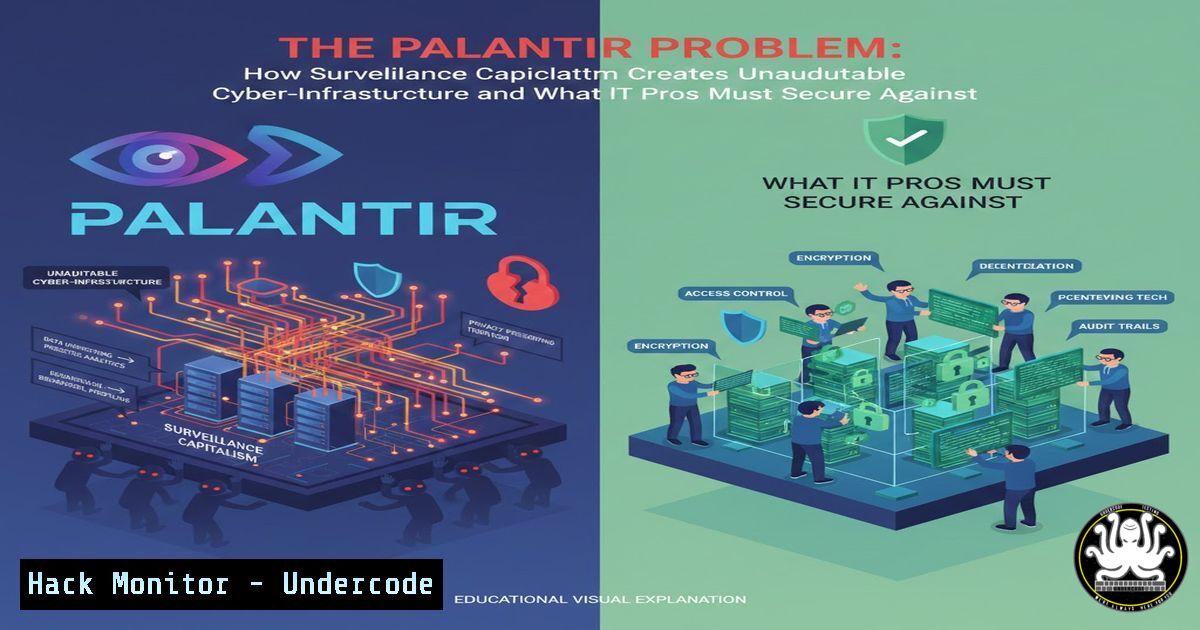
Introduction:
The convergence of mass data integration, proprietary AI scoring models, and ethically unconstrained software deployment represents a paramount cybersecurity and ethical crisis. Platforms like Palantir’s Gotham and Foundry exemplify a new threat model: not a breach of systems, but the very architecture of the system itself, which industrializes suspicion by merging siloed data into a non-transparent, legally opaque intelligence layer. This shifts the security discussion from protecting data from attackers to protecting societies from the infrastructure that holds their data.
Learning Objectives:
- Understand the technical architecture of integrated surveillance platforms and their associated cyber-risks, including data sovereignty loss and uncontrollable system behavior.
- Learn defensive IT strategies to detect data exfiltration to such platforms and to harden systems against unauthorized mass data integration.
- Explore ethical frameworks and technical controls (audit logging, data minimization) that can be implemented to counter opaque algorithmic scoring and profiling.
You Should Know:
- The Architecture of Industrialized Suspicion: Data Integration Layers
Modern surveillance platforms operate by building a meta-layer atop existing organizational data silos. They use APIs, data pipelines, and ETL (Extract, Transform, Load) processes to ingest records from disparate sources—law enforcement databases, public health registries, telecom metadata, social media graphs—into a unified, searchable knowledge graph.
Step-by-step guide explaining what this does and how to use it:
What it does: This integration creates a “single source of truth” that far exceeds the sum of its parts. Relationships between entities (persons, locations, events) are inferred, creating a pervasive surveillance network.
How to Detect It (Defensive Security Perspective): As a network or security analyst, you must monitor for unusual data flows indicative of mass integration.
Command (Linux – Zeek/Bro Log Analysis): Search for large, sustained outbound connections to unknown or cloud-based analytics IPs.
cat conn.log | zeek-cut id.orig_h id.resp_h id.resp_p duration orig_bytes | awk '$5 > 1000000' | sort -n
Action: Identify internal servers making large, periodic data exports. Check if these correspond to authorized integrations. Use Data Loss Prevention (DLP) tools to flag unauthorized transfers of structured personal data.
- The Black Box Threat: Proprietary, Non-Auditable Scoring Models
Once data is integrated, individuals and groups are scored by machine learning models for risk, threat, or “suspicion.” These models are proprietary, their training data is secret, and their decision-making process is non-auditable. This creates a critical vulnerability: biased or flawed logic that cannot be inspected, challenged, or patched.
Step-by-step guide explaining what this does and how to use it:
What it does: It automates prejudice and institutionalizes error at scale. A false positive in a policing context can have severe real-world consequences.
How to Mitigate It (IT/Governance Perspective): Advocate for and implement “Algorithmic Audit” requirements in vendor contracts.
Tutorial: Demand transparency reports. Implement rigorous internal logging that captures all inputs provided to the scoring system and the scores returned.
Example Log Schema: Create a secure, immutable log for every query:
{
"timestamp": "2023-10-27T10:00:00Z",
"query_parameters": "{"target_id": "12345", "data_sources": ["HR", "AccessLogs"]}",
"model_version": "Palantir-Gotham-2.4",
"output_score": 0.87,
"reasoning_codes": ["HR_TERMINATION", "FREQUENT_OFFICE_ACCESS"]
}
Action: Use this log for independent statistical analysis to detect bias (e.g., disproportionately high scores for a demographic group).
- The Sovereignty Breach: Cloud Infrastructure and Foreign Intelligence Access
As noted in the Swiss risk assessment, hosting such integrated data in a vendor’s cloud (often U.S.-based for Palantir) surrenders data sovereignty. It creates a prime target for state-level intelligence agencies and exposes the data to foreign jurisdiction laws (e.g., U.S. Cloud Act).
Step-by-step guide explaining what this does and how to use it:
What it does: It bypasses national data protection laws and creates a single point of catastrophic failure or espionage.
How to Secure Against It (Cloud Security Hardening):
Demand On-Premise or Sovereign Cloud Deployment: This is a non-negotiable requirement for sensitive government or critical infrastructure data.
Command (Cloud Security – AWS Policy Check): If using a hybrid model, aggressively limit access.
{
"Version": "2012-10-17",
"Statement": [{
"Effect": "Deny",
"Principal": "",
"Action": "s3:GetObject",
"Resource": "arn:aws:s3:::sensitive-data-bucket/",
"Condition": {"StringNotEquals": {"aws:PrincipalOrgID": "o-xxxxxxxxxx"}}
}]
}
Action: Enforce end-to-end encryption before data leaves the premises, with keys held solely by your organization. Use Hardware Security Modules (HSMs).
- Mission Creep as a Technical Feature: How Surveillance Systems Metastasize
The initial use case (e.g., tracking serious criminals) inevitably expands to lesser crimes, immigration enforcement, protest monitoring, and predictive policing. Technically, this is facilitated by the platform’s design: once the data pipeline and graph are built, adding a new “target profile” is just a configuration change.
Step-by-step guide explaining what this does and how to use it:
What it does: It normalizes mass surveillance within an organization, eroding ethical and legal boundaries gradually.
How to Monitor and Constrain It (Compliance & DevOps):
Implement Change Control for Analytics Projects: Treat changes to surveillance model parameters or data source integrations with the same rigor as network firewall rule changes.
Tutorial: Use Infrastructure as Code (IaC) and Git workflows to manage platform configuration.
 Ansible Playbook snippet for reviewing a proposed data source addition
- name: Validate new data source integration
hosts: localhost
vars:
proposed_source: "SocialMedia_Scraper"
required_approvals: ["DPO", "Legal", "CISO"]
tasks:
- name: Fail if approvals not in log
fail:
msg: "Integration requires sign-off from {{ required_approvals }}"
when: not (approvals_log | contains(required_approvals))
Action: Mandate quarterly reviews of all active data sources, search queries, and scoring models. Archive and delete any not under explicit, active authorization.
- Building Defensive IT: Countermeasures for the Endpoint and Network
While opposing the macro-architecture, IT professionals can build technical barriers that make indiscriminate data harvesting more difficult and detectable.
Step-by-step guide explaining what this does and how to use it:
What it does: Increases the cost and visibility of mass data collection, promoting data minimization by design.
How to Implement It:
Endpoint Data Tagging: Use tools like Microsoft Purview Information Protection or open-source alternatives to tag sensitive files. Policies can block uploads to unauthorized cloud analytics platforms.
Command (Windows – PowerShell to Find Unusual Processes Accessing Sensitive Data):
Get-WmiObject -Query "SELECT  FROM Win32_Process WHERE Name LIKE '%python%' OR Name LIKE '%powershell%'" | ForEach-Object {
$proc = $_
Get-Process -Id $proc.ProcessId | Select-Object Name, Id,
@{Name="FileHandles";Expression={ (Get-WmiObject Win32_Process -Filter "ProcessId='$($<em>.Id)'").HandleCount }}
} | Where-Object {$</em>.FileHandles -gt 1000}  High handle count can indicate data scraping
Network Segmentation: Isolate databases containing personal information. Allow access only via specific application servers, not directly to analyst workstations or external vendor IPs. Log all access attempts exhaustively.
What Undercode Say:
- Key Takeaway 1: The greatest cyber-risk may not be an external hacker, but the authorized, all-seeing platform you willingly install. Its “feature” is your vulnerability—the irreversible merging of data silos into an opaque, scoring engine.
- Key Takeaway 2: Technical sovereignty—control over your encryption keys, your logs, your deployment model, and your algorithm’s logic—is not a luxury; it is the primary defense against industrialized suspicion and the erosion of democratic opacity.
The analysis here frames Palantir not as a unique monster, but as the current pinnacle of a dangerous technological trend. The core problem is the design pattern: centralized data fusion + opaque algorithms + ethical agnosticism. IT and security professionals are on the front lines. Our task is no longer just to keep data in. It is to fiercely control how it is used, to implement adversarial defensiveness even against authorized systems, and to build technical guardrails (immutable audit logs, data minimization, strict access controls) that enforce ethical boundaries. The tools we wield to secure networks are the same tools we must use to constrain surveillance infrastructures from within.
Prediction:
In the next 3-5 years, we will see the rise of open-source intelligence (OSINT) and ethical hacker efforts focused on “auditing the auditors.” Just as penetration testing exposed network vulnerabilities, we will see specialized red teams attempting to probe, reverse-engineer, and publicly document the biases and failures of these proprietary scoring systems. Legally, we will see landmark cases where “algorithmic due process” becomes a requirement, forcing vendors to disclose enough logic for fair challenge. Technologically, there will be a counter-movement towards fully homomorphic encryption and privacy-preserving analytics that provide insights without exposing raw, identifiable data—rendering the Palantir model both ethically and technically obsolete.
▶️ Related Video (76% Match):
🎯Let’s Practice For Free:
IT/Security Reporter URL:
Reported By: Stuart Wood – Hackers Feeds
Extra Hub: Undercode MoN
Basic Verification: Pass ✅


