Listen to this Post
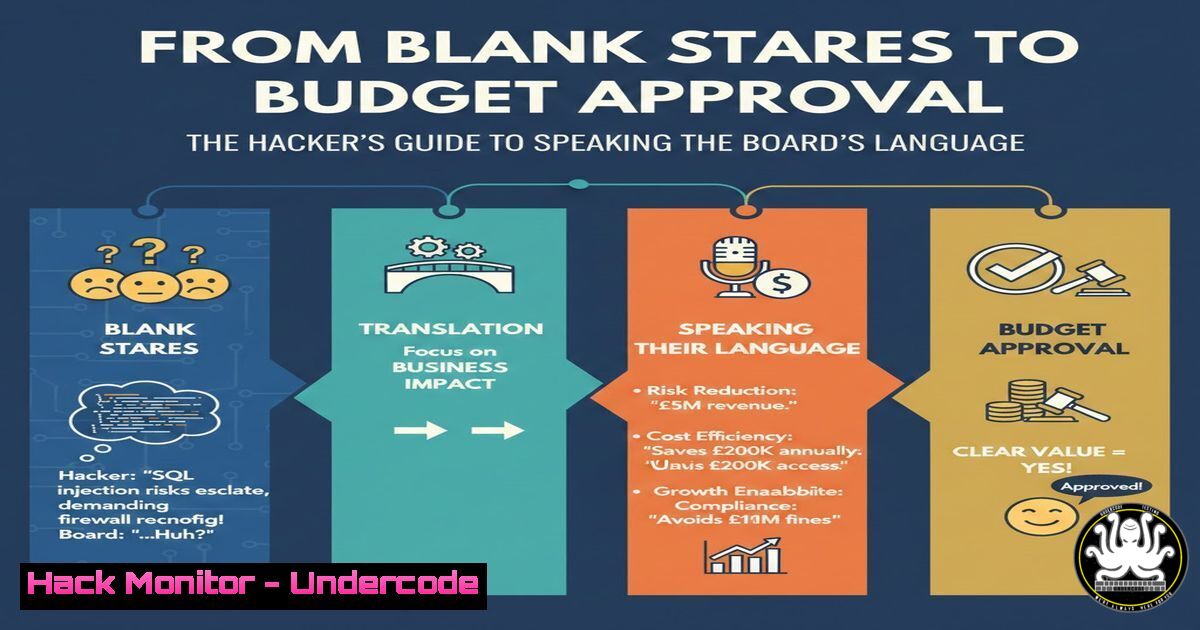
Introduction:
In the high-stakes world of cybersecurity and IT, the most critical vulnerability often isn’t in your code or firewall—it’s the communication gap between your technical team and the executive board. When technical leaders fail to translate complex initiatives like zero-trust architecture, cloud modernization, and advanced monitoring into tangible business outcomes, critical projects stall, budgets shrink, and organizational risk skyrockets. This guide provides a tactical framework for reframing your technical expertise into the language of revenue, risk, and competitive advantage that executives demand.
Learning Objectives:
- Translate core technical security and IT projects into clear business impact statements.
- Develop and present cost-benefit analyses that align with executive priorities like revenue protection and operational efficiency.
- Implement a repeatable communication strategy to secure funding and approval for critical technical initiatives.
You Should Know:
1. Reframing Zero-Trust: From Configuration to Revenue Protection
The technical pitch often gets lost in architecture diagrams and protocol details. Executives need to understand the financial and reputational bottom line.
Step‑by‑step guide:
Technical Foundation: Zero-trust security mandates “never trust, always verify.” This involves micro-segmentation, strict identity and device verification, and least-privilege access.
Business Translation: Instead of detailing SAML or SCEP, quantify the risk. Research the average cost of a data breach in your industry (e.g., IBM’s Cost of a Data Breach Report). Map a potential breach to lost revenue, client attrition, and regulatory fines.
Actionable Pitch: “Implementing a zero-trust model directly protects an estimated $2.5M in annual revenue by mitigating the primary attack vector that led to [Competitor X]’s breach, which cost them 15% of their customer base and $1.8M in immediate remediation and fines.”
- Modernizing Infrastructure: Framing Tech Debt as a Cost Center
Legacy systems are a technical burden, but the board hears “expensive migration.” Reframe the conversation around operational efficiency and market agility.
Step‑by‑step guide:
Technical Foundation: Modernization may involve containerization (Docker/Kubernetes), migrating to cloud-native services (AWS/Azure), or automating provisioning with IaC (Terraform).
Business Translation: Calculate current operational costs (server maintenance, downtime, manual provisioning hours). Contrast with the efficiency gains of automation and scalable cloud resources.
Actionable Pitch & Demo: “Our infrastructure modernization, using Terraform for automation, will reduce operational costs by 30% and decrease our feature deployment cycle from 12 weeks to 3. This `terraform plan` output shows the provisioning of 50 identical environments in minutes, a task that currently takes our team two weeks manually, directly accelerating time-to-revenue.”
- Justifying Advanced Monitoring: Converting Data into Financial Risk Mitigation
A request for a SIEM or EDR platform sounds like a cost. You must articulate it as an insurance policy against catastrophic financial loss.
Step‑by‑step guide:
Technical Foundation: Tools like Splunk, Elastic SIEM, or Microsoft Sentinel aggregate logs, detect anomalies, and automate threat response.
Business Translation: Quantify the cost of downtime. If your e-commerce platform generates $10K per hour, a 4-hour outage is a $40K direct loss, plus brand damage.
Actionable Pitch & Configuration: “Implementing this SIEM solution prevents the 4-hour outages that cost us $40K each. For example, this detection rule for anomalous outbound traffic (index=firewall src_ip=10.0.0.0/8 bytes_out > 100000000 | stats sum(bytes_out) by src_ip) could have flagged the data exfiltration attempt that caused [Peer Company]’s 12-hour breach response, saving them $500K in recovery costs.”
4. The Vocabulary Shift: Building Your Business-Term Glossary
Master a new lexicon. Replace technical jargon with executive-focused terminology.
Step‑by‑step guide:
Do Not Say: “We need to patch these CVEs and implement MFA.”
Do Say: “This is a critical risk mitigation and client trust initiative. Patching these specific vulnerabilities (CVE-2023-XXXXX) prevents a breach vector responsible for 32% of ransomware incidents this year, directly protecting client data. Implementing MFA is a low-cost control that satisfies our cyber insurance requirements and prevents credential-based attacks that lead to operational disruption.”
Practice Exercise: Take your last three project proposals. For each technical bullet point, write a corresponding “Business Impact” bullet using terms like Revenue Protection, Cost Reduction, Risk Mitigation, Competitive Advantage, Client Experience, Operational Efficiency.
5. Building Your Business Case: The One-Page Dashboard
Condense your technical proposal into a single, compelling page that speaks to the C-suite.
Step‑by‑step guide:
- Clear business outcome (e.g., “Project Sentinel: Reducing Financial Exposure from Cyber Events”).
- Executive Summary: Three sentences on the “why,” tied to strategic goals.
- Current Risk/Cost: Quantified in dollars and business terms.
- Proposed Solution: Briefly named, with key components (e.g., “Cloud-Native SIEM, Automated Threat Hunting”).
- Investment & ROI: Total cost, timeline, and quantified return (e.g., “$250K investment; Projects $1.2M annual risk reduction via downtime/prevention”).
- Key Metrics for Success: 3-5 business KPIs (e.g., “Mean Time to Detect (MTTD) reduced to <30 mins,” “Projected annual cost of incidents reduced by 60%”).
What Undercode Say:
– Translation is a Core Security Control. The inability to communicate technical risk in business terms is a critical vulnerability in itself, leading to underfunded defenses and unmitigated risks. Your expertise is worthless if it remains siloed.
– The “So What?” Test. For every technical detail, relentlessly ask “So what does this mean for the business?” If the answer isn’t revenue, cost, risk, clients, or advantage, it doesn’t belong in your boardroom presentation.
+ Analysis: The discussion highlights a paradigm shift. The most effective CISOs and tech leaders are not the deepest technical experts, but the best translators and influencers. They function as business executives who specialize in risk, using technical knowledge to inform strategy rather than lead with it. This requires moving from a mindset of “building the perfect system” to “managing acceptable business risk.” The commentary correctly notes this is a two-way street—executives must also learn to ask better questions—but the onus remains on technical leadership to initiate and drive this alignment by speaking the language of the business they are paid to protect.
Prediction:
The future of cybersecurity and IT leadership will belong to hybrid professionals who are technically competent but business-fluent. As AI and automation handle more routine technical tasks, the premium will shift to professionals who can interpret AI-driven threat intelligence, automated system outputs, and complex architectures into strategic business decisions. We will see the rise of “Risk Translators” as a formal role, and technical certifications will increasingly incorporate business communication and financial analysis modules. Organizations that fail to bridge this gap will experience not only higher cyber risk but also a strategic disadvantage, as their technical teams remain disconnected from—and unable to accelerate—core business objectives.
▶️ Related Video (80% Match):
🎯Let’s Practice For Free:
IT/Security Reporter URL:
Reported By: Wilklu If – Hackers Feeds
Extra Hub: Undercode MoN
Basic Verification: Pass ✅


