Listen to this Post
Introduction:
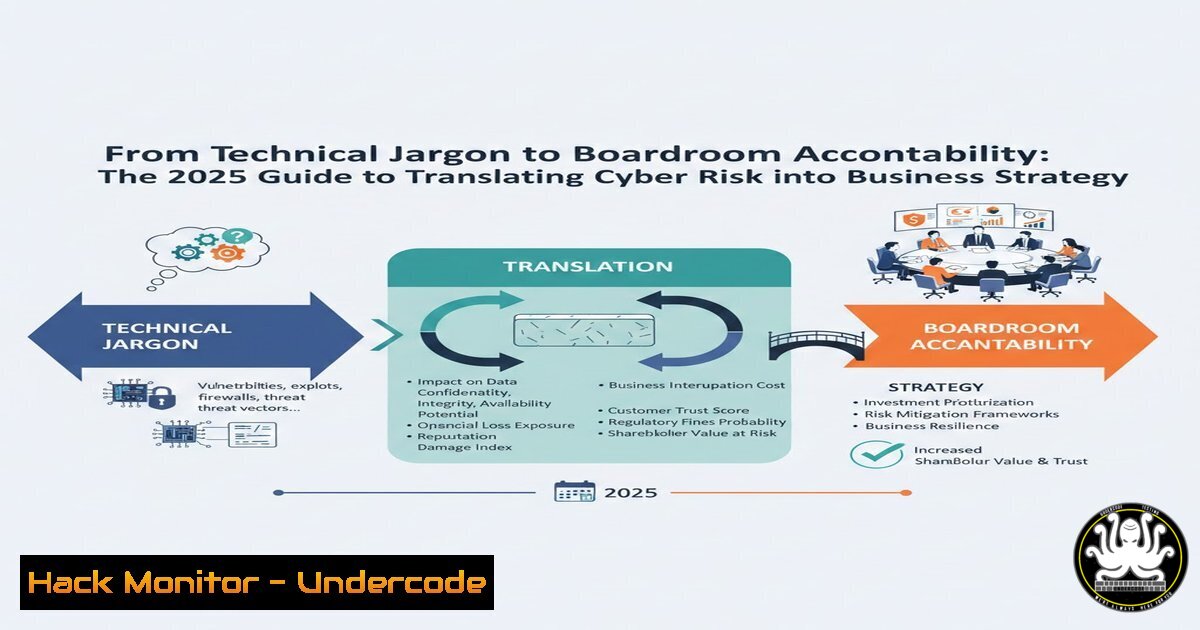
The persistent gap between an organization’s technical cybersecurity defenses and its strategic governance has emerged as the single greatest vulnerability in the modern threat landscape. As highlighted by the National Cybersecurity Strategy Guide 2025, catastrophic incidents are seldom due to a lack of tools but are instead born from governance blind spots and a fundamental failure to communicate cyber risk in terms of business continuity, liability, and trust. This article provides a technical and procedural roadmap for security professionals to bridge this divide, transforming cyber risk from an IT discussion into a core boardroom imperative.
Learning Objectives:
- Translate technical vulnerabilities and security postures into clear business impacts for executive leadership.
- Implement practical, technical controls that directly address governance gaps in incident response and strategic planning.
- Deploy auditing and demonstration tools to quantitatively show risk exposure and the value of security investments.
You Should Know:
- From CVSS to Cash: Translating Technical Vulnerabilities into Financial Risk
The executive mind operates on ROI, liability, and reputational capital. Your vulnerability scanner’s “Critical 9.8” rating is meaningless without context. The step is to map technical findings to business processes.
Step-by-step guide:
- Identify Critical Assets: Use tools like `nmap` and asset management platforms to inventory systems hosting sensitive data or critical applications.
Example: Discover hosts and services on your network segment
nmap -sV -O --top-ports 100 192.168.1.0/24 -oA network_scan
- Map to Business Impact: For each critical asset, document the business process it supports (e.g., “Payroll Server > Employee Payments > Financial Operations & Compliance”).
- Quantify the Impact: Use a simple formula:
Downtime Cost = (Hourly Revenue Impact x Mean Time to Recovery (MTTR)) + (Recovery Labor Costs) + (Regulatory Fines). Present a vulnerability not as “Apache Struts flaw,” but as “A vulnerability in our customer portal that could lead to a 72-hour outage, impacting approximately $2.1M in daily revenue and triggering GDPR investigation penalties.” -
Building the Governance Backbone: Technical Enforcement of Security Policies
Governance gaps often exist because policies are documents, not enforced rules. Your technical architecture must codify them.
Step-by-step guide:
- Enforce Least Privilege: Implement Just-In-Time (JIT) and Just-Enough-Access (JEA) models. In Windows, use PowerShell JEA to create constrained endpoints.
Create a JEA session configuration file limiting a user to specific commands
New-PSSessionConfigurationFile -Path .\HelpDeskJEA.pssc -SessionType 'RestrictedRemoteServer' -VisibleCmdlets 'Get-Service', 'Restart-Service'
Register-PSSessionConfiguration -Path .\HelpDeskJEA.pssc -Name 'HelpDesk'
-
Automate Compliance Auditing: Use open-source tools like `Lynis` for Linux or `Osquery` cross-platform to continuously check system hardening against your policy.
Run a comprehensive security audit on a Linux system
sudo lynis audit system
Use Osquery to check for unexpected listening ports
osqueryi "SELECT  FROM listening_ports WHERE port NOT IN (22, 443, 80);"
-
Simulating to Illuminate: Crafting Credible Crisis Scenarios for the C-Suite
Abstract risk is ignored. Tangible, plausible scenarios are remembered. Build interactive demonstrations.
Step-by-step guide:
- Design a Scenario: Based on real TTPs (Tactics, Techniques, and Procedures), craft a story like “Ransomware via Phish -> Lateral Movement -> ERP System Encryption.”
- Stage a Controlled Demonstration: In an isolated lab, use a framework like `CALDERA` or `Atomic Red Team` to safely execute the attack chain.
Example using Atomic Red Team to simulate credential dumping (Linux)
curl -s https://raw.githubusercontent.com/redcanaryco/atomic-red-team/master/atomics/T1003.008/T1003.008.md | sh
-
Present the Business Timeline: Show a parallel timeline: “At 10:05 AM, the accounting user clicks. By 10:30 AM, data is exfiltrated. By 12:00 PM, production is encrypted. Our current estimated MTTR is 96 hours. Here is the projected financial impact.”
-
Bridging the Perception Gap: Dashboards That Speak the Language of Leadership
Replace SIEM alerts with executive dashboards. Focus on business KPIs: Mean Time to Contain (MTTC), critical systems at risk, and insurance premium impact.
Step-by-step guide:
- Ingest Key Logs: Ensure logs from critical business apps (ERP, CRM) flow into your central log management (e.g., Elastic Stack, Splunk).
- Build Business-Focused Visualizations: Create dashboards that answer executive questions.
Widget 1: “Top 5 Business Processes by Current Risk Score.”
Widget 2: “Trend of Mean Time to Acknowledge (MTTA) Incidents – Last Quarter.”
Widget 3: “Simulated Financial Impact of Top Threat Scenario.” -
Automate Report Generation: Use APIs from your security tools to generate weekly PDF briefs for the board, auto-populated with the above metrics.
-
Hardening the Human Perimeter: Technical Controls for the “Greatest Flaw”
As noted in the discussion, the human element is paramount. Move beyond annual training to technical enforcement and measurement.
Step-by-step guide:
- Implement Phish-Resistant MFA: Enforce FIDO2/WebAuthn security keys for all admin and high-risk access. Disable weaker MFA methods like SMS.
- Apply Application Allow-Listing: Use Windows Defender Application Control (WDAC) or similar tools to block unauthorized executables.
Generate a WDAC policy based on installed software
New-CIPolicy -Level Publisher -FilePath '.\InitialPolicy.xml' -UserPEs -Fallback Hash
ConvertFrom-CIPolicy -XmlFilePath '.\InitialPolicy.xml' -BinaryFilePath '.\InitialPolicy.bin'
- Measure Security Culture: Deploy safe phishing simulations and track click rates per department. Correlate this data with help desk ticket volumes for compromised accounts to present a data-driven case for behavioral security investment.
What Undercode Say:
- The Bridge is Built with Code, Not Just Words: Effective governance requires technical enforcement—scripts, configurations, and automated policies that turn strategic decisions into operational reality. JEA, WDAC, and compliance-as-code are your tools.
- Risk Must Be Demonstrated, Not Just Described: Executive buy-in is secured through credible, tangible demonstrations of failure modes. Isolated labs running frameworks like Atomic Red Team are essential for translating abstract threats into memorable business narratives.
The analysis from the source post and subsequent comments reveals a multifaceted crisis: a disconnect in language, perception, and value attribution. Technicians must evolve into translators and architects. The future of organizational security hinges not on the next “silver bullet” appliance, but on the security team’s ability to architect systems that inherently enforce governance, to instrument the environment in a way that speaks to the CFO, and to simulate failures that resonate with the CEO. The 2025 strategy is clear: cyber risk is business risk, and it must be managed, measured, and communicated as such, with technical rigor as its foundation.
Prediction:
Organizations that fail to operationalize this integration of technical security and business governance will face a stark future. They will become disproportionately vulnerable to systemic, governance-level attacks (like deep supply chain compromises or business email compromise campaigns), while simultaneously struggling with regulatory penalties and soaring cyber insurance premiums. Conversely, companies that successfully make this shift will see cybersecurity mature from a cost center into a demonstrable competitive advantage—enhancing resilience, customer trust, and operational integrity. The role of the CISO will irrevocably shift from a technical manager to a strategic business enforcer, accountable for quantifying and mitigating existential digital risk.
▶️ Related Video (76% Match):
🎯Let’s Practice For Free:
IT/Security Reporter URL:
Reported By: Chaf007 Les – Hackers Feeds
Extra Hub: Undercode MoN
Basic Verification: Pass ✅


