
Listen to this Post
Introduction:
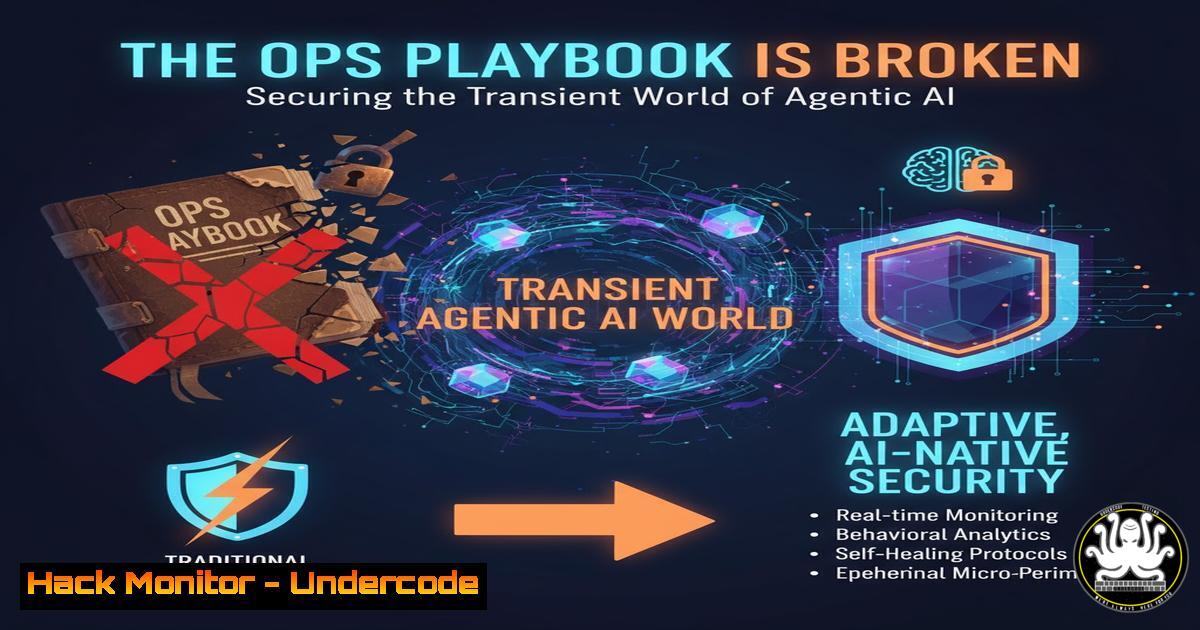
The rise of Agentic AI is dismantling traditional IT and security operations models. These dynamic, short-lived AI entities operate in a state of constant flux, spawning and terminating in seconds, which renders conventional security tools and playbooks designed for stable systems obsolete. This new paradigm demands a fundamental shift in how we approach monitoring, identity, and infrastructure hardening to prevent a cascade of novel security vulnerabilities.
Learning Objectives:
- Understand the unique security challenges posed by transient, non-persistent Agentic AI systems.
- Learn critical commands and techniques for securing cloud-native environments where AI agents typically operate.
- Develop a strategy for implementing zero-trust and behavioral analysis in a dynamic AI ecosystem.
You Should Know:
1. The Identity Crisis: Securing Ephemeral Service Principals
AI agents don’t log in with usernames and passwords; they operate using temporary cloud identities. An improperly scoped service account can be catastrophic.
 GCP: Check what permissions a service account has
gcloud projects get-iam-policy $PROJECT_ID --flatten="bindings[].members" --format="table(bindings.role)" --filter="bindings.members:serviceAccount:${SERVICE_ACCOUNT_EMAIL}"

AWS: List policies attached to an IAM role
aws iam list-attached-role-policies --role-name ${AGENT_EXECUTION_ROLE}
Step-by-step guide:
- Never use long-lived service account keys. Instead, leverage Workload Identity in GCP or IAM Roles for Service Accounts in AWS.
- Use the `gcloud` command above to audit the effective permissions of a service account. Look for overly permissive roles like `roles/editor` or
roles/owner. - In AWS, use the `aws iam` command to list policies attached to the execution role your agent assumes. Adhere to the principle of least privilege, granting only the specific API actions needed.
2. Container Hardening for Agent Execution
Most agents run in containers. A vulnerable base image is a primary attack vector.
 Scan a container image for vulnerabilities using Trivy
trivy image --severity HIGH,CRITICAL ${YOUR_AGENT_IMAGE}

Check a running container's security profile
docker container diff ${CONTAINER_ID}
Step-by-step guide:
- Integrate `trivy image` into your CI/CD pipeline before deployment. It will list CVEs in your base image and application dependencies.
- If a critical vulnerability is found, the build should fail.
- Use `docker container diff` on a running agent to see which files it has modified. Unexpected changes could indicate a runtime compromise.
3. API Security: Guarding the Agent’s Communication Layer
Agents communicate via APIs. Unprotected endpoints are low-hanging fruit.
 Use curl to test for missing authentication on an API endpoint
curl -X POST -H "Content-Type: application/json" -d '{"query":"test"}' ${YOUR_AGENT_API_URL}

Use nmap to check for unexpectedly open ports on the host
nmap -sT -p- --min-rate 5000 ${AGENT_HOST_IP}
Step-by-step guide:
- The first `curl` command should return a `401 Unauthorized` or
403 Forbidden. If you get a200 OK, your endpoint is exposed. - Always implement robust API keys, OAuth 2.0, or mutual TLS (mTLS) for service-to-service communication.
- Regularly run the `nmap` scan to ensure only necessary ports are open on your hosts, reducing the attack surface.
4. Behavioral Anomaly Detection with Process Monitoring
You can’t profile a single agent, but you can profile the system’s behavior.
 Linux: Monitor for suspicious child process spawning
ps aux --forest

Linux: Audit process execution with auditd (check rules first)
sudo auditctl -l | grep execve
Step-by-step guide:
- The `ps aux –forest` command visualizes the process tree. Look for an agent spawning unusual children like
bash,sh,curl | bash, or cryptocurrency miners. - Configure `auditd` rules to log all `execve` syscalls (which execute programs). This creates an audit trail for forensic analysis after a detected anomaly.
- Feed these logs to a SIEM or security data lake for behavioral analysis to establish a baseline and flag deviations.
-
Cloud Logging Aggregation: Finding the Needle in a Haystack
Agent activity is logged, but across dozens of transient, distributed services.
 GCP: Query logs for a specific agent invocation
gcloud logging read "resource.type=cloud_run_revision AND jsonPayload.message:\"${AGENT_SESSION_ID}\"" --limit=10

AWS: Get the last 10 log events from a CloudWatch log group
aws logs get-log-events --log-group-name "/aws/lambda/${AGENT_FUNCTION}" --log-stream-name "${STREAM}" --limit 10
Step-by-step guide:
- Structure your agent code to generate a unique `SESSION_ID` or `CORRELATION_ID` for each invocation.
- Use the `gcloud logging read` or `aws logs get-log-events` commands to trace the entire lifecycle of a single, suspicious agent session across all services.
- Ensure all relevant services (API gateways, compute instances, serverless functions) are writing to a centralized logging service.
6. Infrastructure as Code (IaC) Security
The environment agents run in is defined by code. A misconfiguration in a template is a systemic vulnerability.
 Scan Terraform code for misconfigurations with tfsec
tfsec .

Check for Kubernetes manifest vulnerabilities with kube-score
kube-score score deployment.yaml
Step-by-step guide:
- Run `tfsec` against your Terraform codebase as part of your pre-commit hooks or pull request checks. It will flag unsafe settings, like public S3 buckets or overly permissive firewall rules.
- Use `kube-score` to perform a static code analysis of your Kubernetes manifests. It checks for best practices like specifying resource limits and liveness probes, which are critical for agent stability and security.
- Treat IaC scan failures with the same severity as application code vulnerabilities.
7. Zero-Trust Network Policies in Kubernetes
In a cluster running multiple agents, east-west movement is a key risk.
 A sample Kubernetes NetworkPolicy to isolate an agent namespace
apiVersion: networking.k8s.io/v1
kind: NetworkPolicy
metadata:
name: deny-all-in-default
namespace: agent-namespace
spec:
podSelector: {}
policyTypes:
- Ingress
- Egress
Step-by-step guide:
- Apply the above NetworkPolicy as a default in your agent namespace. It is a “default-deny” rule, blocking all traffic.
- Create additional, explicit NetworkPolicy rules to allow only the necessary communication paths for your agents. For example, allow egress to a specific vector database on port 5432.
- This “default-deny, whitelist-only” approach significantly contains the blast radius if a single agent is compromised.
What Undercode Say:
- The perimeter for Agentic AI is identity, not the network. Over-permissioned service accounts are the new unlocked doors.
- Observability is the new prevention. Without comprehensive, correlated logs, you are flying blind in an environment designed for opacity.
The traditional security model of “build a wall and protect what’s inside” is completely inverted. Agentic systems are a swirling mass of temporary processes where the only constant is change. Security teams must stop trying to map every agent and instead focus on hardening the immutable layers: the underlying cloud permissions, the container images, and the network policies. The goal shifts from preventing a breach to ensuring that when a breach inevitably occurs—due to the immense attack surface—its impact is contained and its activity is immediately visible. The playbook isn’t just broken; it needs to be burned and rewritten from the ground up with transience as the core assumption.
Prediction:
Within two years, we will see the first major software supply chain attack propagated through a network of compromised Agentic AI systems. A malicious agent will poison a data source or model, which will then be automatically ingested and activated by thousands of other downstream agents, creating a self-propagating “AI worm.” This will force the rapid adoption of code-signing for agent artifacts, mandatory integrity checks for inter-agent communication, and the rise of “AI Forensics” as a critical cybersecurity discipline.
🎯Let’s Practice For Free:
IT/Security Reporter URL:
Reported By: Trey Rutledge – Hackers Feeds
Extra Hub: Undercode MoN
Basic Verification: Pass ✅


