Listen to this Post
Introduction:
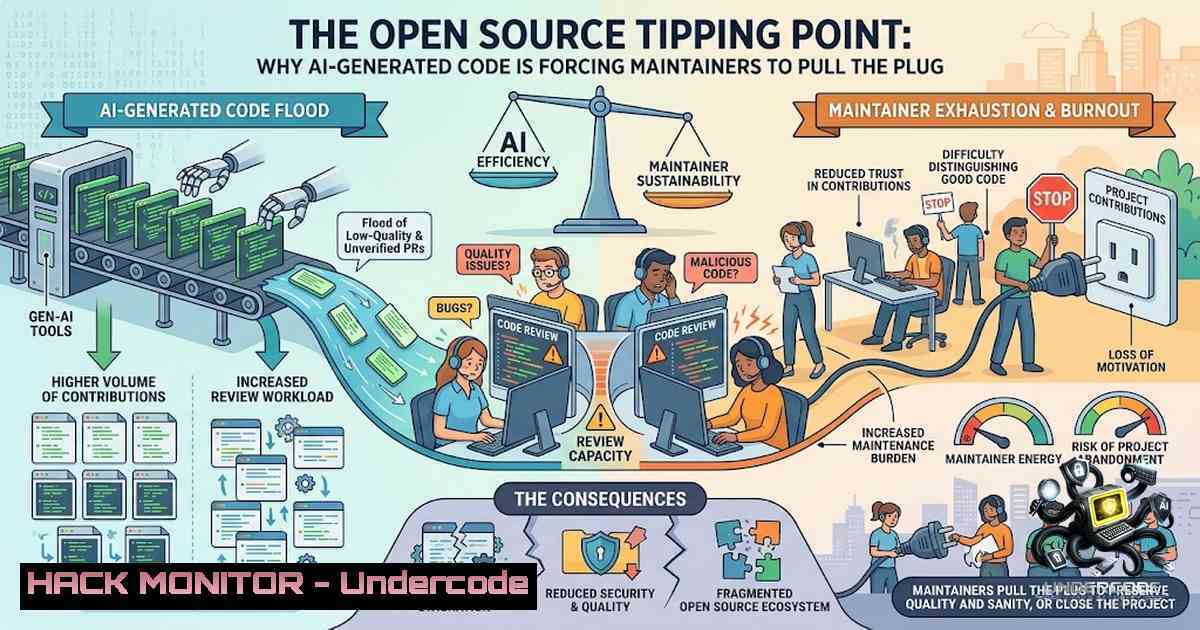
The open source ecosystem, long powered by the implicit social contract between maintainers and contributors, is facing an existential crisis fueled by AI-generated code. What was once a meritocratic system where contributions required genuine effort and codebase understanding has devolved into a flood of low-quality, AI-generated pull requests that waste maintainer time, introduce security vulnerabilities, and erode trust. Projects ranging from Ghostty to cURL are now implementing zero-tolerance policies, banning AI contributions, or shutting down bug bounty programs entirely as the volume of “AI slop” overwhelms volunteer maintainers.
Learning Objectives & Secrets:
- Objective 1: Understand the Scale of the AI Contribution Crisis — Recognize how AI coding assistants have lowered the barrier to entry so dramatically that open source projects are drowning in unvetted, low-effort contributions that maintainers cannot reasonably review.
-
Objective 1 Secret Tip: Many projects are now implementing AI disclosure requirements. Ghostty requires that “if you are using any kind of AI assistance to contribute, it must be disclosed in the pull request” — and violations result in permanent bans.
-
Objective 2: Identify Security Vulnerabilities Unique to AI-Generated Code — AI models frequently hallucinate non-existent package dependencies, introduce insecure defaults, and generate code with critical vulnerabilities like SQL injection and remote code execution flaws.
-
Objective 2 Secret Tip: AI-generated code often contains “slopsquatting” vulnerabilities — attackers create malicious packages on PyPI and npm using names that AI models commonly hallucinate. In one study, roughly 20% of AI-generated Python and JavaScript code samples recommended packages that didn’t exist.
-
Objective 3: Implement Defensive Controls for AI-Generated Code — Organizations must layer human review, static analysis, and AI-specific security scanning to catch vulnerabilities before they reach production.
-
Objective 3 Secret Tip: Lowering AI “temperature” settings reduces hallucinations. The same study showed that 58% of hallucinated packages were repeated across multiple runs, making them predictable attack vectors.
You Should Know:
- The AI Slopageddon: Real-World Impact on Open Source
The open source community is experiencing what industry analysts have dubbed “AI Slopageddon.” Mitchell Hashimoto’s Ghostty implemented a zero-tolerance policy where submitting bad AI-generated code results in permanent bans. cURL, the ubiquitous command-line tool that powers much of the internet, shut down its bug bounty program after six years and $86,000 in payouts because AI-generated reports made the program unsustainable. The Open Transit Software Foundation now reserves the right to “close any pull request that looks or feels like it was generated by an AI without further explanation” — contributors who repeatedly submit AI-generated work face bans.
Projects like Quarkus explicitly state that “submitting code, tests, comments, discussions or issues that appear to be copied directly from an AI with little or no human oversight is not acceptable”. The Typescript-Go project requires AI disclosure and warns that PRs submitted without disclosure “will be closed without review”. This represents a fundamental shift in how open source operates — the era of “open contribution” as we know it may be ending.
Step-by-Step Guide: Auditing Your Project for AI-Generated Contributions
To protect your open source project from AI-generated spam:
- Establish a clear AI policy — Create an `AI_POLICY.md` in your repository root stating whether AI-generated contributions are accepted, what disclosure is required, and the consequences for violations.
-
Enable branch protection rules — Require pull request reviews and status checks before merging. In GitHub: Settings → Branches → Add rule → Require pull request reviews before merging.
-
Implement automated detection — Use tools like the aeon AI Spam label handler that automatically closes PRs flagged as AI-generated.
-
Monitor contribution patterns — Watch for sudden spikes in PR volume, generic commit messages, or code that appears “too clean” with excessive comments explaining obvious functionality.
-
Consider contributor restrictions — GitHub may soon allow maintainers to limit pull requests to specific contributor groups.
2. The Security Nightmare: AI-Generated Vulnerabilities in Production
The security implications of AI-generated code are severe and growing. In August 2025, eight malicious Nx and Nx Powerpack releases were pushed to npm and were live for over five hours before removal. The root cause? A flawed GitHub Actions CI workflow contributed via a pull request estimated to have been generated by Claude Code. The malicious commit modified the CI workflow to send npm tokens to an attacker-controlled server. The payload weaponized local AI coding agents (Claude, Gemini, and Q) via dangerous prompts to inventory sensitive files and exfiltrate secrets, credentials, and sensitive data. This is likely one of the first documented cases of malware leveraging AI assistant CLIs for reconnaissance and data exfiltration.
The PlotAI vulnerability (CVE-2025-3248, CVSS 9.8 Critical) demonstrates another attack vector — lack of validation of LLM-generated output allows attackers to execute arbitrary Python code via remote code execution. The vendor’s “fix” was simply commenting out the vulnerable line, requiring users to uncomment it and accept the risk.
Step-by-Step Guide: Securing Your CI/CD Pipeline Against AI-Generated Malware
Protect your development pipeline from AI-generated attacks:
- Scan all pull requests — Use AI-specific security scanners like Vaultace CLI:
npm install -g vaultace-cli
vaultace auth login
vaultace scan
vaultace fix auto
Vaultace provides AI-powered vulnerability detection specifically for code generated by ChatGPT, GitHub Copilot, Claude, and other AI coding assistants.
-
Integrate AI-BOM scanning — Track AI/LLM components in your codebase with GitHub Actions:
name: AI-BOM Scan
on: [push, pull_request]
jobs:
scan:
runs-on: ubuntu-latest
steps:</p></li>
</ol>

<p>- uses: actions/checkout@v4
- name: AI-BOM Scan
uses: Trusera/ai-bom@main
This continuously discovers and inventories AI/LLM components.
- Never hardcode secrets — Always pass API keys via environment variables or repository secrets. In GitHub Actions:
env:
OPENAI_API_KEY: ${{ secrets.OPENAI_API_KEY }}
Never store them in pipeline files.
- Implement agent security scanning — Use tools like g0 for AI agent security:
name: AI Agent Security
on: [push, pull_request]
jobs:
security:
runs-on: ubuntu-latest
steps:</li>
</ol>

- uses: actions/checkout@v4
- name: AI Agent Security Scan
uses: guard0-ai/g0@main
This catches AI security issues before they reach production.
- Monitor for malicious CI modifications — Regularly audit your CI workflow files for unexpected changes that could expose tokens or secrets.
-
The AI Code Review Problem: Tools That Catch (and Miss) Vulnerabilities
A comprehensive 2025 field test of GenAI code review tools against 240 seeded security defects revealed sobering results. Aggregate precision has improved, but hallucinations still average 18% across the field, and no tool cleared 70% recall on injection-class bugs. CodeRabbit led overall recall at 64%, followed by Claude Sonnet 4.5 at 61%, Copilot Code Review at 54%, Qodo Merge at 49%, and CodeGuru at 41%.
Every tool performed well on obvious SQL and command injection (above 80%) but poorly on authorization flaws requiring request context understanding (below 30%). Business-logic defects averaged just 21% recall. However, when project context was provided via a CLAUDE.md-style project brief describing the authorization model, recall on business-logic issues rose from 24% to 51%. This replicates findings from Google’s 2025 SECL benchmark: roughly 2,000 tokens of project intent improves recall on logic bugs by roughly 2x.
Step-by-Step Guide: Building a Multi-Layer AI Code Review Pipeline
- Layer 1: Static Analysis — Use traditional SAST tools (SonarQube, Semgrep, CodeQL) for deterministic scanning of known vulnerability patterns.
-
Layer 2: AI-Powered Review — Deploy GenAI reviewers but establish guardrails that detect and suppress hallucinated CVE references before they reach developers.
-
Layer 3: Human Review with Context — Require human approval on any AI-suggested change that touches authentication, authorization, or sensitive data paths.
-
Layer 4: Project Context Documentation — Maintain a `CLAUDE.md` or similar project brief describing your authorization model, security requirements, and business logic. This improves AI reviewer recall on logic bugs.
-
Layer 5: Dependency Verification — Never trust AI-recommended package names. Verify every dependency manually and use lockfiles with hash verification to pin packages to known, trusted versions.
-
Cisco’s Project CodeGuard: A Framework for Secure AI Coding
In October 2025, Cisco open-sourced Project CodeGuard, a security framework that builds secure-by-default rules into AI coding workflows. The framework addresses a critical gap: AI-generated code often lacks basic protections including insecure defaults, missing input validation, hardcoded secrets, outdated cryptographic algorithms, and end-of-life dependencies.
Project CodeGuard operates across the entire AI coding lifecycle: before code generation (planning and spec-driven development), during code generation (preventing issues as code is written), and after code generation (automated code review). For example, an input validation rule might suggest secure handling patterns during generation, flag unsafe input processing in real-time, and validate that proper sanitization exists in the final code. A secret management rule could prevent hardcoded credentials from being generated, alert developers when sensitive data patterns are detected, and verify that secrets are properly externalized.
Step-by-Step Guide: Implementing Project CodeGuard
1. Clone the repository:
git clone https://github.com/project-codeguard
cd project-codeguard
- Review the core security rules — Based on OWASP, CWE, and established best practices.
-
Use the automated translators — Convert rules for your AI coding agent (Cursor, Windsurf, GitHub Copilot, Claude Code).
-
Configure your AI agent — Point it to the translated ruleset for your platform.
-
Treat CodeGuard as defense-in-depth — The framework “does not guarantee that any given output is secure. We should always continue to apply standard secure engineering practices, including peer review”.
-
Windows and Linux Commands for AI Code Security
Linux/macOS Commands:
 Scan for sensitive files that AI agents might exfiltrate
find / -type f ( -1ame ".env" -o -1ame ".pem" -o -1ame "id_rsa" -o -1ame ".key" ) 2>/dev/null

Check for AI-generated code patterns (excessive comments, generic variable names)
grep -r "This function" --include=".py" --include=".js" .

Monitor for unexpected AI CLI tool execution
ps aux | grep -E "claude|gemini|q|codex"

Verify package integrity before installation (Python)
pip download --1o-deps --1o-binary :all: <package>
sha256sum <package>.tar.gz
 Compare with expected hash

Scan for hallucinated package names in requirements.txt
while read pkg; do
pip show "$pkg" > /dev/null 2>&1 || echo "Package not found: $pkg"
done < requirements.txt
Windows PowerShell Commands:
 Find sensitive files
Get-ChildItem -Path C:\ -Recurse -Include .env, .pem, .key -ErrorAction SilentlyContinue

Check for AI-generated code patterns
Select-String -Path ".py",".js" -Pattern "This function| TODO:"

Monitor for AI CLI tool processes
Get-Process | Where-Object {$_.ProcessName -match "claude|gemini|q"}

Verify npm package integrity before installation
npm view <package> dist.tarball
 Download and verify checksum
What Undercode Say:
- Key Takeaway 1: The Open Source Social Contract Is Broken. For decades, open source thrived on the implicit agreement that contributors invest time and effort in exchange for learning, resume-building, and community. AI has broken that filter — now anyone can generate plausible contributions with zero understanding, overwhelming maintainers and forcing projects to ban AI contributions entirely. The response from projects like Ghostty, cURL, and Quarkus signals a permanent shift in how open source governance operates.
-
Key Takeaway 2: AI-Generated Code Is Inherently Insecure. The Nx incident demonstrated that AI-generated code can introduce backdoors that weaponize AI assistants for reconnaissance and data exfiltration. The PlotAI vulnerability showed that AI output validation failures can lead to critical RCE vulnerabilities. And slopsquatting attacks represent a new class of supply chain risk where attackers create malicious packages based on AI-hallucinated names. Organizations cannot trust AI-generated code without rigorous, multi-layer security validation.
Analysis: The current situation represents a classic tragedy of the commons. AI tools have dramatically lowered the cost of producing code, but the cost of reviewing and maintaining that code remains with human maintainers who are already overworked and under-resourced. The solution isn’t to ban AI outright — AI-assisted development is here to stay and offers legitimate productivity gains. Instead, the industry needs a combination of technical controls (AI-specific security scanners, CI/CD guardrails, Project CodeGuard-style frameworks), policy controls (disclosure requirements, contribution guidelines, banning policies), and cultural shifts (treating AI-generated code as “draft” requiring human review, not “final” output). Organizations that fail to implement these controls will find themselves vulnerable to supply chain attacks, security breaches, and maintainer burnout.
Prediction:
- +1 The emergence of AI-specific security scanning tools (Vaultace, ai-code-security-scanner, Project CodeGuard) will create a new security sub-industry focused exclusively on validating AI-generated code. This will mature into standard DevSecOps practice within 12-18 months.
-
+1 Open source foundations will standardize AI contribution policies, creating templates that projects can adopt to reduce the burden on individual maintainers. This will help preserve the open source model while adapting to AI realities.
-
-1 The volume of AI-generated contributions will continue to overwhelm maintainers, leading to more projects shutting down bug bounty programs or closing external contributions entirely. This will reduce the security of the open source ecosystem overall.
-
-1 Slopsquatting attacks will become a major vector for supply chain compromise within the next year, as attackers capitalize on the predictability of AI-hallucinated package names.
-
-1 The “vibe coding” trend — developers generating large codebases with AI without understanding the underlying libraries — will result in major security incidents as these applications reach production. The Nx incident is likely the first of many.
-
+1 Enterprise adoption of AI coding assistants will accelerate the development of internal AI code review policies and automated validation pipelines, creating new security roles and best practices.
-
-1 Smaller open source projects without dedicated security resources will be hit hardest, as they lack the capacity to review AI-generated contributions or implement sophisticated guardrails. This will widen the security gap between well-resourced and under-resourced projects.
-
+1 GitHub and other platforms will eventually provide native tools for maintainers to block AI-generated submissions at the repository level, responding to community pressure. This will restore some control to maintainers.
-
-1 The window between AI-generated code being introduced and vulnerabilities being discovered will shrink, forcing organizations to implement real-time security monitoring in development environments rather than relying on post-production scanning.
-
+1 Security frameworks like Project CodeGuard will evolve into industry standards, with major cloud providers offering integrated AI code security as part of their development platforms.
▶️ Related Video (78% Match):
https://www.youtube.com/watch?v=-7XE15p02wQ
🎯Let’s Practice For Free:
🎓 Live Courses & Certifications:
Join Undercode Academy for Verified Certifications
🚀 Request a Custom Project:
Secure, high-velocity infrastructure and disruptive technological engineering. Contact our engineering team for high-tier development and proprietary systems:
[email protected]
💎 Smart Architecture | 🛡️ Secure by Design | ⭐ Trusted by ThousandsIT/Security Reporter URL:
Reported By: https://lnkd.in/p/eFnqKvAx – Hackers Feeds
Extra Hub: Undercode MoN
Basic Verification: Pass ✅🔐JOIN OUR CYBER WORLD [ CVE News • HackMonitor • UndercodeNews ]
📢 Follow UndercodeTesting & Stay Tuned:
- Never hardcode secrets — Always pass API keys via environment variables or repository secrets. In GitHub Actions:


