Listen to this Post
Introduction:
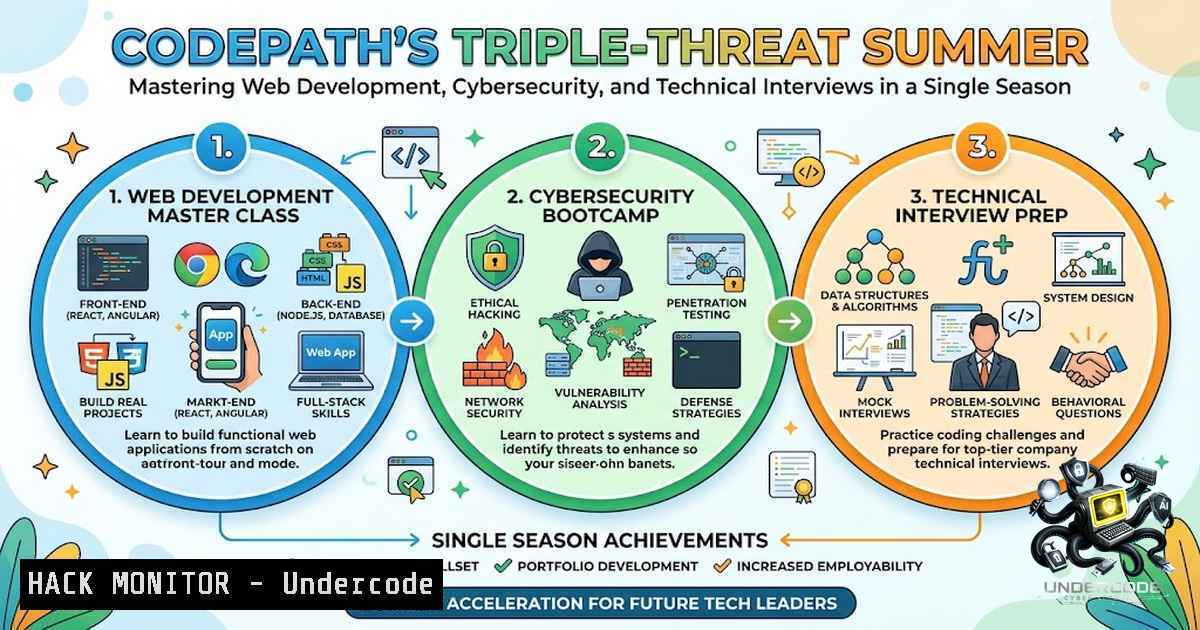
The modern tech landscape demands a trifecta of skills: the ability to build functional web applications, the foresight to secure them against emerging threats, and the algorithmic problem-solving prowess to pass rigorous technical interviews. In a single, intensive 10-week summer program, students at CodePath tackled all three domains simultaneously, navigating 8 hours of weekly Zoom instruction and over 10 hours of independent work. This convergence of web development, cybersecurity fundamentals, and interview preparation represents a new paradigm in accelerated technical education, where AI-driven security threats and structured problem-solving frameworks like UMPIRE are becoming essential components of a developer’s toolkit.
Learning Objectives & Secrets:
- Objective 1: Build Production-Ready Web Applications – Master responsive design and client-side coding by constructing interactive user interfaces using HTML, CSS, and modern JavaScript. The secret tip: go beyond static pages; integrate event listeners, animations, and DOM manipulation to create dynamic, engaging experiences that mimic real-world applications.
- Objective 2: Demystify Autonomous Hacking Agents – Explore how automation and AI are revolutionizing offensive security. The secret tip: understand that AI agents can now autonomously perform reconnaissance, exploitation, and privilege escalation. Focus on how these agents use large language models (LLMs) to reason and plan attacks, and learn to use defensive AI tools to detect and respond to threats 2x faster.
- Objective 3: Ace Technical Interviews with the UMPIRE Framework – Sharpen data structures, algorithms, and Python skills using a structured approach. The secret tip: the UMPIRE method (Understand, Match, Plan, Implement, Review, Evaluate) is not just for coding problems—it’s a communication framework. Narrate your thought process out loud during mock interviews to demonstrate your reasoning, not just your final solution.
You Should Know:
- Building and Styling Web Pages with HTML, CSS, and JavaScript
Creating a functional web page is the first step toward full-stack development. CodePath’s introductory web development course emphasizes building responsive, interactive sites from scratch. Here’s a practical guide to setting up a basic interactive page:
- Step 1: Structure with HTML. Create the skeleton of your page using semantic elements like
<header>,<main>, and<footer>. - Step 2: Style with CSS. Use Flexbox for layout and add colors, fonts, and spacing to make the page visually appealing.
- Step 3: Add Interactivity with JavaScript. Use event listeners to respond to user actions like clicks or form submissions.
- Step 4: Deploy and Test. Use platforms like Replit for initial development and testing.
Example Code Snippet (JavaScript Event Listener):
document.getElementById('myButton').addEventListener('click', function() {
alert('Button clicked!');
});
This simple interaction forms the basis of more complex web applications, leading to full-stack apps with React, Node.js, Express, and PostgreSQL.
2. Exploring Cybersecurity Fundamentals: Linux, SSH, and Metasploit
Cybersecurity education at CodePath begins with system basics: the Linux command line, SSH, RDP, and Public Key Infrastructure (PKI). Hands-on labs often involve penetration testing with tools like Metasploit.
- Step 1: Set Up a Lab Environment. Use a virtual machine (VM) or cloud instance to practice safely. CodePath provides VM setup scripts for this purpose.
- Step 2: Master the Linux Command Line. Learn essential commands for navigation, file management, and process monitoring.
- Step 3: Practice with Metasploit. Use the framework to simulate exploits against known vulnerabilities in a controlled environment.
- Step 4: Understand Password Hashing and Access Control. Analyze the pros and cons of different password storage mechanisms.
Essential Linux Commands:
 Navigate directories
cd /var/log
 List files with details
ls -la
 Check network connections
netstat -tuln
 Secure shell into a remote server
ssh [email protected]
These foundational skills are critical for understanding both offensive and defensive security postures.
3. Harnessing AI for Autonomous Security Operations
The integration of AI into cybersecurity marks a fundamental shift. Autonomous AI agents, powered by advanced machine learning and LLMs, are now capable of executing the full spectrum of offensive operations. Frameworks like RedOps AI use a supervisor-agent model where a central AI delegates tasks to specialized sub-agents for reconnaissance, scanning, and exploitation.
- Step 1: Understand the Threat. Recognize that AI-driven worms can autonomously navigate and attack networks, exploiting flaws and misconfigurations.
- Step 2: Implement Defensive AI. Use AI as a planning partner and research assistant to detect and respond to threats faster.
- Step 3: Practice with AI Tools. Explore open-source frameworks like Raptor, which can generate both vulnerability exploits and patches.
- Step 4: Stay Updated. The landscape is evolving rapidly; continuous learning is essential to keep pace with new attack vectors.
4. Mastering Technical Interviews with the UMPIRE Method
The UMPIRE method is a structured approach to solving coding problems and is central to CodePath’s technical interview preparation. It consists of six phases:
- U – Understand: Clarify the problem by asking questions and identifying input/output types and edge cases.
- M – Match: Relate the problem to known categories (e.g., arrays, strings, trees, graphs).
- P – Plan: Create pseudocode or diagrams to outline the solution.
- I – Implement: Write clean, readable code based on your plan.
- R – Review: Test your code against sample cases and debug.
- E – Evaluate: Analyze the time and space complexity of your solution.
Example Python Implementation for a Common Problem (Two Sum):
def two_sum(nums, target):
seen = {}
for i, num in enumerate(nums):
complement = target - num
if complement in seen:
return [seen[bash], i]
seen[bash] = i
return []
Practicing this method with mock interviews helps build the confidence and communication skills needed to succeed in internship and full-time role interviews.
5. Integrating Full-Stack Development with Security
Modern web development is incomplete without security considerations. CodePath’s advanced web development course covers building full-stack, database-driven applications with user authentication and security. This involves:
- Step 1: Implement Authentication. Use secure methods for user login and session management.
- Step 2: Secure APIs. Protect against common vulnerabilities like SQL injection and cross-site scripting (XSS).
- Step 3: Deploy with Confidence. Use environment variables for sensitive data and ensure your application is configured securely.
Example Node.js/Express Authentication Snippet:
const bcrypt = require('bcrypt');
const saltRounds = 10;
app.post('/register', async (req, res) => {
const hashedPassword = await bcrypt.hash(req.body.password, saltRounds);
// Store hashedPassword in database
});
This integration of development and security skills is what makes graduates attractive to top tech companies.
What Undercode Say:
- Key Takeaway 1: The convergence of web development, cybersecurity, and interview preparation in a single program is not just efficient—it’s essential. Modern developers must be able to build, secure, and articulate their solutions.
- Key Takeaway 2: AI is not just a tool for attackers; it’s a powerful ally for defenders. Learning to leverage AI for both offensive and defensive security operations is a critical skill for the future.
Analysis:
The model of simultaneous, intensive training across multiple domains reflects the reality of the tech industry. Employers are not looking for siloed specialists but for versatile engineers who can navigate the full software development lifecycle. The emphasis on structured problem-solving (UMPIRE) and hands-on cybersecurity labs ensures that students are not just passive learners but active practitioners. The inclusion of AI in the curriculum is particularly forward-thinking, preparing students for a landscape where autonomous agents will play an increasingly significant role in both attacks and defenses. This approach not only accelerates career readiness but also fosters a mindset of continuous learning and adaptability.
Prediction:
- +1 The integration of AI into cybersecurity education will lead to a new generation of defenders who are as adept at using AI for protection as attackers are for exploitation, creating a more balanced and resilient security ecosystem.
- +1 Structured problem-solving frameworks like UMPIRE will become standard in technical interviews, shifting the focus from rote memorization to demonstrated problem-solving and communication skills.
- -1 The rise of autonomous hacking agents will outpace the development of defensive countermeasures, leading to a period of increased vulnerability before AI-driven defense tools become widely adopted.
- -1 The intensity of programs like CodePath’s summer session may not be sustainable for all students, potentially creating a barrier to entry for those who cannot commit to such demanding schedules.
▶️ Related Video (80% Match):
🎯Let’s Practice For Free:
🎓 Live Courses & Certifications:
Join Undercode Academy for Verified Certifications
🚀 Request a Custom Project:
Secure, high-velocity infrastructure and disruptive technological engineering. Contact our engineering team for high-tier development and proprietary systems:
[email protected]
💎 Smart Architecture | 🛡️ Secure by Design | ⭐ Trusted by Thousands
IT/Security Reporter URL:
Reported By: https://lnkd.in/p/eGHjQ9zR – Hackers Feeds
Extra Hub: Undercode MoN
Basic Verification: Pass ✅


