Listen to this Post
Introduction:
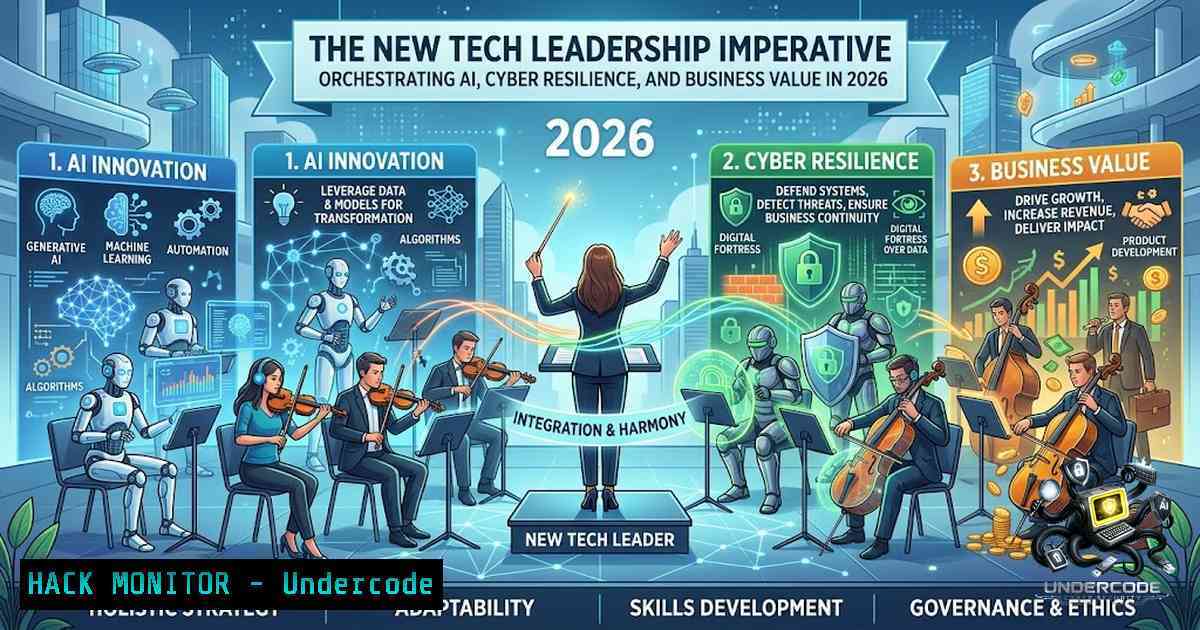
The role of technology leadership has undergone a structural shift. In 2026, the idea of “completing” a digital transformation is dead—the work never ends because the tools, and the people attacking them, never stop changing. Technology is no longer a support function; it is the strategic backbone of every physical and digital operation. Today’s technology leaders—CIOs, CISOs, and CTOs—are no longer just technology implementers. They are business strategists, risk managers, and ecosystem orchestrators who must connect technology to business strategy, collaborate across ecosystems, manage digital and cyber risks, and create sustainable growth. As Muralidharan Ramachandran articulated at the inaugural Gujarat Chapter of Emerging Tech Leaders (ETL), this evolution demands a new leadership compact where success is measured not by transformation initiatives alone, but by measurable business outcomes.
Learning Objectives:
- Understand the evolving role of technology leadership from technical execution to strategic business orchestration
- Master the integration of AI-driven transformation with cybersecurity and digital resilience
- Implement technology governance frameworks that balance innovation with risk management
- Build trusted digital businesses through proactive security and responsible AI adoption
- Translate technology investments into measurable business value and competitive advantage
You Should Know:
- The Agentic Shift: From Chatbots to Autonomous Multi-Agent Systems
Technology leaders are moving past single-task prompts into distributed networks of AI agents that collaborate autonomously to solve complex supply chain, customer, and operational issues. Gartner predicts that 15% of day-to-day work decisions will be made autonomously by 2028. This “agentic shift” requires leaders to stop automating broken processes and instead redesign operations for a “silicon-based” workforce.
However, agentic AI introduces novel security risks. Autonomous AI systems have the potential to automate significant parts of the cyber kill chain, lowering the barrier to entry for less sophisticated threat actors and compressing attacks that previously unfolded over days into hours. The emergence of tools like OpenClaw has demonstrated how legitimate open-source agentic AI tools can be weaponised to breach development pipelines at scale.
Step-by-Step Guide: Securing AI Agent Deployments
- Apply least privilege – Give agents only the minimum access they need, for the shortest time required
- Limit scope – Constrain what an agent can access, what actions it can take, and when it can take them
- Avoid long-lived credentials – Use temporary credentials where possible and revoke elevated access when tasks are complete
- Use secure defaults – Design applications with safe configurations
- Isolate AI agents – Run agents in containerised environments. At a minimum, put them in a Docker container
- Implement kernel-level isolation – Use Linux tools like `unshare –user –1et` to create user and network namespaces, blocking `/proc` access and all network connectivity
Linux Command Example: Isolating an AI Agent Environment
 Create isolated namespace for AI agent execution
unshare --user --1et --pid --fork --mount-proc /bin/bash

Within the isolated environment, strip all environment variables
env -i /path/to/agent --config agent-config.json

For Python-based agents with filesystem isolation
nono run --allow-cwd --credential openai --rollback -- python my_agent.py
Windows Command Example: Auditing AI Agent Service Accounts
 List all service accounts with interactive logon permissions
Get-WmiObject Win32_UserAccount -Filter "LocalAccount=True" | Where-Object {$_.SID -like "S-1-5-21-"} | Format-Table Name, SID

Audit scheduled tasks that may be running AI agents
Get-ScheduledTask | Where-Object {$_.State -1e "Disabled"} | Format-Table TaskName, State
2. Preemptive Cybersecurity: Prediction Is the New Protection
Reactive security is dead. Eighty percent of current tools only tell you once the damage has begun. In 2026, the focus is on using AI to anticipate, deceive, and disrupt threats before they strike. The Five Eyes cyber security agencies have issued a united call to action: the evolving landscape of AI is rapidly transforming cyber risk, and leaders must act swiftly to remain ahead. Frontier AI models are anticipated to exceed current industry expectations, fundamentally transforming both offensive and defensive cyber capabilities—and the timeline is not years, it is months.
Gartner SRM 2026 put resilience, identity, and AI agent governance at the center of cybersecurity strategy as prevention loses ground. Organizations that measure security success by breach prevention have already lost the argument, because prevention at scale is no longer achievable. Resilience is the metric that survives contact with reality—if you can limit impact, maintain critical operations, and recover quickly, you have functionally achieved what prevention promised.
Step-by-Step Guide: Building a Preemptive Cybersecurity Program
- Shift 50% of cyber spending toward proactive AI-driven defense by 2030
- Reduce your attack surface – Limit unnecessary system access and external connectivity. Challenge whether systems need to be exposed at all and isolate those that do not
- Accelerate patching processes – AI is shortening the time between vulnerability discovery and exploitation. Delays in patching increase risk, especially for operational systems with long update cycles
- Address legacy systems – Unsupported systems are easy targets. They are not just technical debt; they are strategic liabilities
- Review and strengthen identity and access controls – Limit who can access critical systems. Enforce strong authentication and regularly review permissions
- Prepare for incidents before they happen – Test response plans, train and prepare teams, and assume breaches will occur. Focus on fast containment and recovery
- Use AI to strengthen defence – Adversaries are already using AI to move faster and more effectively. Defenders must do the same
Linux Command Example: Attack Surface Reduction
 Identify all listening ports and services
ss -tulpn | grep LISTEN
netstat -tulpn | grep LISTEN

Disable unnecessary services (RHEL/CentOS)
systemctl disable --1ow vsftpd
systemctl disable --1ow rpcbind
yum remove -y vsftpd rpcbind

Disable unnecessary services (Debian/Ubuntu)
systemctl disable --1ow vsftpd
systemctl disable --1ow rpcbind
apt-get purge -y vsftpd rpcbind

Configure firewall to restrict access (iptables)
iptables -A INPUT -p tcp --dport 22 -s 192.168.1.0/24 -j ACCEPT
iptables -A INPUT -p tcp --dport 22 -j DROP

Enable auditd for kernel-level monitoring
auditctl -e 1
auditctl -w /etc/passwd -p wa -k identity_changes
auditctl -w /etc/sudoers -p wa -k sudoers_changes
Windows Command Example: Identity and Access Hardening
 Enumerate all local users and their group memberships
Get-LocalUser | ForEach-Object { $<em>.Name; Get-LocalGroup | Where-Object { (Get-LocalGroupMember -Group $</em>.Name).Name -contains $_.Name } }

Enable Windows Defender Attack Surface Reduction rules
Set-MpPreference -AttackSurfaceReductionRules_Ids 3B576869-A4EC-41E9-A4C8-2E1B0A4C5B6E -AttackSurfaceReductionRules_Actions Enabled

Audit and restrict RDP access
Get-1etFirewallRule -DisplayGroup "Remote Desktop" | Where-Object {$_.Enabled -eq $true}
Set-1etFirewallRule -DisplayGroup "Remote Desktop" -RemoteAddress 192.168.1.0/24
3. Zero Trust Architecture: Assume Breach, Verify Everything
The Zero Trust approach has become established as the paradigm: always verify and assume that trust cannot be taken for granted. Traditional VPN architectures extend network access in ways that expose entire systems—once compromised, attackers are able to move laterally without restriction. This is particularly dangerous in environments where cloud workloads are secured but legacy access layers remain exposed.
Step-by-Step Guide: Implementing Zero Trust Architecture (NIST 800-207 Aligned)
- Define your protect surface – Identify the smallest set of critical data, assets, applications, and services (DAAS) that require protection
- Map transaction and traffic flows – Understand how data moves across your organisation to identify trust boundaries
- Architect your zero trust network – Deploy a policy enforcement point in front of every resource
- Microsegment your network – Contain lateral movement by creating granular segments
- Enforce identity-based controls – Implement least privilege architecture (LPA) and just-in-time (JIT) access to neutralise compromised credentials
- Validate device trust continuously – Never assume a device is safe based on network location
- Monitor and continuously improve – Automate policy enforcement and response
Linux Command Example: Microsegmentation with iptables/nftables
 Create isolated network segments using nftables
nft add table inet segment
nft add chain inet segment forward '{ type filter hook forward priority 0; policy drop; }'

Allow only specific service-to-service communication
nft add rule inet segment forward ip saddr 10.0.1.0/24 ip daddr 10.0.2.0/24 tcp dport 443 accept
nft add rule inet segment forward ip saddr 10.0.2.0/24 ip daddr 10.0.1.0/24 tcp dport 443 accept

Log and drop all other inter-segment traffic
nft add rule inet segment forward log prefix "SEGMENT-DROP: " drop
Windows Command Example: Implementing JIT Access
 Use PowerShell to create temporary admin access with expiration
$ExpiryTime = (Get-Date).AddHours(2)
$JITGroup = "JIT-Admins"
Add-LocalGroupMember -Group $JITGroup -Member "DOMAIN\username"

Schedule removal of JIT access using scheduled task
$Action = New-ScheduledTaskAction -Execute "powershell.exe" -Argument "-Command Remove-LocalGroupMember -Group $JITGroup -Member 'DOMAIN\username'"
$Trigger = New-ScheduledTaskTrigger -Once -At $ExpiryTime
Register-ScheduledTask -TaskName "RevokeJITAccess" -Action $Action -Trigger $Trigger
4. The CIO-CISO Compact: Co-Owners of Business Outcomes
Digital transformation no longer succeeds on technology ambition alone. It depends on whether speed, resilience, governance, and security are being shaped together from the start. The CIO-CISO equation is becoming less of a coordination exercise and more of a leadership compact. In a landscape shaped by cloud, digital products, privacy mandates, and rising cyber pressure, organisations can no longer afford a transformation agenda where technology moves first and security catches up after.
The strongest collaboration does not begin with security metrics or IT metrics in isolation. It begins with the recognition that both leaders are working against the same business roadmap. It is no longer enough to ask whether something is fast enough or secure enough. The more useful question is whether the business outcome is being delivered in a way that can withstand operational, regulatory, and trust-related pressure.
Step-by-Step Guide: Building an Effective CIO-CISO Partnership
- Establish shared KPIs – Define business outcomes as the common KPI, not separate IT or security metrics
- Integrate security into design – Security cannot remain an add-on. Embed security from the start of every initiative
- Implement DevSecOps – Development, operations, and security must work as one continuum rather than separate checkpoints
- Create shared ownership – Neither side can deliver the full outcome alone. Move beyond role boundaries to shared stewardship
- Translate risk into business terms – Convey cybersecurity risk in business language rather than technical jargon. Leaders need to make trade-offs, and they expect security teams to support those decisions with clarity
DevSecOps Pipeline Security: Verified Commands
 Example: GitHub Actions workflow with integrated security scanning
name: DevSecOps Pipeline

on:
push:
branches: [ main, develop ]
pull_request:
branches: [ main ]

jobs:
security-scan:
runs-on: ubuntu-latest
steps:
- uses: actions/checkout@v4

SAST: Source code security scanning
- name: Semgrep SAST
uses: returntocorp/semgrep-action@v1
with:
config: p/owasp-top-ten

Secrets detection
- name: TruffleHog secrets scan
uses: trufflesecurity/trufflehog@main
with:
path: ./
base: ${{ github.event.repository.default_branch }}
head: HEAD

IaC scanning
- name: Checkov IaC scan
uses: bridgecrewio/checkov-action@master
with:
directory: ./terraform
framework: terraform
output_format: cli

Container scanning
- name: Trivy container scan
uses: aquasecurity/trivy-action@master
with:
image-ref: ${{ env.IMAGE_NAME }}
format: table
severity: CRITICAL,HIGH
5. Technology Governance and the Agentic AI Framework
Singapore launched the world’s first Model AI Governance Framework for Agentic AI (MGF) in January 2026, providing comprehensive guidance for AI systems capable of autonomous planning, reasoning, and action. The framework focuses on four core dimensions: (1) assessing and bounding risks upfront, (2) making humans meaningfully accountable, (3) implementing technical controls and processes, and (4) enabling end-user responsibility.
As organisations increasingly deploy AI across enterprise networks, AI systems themselves are becoming attractive targets. Vulnerabilities in AI systems could have wider security implications beyond the AI applications themselves, making the secure deployment of AI an increasingly important priority.
Step-by-Step Guide: Implementing the MGF Four-Dimensional Approach
- Assess and bound risks upfront – Conduct use-case-specific assessments that consider agentic-specific factors such as autonomy level, access to sensitive data, and breadth of available data. Bound risks by design by limiting what agents can do through controlling their tool access, permissions, operational environments, and scope of actions
- Make humans meaningfully accountable – Allocate clear responsibilities across the AI lifecycle covering developers, deployers, operators, and end users. Implement human oversight mechanisms that can effectively override, intercept, or review agentic AI actions
- Implement technical controls and processes – Enforce least-privilege access to tools and data, test overall task execution and policy compliance before deployment, and implement real-time monitoring post-deployment
- Enable end-user responsibility – Ensure sufficient information is provided to end users through transparency measures, and educate users on proper use and oversight of agents
Linux Command Example: Securing AI System Access
 Restrict AI system API access using iptables
iptables -A INPUT -p tcp --dport 5000 -s 10.0.0.0/8 -j ACCEPT
iptables -A INPUT -p tcp --dport 5000 -j DROP

Implement filesystem isolation for AI model storage
chmod 750 /opt/ai-models
chown ai-user:ai-group /opt/ai-models

Set SELinux context for AI application
semanage fcontext -a -t httpd_sys_content_t "/opt/ai-app(/.)?"
restorecon -Rv /opt/ai-app

Enable audit logging for AI system access
auditctl -w /opt/ai-models -p rwxa -k ai_model_access
auditctl -w /opt/ai-app/logs -p wa -k ai_app_logs
Windows Command Example: AI System Hardening
 Restrict AI application network access using Windows Firewall
New-1etFirewallRule -DisplayName "Block AI App External" -Direction Outbound -Program "C:\AI\app.exe" -Action Block

Implement AppLocker policy for AI executables
Set-AppLockerPolicy -Policy "C:\AI\applocker-policy.xml" -Merge

Enable Windows Defender Application Guard for AI apps
Set-WDApplicationGuardPolicy -AllowCamera $false -AllowMicrophone $false -AllowPrinting $false
6. Building Digital Trust and Sovereign Data Strategies
Cybersecurity is no longer a technical issue. It is a strategic leadership challenge that shapes resilience, trust, and competitiveness. Trust and governance are recognised as strategic differentiators—60% view trust and governance as a strategic differentiator, yet only 28% measure operational or revenue outcomes tied to trusted AI.
There is a growing global push for data sovereignty. Technology leaders face constant pressure regarding where data lives, who owns the infrastructure, and which vendors can be trusted for the next decade. Ninety-two percent of leaders now prefer tech partners of their own nationality, and for many, a vendor’s origin is now a deal breaker. The challenge is finding the balance between strict control (necessary for regulation) and the agility provided by global cloud giants.
Step-by-Step Guide: Building Digital Trust and Data Sovereignty
- Audit your cloud footprint – Resilience now means having a localised, sovereign infrastructure strategy
- Implement data residency controls – Ensure data remains within required jurisdictions
- Adopt digital provenance tools – Invest in digital integrity as a core capability. If you can’t prove the origin of your data, you can’t trust your AI
- Align with regulators – Co-design architectures and be transparent about trade-offs rather than pushing for speed alone
- Measure trust outcomes – Track operational and revenue outcomes tied to trusted AI
Cloud Hardening Commands (AWS/Azure/GCP)
 AWS: Enable security services
aws guardduty create-detector --enable
aws securityhub enable-security-hub
aws cloudtrail create-trail --1ame security-trail --s3-bucket-1ame logs-bucket

AWS: Enforce IMDSv2
aws ec2 modify-instance-metadata-options --instance-id i-1234567890abcdef0 --http-tokens required

Azure: Enable Security Center
az security auto-provisioning-setting update --1ame default --auto-provision On

Azure: Enforce MFA for all users
az ad group create --display-1ame "MFA-Required" --mail-1ickname "MFA-Required"
az ad group member add --group "MFA-Required" --member-id "user-object-id"

GCP: Enable Cloud Security Command Center
gcloud scc muteconfigs create --organization=ORG_ID --mute-config-id=default --description="Auto-mute low findings"
- API Security and the OWASP API Top 10
As organisations build AI-1ative applications, APIs become the primary attack surface. The OWASP API Security Top 10 is increasingly referenced by PCI-DSS, HIPAA, GDPR, and DORA auditors. The most critical API risks include Broken Object Level Authorization (BOLA), Broken Authentication, and Unrestricted Resource Consumption.
Step-by-Step Guide: Securing APIs in AI-1ative Applications
- Implement strong authentication – Use OAuth2/OIDC with short-lived tokens and refresh token rotation
- Prevent BOLA – Use UUIDs or non-predictable IDs instead of sequential numbers; implement ownership checks on every request in the backend
- Apply granular rate limiting – Protect against abuse and DoS attacks
- Use TLS 1.3 – Encrypt all data in transit
- Sanitise error responses – Never expose stack traces or internal details in production
- Input validation – Validate all inputs at the API gateway level
Linux Command Example: API Gateway Rate Limiting with NGINX
 nginx.conf - Rate limiting for API endpoints
http {
 Define rate limiting zones
limit_req_zone $binary_remote_addr zone=api_limit:10m rate=10r/s;
limit_req_zone $binary_remote_addr zone=auth_limit:10m rate=5r/m;

server {
listen 443 ssl http2;
server_name api.company.com;

Apply rate limiting to API endpoints
location /api/ {
limit_req zone=api_limit burst=20 nodelay;
limit_req_status 429;
proxy_pass http://api-backend;
}

Stricter rate limiting for authentication endpoints
location /auth/ {
limit_req zone=auth_limit burst=3 nodelay;
limit_req_status 429;
proxy_pass http://auth-backend;
}
}
}
Windows Command Example: API Security with IIS
 Configure IIS request filtering and dynamic IP restrictions
Install-WindowsFeature -1ame Web-RequestFiltering, Web-DynIpRestriction

Set maximum URL length and query string length
Set-WebConfigurationProperty -Filter "system.webServer/security/requestFiltering/requestLimits" -1ame "maxUrl" -Value 4096
Set-WebConfigurationProperty -Filter "system.webServer/security/requestFiltering/requestLimits" -1ame "maxQueryString" -Value 2048

Enable IP restrictions for sensitive API endpoints
Add-WebConfigurationProperty -Filter "system.webServer/security/ipSecurity" -1ame "." -Value @{ipAddress="192.168.1.0/24";allowed="true"}
Add-WebConfigurationProperty -Filter "system.webServer/security/ipSecurity" -1ame "." -Value @{ipAddress="255.255.255.255";allowed="false"}
What Undercode Say:
- Technology leadership is no longer about managing infrastructure—it is about orchestrating business outcomes. The CIO, CISO, and CTO must operate as co-owners of business value, not siloed functional leads.
-
Resilience, not prevention, is the new metric of cybersecurity success. With AI accelerating threats and attack surfaces expanding, organisations must assume breaches will occur and focus on containment and rapid recovery.
-
The agentic AI revolution demands a governance-first approach. Singapore’s Model AI Governance Framework for Agentic AI provides a practical blueprint for deploying autonomous AI systems with safety, accountability, and transparency.
The convergence of AI, cybersecurity, and business strategy is redefining what it means to be a technology leader in 2026. The organisations that succeed will be those where technology leaders move beyond technical execution to become enterprise orchestrators—aligning priorities, integrating execution, and directing transformation coherently across interconnected systems, workflows, and decisions. Secure-by-design and secure-by-default must become standard practice, not an aspiration. The timeline for action is not years—it is months. Those who act now will build resilient, trusted digital businesses; those who delay will face growing operational and strategic disadvantage.
Prediction:
- +1 By 2028, organisations that have embedded cybersecurity into their AI transformation strategies from the start will demonstrate 40% faster recovery from incidents and 25% higher customer trust metrics than those that treat security as an add-on.
-
+1 The Model AI Governance Framework for Agentic AI will become the global benchmark for responsible AI deployment, with at least 15 countries adopting similar frameworks by 2027.
-
-1 Organisations that fail to shift 50% of their cyber spending toward proactive AI-driven defence by 2030 will face an estimated 3x higher breach costs and significantly longer recovery times.
-
-1 The widening gap between AI adoption and governance maturity will result in a 200% increase in AI-related security incidents by 2027, particularly involving prompt injection and agentic AI misuse.
-
+1 Technology leaders who successfully bridge the gap between technical execution and business strategy will command premium compensation and board-level influence, with 79% of tech leaders already citing driving enterprise value as their top priority.
-
-1 Legacy systems and unpatched vulnerabilities will remain the primary entry point for attackers, as AI shortens the window between vulnerability discovery and exploitation from weeks to hours.
-
+1 The CIO-CISO compact will evolve into a unified “Chief Digital Trust Officer” role in forward-thinking organisations, consolidating technology, security, and business strategy under single leadership.
▶️ Related Video (80% Match):
https://www.youtube.com/watch?v=2CIEkfl0sYs
🎯Let’s Practice For Free:
🎓 Live Courses & Certifications:
Join Undercode Academy for Verified Certifications
🚀 Request a Custom Project:
Secure, high-velocity infrastructure and disruptive technological engineering. Contact our engineering team for high-tier development and proprietary systems:
[email protected]
💎 Smart Architecture | 🛡️ Secure by Design | ⭐ Trusted by Thousands
IT/Security Reporter URL:
Reported By: Muralidharan Ramachandran – Hackers Feeds
Extra Hub: Undercode MoN
Basic Verification: Pass ✅


