Listen to this Post
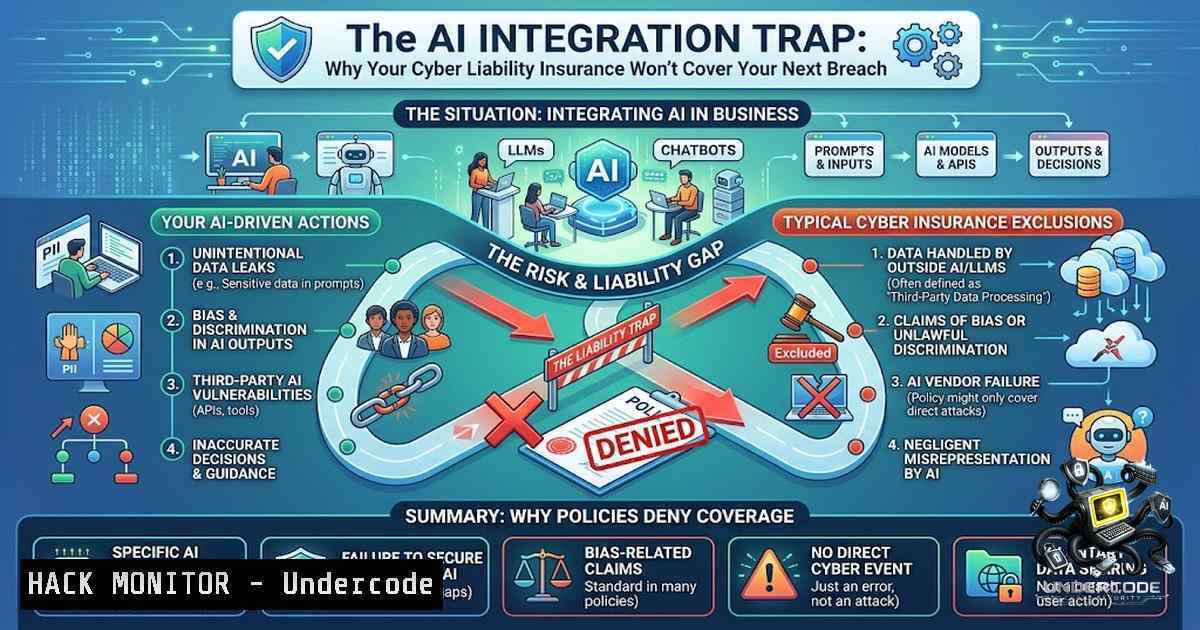
Introduction:
Small business owners are integrating artificial intelligence into their CRM and email systems at an alarming rate—often without a formal risk assessment, vendor due diligence, or even a basic understanding of how their cyber liability policy treats AI-related incidents. The hard truth, as GABN.NET’s Undercode emphasizes, is that this constitutes negligence in the eyes of insurance carriers. When a vendor connects to your data, the questions about threat vectors and data protection should start immediately—yet nine times out of ten, small business owners have already connected AI to their critical systems without asking a single question. This article breaks down the technical, legal, and operational realities of AI integration and provides actionable steps to avoid having your next cyber claim denied.
Learning Objectives:
- Understand how AI integration triggers negligence exclusions in cyber liability insurance policies
- Implement technical controls to demonstrate due diligence for AI-connected CRM and email systems
- Conduct proper vendor risk assessments and maintain auditable documentation for insurance compliance
- Configure email authentication (SPF, DKIM, DMARC) and data loss prevention for AI-generated communications
- Establish human-in-the-loop oversight and least-privilege access for AI agents
- The “Silent AI” Risk: What Your Policy Doesn’t Say
The insurance industry is rapidly evolving to address AI risks, but most policies were drafted for human-led decision-making and conventional technology failures. When AI is involved, claims can fall into grey zones, exclusions, sub-limits, or disputed interpretations—a phenomenon increasingly referred to as “silent AI” risk. This ambiguity matters because AI losses are no longer theoretical. For small and medium-sized enterprises, a single uninsured event—an error, privacy incident, regulatory investigation, or lawsuit—can be financially destabilizing.
Some carriers have introduced “absolute” exclusions that eliminate coverage for “any actual or alleged use, deployment, or development of Artificial Intelligence”. This means that a discrimination case involving an AI résumé screening tool, a negligence claim tied to an AI-driven contract review platform, or even a fiduciary duty allegation that a board failed to oversee AI risks can all be excluded. While a negligence claim for document review might be covered if conducted by a person, coverage now may be excluded if AI were involved.
Step-by-Step Guide: Auditing Your Policy for AI Exclusions
- Request your full policy wording—not just the summary—from your broker
- Search for key terms: “artificial intelligence,” “AI,” “machine learning,” “generative AI,” “automated decision-making”
- Look for exclusionary language: phrases like “any actual or alleged use” or “absolute exclusion”
- Identify “silent AI” gaps: areas where AI is neither explicitly covered nor excluded
- Document findings and schedule a review with your insurance advisor
-
Technical Due Diligence: Audit Logs, Access Controls, and Least Privilege
Insurance carriers are increasingly requiring evidence of vendor due diligence programs and third-party risk supply chain governance. For AI integrations, this means implementing foundational security controls that demonstrate you are not acting negligently.
Least-privilege access, sandboxing, secure credential management, and comprehensive audit logging are foundational controls for securing agentic AI workflows. An AI agent with broad access to your CRM, email system, and file storage is not merely a productivity tool—it is a privileged user account operating at machine speed and must be governed accordingly.
Linux Command: Auditing AI Agent Access with Auditd
 Install auditd if not present
sudo apt-get install auditd audispd-plugins -y

Monitor access to CRM and email configuration files
sudo auditctl -w /etc/crm/config.yaml -p rwxa -k ai_agent_access
sudo auditctl -w /etc/email/smtp.conf -p rwxa -k ai_agent_access

Monitor API key file access
sudo auditctl -w /etc/secrets/api_keys.env -p r -k ai_credential_access

Generate a report of all AI agent access events
sudo ausearch -k ai_agent_access --format text | less
Windows PowerShell: Auditing AI Service Accounts
 Enable advanced audit policy for service account logons
auditpol /set /subcategory:"Logon" /success:enable /failure:enable

Review AI agent service account activity
Get-WinEvent -FilterHashtable @{LogName='Security'; ID=4624,4625} |
Where-Object {$<em>.Message -match "AI_AGENT"} |
Select-Object TimeCreated, @{Name="Account";Expression={$</em>.Properties[bash].Value}}

List all service accounts with CRM/email access
Get-ADUser -Filter {Enabled -eq $true -and (SamAccountName -like "ai" -or SamAccountName -like "agent")} -Properties MemberOf
3. Securing AI-Generated Email: SPF, DKIM, DMARC Enforcement
When AI agents send email as part of business processes, they may handle protected information such as customer data, employee records, financial details, or confidential business plans. If that message is sent through an unmanaged application relay or third-party sender without consistent security controls, organizations lose visibility and control at the moment the message leaves the organization.
SPF, DKIM, and DMARC enforcement (quarantine or reject) ensure that emails sent by AI agents are authenticated and protect organizations from email spoofing and domain abuse. Without these controls, AI-generated email can introduce risks including oversharing protected information, misrouting, inconsistent encryption, domain abuse, and compliance gaps.
Step-by-Step Guide: Implementing DMARC for AI Email Senders
- Publish an SPF record that includes all authorized AI sending services:
 In your domain's DNS TXT record
v=spf1 include:spf.ai-service.com include:spf.crm-provider.com ~all
2. Configure DKIM for each AI sending domain:
 Generate DKIM keys for AI agent (Linux)
opendkim-genkey -D /etc/dkim/ -d yourdomain.com -s ai_agent
chmod 600 /etc/dkim/ai_agent.private

Add the public key to your DNS as a TXT record
 ai_agent._domainkey.yourdomain.com
3. Implement DMARC policy starting with monitoring:
 Start with p=none to monitor without enforcement
_dmarc.yourdomain.com TXT "v=DMARC1; p=none; rua=mailto:[email protected]; pct=100"
- Review reports for 30 days, then move to quarantine or reject:
 After verification, enforce DMARC
_dmarc.yourdomain.com TXT "v=DMARC1; p=reject; rua=mailto:[email protected]; pct=100"
- Log every AI-generated action with its triggering event and the model output that caused it
-
Vendor Risk Management: What to Ask Before Connecting AI
When a vendor wants to connect to your data, the leadership team in regulated industries knows what to ask about threat vectors and data protection. Small business owners, however, often skip these questions entirely. Insurers are responding by requiring vendor due diligence programs and evidence of third-party risk supply chain governance.
Every major regulatory framework—HIPAA, CMMC, PCI DSS, NYDFS Part 500, and GDPR—does not exempt AI agents. Under HIPAA, any AI vendor that creates, receives, maintains, or transmits Protected Health Information is a business associate and must sign a Business Associate Agreement.
Step-by-Step Guide: AI Vendor Due Diligence Checklist
- Request and review the vendor’s SOC 2 Type II report, focusing on security and confidentiality trust criteria
- Verify encryption standards: AES-256 at rest, TLS 1.3 in transit
3. Confirm MFA enforcement for all administrative access
- Request audit logs showing who accessed what data and when
- Review AI model training data sources—are they using your data to train their models?
- Confirm data retention and deletion policies—what happens when you terminate the contract?
- Request a Software Bill of Materials to understand the vendor’s supply chain dependencies
- Document all findings and maintain evidence for insurance underwriting
Linux Command: Scanning for Third-Party AI Dependencies
 Scan JavaScript projects for AI/ML dependencies
npm list | grep -E "ai|ml|tensorflow|openai|anthropic|langchain"

Scan Python projects for AI packages
pip list | grep -E "ai|ml|tensorflow|openai|anthropic|langchain|transformers"

Check for exposed API keys in code repositories
grep -r "sk-[a-zA-Z0-9]" . --exclude-dir=.git
grep -r "api_key" . --exclude-dir=.git
5. Human-in-the-Loop: Preventing Autonomous AI Disasters
Carriers evaluate controls such as human-in-the-loop oversight, model-update procedures, and vendor-management rigor. Policies requiring human involvement may not cover fully automated AI actions. Implementing human-in-the-loop (HITL) controls demonstrates due diligence and provides a clear audit trail.
Step-by-Step Guide: Implementing HITL for AI Operations
- Gate writes behind per-action approval: configure AI agents so any send, update, or charge requires an explicit confirm step before it fires
- Run deterministic rules first (regex, field validators, blocklists) to catch obvious issues cheaply, then run lightweight AI guardrail in the background on anything that slips through
- Scope OAuth permissions and evaluate whether AI features can be disabled for specific data types, folders, or account categories
- Apply rate limits or anomaly detection on high-volume automated actions
- Block any one leg of the workflow: sandbox the tools, scope the data access
Windows PowerShell: Monitoring AI Agent Activity with Event Logs
 Create a custom event log for AI agent monitoring
New-EventLog -LogName "AI_Agent_Security" -Source "AI_Agent_Monitor"

Log all AI agent actions with context
Write-EventLog -LogName "AI_Agent_Security" -Source "AI_Agent_Monitor" -EventId 1000 -Message "AI Agent $($env:COMPUTERNAME) performed action: SendEmail - Recipient: $recipient - ActionID: $actionID - ApprovalRequired: $true"

Query AI agent activity
Get-EventLog -LogName "AI_Agent_Security" -Source "AI_Agent_Monitor" -1ewest 100 | Format-Table TimeGenerated, Message
6. Data Loss Prevention for AI Workflows
AI agents connected to CRM and email systems can inadvertently expose protected information. Traditional email security strategies focus heavily on inbound threats—stopping phishing, malware, and business email compromise. But agentic workflows expand the perimeter, and non-human senders can compose and transmit messages at scale using enterprise data from CRM, ITSM, HR, finance, and custom applications.
Step-by-Step Guide: Configuring DLP for AI Email Senders
- Classify the types of protected information that AI workflows can access and transmit
- Route agent-generated email through a centralized relay with authentication, logging, and policy enforcement
- Apply DLP and encryption policies based on content sensitivity, recipient domain, and business context
- Continuously review sender authorization, domain alignment, and delivery patterns
- Configure content inspection rules for sensitive data patterns (credit cards, SSN, PHI)
Linux Command: Implementing Content Filtering with ClamAV and Custom Signatures
 Install ClamAV for content inspection
sudo apt-get install clamav clamav-daemon -y

Create custom signatures for sensitive data patterns
echo "CreditCardRegex: /[0-9]{4}[- ][0-9]{4}[- ][0-9]{4}[- ][0-9]{4}/" >> /var/lib/clamav/custom.ndb
echo "SSNRegex: /[0-9]{3}[- ][0-9]{2}[- ][0-9]{4}/" >> /var/lib/clamav/custom.ndb

Update virus definitions
sudo freshclam

Scan outgoing email content
clamscan --recursive --infected --detect-pua=yes /var/spool/mail/outgoing/
7. Documentation: The Evidence That Saves Your Claim
Insurance carriers increasingly demand proof of security controls as a condition of coverage. Without proper documentation, even the best technical controls won’t help when it’s time to file a claim.
Step-by-Step Guide: Building Your Insurance Documentation Package
- Maintain an AI inventory: document every AI tool in use, its purpose, data access, and vendor
- Keep vendor due diligence records: assessment results, BAAs, SOC 2 reports
- Store audit logs: minimum 12 months of access and activity logs
- Document security controls: MFA, least-privilege, encryption, DLP configurations
- Maintain incident response plan: with specific procedures for AI-related incidents
- Create a policy review schedule: quarterly reviews of insurance coverage against AI usage
What Undercode Say:
- Key Takeaway 1: Small business owners are connecting AI to CRM and email systems without due diligence—and insurance carriers view this as negligence. The gap between what business owners think is covered and what policies actually cover is widening daily.
-
Key Takeaway 2: The leadership teams in regulated industries already know what questions to ask about threat vectors and data protection. Small business owners need to adopt the same mindset or risk having claims denied when they need coverage most.
Analysis: Undercode’s assessment that “nine times out of 10” small business owners have already connected AI to their critical systems without proper vetting is consistent with market data—SMEs are adopting AI fast through everyday tools embedded in email, CRMs, and accounting platforms. The core insight is that ignorance is no longer a defense; insurance carriers are actively looking for AI-related negligence when evaluating claims. The distinction between regulated industries and small businesses comes down to institutional knowledge—regulated sectors have compliance teams asking these questions, while small businesses often lack that expertise. The solution is not to avoid AI but to engage a trusted advisor who can conduct proper due diligence. The financial stakes are high: for an SME, a single uninsured AI-related event can be financially destabilizing.
Prediction:
+1 Cyber insurance carriers will increasingly require AI-specific questionnaires and technical audits as part of underwriting, creating a new market for AI security consulting and compliance services.
+1 AI-specific insurance products will mature and proliferate, offering affirmative coverage for AI-related incidents but at significantly higher premiums and with stricter technical requirements.
-1 Small businesses that fail to conduct proper AI due diligence will face a wave of denied claims over the next 12–24 months, potentially forcing many to operate without effective cyber coverage.
-1 The “absolute” AI exclusions appearing in D&O, E&O, and professional liability policies will create significant coverage gaps that most business owners are unaware of until they file a claim.
-1 As AI exclusions proliferate and claims disputes increase, litigation over insurance coverage for AI-related incidents will become a major cost center for affected businesses.
+1 Organizations that proactively implement the technical controls outlined in this article—audit logging, least-privilege access, DMARC enforcement, HITL oversight, and comprehensive documentation—will secure more favorable insurance terms and faster claims processing.
▶️ Related Video (80% Match):
https://www.youtube.com/watch?v=2DLF0VSkwa0
🎯Let’s Practice For Free:
🎓 Live Courses & Certifications:
Join Undercode Academy for Verified Certifications
🚀 Request a Custom Project:
Secure, high-velocity infrastructure and disruptive technological engineering. Contact our engineering team for high-tier development and proprietary systems:
[email protected]
💎 Smart Architecture | 🛡️ Secure by Design | ⭐ Trusted by Thousands
IT/Security Reporter URL:
Reported By: This Lesson – Hackers Feeds
Extra Hub: Undercode MoN
Basic Verification: Pass ✅


