Listen to this Post
Introduction:
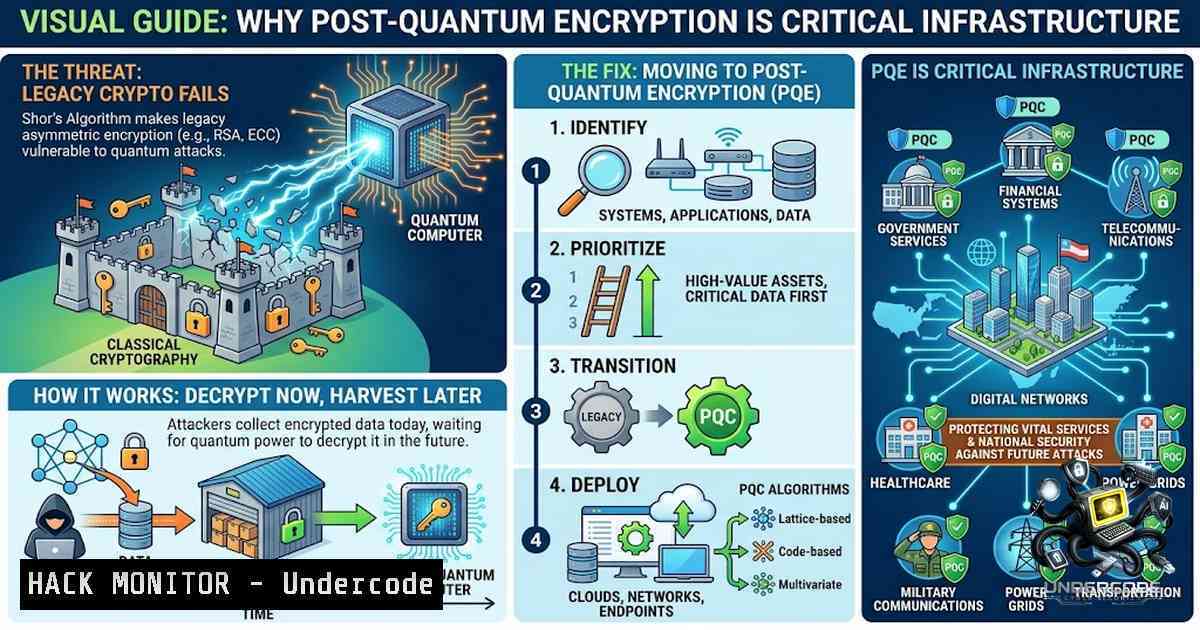
The digital foundations upon which nations and corporations are building their AI-powered futures were never designed to withstand the scale, speed, or sophistication of emerging quantum threats. As Melissa Chambers, Co-Founder and CEO of Sitehop, warns, a vulnerability gap is growing between AI adoption and protection—a gap that adversarial quantum computers will exploit to break RSA, ECDH, and ECDSA encryption that secures everything from financial transactions to state secrets. With the White House issuing Executive Order 14409 mandating federal systems transition to NIST-approved post-quantum cryptography (PQC) by 2030, and CISA cataloging PQC product categories across the enterprise stack, the question is no longer if organizations should migrate, but how.
Learning Objectives:
- Understand the “harvest now, decrypt later” threat model and why legacy cryptography is vulnerable to quantum attacks
- Inventory cryptographic assets and prioritize high-risk systems for PQC migration
- Implement hybrid post-quantum key exchange using OpenSSL 3.5+ with ML-KEM (Kyber) and ML-DSA (Dilithium)
- Configure quantum-resistant TLS 1.3 and VPN tunnels using hybrid KEM groups
- Build a quantum-resistant Certificate Authority (CA) infrastructure compliant with NIST FIPS 203/204/205
You Should Know:
- The Harvest-1ow-Decrypt-Later Threat—Why Your Data Is Already at Risk
The most immediate driver for post-quantum adoption today is not a quantum computer breaking encryption tomorrow—it is the “harvest now, decrypt later” threat model. Adversaries are already collecting encrypted data, including state secrets, financial records, and personal information, with the expectation that large-scale quantum computers will decrypt it within the next decade. Critical infrastructure assets—SCADA controllers, industrial sensors, medical devices, and grid components—have operational lifecycles measured in fifteen to thirty years. If you deploy a system today using RSA-2048 or ECDSA, that system will still be in operation when quantum computers can break those algorithms. The time to act is now.
Step-by-Step Guide: Assessing Your Cryptographic Footprint
Before migrating, you must know what you are protecting. Here is how to inventory your cryptographic assets:
Linux (Using openssl and custom scripts):
 Scan all TLS certificates on your network
nmap -sV --script ssl-cert -p 443 192.168.1.0/24

Extract and analyze certificate algorithms
for cert in $(find /etc/ssl -1ame ".pem"); do
openssl x509 -in $cert -text -1oout | grep -E "Public-Key|Signature Algorithm"
done

Check SSH host key algorithms
ssh -Q key | grep -E "ecdsa|rsa|ed25519"
Windows (Using PowerShell):
 Enumerate certificates in machine store
Get-ChildItem -Path Cert:\LocalMachine\My | Select-Object Subject, NotAfter,
@{Name="Algorithm";Expression={$_.PublicKey.Oid.FriendlyName}}

Check TLS cipher suites
Get-TlsCipherSuite | Select-Object Name, Certificate, KeyExchange, Cipher
2. NIST PQC Standards—What You Need to Deploy
NIST finalized the first three post-quantum cryptography standards in August 2024:
| Standard | Algorithm | Type | Classical Equivalent |
|-|–|||
| FIPS 203 | ML-KEM (Kyber) | Key Encapsulation | RSA, ECDH |
| FIPS 204 | ML-DSA (Dilithium) | Digital Signatures | RSA, ECDSA |
| FIPS 205 | SLH-DSA (SPHINCS+) | Hash-Based Signatures | RSA, ECDSA |
For national security systems, the NSA’s CNSA 2.0 mandates ML-DSA-87 and ML-KEM-1024. For commercial organizations, NIST FIPS 203/204/205 provides the compliance baseline. Importantly, symmetric cryptography (AES-256) remains quantum-safe—this has significant architectural implications for how you prioritize PQC deployment in constrained environments.
3. Hybrid Post-Quantum Deployment—The Bridge Strategy
Hybrid deployment combines classical cryptography (RSA/ECDSA) with PQC algorithms, providing defense-in-depth during the transition period. While Europe views hybrid methods as a safety net for years to come, the UK and US regard them as a necessary but temporary transitional solution.
Step-by-Step Guide: Configuring Quantum-Safe TLS 1.3 with OpenSSL 3.5+
OpenSSL 3.5+ natively supports post-quantum cryptography with no external libraries required. Here is how to configure quantum-safe TLS:
Step 1: Verify OpenSSL version and PQC support
openssl version  Should be 3.5.0 or higher
openssl list -kem-algorithms | grep -E "ML-KEM|Kyber"
 Expected output: ML-KEM-512, ML-KEM-768, ML-KEM-1024
Step 2: Configure hybrid key exchange groups in openssl.cnf
 /etc/ssl/openssl.cnf - Add to [bash] section
ssl_conf = ssl_sect
[bash]
system_default = system_default_sect
[bash]
Groups = X25519MLKEM768:ML-KEM-768:P-256
CipherString = DEFAULT@SECLEVEL=2
Step 3: Generate a quantum-resistant private key using ML-DSA
 Generate ML-DSA-87 key (FIPS 204) for a CA certificate
openssl genpkey -algorithm ML-DSA-87 -out ca_ml_dsa_87.key

Generate ML-KEM-768 key for KEM operations
openssl genpkey -algorithm ML-KEM-768 -out server_ml_kem_768.key
Step 4: Create a self-signed certificate with ML-DSA signature
openssl req -1ew -x509 -key ca_ml_dsa_87.key -out ca_ml_dsa_87.crt \
-days 365 -subj "/CN=Quantum-Safe CA"
Step 5: Configure NGINX for hybrid TLS 1.3
 /etc/nginx/nginx.conf
ssl_protocols TLSv1.3;
ssl_ecdh_curve X25519MLKEM768:ML-KEM-768:P-256;
ssl_ciphers TLS_AES_256_GCM_SHA384:TLS_CHACHA20_POLY1305_SHA256;
ssl_prefer_server_ciphers off;
Step 6: Test your quantum-safe TLS configuration
 Using openssl s_client with hybrid KEM
openssl s_client -connect your-server.com:443 -tls1_3 -groups X25519MLKEM768

Check the negotiated key exchange algorithm
openssl s_client -connect your-server.com:443 -tls1_3 -showcerts | grep "KEM"
4. Building a Quantum-Resistant Certificate Authority (CA) Infrastructure
A complete hands-on lab guide for building a quantum-resistant CA using OpenSSL 3.5+ is available, with three learning paths: NIST FIPS 203/204/205, NSA CNSA 2.0, and alternative algorithms (HQC, FrodoKEM, BIKE).
Step-by-Step Guide: Root CA with ML-DSA-87
 Step 1: Create root CA directory structure
mkdir -p ~/pq-ca/root-ca/{certs,crl,newcerts,private}
cd ~/pq-ca/root-ca
touch index.txt
echo 1000 > serial

Step 2: Generate root CA key using ML-DSA-87
openssl genpkey -algorithm ML-DSA-87 -out private/ca.key

Step 3: Create root CA certificate
openssl req -1ew -x509 -key private/ca.key -out certs/ca.crt \
-days 3650 -config <(
cat << EOF
[bash]
distinguished_name = req_distinguished_name
prompt = no
[bash]
CN = Quantum-Safe Root CA
EOF
)

Step 4: Generate intermediate CA key using ML-DSA-65
openssl genpkey -algorithm ML-DSA-65 -out private/intermediate.key

Step 5: Create intermediate CSR and sign with root
openssl req -1ew -key private/intermediate.key -out intermediate.csr
openssl ca -in intermediate.csr -out certs/intermediate.crt \
-keyfile private/ca.key -cert certs/ca.crt -days 1825
5. Post-Quantum VPN Configuration—Securing Network Tunnels
WireGuard can be enhanced with post-quantum resistance using the `PresharedKey` option or tools like Rosenpass.
Step-by-Step Guide: Enabling Quantum-Resistant WireGuard
 Step 1: Generate a post-quantum preshared key
wg genpsk > quantum-psk.key

Step 2: Add the preshared key to your WireGuard configuration
cat >> /etc/wireguard/wg0.conf << EOF
[bash]
PublicKey = <peer_public_key>
PresharedKey = $(cat quantum-psk.key)
AllowedIPs = 10.0.0.2/32
EOF

Step 3: Restart WireGuard
wg-quick down wg0 && wg-quick up wg0

Step 4: Verify the connection
wg show
For OpenVPN, with OpenSSL 3.5+ and the oqs-provider, PQC can be integrated into TLS handshakes.
6. AI Security Threats—The Vulnerability Gap
As AI adoption accelerates, adversarial machine learning (AML) presents a significant barrier to large-scale AI deployment in safety-critical environments. Attackers can achieve success rates of over 80%—and 100% under specific conditions—using evasion and poisoning attacks that undermine model reliability. The convergence of AI vulnerabilities with quantum threats creates a compound risk: AI systems that rely on classical cryptography for model protection and data integrity are doubly exposed.
Mitigation Strategies:
- Implement cryptographic model signing using ML-DSA to verify AI model integrity
- Use ML-KEM for secure key exchange between AI training nodes
- Deploy hybrid PQC for API security protecting AI inference endpoints
- Monitor for adversarial inputs using intrusion detection systems with post-quantum-signed alerts
What Undercode Say:
- The migration window is closing. With Executive Order 14409 setting binding milestones for federal systems by 2030 and all assets by 2035, organizations that delay PQC adoption will face compliance penalties and security breaches. The “harvest now, decrypt later” threat means your encrypted data is already vulnerable—quantum computers don’t need to exist today to compromise your secrets.
-
Hybrid deployment is the only practical path forward. Pure PQC deployments are not yet viable for most production environments due to performance constraints on constrained microcontrollers. Hybrid schemes (classical + PQC) provide defense-in-depth while maintaining interoperability with legacy systems. Organizations should pilot hybrid PQC on critical internal services and make hybrid post-quantum the default for all new deployments.
Prediction:
-
+1 By 2028, major cloud providers (AWS, Azure, GCP) will offer PQC-enabled KMS (Key Management Service) as default, with hybrid TLS becoming the industry standard for all API endpoints.
-
+1 The NIST PQC standards (FIPS 203/204/205) will be incorporated into FedRAMP and CMMC compliance frameworks by 2027, accelerating commercial adoption through federal acquisition requirements.
-
-1 Critical infrastructure sectors—energy, water, transportation—will lag behind enterprise IT in PQC adoption, with OT and IoT systems remaining vulnerable into the 2030s due to hardware constraints and long replacement cycles.
-
-1 AI-powered cyberattacks leveraging adversarial machine learning will exploit the cryptographic vulnerability gap, with attackers combining quantum-enabled decryption with AI-driven reconnaissance to achieve unprecedented breach velocities.
-
+1 Open-source implementations of NIST PQC standards across eight programming languages (Go, Rust, Python, Java, JavaScript, Swift, .NET, PHP) with full cross-language interoperability will democratize PQC adoption and reduce implementation costs for enterprises.
-
-1 Organizations that fail to complete cryptographic inventory by 2028—as mandated by emerging national frameworks—will face significant operational disruptions during rushed migrations, with potential service outages and security incidents.
▶️ Related Video (74% Match):
https://www.youtube.com/watch?v=1kAZWMzhhRM
🎯Let’s Practice For Free:
🎓 Live Courses & Certifications:
Join Undercode Academy for Verified Certifications
🚀 Request a Custom Project:
Secure, high-velocity infrastructure and disruptive technological engineering. Contact our engineering team for high-tier development and proprietary systems:
[email protected]
💎 Smart Architecture | 🛡️ Secure by Design | ⭐ Trusted by Thousands
IT/Security Reporter URL:
Reported By: Post Quantum – Hackers Feeds
Extra Hub: Undercode MoN
Basic Verification: Pass ✅


