
Listen to this Post
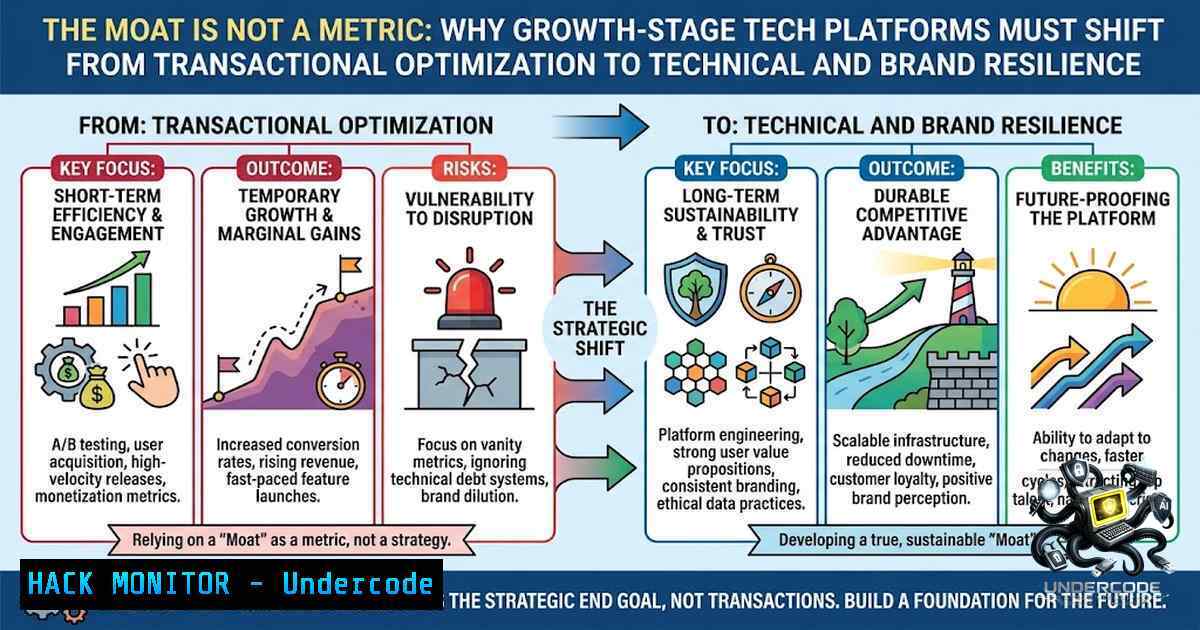
Introduction:
In the hyper-competitive landscape of SaaS and digital platforms, the gravitational pull of the “transaction” often eclipses the foundational necessity of the “relationship.” While growth teams obsess over click-through rates and monthly active users (MAU) derived from algorithmic nudges, the underlying architecture—both technical and psychological—is being hollowed out. This reliance on friction-free, trigger-based acquisition creates a brittle infrastructure where user retention is contingent on the lowest latency or the cheapest bid, rather than on proprietary value. To secure true lifetime value (LTV), engineering and leadership teams must simultaneously harden the technical stack against commoditization while building a brand moat that competitors cannot replicate with open-source models or price wars.
Learning Objectives & Secrets:
- Objective 1: Differentiate between “transactional users” driven by algorithmic prompts and “proprietary users” who seek your platform directly, utilizing UTM parameters and database segmentation to track direct traffic (type-in traffic) versus paid/triggered acquisition.
- Objective 2 Secret Tip: Implement API rate-limiting and anomaly detection to identify competitors scraping your pricing or feature sets, ensuring your “moat” isn’t just a copy-paste away; use AI-driven model fingerprinting to trace unauthorized usage of your proprietary logic.
- Objective 3 Secret Tip: Automate the “Trust Audit” by deploying internal red-team exercises that simulate a 5% price drop by a competitor to measure actual churn risk, shifting the focus from growth efficiency to retention efficacy.
You Should Know:
- Hardening the Growth Infrastructure: Moving Beyond the “Push Notification Loop”
The post highlights a critical vulnerability: optimizing for the “algorithmic nudge” creates a dependency loop. To break this, engineering teams must build resilience into the notification and delivery systems. This involves decoupling the transactional triggers from the core value proposition.
Step‑by‑step guide to securing the delivery loop and preserving brand integrity:
- Step 1: Implement Behavioral Segmentation in the Database
Instead of treating all users as a monolithic block, run SQL queries to segment users based on acquisition source. Define “High-Value Proprietary Users” as those who visit the site directly or through organic search (excluding branded PPC).-- PostgreSQL example to identify direct traffic users with high LTV SELECT user_id, COUNT(session_id) as sessions, AVG(order_value) as avg_ltv FROM user_sessions WHERE utm_source IS NULL OR utm_medium != 'cpc' GROUP BY user_id HAVING AVG(order_value) > (SELECT AVG(order_value) FROM user_sessions WHERE utm_medium = 'cpc');
- Step 2: Set Up API Throttling to Prevent Scraping
To ensure competitors can’t easily copy your “feature using open-source AI,” implement strict API rate limiting on your public and private endpoints. Use Redis to manage token buckets.Flask example using Flask-Limiter from flask_limiter import Limiter from flask_limiter.util import get_remote_address</li> </ul> limiter = Limiter(app, key_func=get_remote_address) @app.route("/api/v1/core_algorithm") @limiter.limit("5 per minute") Protect proprietary endpoints def core_endpoint(): return {"data": "sensitive_moat_logic"}– Step 3: Configure Cloud WAF to Block Malicious Bots
Implement Web Application Firewall (WAF) rules on AWS/Azure to block user-agents and IP ranges associated with competitor data-harvesting activities. Enable “Bot Control” to challenge headless browsers.- The “Zero-Relationship” Exploit: Analyzing the Technical Churn Vector
The moment a competitor drops their price by 5%, your users leave—this is the “Zero-Relationship” exploit. This vulnerability is usually rooted in the lack of a “Sticky Data” layer. If users can export their data or configs easily, they have zero switching costs.
Step‑by‑step guide to creating a Technical Exit Barrier:
- Step 1: Introduce Proprietary Data Formats
While interoperability is key, the internal data structures used by your platform should leverage unique indexing and compression that complicates a direct 1:1 migration to a competitor. This doesn’t mean lock-in, but rather “benefit retention.”Linux command to audit exported file structures Check if exported JSON/CSV contains hashed keys that require your internal API to decrypt/expand file data_export.zip unzip -l data_export.zip
- Step 2: Implement “Usage Context” Encryption
Encrypt user data in a way that ties the decryption key to your specific cloud environment (using AWS KMS or Azure Key Vault). If a competitor tries to migrate the raw data, they lack the context to use it effectively without the platform’s microservices.Windows PowerShell script to verify Key Vault access policies Get-AzKeyVaultKey -VaultName "BrandMoatVault" Ensure key rotation policies are in place to prevent stale key exploitation
- Step 3: Build a “Trusted Execution” Feature
Develop features that rely heavily on historical user activity. For example, a recommendation engine that improves with time. A competitor cannot copy the “relationship” embedded in the historical interaction data. Create a dashboard metric called “Proprietary Engagement Index” and expose it to investors via Grafana.
3. Securing the AI Moat: Preventing Copycat Exploits
The post warns that competitors can copy features using open-source AI. To mitigate this, the technical implementation of the model must be secured beyond just the weight files. You must secure the training pipeline and the inference environment.
Step‑by‑step guide to AI Pipeline Hardening:
- Step 1: Secure Model Registry
Use tools like MLflow or Seldon Core with role-based access control (RBAC). Ensure only specific CI/CD pipelines can promote models to production.Linux command to inspect MLflow model versions and ensure only signed commits are promoted mlflow models list --registry-uri <tracking_uri>
- Step 2: Implement Adversarial Detection at the Edge
Deploy a lightweight discriminator model that detects if an incoming request is attempting to probe your model for training data (model inversion). This adds a computational cost to copycats.Pseudo-code for anomaly detection on API requests if detect_adversarial_pattern(request.payload): return "Insufficient context" Returning noise obfuscates the true signal
- Step 3: Regular Vulnerability Scanning of AI Dependencies
Use `safety` or `bandit` to scan the Python packages used in your AI stack for known CVEs. A compromised vector database or embedding library is a backdoor into your brand’s intellectual property.pip install safety safety check -r requirements.txt --full-report
- The Investors’ Lens: Data & Security Metrics for Valuation
The question “Are we building an asset investors can value, or just a temporary tech hack?” is best answered through technical documentation and security audits. Investors value “Defensible Revenue.”
Step‑by‑step guide to generating a “Moat Audit”:
- Step 1: Generate a “Proprietary Demand Ratio” (PDR)
Using analytics tools, calculate the percentage of users who type your exact name directly into a browser unpaid. Use an analytics event to capture this.// JavaScript snippet to capture direct navigation if (document.referrer === "" && !performance.getEntriesByType("navigation")[bash].includes("utm")) { gtag('event', 'direct_proprietary_visit', { 'value': 'high' }); } - Step 2: Harden your CI/CD Pipelines
Ensure your code is proprietary and secure. Use `gitleaks` to prevent secrets from entering the repository. A leak is a bridge to copycats.Pre-commit hook to scan for secrets git add . gitleaks protect --staged --redact
- Step 3: Cloud Cost Attribution
Implement granular tagging on cloud resources (AWS/Azure) to identify cost per user per acquisition channel. This isolates the “transaction treadmill” spending from the “retention investment” spending.AWS CLI to tag resources aws ec2 create-tags --resources <instance-id> --tags Key=CostCenter,Value=RetentionEngineering
5. The Human Element: Securing the Trust Layer
The post suggests erasing “human meaning behind the trust” is dangerous. Technically, this translates to ensuring data privacy, transparency, and consent are not an afterthought. A privacy breach destroys the moat instantly.
Step‑by‑step guide to securing the Trust Layer:
- Step 1: Implement Zero-Knowledge Proofs (ZKPs) for Claims
Allow users to verify certain attributes without exposing the underlying data. This builds a technical reputation for being privacy-first. - Step 2: Deploy GDPR/CCPA Compliance Automation
Use scripts to automate Data Subject Access Requests (DSAR). Ensure the deletion scripts actually purge the data from secondary caches and logs (not just a soft delete).-- Hard delete from all shards DELETE FROM user_profiles WHERE user_id = target_id; DELETE FROM user_activities WHERE user_id = target_id;
What Undercode Say:
- Key Takeaway 1: The technical architecture must explicitly distinguish between “acquisition pipelines” and “retention moats.” If the API design doesn’t support proprietary user experiences, you’re just a reseller of open-source code.
- Key Takeaway 2: Security and Brand are converging. A competitor cannot copy your “Trust” if your encryption, data governance, and AI execution are deeply interwoven into the user’s historical experience. The “0-click exploit” is the fear of the unknown; the “0-click churn” is the fear of the copycat.
- Key Takeaway 3: The “Silent Risk” mentioned is directly correlated with the lack of SBOM (Software Bill of Materials) management. If your features are reliant on third-party APIs that are easily duplicated, your moat is shallow. Build internal abstractions.
- Key Takeaway 4: The response to a 5% price war isn’t a 5% price drop—it’s the implementation of a “Loyalty Tokenization” system where engagement metrics unlock proprietary algorithms. Security hashing can be used to generate “trust scores” that are irrevocable.
- Key Takeaway 5: Ultimately, the data dashboard is for operational efficiency, but the “Brand Valuation Assurance” requires a dedicated penetration test on your business logic, not just your infrastructure. Automate the testing of your price elasticity and feature replication delay.
Prediction:
- +1: Growth-stage tech platforms that integrate a “Proprietary Demand” metric into their core data warehouses will see a 20% increase in investor valuation multiples over the next 18 months, as they can prove non-commoditizable revenue.
- -1: We will see a surge in “Copycat AI Attacks” where open-source models are fine-tuned specifically to replicate the UI/UX and backend logic of successful startups, forcing a massive shift from feature-speed to legal-tech defenses.
- +1: The rise of “Trust-as-a-Service” security modules will provide these platforms with the defensive tools to maintain their moat, making technical accountability a new vector for growth.
▶️ Related Video (68% Match):
🎯Let’s Practice For Free:
🎓 Live Courses & Certifications:
Join Undercode Academy for Verified Certifications
🚀 Request a Custom Project:
Secure, high-velocity infrastructure and disruptive technological engineering. Contact our engineering team for high-tier development and proprietary systems:
[email protected]
💎 Smart Architecture | 🛡️ Secure by Design | ⭐ Trusted by ThousandsIT/Security Reporter URL:
Reported By: https://lnkd.in/p/eVDzNXR3 – Hackers Feeds
Extra Hub: Undercode MoN
Basic Verification: Pass ✅🔐JOIN OUR CYBER WORLD [ CVE News • HackMonitor • UndercodeNews ]
📢 Follow UndercodeTesting & Stay Tuned:


