
Listen to this Post
Introduction:
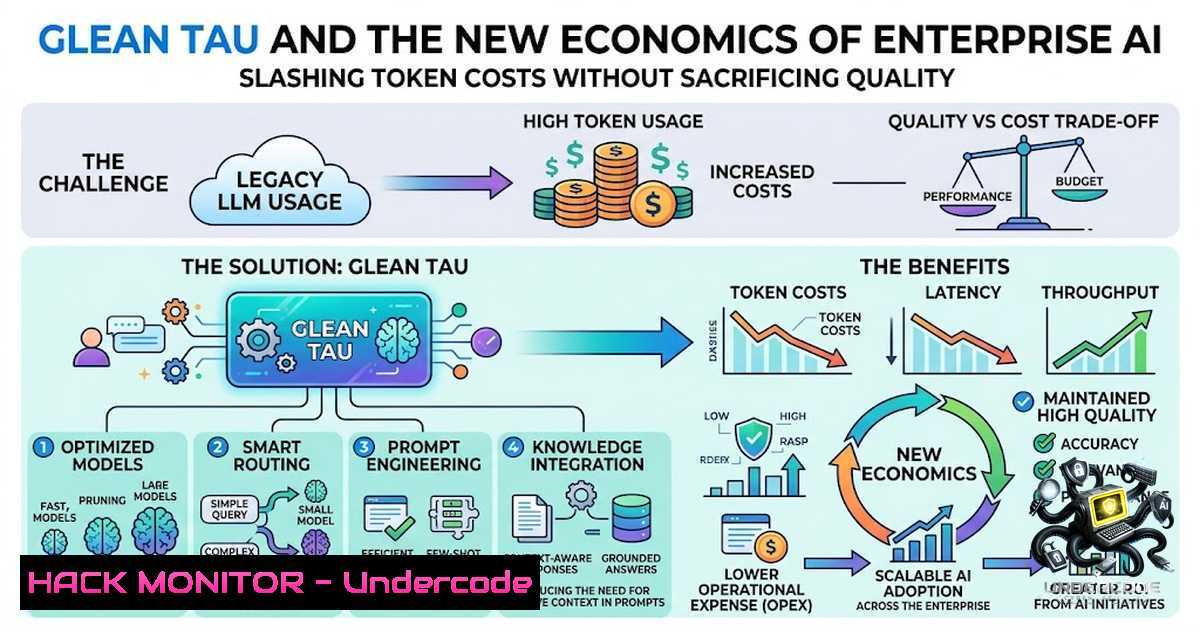
Enterprise AI deployment has entered a new phase where cost control rivals model capability as the primary decision-making factor. As organizations scale AI assistants across thousands of employees, token consumption—the fundamental unit of AI operational expense—has emerged as a critical bottleneck. Glean’s latest benchmark, comparing its AI Assistant against Anthropic’s Claude Cowork across 180+ enterprise tasks, reveals a startling disparity: Glean averaged $0.58 per task versus $2.98 for Claude Cowork, an 81% reduction in token costs, while being preferred 78% of the time. This cost-performance inflection point signals a broader shift in how enterprises must evaluate and deploy AI systems.
Learning Objectives & Secrets:
- Objective 1: Master Enterprise AI Cost Optimization – Understand how pre-indexed, permission-aware data architectures reduce token consumption by eliminating redundant retrieval calls. Glean’s approach used 1.3 million tokens versus 4.4 million for Claude Cowork—a 70% reduction—demonstrating that context management, not model selection, drives cost efficiency.
-
Objective 2 Secret Tip: Implement Automatic Model Routing – Rather than relying on a single model for all tasks, intelligent routing selects different models and reasoning settings based on workload complexity. This dynamic approach balances quality and price, as no single model is optimal for every use case.
-
Objective 3 Secret Tip: Measure and Mitigate “Botsitting” Costs – Glean’s Work AI Institute survey of 6,000 digital workers found employees spend 6.4 hours weekly supervising AI systems—more time than they spend using AI productively. Eliminating this overhead through better context awareness delivers both cost and productivity gains.
You Should Know:
- Pre-Indexed Enterprise Context: The Architecture Behind Cost Savings
The fundamental difference between Glean and conventional AI assistants lies in data architecture. Traditional systems like Claude Cowork must repeatedly search, retrieve, and reason through fragmented data for each query, consuming massive token volumes. Glean maintains a pre-indexed, permission-aware view of company data that eliminates redundant retrieval. This is the technical equivalent of having a dedicated enterprise search index versus performing a full web crawl for every question.
Step‑by‑step guide to understanding and implementing context-aware AI architecture:
- Audit your current AI data access patterns – Monitor how many retrieval calls each query generates. Tools like `tcpdump` or Wireshark can capture API traffic to model providers, revealing token consumption per interaction.
-
Implement a unified enterprise index – Centralize data sources (SharePoint, Google Drive, Confluence, Salesforce) into a searchable index with permission inheritance. On Linux, consider Elasticsearch with role-based access controls:
 Install Elasticsearch and configure role-based permissions
curl -X PUT "localhost:9200/<em>security/role/enterprise_ai" -H 'Content-Type: application/json' -d'
{
"indices": [
{
"names": ["company_data</em>"],
"privileges": ["read"],
"field_security": {
"grant": ["title", "content", "metadata."]
}
}
]
}'
- Cache frequent queries – Implement Redis or Memcached to store common request-response pairs, reducing redundant token expenditure:
 Redis caching for AI responses
redis-cli SETEX "query:hash" 3600 "cached_response"
redis-cli GET "query:hash"
- Log and analyze token usage – On Windows, use PowerShell to monitor API consumption:
 Monitor API call volumes and token usage
Get-WinEvent -LogName "Application" | Where-Object { $<em>.Message -match "token" } |
Group-Object { $</em>.TimeCreated.Date } | Select-Object Name, Count
- Automatic Model Routing: Dynamic Selection for Cost-Performance Optimization
Glean’s routing engine evaluates incoming tasks and selects the appropriate model—whether frontier systems from established suppliers or newer open models at lower price points. This isn’t simple load balancing; it’s semantic routing that considers task complexity, required reasoning depth, and cost tolerance.
Step‑by‑step guide to implementing model routing:
- Classify task types – Categorize queries by complexity: simple fact retrieval, moderate analysis, or complex multi-step reasoning. Use a lightweight classifier (e.g.,
distilbert) to route intelligently.
 Python model router using Hugging Face transformers
from transformers import pipeline
classifier = pipeline("zero-shot-classification", model="facebook/bart-large-mnli")

def route_query(query):
labels = ["simple_fact", "analysis", "complex_reasoning"]
result = classifier(query, labels)
if result['scores'][bash] > 0.7:  simple_fact
return "openai/gpt-3.5-turbo"  cheaper model
elif result['scores'][bash] > 0.6:  analysis
return "anthropic/claude-3-sonnet"
else:  complex
return "anthropic/claude-3-opus"  most capable
- Set cost thresholds per model – Define maximum acceptable spend per task type. For example, restrict complex reasoning to 10% of total queries to control budget.
 Linux: Set API cost limits using environment variables
export MAX_TOKEN_SPEND_PER_DAY=1000000
export MODEL_PRIORITY="efficient,balanced,frontier"
- Monitor routing effectiveness – Track which models are selected and their associated costs. Use Grafana and Prometheus for real-time dashboards.
 prometheus.yml - Monitor token usage by model
- job_name: 'ai_routing'
static_configs:
- targets: ['localhost:9090']
metrics_path: '/metrics'
params:
model: ['gpt-3.5', 'claude-sonnet', 'claude-opus']
3. API Security and Token Governance
With AI spend scaling rapidly, API key management and governance become critical security concerns. Uber and ServiceNow have publicly disclosed how quickly annual AI budgets were consumed by token-intensive tools, highlighting the need for robust controls.
Step‑by‑step guide to securing AI API access:
- Implement API key rotation – Automate key rotation using HashiCorp Vault or AWS Secrets Manager:
 Vault CLI for API key management
vault kv put secret/ai_api/openai key=sk-xxx ttl=30d
vault kv get -field=key secret/ai_api/openai
- Enforce rate limiting per user/team – Use NGINX or Envoy to limit requests and prevent cost spikes:
 NGINX rate limiting for AI endpoints
limit_req_zone $binary_remote_addr zone=ai_api:10m rate=10r/s;
location /api/ai/ {
limit_req zone=ai_api burst=20;
proxy_pass http://ai_backend;
}
- Audit token consumption – Windows PowerShell script to audit usage:
 Audit token usage by department
$logs = Import-Csv "api_logs.csv"
$logs | Group-Object Department | ForEach-Object {
$totalTokens = ($<em>.Group | Measure-Object -Property Tokens -Sum).Sum
Write-Host "$($</em>.Name): $totalTokens tokens"
}
- Glean Tau: Desktop AI Workspace and Security Controls
Glean Tau extends enterprise AI from cloud applications to the desktop, enabling multi-step tasks like file organization, document analysis, and spreadsheet creation across local files and connected applications. The platform carries existing governance and security controls into this expanded surface.
Step‑by‑step guide to deploying secure desktop AI:
- Configure local file permissions – Ensure Glean Tau respects existing file system ACLs:
 Linux: Verify file permissions for AI access
find /home/user/documents -type f -exec ls -la {} \; | grep -E "^-rw-r--"
- Implement context-aware threat detection – Glean’s Enterprise Graph separates legitimate agent activity from data harvesting or exfiltration, even when individual steps appear permitted.
 Python: Detect anomalous agent behavior
import pandas as pd
from scipy import stats

def detect_anomaly(access_log):
df = pd.DataFrame(access_log)
z_scores = stats.zscore(df['files_accessed_per_minute'])
return df[abs(z_scores) > 3]  Return anomalous sessions
- Enforce restricted-topic policies – Use Glean Protect to block queries on sensitive subjects.
5. Measuring and Optimizing the “Botsitting” Problem
Employees spend 6.4 hours weekly supervising AI—more than they spend using it productively. This hidden labor cost often exceeds direct token expenses.
Step‑by‑step guide to measuring AI productivity:
- Track time spent correcting AI outputs – Implement logging that captures user corrections and interventions.
-
Calculate true cost per task – Include both token costs and employee supervision time:
True Cost = (Token Cost) + (Supervision Hours × Employee Hourly Rate)
- Optimize for minimal supervision – Prioritize tasks where AI requires the least correction.
What Undercode Say:
- Key Takeaway 1: Enterprise AI economics are fundamentally about context management, not model selection. Organizations that pre-index and permission their data correctly can achieve 5x cost advantages without sacrificing quality.
-
Key Takeaway 2: The “botsitting” crisis—6.4 hours weekly per employee—represents a massive hidden cost that context-aware architectures can eliminate. This is where the real ROI of enterprise AI lies.
Analysis: Glean’s benchmark results challenge the prevailing assumption that more capable models necessarily justify higher costs. By demonstrating that a context-rich architecture with intelligent routing can outperform a frontier model at 81% lower cost, Glean has identified a fundamental inefficiency in how most enterprises deploy AI. The implication is clear: IT leaders must shift focus from model selection to data architecture and governance. Companies that treat AI as a search problem rather than a generation problem will achieve better economics. However, this also raises security considerations—centralizing enterprise data into a unified index creates a high-value attack surface that requires robust access controls and threat detection. Glean’s context-aware threat detection, which distinguishes legitimate agent activity from data harvesting even when individual actions appear permitted, addresses this risk directly.
Prediction:
- +1 Enterprises will increasingly adopt pre-indexed, permission-aware AI architectures as the default deployment model, reducing token costs by 60-80% across the board within 18 months.
- +1 The “model routing” layer will become a standard component of enterprise AI stacks, with open-source routing frameworks emerging to compete with proprietary solutions.
- -1 Organizations that fail to implement context-aware architectures will face unsustainable AI cost growth, potentially forcing rollbacks of AI deployments.
- -1 The centralization of enterprise data for AI indexing will attract increased attention from attackers, making AI-specific threat detection a critical security investment.
- +1 The “botsitting” metric will become a standard KPI for AI ROI, driving demand for tools that measure and reduce human oversight overhead.
▶️ Related Video (78% Match):
🎯Let’s Practice For Free:
🎓 Live Courses & Certifications:
Join Undercode Academy for Verified Certifications
🚀 Request a Custom Project:
Secure, high-velocity infrastructure and disruptive technological engineering. Contact our engineering team for high-tier development and proprietary systems:
[email protected]
💎 Smart Architecture | 🛡️ Secure by Design | ⭐ Trusted by Thousands
IT/Security Reporter URL:
Reported By: https://lnkd.in/p/evUTVTnb – Hackers Feeds
Extra Hub: Undercode MoN
Basic Verification: Pass ✅


