Listen to this Post
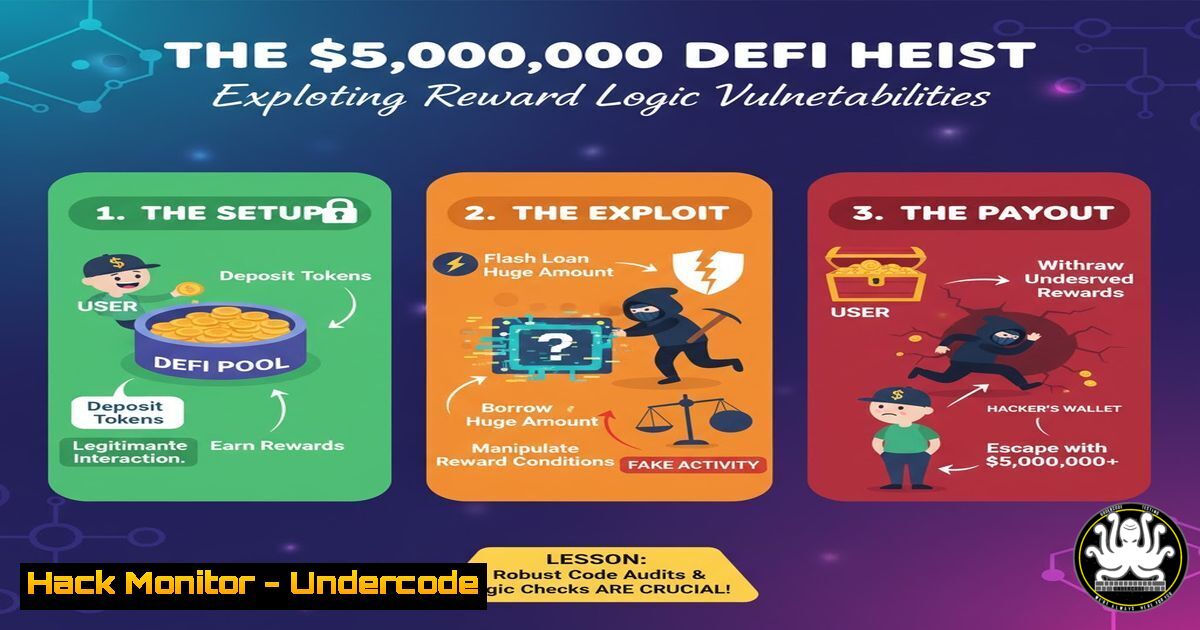
Introduction:
Decentralized Finance (DeFi) protocols are revolutionizing finance, but their immutable smart contracts present a massive attack surface. A single logic flaw in reward distribution mechanisms can lead to catastrophic losses, as evidenced by a recent hack that siphoned $5 million. This incident underscores the critical need for robust smart contract auditing and a deep understanding of common vulnerability patterns.
Learning Objectives:
- Understand the mechanics of a DeFi reward logic vulnerability.
- Learn to identify similar flawed patterns in smart contract code.
- Acquire hardening techniques to secure reward distribution mechanisms.
You Should Know:
1. The Flawed Reward Distribution Mechanism
The core of this exploit lay in an incorrect calculation for user rewards. The vulnerable contract likely used a simplistic model that failed to properly account for the total supply of staked tokens or the individual user’s share at the time of reward claim.
Vulnerable Code Snippet (Solidity):
// FLAWED REWARD CALCULATION
function claimRewards() public {
uint256 rewards = (userStaked[msg.sender]  rewardRate) / totalStaked;
require(payable(msg.sender).send(rewards), "Transfer failed");
userStaked[msg.sender] = 0; // Resets stake after claim
}
Step-by-step guide:
This flawed function calculates rewards based on the current totalStaked. An attacker can exploit this by:
1. Calling the function to calculate their reward amount.
2. Before the `send` transaction is fully confirmed and the state updated, performing a flash loan to add a massive amount to totalStaked.
3. This artificially inflates the denominator in the reward calculation, but if the reward amount was already calculated and in the mempool, the attacker receives a disproportionately large payout based on the previous, lower `totalStaked` value, before their stake is reset.
2. Simulating the Attack with a Forked Mainnet
Security researchers use tools like Hardhat and Ganache to fork the Ethereum mainnet and test exploits in a safe, local environment.
Hardhat Forking Configuration (hardhat.config.js):
module.exports = {
networks: {
hardhat: {
forking: {
url: "https://mainnet.infura.io/v3/YOUR_INFURA_PROJECT_ID",
blockNumber: 15437842, // Fork from a block before the exploit
}
}
}
};
Step-by-step guide:
- Configure Hardhat to fork the mainnet using an Infura or Alchemy node.
- Impersonate the attacker’s account using
await hre.network.provider.request({method: "hardhat_impersonateAccount", params:})</code>.</li> <li>Connect to the impersonated account and redeploy the exploit contract or call the vulnerable function directly to observe the state changes and fund drainage.</li> </ol> <h2 style="color: yellow;">3. Identifying Reentrancy Vulnerabilities</h2> While not the primary vector in this case, reward functions are often susceptible to reentrancy attacks if state updates happen after external calls. <h2 style="color: yellow;">Secure Pattern with Checks-Effects-Interactions:</h2> [bash] // SECURE REWARD CLAIM function claimRewards() public { // CHECK: Calculate rewards owed uint256 rewards = calculateRewards(msg.sender); // EFFECTS: Update state BEFORE interaction userLastClaim[msg.sender] = block.timestamp; userRewards[msg.sender] = 0; // INTERACTION: Perform external call last (bool success, ) = msg.sender.call{value: rewards}(""); require(success, "Transfer failed"); }Step-by-step guide:
- Checks: Perform all necessary validations and calculations first.
- Effects: Update all internal state variables (like resetting rewards to zero). This prevents a reentrancy attack where a malicious contract could call `claimRewards` again before its balance was updated.
- Interactions: Finally, make the external transfer to the user. This pattern is a fundamental security practice in Solidity development.
4. Hardening with Pull-over-Push Payment Architecture
A more robust design is to use a "pull" payment system, where users withdraw rewards instead of having them "pushed" automatically.
Secure Pull Payment Contract:
// PULL PAYMENT PATTERN mapping(address => uint256) public pendingRewards; function calculateAndStoreRewards(address _user) internal { uint256 rewards = calculateRewards(_user); pendingRewards[bash] += rewards; userLastUpdate[bash] = block.timestamp; } // User initiates the withdrawal safely function withdrawRewards() public { calculateAndStoreRewards(msg.sender); uint256 amount = pendingRewards[msg.sender]; pendingRewards[msg.sender] = 0; (bool success, ) = msg.sender.call{value: amount}(""); require(success, "Transfer failed"); }Step-by-step guide:
- The protocol calculates and accrues rewards to a user's `pendingRewards` balance internally.
- The user must call `withdrawRewards()` to initiate the transfer.
- This separates the calculation from the payment, mitigating complex interdependencies and flash loan exploits related to state changes during the payment process.
5. Static Analysis with Slither
Automated tools can help identify common vulnerability patterns. Slither is a powerful static analysis framework for Solidity.
Running Slither on a Codebase:
Install Slither pip install slither-analyzer Run a vulnerability scan on a contract slither . --contract-name VulnerableRewardContract Check specifically for reentrancy slither . --detect reentrancy-eth Generate an inheritance graph to understand complexity slither . --print inheritance-graph
Step-by-step guide:
1. Install Slither via pip.
2. Navigate to your Solidity project directory.
- Run Slither with the `--detect` flag to look for specific vulnerability classes like
reentrancy-eth,incorrect-equality, ortimestamp. - Review the output report for potential vulnerabilities that require manual verification.
6. Formal Verification with Invariants
For critical contracts, formal verification can mathematically prove that certain logical properties (invariants) hold true under all conditions.
Defining an Invariant for Total Rewards:
// This is a conceptual example for a spec/system like Certora // Invariant: totalReleasedRewards == sum(userPendingRewards) + contractBalance rule total_rewards_invariant(uint128 amount, address user) { env e; // Assume initial state satisfies the invariant require init_condition(e); // Simulate any function call (e.g., stake, claim, withdraw) other_functions(e, amount, user); calculateAndStoreRewards(e, user); withdrawRewards(e, user); // The invariant must hold after any sequence of operations assert totalReleasedRewards() == sum_userPendingRewards() + getContractBalance(); }Step-by-step guide:
- Define the system's invariants. For a reward contract, a key invariant is that the total rewards released plus the contract's balance must equal the sum of all pending, unwithdrawn user rewards.
- Use a formal verification tool like the Certora Prover to model the contract's rules.
- The tool will symbolically execute all possible paths to check if the invariant can ever be violated, providing a high level of assurance for that specific logic.
7. Post-Mortem Incident Response Command Log
After an exploit, a rapid and structured response is crucial. The following commands help in triaging and understanding the attack on a blockchain level.
Ethereum Forensic Commands:
1. Get transaction details of the exploit curl -X POST --data '{"jsonrpc":"2.0","method":"eth_getTransactionByHash","params":["0xEXPLOIT_TX_HASH"],"id":1}' https://mainnet.infura.io/v3/YOUR_PROJECT_ID <ol> <li>Trace the transaction to see internal calls curl -X POST --data '{"jsonrpc":"2.0","method":"debug_traceTransaction","params":["0xEXPLOIT_TX_HASH", {"tracer": "callTracer"}],"id":1}' https://mainnet.infura.io/v3/YOUR_PROJECT_ID</p></li> <li><p>Check event logs for the exploited contract curl -X POST --data '{"jsonrpc":"2.0","method":"eth_getLogs","params":[{"address": "0xVULNERABLE_CONTRACT","fromBlock": "0xSTART_BLOCK","toBlock": "0xEND_BLOCK"}]"id":1}' https://mainnet.infura.io/v3/YOUR_PROJECT_ID
Step-by-step guide:
- Use `eth_getTransactionByHash` to retrieve the basic details of the malicious transaction.
- Use a node's `debug_traceTransaction` method (requires an archive node) to get a full trace of all internal smart contract calls made during the exploit, revealing the attack flow.
- Use `eth_getLogs` to query all events emitted by the vulnerable contract around the time of the attack, which can show state changes and function calls.
What Undercode Say:
- The Devil is in the Details: A seemingly minor miscalculation in a single function can dismantle a multi-million dollar system. Logic bugs are often subtler and harder to catch than classic vulnerabilities like reentrancy.
- Automation is Not a Silver Bullet: While tools like Slither are essential, they cannot understand high-level business logic flaws. This exploit required a human-level understanding of the intended reward distribution mechanism to identify the discrepancy.
The $5 million loss is a stark reminder that DeFi protocol security must evolve beyond checking for known vulnerability patterns. The industry is shifting towards a combination of rigorous, manual expert review, advanced static analysis, and formal verification for critical logic paths. This multi-layered approach, while costly, is becoming the minimum standard for protocols that wish to hold user funds. The complexity of financial interactions in DeFi means that testing must simulate not just correct usage, but every possible incorrect and malicious usage as well.
Prediction:
Logic-based exploits in DeFi will increasingly become the primary attack vector as classic vulnerabilities are slowly eradicated through better education and tooling. This will fuel the growth of a specialized smart contract auditing market, with a premium on experts who can model complex financial interactions. We will see the rise of "DeFi insurance" protocols that use on-chain governance to vote on payouts for such hacks, and a potential regulatory push for some form of certification for protocols holding assets above a certain threshold. The arms race between exploiters and developers will center on economic game theory and state mechanism design, making cybersecurity and financial engineering inseparable disciplines.
🎯Let’s Practice For Free:
IT/Security Reporter URL:
Reported By: Root Kit00 - Hackers Feeds
Extra Hub: Undercode MoN
Basic Verification: Pass ✅


