Listen to this Post
Introduction:
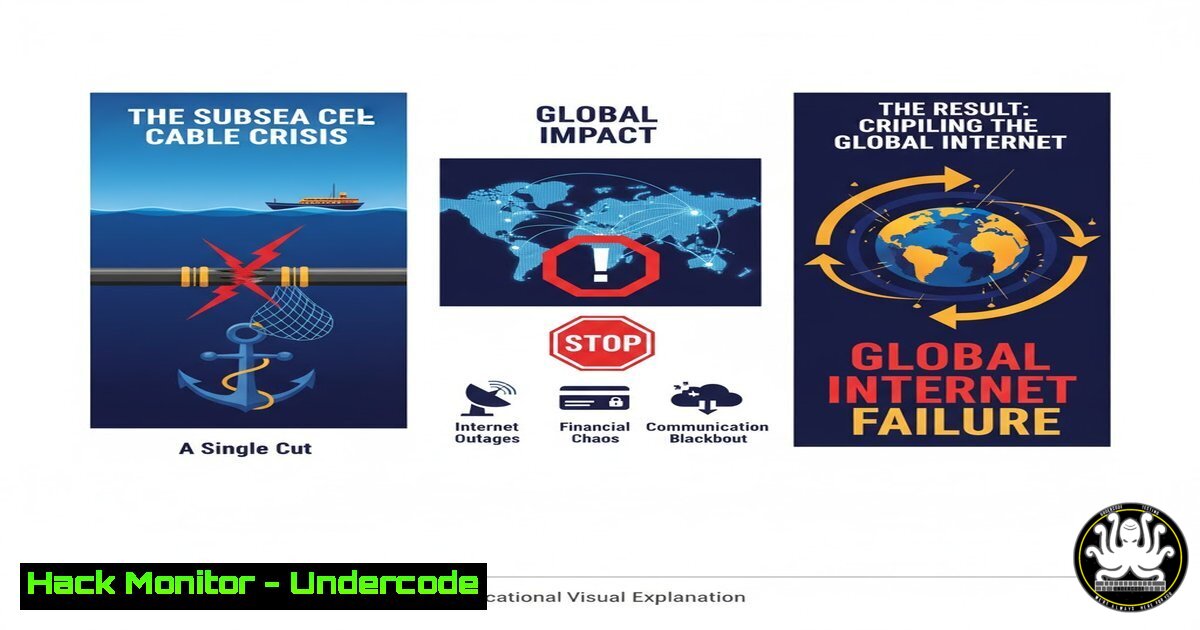
The digital backbone of our global economy relies on a hidden network of submarine cables, and a landmark EU report has sounded the alarm on their profound vulnerability. This article deconstructs the emerging threats to this critical infrastructure and provides a technical playbook for understanding, simulating, and mitigating these risks, moving from high-level policy to actionable command-line security.
Learning Objectives:
- Understand the seven primary risk scenarios to submarine cable infrastructure as identified by the EU Expert Group.
- Learn how to use open-source tools for network path analysis and resilience testing.
- Develop skills for hardening network configurations and simulating cable disruption scenarios.
You Should Know:
1. Mapping Your Critical Network Dependencies
Before you can defend your infrastructure, you must understand its physical and logical paths. Traceroute remains the fundamental tool for this.
Verified Commands:
– `traceroute 8.8.8.8`
– `mtr –report –report-cycles 10 8.8.8.8`
– `tcptraceroute google.com 443` (Bypasses filters on standard ICMP)
– `paris-traceroute -T -p 443 8.8.8.8` (Mitrates per-hop load balancers)
Step-by-step guide:
The standard `traceroute` maps the path packets take to a destination by sending packets with increasing Time-To-Live (TTL) values. `mtr` (My Traceroute) provides a continuous, real-time view of latency and packet loss, crucial for identifying unstable links that could indicate reliance on a strained submarine cable. For services that block ICMP (used by standard traceroute), `tcptraceroute` or `paris-traceroute` use TCP SYN packets to port 443 (HTTPS), mimicking real web traffic and providing a more accurate path for critical services.
2. Simulating Cable Outages with BGP
The Border Gateway Protocol (BGP) is the internet’s routing protocol. When a cable is cut, BGP re-routes traffic. You can simulate and observe this.
Verified Commands & Code:
– `bgpstream.com` (Historical BGP data)
– `tcpdump -i any -w bgp_capture.pcap ‘tcp port 179’` (Capture BGP sessions)
– `birdc show route all` (On a BGP router)
– `exabgp –cli ‘show routes extensive’` (Query BGP table)
Step-by-step guide:
Use a service like BGPStream to review historical incidents where a submarine cable fault caused global BGP updates. To see it in a lab, use `tcpdump` to capture BGP traffic (port 179) on a router. After simulating a link failure (e.g., shutting down a network interface), observe the BGP table with `birdc` or exabgp. You will see the withdrawal of the routes dependent on that link and the subsequent installation of alternative paths, demonstrating the internet’s inherent but not instantaneous resilience.
3. Stress-Testing Network Resilience
ENISA’s stress-testing handbook emphasizes validating resilience against specific scenarios.
Verified Commands & Configurations:
– `iperf3 -c
– `tc qdisc add dev eth0 root netem delay 500ms loss 5%` (Simulate high-latency, lossy link)
– `nmap -T4 -A -oA network_scan
– `wget –mirror –page-requisites –html-extension http://your-critical-site.com` (Test data survivability)
Step-by-step guide:
First, establish a performance baseline with `iperf3` and a service availability scan with nmap. Then, use the Linux Traffic Control (tc) tool to artificially degrade your network interface (eth0) with high latency and packet loss, simulating the congestion on remaining cables after a primary one is cut. Re-run your `iperf3` and `nmap` scans. The performance drop and potential service timeouts reveal your application’s tolerance for severe network degradation.
4. Hardening Critical Service Configurations
Services must be configured to handle network instability gracefully.
Verified Configurations (Snippet):
Nginx (Web Server):
proxy_connect_timeout 10s;
proxy_send_timeout 30s;
proxy_read_timeout 30s;
keepalive_timeout 75s;
resolver 8.8.8.8 1.1.1.2 valid=300s;
resolver_timeout 5s;
PostgreSQL (Database):
tcp_keepalives_idle = 60
tcp_keepalives_interval = 10
tcp_keepalives_count = 10
Step-by-step guide:
These configurations are vital for survivability. The Nginx settings prevent backend connections from hanging indefinitely, forcing a retry or graceful failure. The `resolver` directives ensure the server can still resolve DNS if its primary resolver becomes unreachable. The PostgreSQL settings ensure that idle TCP connections are proactively checked, preventing a buildup of “half-dead” connections that can exhaust database resources during network flaps.
5. Implementing Encrypted DNS for Redundancy
When cable cuts affect DNS resolution, encrypted DNS provides a resilient alternative.
Verified Commands:
– `dig @9.9.9.9 google.com` (Query Quad9 DNS)
– `kdig -d @1.1.1.1 google.com +tls` (DNS-over-TLS with KnotDig)
– `nslookup -type=SOA yourdomain.com` (Verify your SOA records are accessible)
– Configure `systemd-resolved` for DoT: `sudo resolvectl dns eth0 9.9.9.9dns.quad9.net 1.1.1.1cloudflare-dns.com`
Step-by-step guide:
Standard DNS is unencrypted and can be easily hijacked or blocked. DNS-over-TLS (DoT) encrypts your DNS queries, making them more resilient to manipulation on congested or compromised paths. Test basic resolution with dig, then use `kdig +tls` to perform a secure query. Finally, configure your system’s resolver (systemd-resolved) to use multiple, geographically diverse DoT providers, ensuring DNS resilience even if your ISP’s resolvers are impacted.
6. Cloud-Specific Path Analysis
Modern cloud providers have their own global networks. Understanding their topology is key.
Verified Commands (AWS CLI):
– `aws ec2 describe-route-tables –route-table-id rtb-xxxxxx`
– `traceroute -A -p 80
– `aws cloudwatch get-metric-data –metric-data-queries file://query.json` (Monitor network performance)
Step-by-step guide:
In a cloud environment, you don’t control the physical path, but you can audit your logical routing. Use the AWS CLI to inspect your VPC route tables and ensure there are no single points of failure. Perform a traceroute to your public-facing endpoints (like an Elastic Load Balancer) from a region outside your primary one to visualize the cloud provider’s backbone. Correlate this with CloudWatch metrics to establish a baseline for cross-region latency.
7. Proactive Threat Hunting with YARA
Nation-state actors may preposition malware for a coordinated attack during a physical crisis.
Verified YARA Rule (Snippet):
rule Suspicious_Cable_Related_Phishing {
meta:
description = "Detects lures related to maritime or cable security"
author = "Your-CSOC"
strings:
$s1 = "Submarine Cable Maintenance" nocase
$s2 = "Maritime Network Alert" nocase
$s3 = "INC-2024" wide
condition:
2 of them and filesize < 500KB
}
Step-by-step guide:
YARA is a pattern-matching tool for malware hunters. This rule looks for phishing lures that exploit the topic of cable security. The `strings` section defines suspicious keywords, and the `condition` states that if two are found in a small file, it’s a match. You can run this rule across your email gateway or endpoint detection response (EDR) system with: yara -r suspicious_rules.yar /path/to/scan. This proactive hunting can identify targeted attacks before a physical disruption occurs.
What Undercode Say:
- The physical layer is the new cyber battleground. Attacks will move from data centers to the deep sea.
- Resilience is no longer a software-only problem; it requires geopolitical and physical risk assessment.
The EU’s report and subsequent funding mark a pivotal shift, acknowledging that the internet’s most critical chokepoints are not in software, but on the ocean floor. The technical community must expand its scope beyond firewalls and zero-days to include BGP dynamics, undersea cable maps, and satellite-based fallback systems. The €20 million for Regional Cable Hubs is a start, but the real work is in the operational integration of these physical risks into our daily cyber defense playbooks. The next major cyber incident may not be a ransomware attack on a pipeline, but a “ship’s anchor” coincidentally cutting the very cables that pipeline’s SCADA systems rely on.
Prediction:
Within the next 3-5 years, a coordinated hybrid attack—combining a physical cable cut with a simultaneous, targeted DDoS on the remaining alternative paths—will cause a multi-day internet blackout for at least one major European nation. This will catalyze a multi-billion-euro investment in sovereign, low-earth-orbit (LEO) satellite internet constellations as a mandatory redundancy for critical government and financial services, fundamentally altering the global internet’s architecture towards a space-sea-land triad.
🎯Let’s Practice For Free:
IT/Security Reporter URL:
Reported By: %F0%9F%9B%A1%EF%B8%8F Eric – Hackers Feeds
Extra Hub: Undercode MoN
Basic Verification: Pass ✅


