Listen to this Post
Introduction
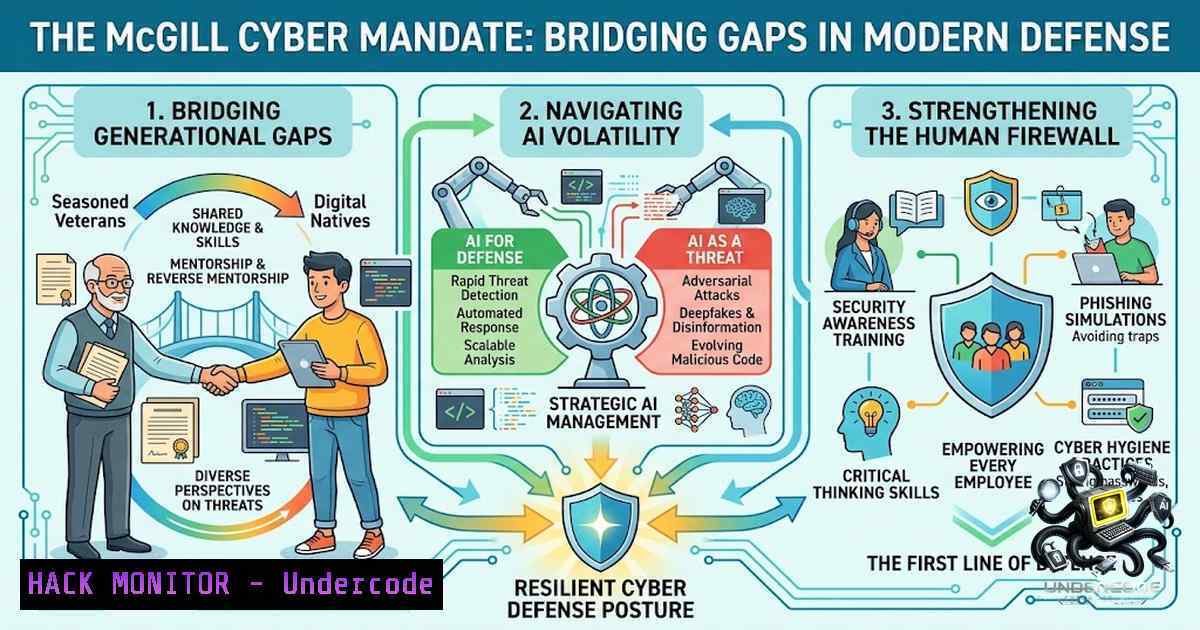
The contemporary cybersecurity landscape is no longer solely defined by firewall configurations or zero-day exploit chains; it is increasingly shaped by the human element, cross-generational knowledge transfer, and the rapid integration of Artificial Intelligence into both offensive and defensive toolkits. The recent engagement at McGill University’s Cyber Defender – Ethical Hacking program highlights a pivotal shift in the industry—moving beyond pure technical acumen towards a holistic model that values leadership, diversity, and adaptive communication. As organizations grapple with the complexities of cloud hardening and API security, the foundational lessons imparted to the next generation of defenders must include not only command-line proficiency but also the strategic foresight required to navigate AI-driven threats and multi-jurisdictional compliance.
Learning Objectives
- Objective 1: Understand the socio-technical dynamics of cybersecurity, including the importance of communication and teamwork beyond isolated technical tasks.
- Objective 2: Identify the evolving role of the Chief Information Security Officer (CISO) in mitigating AI-generated risks and orchestrating cross-functional incident response.
- Objective 3: Gain practical proficiency in foundational system hardening and reconnaissance commands on Linux and Windows, applicable to entry-level defensive roles.
You Should Know
- The Anatomy of a Cyber Defender: From Terminal to Boardroom
The modern cybersecurity professional must operate across two distinct planes: the technical infrastructure and the organizational culture. While the McGill session emphasized soft skills like leadership and myth-busting, these are built upon a bedrock of operational proficiency. Defenders must be capable of assessing system integrity using built-in tools, whether on Linux or Windows.
Step‑by‑step guide: Foundational System Health and User Audit
To secure any environment, one must first understand its baseline. For Linux distributions, use the following commands to audit user permissions and running processes, which are critical in identifying unauthorized access vectors:
 List all users currently logged in
who -a
 Review recent authentication attempts (often used in incident response)
sudo last -a
 Show active network connections to detect beaconing or data exfiltration
ss -tulpn
 Check for high-privilege processes running unexpectedly
ps -aux | grep root
For Windows environments, native PowerShell commands offer similar visibility:
 Display detailed user account information, including last logon
Get-LocalUser | Select-Object Name, Enabled, LastLogon
 Identify active network connections with associated process IDs
Get-1etTCPConnection | Where-Object { $_.State -eq 'Established' }
 Retrieve system boot time and critical event logs for forensic baselining
Get-CimInstance -ClassName Win32_OperatingSystem | Select-Object LastBootUpTime
Get-WinEvent -LogName Security -MaxEvents 50
Explanation: These commands are not merely for routine maintenance; they represent the first line of defense in detecting anomalies. By scripting these audits into a daily cron job or scheduled task, organizations can establish a pattern of normalcy, allowing junior analysts to quickly spot deviations indicative of a compromise.
- The CISO Mandate: Strategic Leadership vs. Technical Triage
During the McGill session, the role of the CISO stood out as a point of curiosity. In the context of AI-enabled security operations, the CISO is no longer a technical executor but a strategic translator. They bridge the gap between machine-speed attacks and executive risk tolerance. This requires understanding attack surfaces that expand beyond traditional endpoints—specifically, the API economy and public cloud misconfigurations.
Step‑by‑step guide: Cloud Hardening and API Security Principles
Securing cloud infrastructure often begins with identity management. For AWS environments, using the CLI to audit Identity and Access Management (IAM) policies is paramount:
 List all IAM users and their associated group policies
aws iam list-users --query 'Users[].[UserName,Arn]' --output table
 Analyze specific policies for over-permissive actions (wildcard privileges)
aws iam list-policies --scope Local --query 'Policies[].[PolicyName,DefaultVersionId]'
To secure APIs—often the gateway to sensitive data—implement stringent rate limiting and validate input schemas. In a Linux web server environment, this is often configured via Nginx rate limits:
location /api/v1/ {
limit_req zone=one burst=5 nodelay;
proxy_pass http://backend_api;
}
Explanation: Hardening is not a static event; it requires continuous monitoring. The CISO’s leadership dictates the prioritization of these fixes based on business impact, moving beyond the purely technical into risk management.
3. Artificial Intelligence: The Double-Edged Sword
The integration of AI into cybersecurity has been highlighted as both an enabler and a source of new challenges. While AI accelerates threat detection and automates incident playbooks, it also lowers the barrier to entry for malicious actors, enabling sophisticated phishing campaigns and deepfake social engineering. Defenders must pivot to using AI for behavioral analytics, but must also maintain vigilance against adversarial AI.
Step‑by‑step guide: Implementing AI-Enhanced Log Analysis with ELK
To leverage AI for log analysis, set up a Logstash pipeline that integrates with machine learning nodes:
 Example Logstash configuration for ingesting Apache logs and enriching data
input { file { path => "/var/log/apache2/access.log" } }
filter {
grok { match => { "message" => "%{COMBINEDAPACHELOG}" } }
date { match => [ "timestamp", "dd/MMM/yyyy:HH:mm:ss Z" ] }
}
output {
elasticsearch { hosts => ["localhost:9200"] }
}
Utilizing X-Pack’s machine learning capabilities, set up job anomalies for sudden spikes in 404 errors, which could indicate a directory traversal attack. However, teams must be trained to interpret these signals without over-relying on automation, preserving the human oversight that the McGill students identified as crucial.
4. Diversity and the Human Firewall
The visible participation of young women and international students at McGill reinforces the theory that diverse teams outperform homogenous ones in problem-solving. This is especially true in cybersecurity, where threat actors think outside the box. Cultivating a culture of inclusivity means mentoring junior staff on not just technical tools but also on clear reporting structures.
Step‑by‑step guide: Building a Security Champions Program
For enterprises looking to replicate this educational enthusiasm, establish a “Security Champions” program where developers are trained to write secure code. Provide them with scripts to scan for vulnerabilities pre-production:
 Using OWASP Dependency-Check to scan Java/Python libraries
dependency-check --scan ./src --format HTML --out report.html
Explanation: This democratizes security, reducing the burden on specialized teams and shifting “left” in the software development lifecycle (SDLC).
5. Debunking Myths: Beyond the Hacker Stereotype
The students’ realization that cybersecurity goes far beyond hacking is a crucial step in professional development. A holistic view includes incident response (IR) planning, regulatory compliance (GDPR, PCI-DSS), and digital forensics. Defenders must practice tabletop exercises that simulate supply chain attacks.
Step‑by‑step guide: Simulating a Log Extraction for Incident Response
During a breach, preserving evidence is critical. On Linux, use `dd` to create a forensic image of a compromised drive:
dd if=/dev/sda of=/mnt/backup/evidence.img bs=4M status=progress
On Windows, utilize PowerShell to extract registry hives for timeline analysis:
reg export HKEY_LOCAL_MACHINE\SYSTEM C:\temp\SYSTEM_backup.hive
Explanation: These forensic techniques ensure that data collected remains admissible and intact, forming the basis of post-incident analysis.
What Undercode Say
- Key Takeaway 1: The emphasis on geographical and cultural diversity—specifically the representation of Tunisian and Moroccan students—highlights the globalization of the talent pool. This is not merely a demographic checkmark but a strategic asset for organizations facing internationally sourced threats.
- Key Takeaway 2: The revelation that the session’s most profound takeaways were soft skills (communication, leadership, and team dynamics) suggests that the industry is reaching a maturation point. Technical skills are a commodity; the ability to articulate risk to stakeholders and manage incident stress is the differentiator.
Analysis: The McGill session effectively dismantled the stereotype of the solitary hacker, presenting a field that is deeply social and culturally aware. The inclusion of AI as a topic demonstrates a curriculum that is current, moving beyond static firewalls. For attendees, the realization that leadership is attainable—even as a junior—will likely accelerate their career progression. However, the industry must ensure that this enthusiasm is met with robust mentorship programs to retain this diverse talent. The “little bit of harissa” anecdote serves as a powerful reminder that identity and passion are integral to team cohesion, reducing burnout which is prevalent in cyber roles.
Prediction
- +1: The focus on interpersonal skills and leadership will drive a new wave of CISO candidates who are as proficient in communication as they are in risk quantification, potentially bridging the gap between IT and business units.
- -1: As the entry-level talent pool diversifies, organizations that fail to adapt their corporate cultures to accommodate these multi-faceted backgrounds risk alienating the very talent they seek to retain, leading to increased churn and vulnerability.
- +1: The emphasis on AI as both a threat and a tool will accelerate the development of “Explainable AI” solutions, allowing defenders to validate findings and maintain human oversight, thus reducing false positive fatigue.
- -1: Without continuous educational outreach like the McGill program, the current talent shortage could escalate, as the pipeline of qualified candidates fails to keep pace with the expanding digital attack surface.
▶️ Related Video (76% Match):
🎯Let’s Practice For Free:
🎓 Live Courses & Certifications:
Join Undercode Academy for Verified Certifications
🚀 Request a Custom Project:
Secure, high-velocity infrastructure and disruptive technological engineering. Contact our engineering team for high-tier development and proprietary systems:
[email protected]
💎 Smart Architecture | 🛡️ Secure by Design | ⭐ Trusted by Thousands
IT/Security Reporter URL:
Reported By: https://lnkd.in/p/eb7bpC2T – Hackers Feeds
Extra Hub: Undercode MoN
Basic Verification: Pass ✅


