Listen to this Post
Introduction
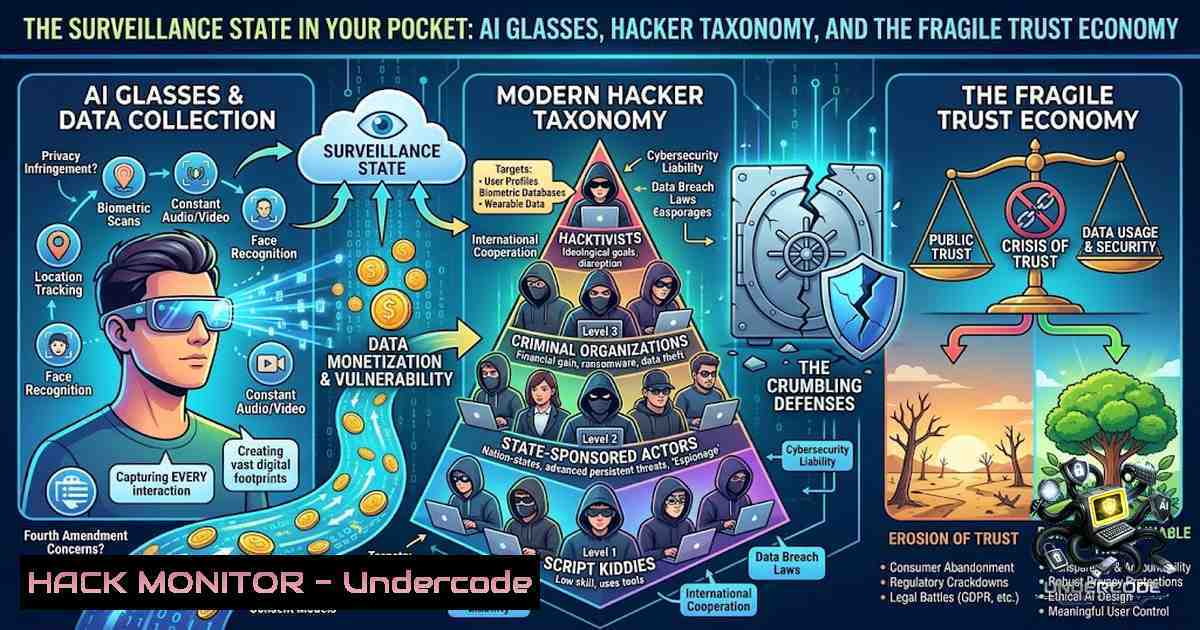
The convergence of ambient AI, adversarial threat intelligence, and regulatory fragmentation is redefining the perimeter of digital trust. As camera-equipped smart glasses become indistinguishable from conventional eyewear and Google overhauls its hacker nomenclature to track over 5,000 active threat clusters, organizations must reckon with a reality where privacy violations originate from consumer-grade wearables and state-sponsored actors operate under evolving taxonomies that demand continuous defensive recalibration.
Learning Objectives
- Understand the privacy and security implications of AI-enabled smart glasses and their impact on physical security postures
- Analyze Google’s revised threat actor naming framework and its operational significance for incident response
- Evaluate the cybersecurity considerations surrounding autonomous vehicle infrastructure and satellite internet constellations
- Apply practical hardening techniques for Linux and Windows environments against surveillance and reconnaissance threats
You Should Know
1. AI Smart Glasses: The Unseen Attack Surface
The proliferation of Meta’s Ray-Ban glasses—over 7 million units sold globally—alongside budget alternatives from retailers like Kmart ($89 camera glasses) has introduced an unprecedented surveillance vector into public spaces. Unlike traditional security cameras, these devices are visually indistinguishable from regular eyewear, feature built-in microphones, and integrate AI assistants capable of real-time facial recognition and data exfiltration. The core security concern extends beyond privacy: these devices can capture sensitive credentials, screen contents, and authentication tokens displayed on nearby laptops and smartphones—as demonstrated by the Melbourne incident where an unsuspecting victim’s workstation was photographed without their knowledge.
Technical Implications for Security Teams:
Organizations must update their physical security policies to address wearable surveillance threats. Consider the following defensive measures:
Linux – Detect Rogue Bluetooth Devices (Passive Scanning):
 Scan for nearby Bluetooth devices that may include smart glasses
sudo hcitool scan
 Passive monitoring of Bluetooth advertisements
sudo btmon
 Identify specific smart glass MAC address ranges (Meta Ray-Ban OUI: 70:B3:D5)
sudo hcitool inq | grep -i "70:b3:d5"
Windows – Monitor Connected Devices via PowerShell:
 List all paired Bluetooth devices
Get-PnpDevice -Class Bluetooth | Where-Object {$<em>.FriendlyName -match "Ray-Ban|Meta|Glasses"}
 Enable Bluetooth device logging
wevtutil set-log "Microsoft-Windows-BTHUSB/Operational" /enabled:true /retention:false /maxsize:20480
 Query Bluetooth connection history
Get-WinEvent -LogName "Microsoft-Windows-BTHUSB/Operational" | Where-Object {$</em>.Id -eq 4}
Step-by-Step Guide: Implementing Smart Glass Detection in Corporate Environments
- Deploy RF Monitoring: Configure a dedicated Raspberry Pi with a Bluetooth adapter to continuously log nearby device advertisements using `hcitool lescan –duplicates`
2. Signature Matching: Create a database of known smart glass MAC OUI prefixes (Meta: 70:B3:D5, 00:1A:7D; Snap: 5C:CF:7F) and trigger alerts on detection - Policy Enforcement: Implement mandatory “no recording devices” policies in sensitive areas, complemented by active scanning at access points
- Employee Training: Educate staff on identifying smart glasses through the subtle LED indicator (though easily obscured) and proper reporting procedures
2. Hacker Taxonomy: Why Naming Matters for Defense
Google’s Threat Intelligence Group has retired the opaque APT numbering system in favor of a structured nomenclature where each group receives a memorable first name and a second name whose initial indicates country of origin—Castle for China, Ion for Iran, Neptune for North Korea, and Relic for Russia. This seemingly administrative change carries profound implications for cybersecurity operations.
The significance lies in attribution and behavioral profiling. As Shane Huntley, CTO of Google Threat Intelligence Group, explains, understanding how an adversary operates—their tactics, techniques, and procedures (TTPs)—is “critically important to help the response and also work out your coverage against these threats”. With over 5,000 “activity clusters” tracked globally, the ability to rapidly correlate an intrusion with known adversary behavior can shave hours or days off incident response timelines.
Practical Threat Intelligence Integration:
Linux – MITRE ATT&CK Framework Lookup:
 Query MITRE ATT&CK for specific group TTPs using curl
curl -s "https://attack.mitre.org/groups/G0007/" | grep -E "Technique|T[0-9]{4}" | head -20
 Automated YARA rule deployment for known Lazarus Group indicators
yara -r ./lazarus_rules.yar /var/log/ -m
Windows – Threat Hunting with Sysmon and Event Logs:
 Enable Sysmon to capture process creation and network connections
Sysmon64.exe -accepteula -i sysmon-config.xml
 Query for known APT persistence mechanisms
Get-WinEvent -FilterHashtable @{LogName='System'; ProviderName='Microsoft-Windows-Security-Auditing'; ID=4697} | Where-Object {$<em>.Message -match "schtasks|regsvr32|powershell"}
 Cross-reference with known threat group indicators
$known_hashes = Get-Content .\ioc_hashes.txt
Get-FileHash -Path C:\Windows\System32\ -Algorithm SHA256 | Where-Object {$</em>.Hash -in $known_hashes}
Step-by-Step Guide: Building an Adversary-Centric Defense
- Establish Baseline: Document normal network behavior using Zeek (formerly Bro) to establish a baseline for anomaly detection
- Threat Intelligence Feed Integration: Subscribe to structured threat intelligence (STIX/TAXII) feeds from Google’s Threat Intelligence Group or MITRE to receive real-time IOC updates
- Automated Correlation: Deploy TheHive or MISP to automatically correlate alerts with known adversary TTPs
- Playbook Development: Create incident response playbooks specific to each threat group’s known behavior patterns—for instance, Lazarus Group’s focus on cryptocurrency theft versus APT41’s dual-use espionage and cybercrime operations
- Continuous Refinement: Regularly update internal threat models as Google and other vendors release new attribution data
3. Autonomous Vehicle Infrastructure: The Security Elephant
Zoox’s receipt of an NHTSA exemption to operate up to 2,500 purpose-built robotaxis without steering wheels or pedals marks a regulatory milestone. However, this advancement introduces a complex attack surface spanning vehicle-to-everything (V2X) communication, cloud backend infrastructure, and sensor fusion systems. The cybersecurity implications are staggering: a compromised robotaxi fleet could be weaponized for physical attacks, surveillance, or ransomware extortion.
Critical Security Considerations for AV Infrastructure:
- Sensor Spoofing: LiDAR, radar, and camera systems are vulnerable to adversarial inputs—a well-placed laser or ultrasonic noise generator could cause emergency braking or navigation errors
- V2X Communication: Unencrypted or poorly authenticated vehicle-to-infrastructure messages could enable man-in-the-middle attacks
- Cloud Backend: The command-and-control infrastructure managing fleet operations represents a high-value target for nation-state actors
Linux – Network Hardening for IoT/AV Backend:
 Implement strict iptables rules for V2X communication ports
sudo iptables -A INPUT -p udp --dport 15118 -j DROP  ISO 15118 charging communication
sudo iptables -A INPUT -p tcp --dport 443 -m state --state NEW -m recent --set
sudo iptables -A INPUT -p tcp --dport 443 -m state --state NEW -m recent --update --seconds 60 --hitcount 10 -j DROP
 Monitor for abnormal CAN bus traffic patterns
sudo modprobe can
sudo ip link set can0 type can bitrate 500000
sudo ifconfig can0 up
candump can0 -L | grep -v "00000000"
Windows – Securing AV Development Environments:
 Enable Windows Defender Application Guard for containerized development
Enable-WindowsOptionalFeature -Online -FeatureName Windows-Defender-ApplicationGuard
 Implement USB device control to prevent sensor interface tampering
Set-ItemProperty -Path "HKLM:\SOFTWARE\Policies\Microsoft\Windows\DeviceGuard" -1ame "ConfigureSystemGuardLaunch" -Value 1
 Audit all remote desktop connections
Set-ItemProperty -Path "HKLM:\SYSTEM\CurrentControlSet\Control\Terminal Server" -1ame "fDenyTSConnections" -Value 0
auditpol /set /subcategory:"Remote Desktop Services" /success:enable /failure:enable
4. Satellite Internet: The New Battleground
Amazon’s Leo project, aiming to deploy thousands of low-Earth orbit satellites, is racing to close the gap with SpaceX’s Starlink. This orbital infrastructure introduces unique cybersecurity challenges: satellite uplink/downlink interception, ground station compromise, and supply chain attacks on satellite firmware.
Key Hardening Measures:
Linux – Secure Ground Station Communications:
 Implement IPsec for satellite communication links
sudo strongswan up satellite-conn
 Monitor for unauthorized spectrum usage with rtl-sdr
rtl_sdr -f 2400000000 -s 2400000 -g 20 - | sox -t raw -r 2400000 -e signed -b 8 -c 1 - - spectrogram -x 800 -y 600 -o spectrum.png
 Verify satellite firmware integrity
openssl dgst -sha256 -verify public_key.pem -signature firmware.sig firmware.bin
Windows – Satellite Network Monitoring:
 Configure advanced firewall logging for satellite gateway traffic
Set-1etFirewallProfile -Profile Domain,Public,Private -LogFileName "C:\Logs\pfirewall.log" -LogMaxSizeKilobytes 32768 -LogAllowed True
 Monitor for anomalous outbound connections to satellite ground stations
Get-1etTCPConnection | Where-Object {$_.RemotePort -in 8080,8443,443,80} | Export-Csv -Path "C:\Logs\satellite_connections.csv"
- The Human Element: Social Engineering in the AI Era
The restaurant reservation arms race—where bots, premium services, and credit card perks create an increasingly complex technology ecosystem—serves as a microcosm of broader cybersecurity challenges. The same techniques used to secure coveted tables (automated booking, notification monitoring, etc.) mirror the tactics employed in credential stuffing, account takeover, and inventory hoarding attacks.
Defensive Countermeasures:
Linux – Bot Detection and Mitigation:
 Implement rate limiting with iptables
sudo iptables -A INPUT -p tcp --dport 80 -m connlimit --connlimit-above 20 -j REJECT
 Deploy fail2ban for application-level protection
sudo apt-get install fail2ban
sudo systemctl enable fail2ban
 Monitor for automated traffic patterns
tail -f /var/log/nginx/access.log | grep -E "HEAD /|POST /api" | uniq -c | sort -1r
Windows – Account Protection Measures:
 Implement Microsoft Defender Credential Guard
Set-ItemProperty -Path "HKLM:\SYSTEM\CurrentControlSet\Control\DeviceGuard\Scenarios\CredentialGuard" -1ame "Enabled" -Value 1
 Enforce MFA for all administrative accounts
Set-MsolUser -UserPrincipalName [email protected] -StrongAuthenticationRequirements @(@{RelyingParty=""; State="Enabled"})
 Monitor for impossible travel scenarios
Get-ADUser -Filter  -Properties LastLogonDate,LastLogon | Where-Object {$<em>.LastLogonDate -gt (Get-Date).AddHours(-24)} | ForEach-Object {
$lastIP = (Get-ADUser $</em>.SamAccountName -Properties msRTCSIP-UserRoutingGroupId).msRTCSIP-UserRoutingGroupId
 Compare with geographical database
}
What Undercode Say
- Privacy is the new perimeter: AI-enabled wearables like Meta’s Ray-Ban glasses have effectively rendered traditional physical security controls obsolete—security teams must now treat public spaces as untrusted environments and implement technical countermeasures
-
Attribution drives defense: Google’s refined hacker taxonomy isn’t academic; it enables faster incident response by allowing defenders to instantly contextualize attacks against known adversary behavior patterns
-
Regulatory lag creates opportunities: The NHTSA exemption for Zoox demonstrates that autonomous vehicle regulations are struggling to keep pace with technology—creating both innovation opportunities and security gaps that adversaries will exploit
-
The nostalgia-security paradox: The growing vintage computer movement represents more than sentiment—it underscores how rapidly technology evolves and how quickly security paradigms shift, making historical awareness essential for future defense
-
Every system is a target: From restaurant reservation bots to satellite constellations, the digitization of everyday life creates new attack surfaces that demand security consideration from inception, not as an afterthought
Prediction
-
+1 Smart glasses will become the next major enterprise security headache, with organizations mandating detection systems and no-recording policies within 12-18 months, creating a new market for wearable detection and jamming technologies
-
-1 The fragmentation of threat actor naming conventions will worsen before it improves, as Google’s system adds yet another taxonomy to an already confusing landscape, potentially hindering cross-organizational threat intelligence sharing
-
+1 NHTSA’s Zoox exemption will catalyze autonomous vehicle deployment across the United States, but will also expose critical infrastructure vulnerabilities that will demand new cybersecurity standards for the automotive sector
-
-1 Satellite internet constellations will become a prime target for nation-state cyber operations, with ground stations and uplink/downlink communications presenting lucrative espionage and disruption opportunities that current security measures are ill-equipped to handle
-
+1 The convergence of AI, wearables, and autonomous systems will drive a new wave of privacy-preserving technologies—including differential privacy, federated learning, and hardware-based attestation—as consumers and regulators demand stronger protections
-
-1 The restaurant reservation bot ecosystem foreshadows a broader trend where AI-powered automation will increasingly intermediate everyday transactions, creating new classes of cybercrime focused on service denial and scalping that will strain existing fraud detection systems
▶️ Related Video (78% Match):
https://www.youtube.com/watch?v=1NShruSoJHg
🎯Let’s Practice For Free:
🎓 Live Courses & Certifications:
Join Undercode Academy for Verified Certifications
🚀 Request a Custom Project:
Secure, high-velocity infrastructure and disruptive technological engineering. Contact our engineering team for high-tier development and proprietary systems:
[email protected]
💎 Smart Architecture | 🛡️ Secure by Design | ⭐ Trusted by Thousands
IT/Security Reporter URL:
Reported By: https://lnkd.in/p/eXFduzJK – Hackers Feeds
Extra Hub: Undercode MoN
Basic Verification: Pass ✅


