
Listen to this Post
Introduction:
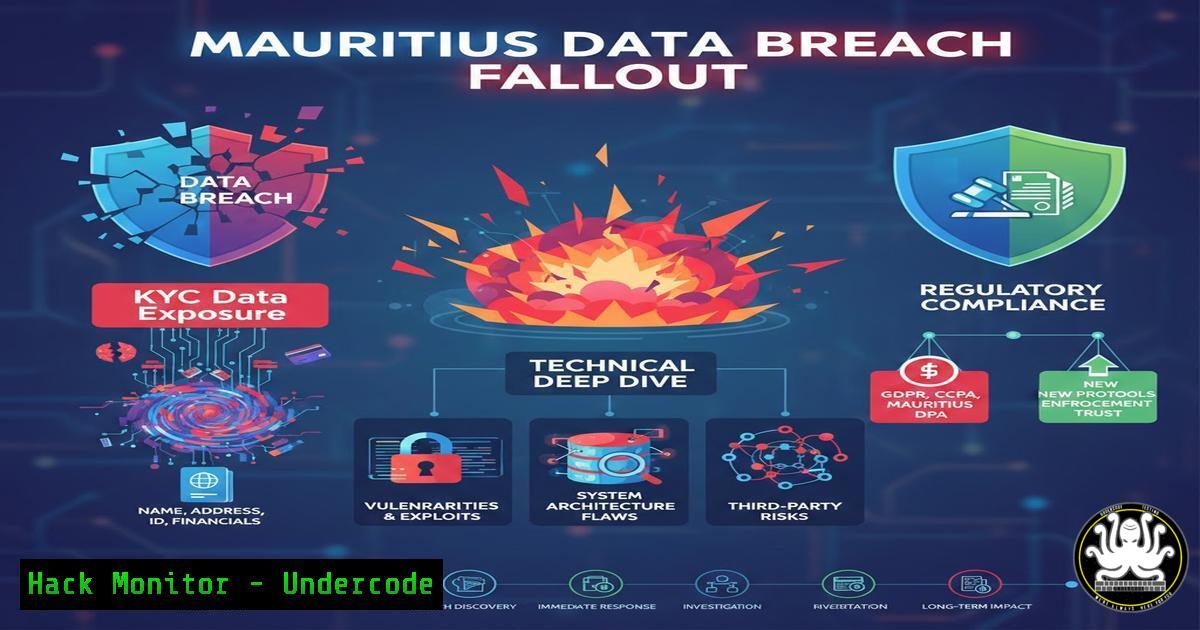
The recent Mauritius Data Protection Commission (DPC) communique highlights a critical cybersecurity crisis involving the theft of Know Your Customer (KYC) data from financial management companies. This breach, exposing sensitive passport details, transcends individual privacy violations, escalating to systemic risks of large-scale identity theft and financial fraud. For IT and security professionals, this incident serves as a stark case study in securing regulated data, incident response protocols, and the technical aftermath of a compliance failure.
Learning Objectives:
- Understand the technical attack vectors likely used to compromise KYC data repositories.
- Learn the immediate forensic and containment steps required following a regulated data breach.
- Master key hardening techniques for databases and APIs handling sensitive PII and KYC documentation.
You Should Know:
- Anatomy of a KYC Data Breach: Probable Attack Vectors
The leak of structured KYC data, including passport scans, points to a compromise beyond a simple phishing attack. Attackers likely targeted the database or file storage systems of the Management Companies.
Step‑by‑step guide explaining what this does and how to use it.
Reconnaissance: Attackers scan for exposed assets. Use `nmap` to audit your own perimeter: nmap -sV --script vuln <your-company-IP-range>. This identifies open ports (e.g., 1433 for MS SQL, 3306 for MySQL, 22 for SFTP) with known vulnerabilities.
Initial Access: Common vectors include:
SQL Injection: Exploiting unpatched web applications querying the KYC database. Test with tools like SQLmap on authorized systems only: sqlmap -u "https://test-site.com/view?id=1" --batch --dbs.
Compromised Credentials: Breached service accounts for database or file servers. Mitigate by enforcing MFA and regular credential rotation.
Unsecured Cloud Storage: S3 buckets or Azure Blob Containers with KYC documents set to “public.” Use AWS CLI to check: aws s3api get-bucket-acl --bucket <bucket-name>.
Exfiltration: Data is compressed and exported. Monitor for large outbound data transfers from your database servers using network monitoring tools or endpoint detection logs.
2. Immediate Post-Breach Forensic Triage
Once a breach is suspected, time is critical. The goal is to confirm, contain, and preserve evidence for regulatory reporting.
Step‑by‑step guide explaining what this does and how to use it.
Isolate the System: Network segmentation is key. On Linux, use `iptables` to block all but forensic traffic: iptables -A INPUT -s <forensic-station-IP> -j ACCEPT; iptables -A INPUT -j DROP.
Capture Volatile Data: Before powering off, collect evidence from a compromised Linux server:
 Capture network connections
netstat -tunap > /forensic/network_connections.txt
 List running processes
ps aux > /forensic/running_processes.txt
 Capture open files
lsof > /forensic/open_files.txt
Image the Disk: Use `dd` or `dcfldd` to create a forensic image: dcfldd if=/dev/sda of=/evidence/server1.img hash=sha256 hashlog=/evidence/server1.hash.
Analyze Logs: Centralize and scrutinize application, database, and authentication logs for anomalies around the breach timeframe.
3. Secure Database Configuration for PII
KYC data must be stored with maximum security. Default configurations are insufficient.
Step‑by‑step guide explaining what this does and how to use it.
Encryption at Rest: Enable Transparent Data Encryption (TDE) for SQL Server or use `pgcrypto` for PostgreSQL. For MySQL: ALTER TABLE kyc_documents ENCRYPTION='Y';.
Column-Level Encryption: For ultra-sensitive fields like passport numbers, encrypt in application before storage. Example using Python’s `cryptography` library:
from cryptography.fernet import Fernet
key = Fernet.generate_key()
cipher_suite = Fernet(key)
encrypted_passport_number = cipher_suite.encrypt(b"PASSPORT123")
 Store encrypted_passport_number in DB
Least Privilege Access: Create specific database roles. In PostgreSQL:
CREATE ROLE kyc_reader;
GRANT CONNECT ON DATABASE kyc_db TO kyc_reader;
GRANT SELECT ON TABLE passport_data TO kyc_reader;
-- Assign to a user
GRANT kyc_reader TO specific_user;
4. Hardening API Endpoints Accessing KYC Data
APIs are a primary gateway for KYC data. They must be rigorously secured.
Step‑by‑step guide explaining what this does and how to use it.
Implement Strict Authentication & Authorization: Use OAuth 2.0 with scope-based access tokens. Validate tokens and scopes on every request.
Rate Limiting: Prevent brute-force attacks and data scraping. Using an API Gateway like NGINX:
location /api/v1/kyc/ {
limit_req zone=kyc_limit burst=5 nodelay;
proxy_pass http://backend_service;
}
Input Validation & Output Encoding: Sanitize all inputs to prevent injection attacks. Encode JSON/XML outputs to mitigate misinterpretation.
Audit Logging: Log all API access attempts—successful and failed—with user ID, timestamp, endpoint, and action. This is crucial for DPC reporting.
5. Automating Data Subject Notification: A Technical Obligation
The DPC mandates notifying high-risk individuals. This process must be secure, auditable, and timely.
Step‑by‑step guide explaining what this does and how to use it.
Risk Triage Scripting: Automate identifying high-risk individuals based on data sensitivity. A Python script could parse forensic results and score risk.
Secure Communication Channel: Do not use the potentially compromised email system. Integrate with a secure, third-party notification service via API.
Process Automation: Create a workflow that:
- Ingests the list of impacted data subjects from the forensic report.
2. Generates unique, trackable notification tokens for each.
3. Queues notifications via the secure channel.
4. Logs every dispatch attempt for compliance proof.
What Undercode Say:
- Compliance is a Technical Architecture Problem. The Mauritius incident underscores that GDPR/DPA compliance cannot be a legal checkbox alone. It must be engineered into the system through encryption, least-privilege access, and comprehensive logging from the ground up.
- Breach Response is a Live Fire Drill. Your incident response plan must be executable within hours, not days. The technical steps of isolation, evidence collection, and regulatory communication must be documented, practiced, and tool-enabled to meet the strict notification deadlines.
This incident reveals a dangerous convergence of high-value data, potentially inadequate security controls in specialized financial sectors, and aggressive threat actors. The technical response directly influences legal and reputational outcomes.
Prediction:
This breach will catalyze a global regulatory crackdown on data processors in the financial services supply chain, particularly management companies and third-party KYC vendors. We predict a surge in mandatory security certifications for these entities, increased fines for delayed reporting, and the accelerated adoption of privacy-enhancing technologies (PETs) like confidential computing for data processing. Technically, the future will demand “zero-trust” architectures for KYC workflows, where data is never fully centralized or unencrypted, fundamentally changing how identity verification systems are built.
▶️ Related Video (76% Match):
🎯Let’s Practice For Free:
IT/Security Reporter URL:
Reported By: Activity 7410910302248169472 – Hackers Feeds
Extra Hub: Undercode MoN
Basic Verification: Pass ✅


