
Listen to this Post
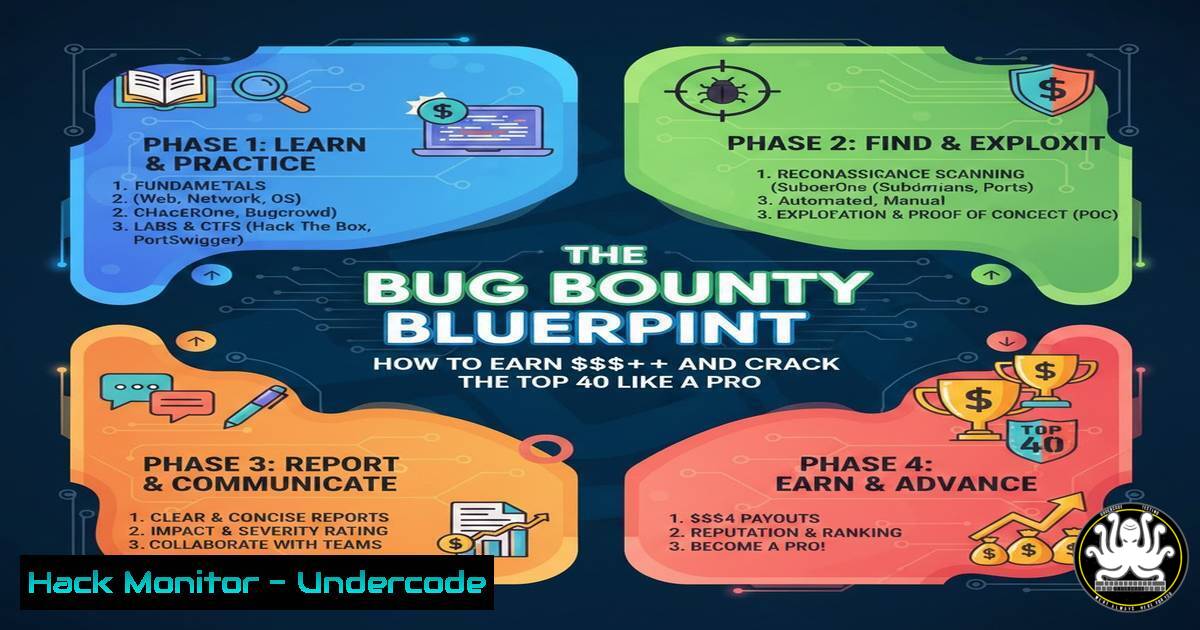
Introduction:
Bug bounty hunting has evolved from a niche hobby into a lucrative, high-impact cybersecurity career path, as evidenced by researchers like Abdulrahman Zaki ranking on global platforms like Bugcrowd and Mastercard. This professional pursuit requires a blend of systematic vulnerability discovery, ethical reporting, and continuous skill development to secure high-value systems and earn substantial rewards. This article deconstructs the methodology behind achieving top-tier bug bounty success, providing actionable steps for aspiring hunters.
Learning Objectives:
- Understand the core methodology for effective target reconnaissance and attack surface mapping.
- Learn to identify and validate common high-impact vulnerability classes (P1-P4).
- Master the professional workflow for crafting proof-of-concept exploits and submitting detailed, actionable reports.
You Should Know:
1. The Foundation: Building Your Reconnaissance Engine
Before a single test is launched, successful hunters automate the discovery of targets and endpoints. This involves using open-source intelligence (OSINT) and subdomain enumeration to map the entire digital footprint of a program. A well-tuned recon pipeline is non-negotiable.
Step‑by‑step guide explaining what this does and how to use it.
First, set up a Linux environment (Kali Linux recommended). Use tools like amass, subfinder, and `assetfinder` for subdomain enumeration. Combine the results, filter out duplicates, and then probe for alive hosts using `httpx` or httprobe.
 Install tools (on Kali: sudo apt install amass)
amass enum -d target.com -o amass_subs.txt
subfinder -d target.com -o subfinder_subs.txt
cat amass_subs.txt subfinder_subs.txt | sort -u > all_subs.txt
cat all_subs.txt | httpx -silent -threads 100 -o alive_hosts.txt
This creates a clean list of active web endpoints. Next, use `waybackurls` and `gau` to fetch historical URLs from archives, and `ffuf` for directory brute-forcing to discover hidden parameters and endpoints.
cat alive_hosts.txt | waybackurls | sort -u > wayback_urls.txt
ffuf -w /usr/share/wordlists/dirb/common.txt -u https://target.com/FUZZ -fc 403 -o fuzz_results.txt
Merge all URL sources, and you have a powerful target list for manual testing and automated scanning input.
- Prioritizing the Attack Surface: From P1 to P4
Not all vulnerabilities are equal. Platforms categorize bugs by severity: P1 (Critical) like Remote Code Execution (RCE) on core infrastructure, down to P4 (Low) like informational leaks. Your initial focus must be on functionalities handling sensitive data (login, payment, file upload, API keys).
Step‑by‑step guide explaining what this does and how to use it.
Start with endpoints identified in your recon. Use a proxy like Burp Suite or OWASP ZAP to intercept all traffic. Manually test all authentication and authorization flows. Check for:
– Broken Access Control: Can you access another user’s data by changing an ID parameter? Test with curl:
curl -H "Authorization: Bearer <YOUR_TOKEN>" https://api.target.com/user/123/orders`user/124/orders
Then try. A successful response indicates a broken IDOR (Insecure Direct Object Reference).dalfox`.
- SQL Injection: Use automated tools like `sqlmap` cautiously and only on authorized targets. A basic test for error-based SQLi:
`https://target.com/products?id=1'` - Look for database errors in the response.
- Cross-Site Scripting (XSS): Test all input fields and URL parameters with a simple payload like `` or use a scanner like
- The Art of the Proof of Concept (PoC)
A valid bug report requires a clear, reproducible PoC. This is not just stating “X is vulnerable,” but demonstrating the impact. For a critical bug, you must show how it can be exploited.
Step‑by‑step guide explaining what this does and how to use it.
For a discovered Server-Side Request Forgery (SSRF) vulnerability, a minimal PoC might involve making the server fetch an internal resource or your controlled server.
1. You find a parameter `?url=https://api.target.com/fetchdata`.
2. Test by changing it to your Burp Collaborator or a Request Bin URL: `?url=http://yourburpcollaborator.net`.
3. If you receive an HTTP request from the target’s server, you have confirmed SSRF. Now, escalate:
– Attempt to access internal metadata endpoints (e.g., `http://169.254.169.254/latest/meta-data/` on AWS).
4. Document every step with screenshots and the exact HTTP requests/responses from your proxy.
4. Mastering the Report: From Finding to Fix
The report is your deliverable. A poor report can lead to rejection, even for a valid bug. It must be structured, clear, and actionable for the security team.
Step‑by‑step guide explaining what this does and how to use it.
Follow this template:
- Concise (e.g., “SSRF in `/api/fetch` leading to AWS Metadata Exposure”).
- Summary: One-line impact statement.
- Steps to Reproduce: Numbered list, exact URLs, parameters, and payloads. Include curl commands they can copy/paste.
</li>
</ul>

<ol>
<li>Navigate to https://target.com/api/fetch?url=<external_url></li>
<li>Change parameter to `url=http://169.254.169.254/latest/meta-data/`</li>
<li>Observe the instance metadata is returned in the response.
– Impact Analysis: Explain the risk (e.g., “This could allow an attacker to steal cloud credentials and compromise the entire infrastructure”).
– Remediation: Suggest a fix (e.g., “Validate and sanitize input, use an allowlist of permitted domains, and block internal IP ranges”).
5. Automating Validation and Workflow
Top hunters use scripts to automate repetitive tasks like parameter discovery, initial vulnerability screening, and organizing results. This frees up time for deep, manual exploitation.
Step‑by‑step guide explaining what this does and how to use it.
Create a simple bash script to run initial checks on a list of URLs. For example, a script to check for common headers misconfigurations and open directories:
!/bin/bash
while read url; do
echo "Testing: $url"
curl -I $url | grep -i "security|x-frame-options|server"
 Check for common sensitive files
for path in /.env /config.php /backup.zip; do
curl -s -o /dev/null -w "%{http_code}" $url$path | grep -v 404 && echo "[+] Found: $url$path"
done
done < urls.txt
Save this as quick_scan.sh, run chmod +x quick_scan.sh, and execute it against your `alive_hosts.txt` file.
6. Continuous Learning: The Certification Path
As highlighted in the post, formal training and certifications (e.g., eJPT, OSCP, eWPTX) provide structured learning paths for penetration testing methodologies that directly apply to bug bounties.
Step‑by‑step guide explaining what this does and how to use it.
1. Start with Foundations: The eLearnSecurity Junior Penetration Tester (eJPT) is a practical, entry-level cert focusing on basic network attacks and web app testing.
2. Move to Advanced Penetration Testing: The Offensive Security Certified Professional (OSCP) is the gold standard for hands-on, rigorous exploitation and privilege escalation. It teaches persistence and thorough methodology.
3. Specialize in Web Applications: The eLearnSecurity Web Application Penetration Tester (eWPT) and eWPTX cover advanced web vulnerabilities, custom exploit development, and complex chaining of bugs—exactly what’s needed for high-value bounty findings.
What Undercode Say:
- Methodology Over Tools: Success isn’t about having the most tools, but about a relentless, systematic approach to recon, testing, and validation. Automation handles breadth, but human ingenuity finds the deep, logical flaws.
- The Professional Mindset: Treat bug hunting as a consulting service. Your value is in your ability to clearly communicate risk and provide a path to remediation, not just in finding flaws. This builds reputation and leads to repeat rewards and private program invitations.
Prediction:
The bug bounty ecosystem will continue to professionalize, with platforms increasingly using AI to triage reports and hunters using AI to enhance recon and fuzzing. This will raise the bar for submissions, making low-quality reports obsolete. The future top hunters will be those who combine advanced AI-assisted tooling with deep, creative manual testing skills to find novel vulnerability chains that automated systems miss, particularly in complex fintech and API-driven environments like Mastercard. The financial incentives will grow, but so will the competition and sophistication required to succeed.
🎯Let’s Practice For Free:
IT/Security Reporter URL:
Reported By: 3bdozaki Cybersecurity – Hackers Feeds
Extra Hub: Undercode MoN
Basic Verification: Pass ✅


