Listen to this Post
Introduction:
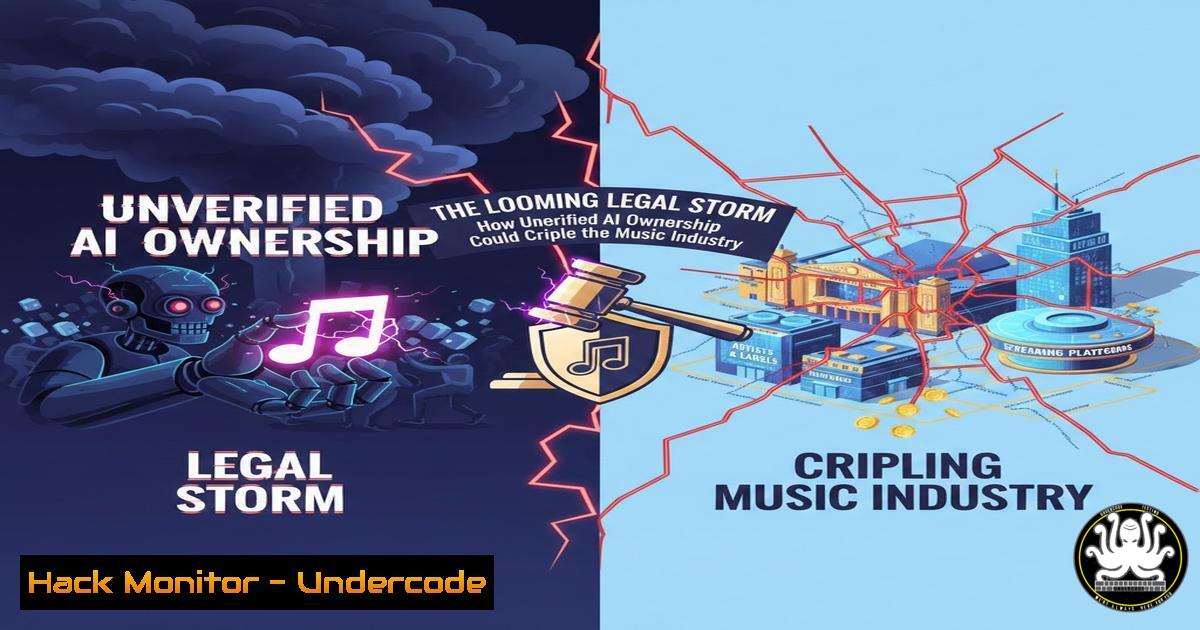
The nascent field of generative AI in music is hurtling toward a crisis of provenance and ownership. As highlighted by industry insiders, disputes over who truly owns the rights to an AI-generated artist are emerging, with no clear legal or technical framework for resolution. This article will dissect the cybersecurity, IT, and procedural failures that allow such conflicts to arise and provide a actionable guide for artists, developers, and labels to protect their intellectual property in the age of AI.
Learning Objectives:
- Understand the critical intersection of AI model provenance, copyright law, and digital asset management.
- Implement technical safeguards for AI training data and model ownership verification.
- Develop a legal and IT strategy to establish and defend ownership claims for AI-generated content.
You Should Know:
1. The Foundation: Verifiable Model Provenance
The core of any AI ownership claim lies in the ability to prove the origin and authorship of the model itself. Without a verifiable chain of custody for the training data and the model’s weights, any claim is merely anecdotal.
Step‑by‑step guide explaining what this does and how to use it.
Step 1: Cryptographic Hashing of Training Datasets. Before training begins, generate a SHA-256 hash of your entire training dataset. This creates a unique, unforgeable fingerprint.
Linux/macOS Command: `find /path/to/training_data -type f -name “.” -exec sha256sum {} \; | sort | sha256sum`
What it does: This command finds all files in the directory, calculates individual SHA-256 hashes, sorts them, and then hashes the list of hashes. This creates a single, deterministic hash for the entire dataset, regardless of file order.
Step 2: Timestamping with a Blockchain. To prove the dataset existed at a specific point in time, submit the generated hash to a blockchain-based timestamping service or a public blockchain itself (e.g., via an OP_RETURN transaction on Bitcoin or a smart contract on Ethereum). This creates an immutable, time-stamped proof of existence.
Step 3: Embedding Provenance in the Model. After training, embed the dataset hash, your copyright information, and the training timestamp directly into the model’s metadata or as a watermark within the model’s weights.
2. Smart Contracts for Transparent Ownership and Royalties
Disputes often involve revenue. Smart contracts can automate royalty distribution and encode ownership logic transparently and immutably.
Step‑by‑step guide explaining what this does and how to use it.
Step 1: Define Ownership Shares. Determine the percentage splits for the model creator, the vocalist, the producer, etc.
Step 2: Deploy a Smart Contract. Use a platform like Ethereum or a more music-focused chain like Audius. The contract’s code will hold the wallet addresses of all rights-holders and the predefined royalty splits.
Example Solidity Snippet (Conceptual):
// Simplified example
contract MusicAIRoyalty {
address public modelOwner;
address public vocalist;
mapping(address => uint) public shares;

constructor(address _vocalist) {
modelOwner = msg.sender;
vocalist = _vocalist;
shares[bash] = 70;
shares[bash] = 30;
}

function distributeRoyalty() external payable {
uint total = msg.value;
payable(modelOwner).transfer(total  shares[bash] / 100);
payable(vocalist).transfer(total  shares[bash] / 100);
}
}
Step 3: Integrate with Distribution Platforms. Configure your digital music distribution to route payments to the smart contract’s address, which will then auto-distribute funds according to the immutable rules.
- Immutable Audit Logging for the AI Creation Pipeline
A detailed, tamper-proof log of the entire creative process is crucial evidence in a dispute.
Step‑by‑step guide explaining what this does and how to use it.
Step 1: Centralize Logging. Use a system like the ELK Stack (Elasticsearch, Logstash, Kibana) or a cloud service like AWS CloudTrail to aggregate logs from all systems involved: your training environment, version control (Git), and digital audio workstations.
Step 2: Implement Immutable Logging. Configure your logging system to write to a Write-Once-Read-Many (WORM) storage system. This prevents anyone, including admins, from altering historical logs.
AWS S3 Command (via CLI) to enable Object Lock: `aws s3api put-object-lock-configuration –bucket my-audio-logs-bucket –object-lock-configuration ObjectLockEnabled=Enabled`
Step 3: Log Key Events. Ensure every action is logged: dataset ingestion (including its hash), model training initiation/completion, parameter adjustments, and final model generation with its output hash.
4. Establishing a “Human-in-the-Loop” Watermark
Beyond the model, the output itself—the music—must be attributable.
Step‑by‑step guide explaining what this does and how to use it.
Step 1: Choose a Watermarking Technique. Use inaudible audio watermarking (steganography) or a perceptual hashing algorithm like Phonographic Performance Limited (PPL)/Video Performance Limited (VPL) to create a unique fingerprint for every generated track.
Step 2: Encode Ownership Data. The watermark should contain a reference to the model’s provenance hash and the generating wallet address from the smart contract.
Step 3: Verify and Monitor. Use automated services to scan streaming platforms and social media for unauthorized uses of your watermarked AI-generated music, providing a technical basis for takedown notices.
5. Legal-Tech Integration: The Proof of Creation File
Bridging the gap between technical proof and legal admissibility.
Step‑by‑step guide explaining what this does and how to use it.
Step 1: Automate Artifact Collection. Create a script that bundles the following into a single, signed archive: The dataset hash, the blockchain timestamp transaction ID, the model’s provenance metadata, the smart contract address, and the audio file’s perceptual hash.
Step 2: Digital Signature. Cryptographically sign this archive file with a private key corresponding to a publicly verifiable certificate (e.g., from a commercial Certificate Authority).
OpenSSL Command to sign a file: `openssl dgst -sha256 -sign private.key -out proof_bundle.sha256 proof_bundle.zip`
Step 3: Standardize the Process. This “Proof of Creation” file becomes the definitive, court-admissible evidence of ownership, submitted alongside traditional copyright registration.
What Undercode Say:
- Technical Provenance is Non-Negotiable: Relying on “I made it first” is a pre-digital argument. In the AI era, ownership must be baked into the model and its outputs through cryptographic verification and immutable logging from day one.
- Smart Contracts are Your First Legal Draft: Automating royalty distribution via code is not just efficient; it’s a powerful, transparent, and unarguable statement of ownership structure that preempts financial disputes.
The dispute over an AI artist’s rights is not a one-off event but a symptom of a systemic failure to integrate IT governance with creative processes. The music industry, already plagued by royalty and ownership conflicts, is naively repeating its past mistakes with a technology that operates at a scale and speed that makes manual resolution impossible. The organizations that will thrive are those that treat their AI training pipelines and generative systems with the same rigor as a financial institution’s transaction ledger—auditable, secure, and transparent. The legal framework will inevitably lag; your technical one cannot.
Prediction:
The current “wild west” phase of AI music will culminate in a series of high-profile, industry-defining lawsuits within the next 18-24 months. The outcomes will hinge not on artistic merit, but on which party can present the most robust, technically verifiable chain of provenance. This will force a rapid standardization of ownership-verification technologies, making tools for cryptographic timestamping, model watermarking, and smart contract integration as fundamental to a music producer’s toolkit as a Digital Audio Workstation is today. Labels and platforms will soon mandate proof of clear title and verifiable ownership metadata before distributing any AI-generated content, creating a two-tier market: compliant, legally-safe AI music and the rest, which will be deemed too risky to monetize.
🎯Let’s Practice For Free:
IT/Security Reporter URL:
Reported By: Petecallaghans You – Hackers Feeds
Extra Hub: Undercode MoN
Basic Verification: Pass ✅


