Listen to this Post
Introduction
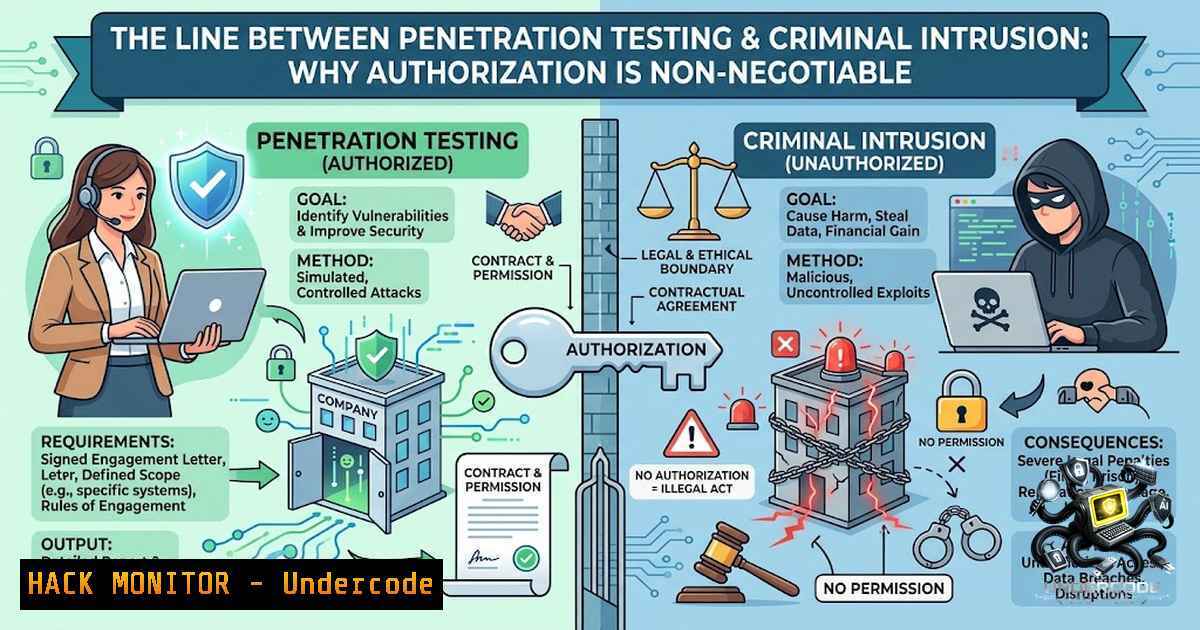
In the cybersecurity industry, the distinction between ethical security testing and illegal intrusion hinges on a single document: written authorization. When a prospect requests an application security assessment via email without formal agreement, they are not asking for a test—they are asking for a criminal act under most European jurisdictions, including Germany’s dedicated legal provisions. The vendor who agrees to such requests reveals more about their ethical boundaries than their technical capabilities.
Learning Objectives & Secrets
- Objective 1: Understand the legal and professional obligations governing penetration testing, including jurisdictional requirements for written authorization before any testing activity.
- Objective 2 Secret Tip: Use the authorization request itself as an evaluation criterion—vendors who bypass formal agreements demonstrate a willingness to disregard controls that protect your data.
- Objective 3 Secret Tip: Read bug bounty program terms thoroughly; many explicitly prohibit AI-enabled testing tools, creating additional compliance layers that require careful navigation.
You Should Know
- The Legal Framework of Authorization in European Cybersecurity
Authorization is not administrative bureaucracy—it is the foundational control that separates legitimate security testing from criminal activity. In Germany, Section 202a of the Criminal Code (StGB) specifically addresses data espionage and hacking, carrying penalties including imprisonment. Similar provisions exist across EU member states under frameworks like the GDPR and national cybersecurity laws.
The evaluation service agreement serves multiple critical functions beyond mere legal protection:
– Establishes clear scope boundaries for testing activities
– Defines acceptable testing methodologies and tools
– Provides liability protection for both parties
– Creates a documented chain of authorization for audit and compliance purposes
– Sets expectations for reporting, communication, and remediation
Without these protections, any testing activity constitutes unauthorized access, regardless of intent or potential security benefits. Security leaders must treat authorization as the first and most important control in the security testing chain.
2. Vetting Security Vendors Through Their Authorization Practices
When a security vendor agrees to test systems without proper authorization, they are demonstrating a fundamental failure in security culture. This behaviour indicates several critical red flags:
Step-by-step guide to vendor vetting through authorization:
- Request formal documentation: Never accept verbal or email-only authorization. Require signed agreements with clear scope definitions.
- Review their response to authorization requirements: Legitimate vendors will insist on proper documentation—this is a positive signal.
- Test their boundary enforcement: Ask about their process for handling requests that fall outside authorized scope.
- Verify their understanding of legal frameworks: Ask specific questions about jurisdictional requirements for testing activities.
- Check their insurance coverage: Ensure professional liability and errors & omissions coverage specifically includes penetration testing activities.
- Review their breach notification procedures: Confirm they have protocols for handling discovered data during testing.
Linux command for verifying system logs after authorized testing:
 Check for unauthorized access attempts in system logs
sudo grep "Failed password" /var/log/auth.log | tail -20

Review sudo access attempts
sudo grep "sudo" /var/log/auth.log | tail -20

Check for unusual outbound connections that might indicate testing tools
sudo netstat -tunap | grep ESTABLISHED | awk '{print $5}' | sort | uniq -c | sort -1r
Windows PowerShell command for audit log review:
 Review security event logs for failed logon attempts
Get-EventLog -LogName Security -InstanceId 4625 | Select-Object TimeGenerated, Message -First 20

Check for unusual process creation
Get-EventLog -LogName Security -InstanceId 4688 | Select-Object TimeGenerated, Message -First 20

Review PowerShell script block logging if enabled
Get-WinEvent -LogName "Microsoft-Windows-PowerShell/Operational" | Where-Object { $_.Id -eq 4104 } | Select-Object TimeCreated, Message -First 10
- Bug Bounty Program Compliance and AI Tool Restrictions
Bug bounty programs represent a controlled environment for vulnerability disclosure, but they come with specific restrictions that security professionals must respect. The prohibition on AI-enabled testing tools is increasingly common, reflecting concerns about:
– Automated scanning generating excessive traffic and false positives
– AI tools potentially violating data privacy through content processing
– Unpredictable behaviour from machine learning models
– Compliance with data protection regulations when AI processes sensitive data
Tool compliance verification checklist:
1. Review program terms before any testing activity
- Document all tools and methodologies planned for testing
3. Obtain explicit approval for any automated scanning
- Ensure AI tools are disabled or excluded from testing scope
5. Maintain detailed logs of all testing activities
4. The Business Case for Rigorous Authorization Processes
Security leaders who treat authorization as friction misunderstand its business value. Proper authorization processes:
Step-by-step implementation guide:
- Develop a standard evaluation service agreement template that includes scope, methodology, reporting requirements, and liability provisions.
- Create an internal approval workflow that involves legal, IT, and security stakeholders before any testing commences.
- Build a vendor risk assessment process that evaluates security practices including authorization handling.
- Document all testing activities with timestamps, personnel, and tool identification for audit purposes.
- Establish incident response procedures for handling discoveries during testing, including data handling and disclosure protocols.
API security configuration example for restricting testing access:
 Example API gateway rate limiting to prevent automated scanning abuse
rate_limits:
- path: /api/
method: ALL
rate: 100
per: minute
response_code: 429
message: "Rate limit exceeded. Please contact security team for authorized testing."

IP whitelisting for approved testing sources
ip_whitelist:
- "192.168.1.0/24"  Internal testing network
- "203.0.113.0/24"  Approved vendor IP range

Header validation for testing authorization
header_validation:
- header: "X-Testing-Authorization"
required: true
validation: "Bearer ${TESTING_TOKEN}"
- Cloud Security Hardening in Response to Unauthorized Access Attempts
When unauthorized testing occurs, cloud environments require specific hardening measures to prevent data exposure and maintain compliance.
AWS CLI commands for security hardening:
 List all security groups and their inbound rules
aws ec2 describe-security-groups --query 'SecurityGroups[].[GroupName, IpPermissions]'

Review CloudTrail for unauthorized API calls
aws cloudtrail lookup-events --lookup-attributes AttributeKey=EventName,AttributeValue=RunInstances

Enable VPC Flow Logs for network monitoring
aws ec2 create-flow-logs --resource-ids vpc-12345678 --resource-type VPC --traffic-type ALL --log-group-1ame VPCFlowLogs --log-destination-type cloud-watch-logs

Review IAM policies for excessive permissions
aws iam list-policies --scope Local --query 'Policies[?DefaultVersionId]'
Azure CLI commands for security assessment:
 List all network security group rules
az network nsg rule list --1sg-1ame MyNSG --resource-group MyResourceGroup

Review Azure Activity Log for security events
az monitor activity-log list --query "[?contains(resourceGroupName, 'myresourcegroup')]" --output table

Check just-in-time VM access configuration
az security jit-policy list
GCP commands for security monitoring:
 List firewall rules that may allow unauthorized access
gcloud compute firewall-rules list

Review audit logs for suspicious activity
gcloud logging read "logName:projects/myproject/logs/cloudaudit.googleapis.com%2Factivity" --limit 10

Check IAM policy bindings
gcloud projects get-iam-policy myproject
6. Vulnerability Exploitation and Mitigation Without Authorization
Attempting to exploit vulnerabilities without authorization creates exposure to legal liability and professional consequences. Ethical security professionals must:
1. Never attempt exploitation without explicit written authorization
- Report discovered vulnerabilities through appropriate channels (bug bounty programs, responsible disclosure)
- Maintain detailed documentation of discovery methods and potential impacts
- Cooperate with affected organizations to enable proper remediation
- Preserve evidence in a format suitable for forensic analysis
Example vulnerability discovery process:
 Passive reconnaissance that does not require authorization
nmap -sV -p 80,443,22 --open target.com  Banner grabbing

Research public information about potential vulnerabilities
searchsploit apache 2.4.49  Search public exploit database

Manual inspection of public-facing configurations
curl -I https://target.com  Check server headers
Mitigation steps for discovered vulnerabilities:
- Document the finding with technical details and potential impact
2. Notify the affected organization through official channels
- Allow reasonable time for remediation before public disclosure
4. Follow responsible disclosure frameworks (CERT/CC, ISO 29147)
5. Maintain confidentiality of sensitive details
7. Building a Security Culture That Values Authorization
Organizations that treat authorization as a checkbox rather than a core security control expose themselves to significant risk. Building a culture that values proper authorization requires:
Step-by-step cultural implementation:
- Leadership commitment: Executive teams must demonstrate the importance of authorization through their actions and decisions.
- Training and awareness: Regular education on legal obligations and ethical responsibilities.
- Process integration: Embed authorization requirements into all security testing workflows.
- Performance metrics: Include authorization compliance in security team performance evaluations.
- Communication standards: Establish clear language and protocols for requesting and granting testing authorization.
- Third-party management: Extend authorization requirements to all vendors and partners.
- Continuous improvement: Regularly review and update authorization processes based on lessons learned and regulatory changes.
What Undercode Say
- Key Takeaway 1: Authorization is the first and most critical control in security testing—without it, no amount of technical sophistication provides protection against legal and professional consequences.
- Key Takeaway 2: Vendors who bypass authorization requirements reveal a willingness to prioritize deals over ethics, making them unsuitable partners for protecting sensitive data.
- Key Takeaway 3: Bug bounty program restrictions, including AI tool prohibitions, require careful review and compliance to maintain program participation and legal standing.
- Key Takeaway 4: Security leaders must treat the authorization process as an evaluation criterion, not an obstacle, and use it to distinguish professional vendors from those who cut corners.
- Key Takeaway 5: Documentation, scoping, and legal review are not friction—they are the foundation of ethical security testing and protect all parties involved.
Analysis: The cybersecurity industry faces a persistent tension between the desire for rapid security assessments and the legal requirements governing such activities. This conflict intensifies as organizations demand faster results while maintaining compliance with increasingly complex regulations. Security professionals who compromise on authorization requirements not only expose themselves to legal liability but also undermine the trust that forms the basis of effective security partnerships. The emergence of AI-enabled testing tools adds another layer of complexity, requiring organizations to carefully evaluate both the technical capabilities and compliance implications of automated testing approaches. Ultimately, the organizations that treat authorization as an inviolable requirement rather than a negotiable inconvenience will build stronger, more trustworthy security programs and partnerships.
Prediction
+1 Organizations that formalize authorization processes and enforce compliance will experience reduced legal exposure and stronger vendor relationships, positioning themselves as trusted security partners in an increasingly regulated landscape.
-1 Organizations that continue to bypass authorization requirements or pressure vendors to test without proper agreements will face increasing legal scrutiny, with regulators imposing significant fines and sanctions for unauthorized testing activities.
+1 Bug bounty programs will expand their restrictions on AI-enabled tools, driving innovation in manual testing techniques and specialized tools that respect program boundaries while maintaining effectiveness.
-1 Security vendors that compete on speed rather than ethics will face market consolidation as clients increasingly prioritize trust and compliance over quick results, leading to reduced competition and potential service gaps.
-1 The growing complexity of authorization requirements across different jurisdictions will create confusion and potential violations for multinational organizations, requiring dedicated legal and compliance resources to navigate effectively.
+1 Professional standards and certification bodies will strengthen requirements around authorization documentation, raising the bar for entry into the security testing profession and improving overall industry quality.
-1 Small and medium organizations with limited legal resources may struggle to maintain proper authorization documentation, making them more vulnerable to both regulatory action and security incidents.
+1 The integration of authorization verification into security tools and platforms will automate compliance checking, reducing the risk of unauthorized testing and simplifying the vendor evaluation process.
-1 Organizations that rely heavily on automated testing tools may face increased scrutiny as regulators examine the scope and authorization for AI-driven scanning activities.
+1 Security leaders who champion rigorous authorization processes will emerge as thought leaders and trusted advisors, driving industry-wide adoption of best practices for ethical security testing.
▶️ Related Video (84% Match):
🎯Let’s Practice For Free:
🎓 Live Courses & Certifications:
Join Undercode Academy for Verified Certifications
🚀 Request a Custom Project:
Secure, high-velocity infrastructure and disruptive technological engineering. Contact our engineering team for high-tier development and proprietary systems:
[email protected]
💎 Smart Architecture | 🛡️ Secure by Design | ⭐ Trusted by Thousands
IT/Security Reporter URL:
Reported By: https://lnkd.in/p/eevh97Xn – Hackers Feeds
Extra Hub: Undercode MoN
Basic Verification: Pass ✅


