Listen to this Post
Introduction:
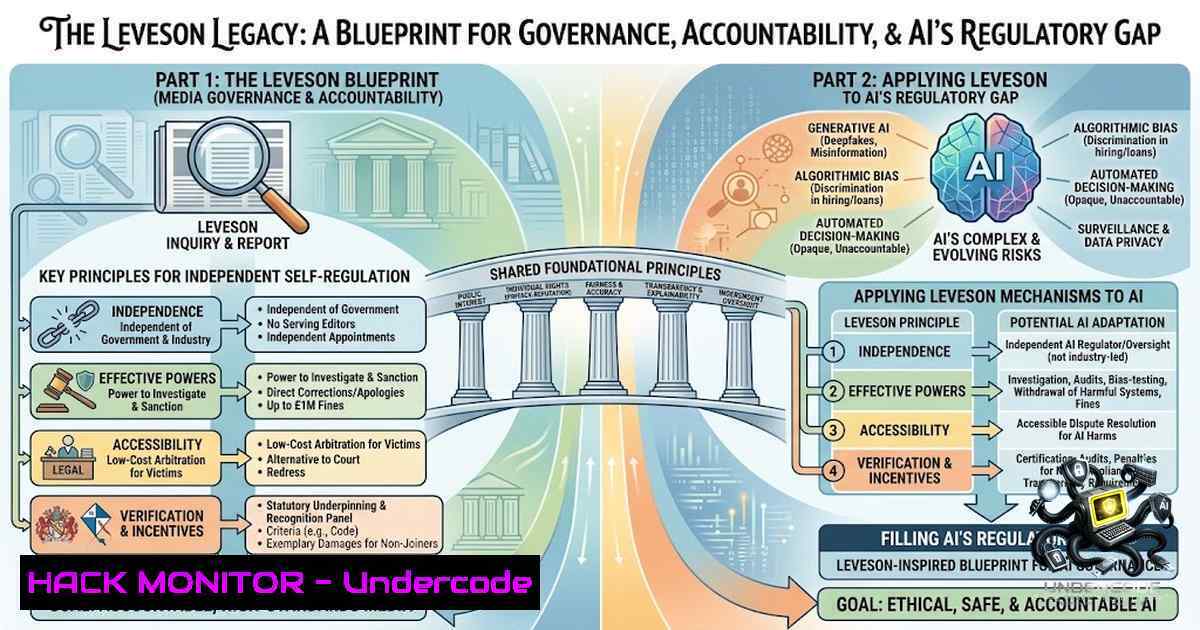
The UK’s Leveson Inquiry, born from the phone-hacking scandal, serves as a critical case study in systemic governance failure. While rooted in press ethics, its core themes—independent verification, enforcement mechanisms, and the protection of whistleblowers—are directly analogous to the challenges facing modern cybersecurity, AI governance, and social media moderation. The failure to implement Leveson’s recommendations highlights a universal truth: without robust, verified oversight and legal incentives for compliance, self-regulation inevitably fails, leaving systems vulnerable to exploitation and abuse.
Learning Objectives:
- Understand the parallels between press regulation failures and current vulnerabilities in AI and social media ecosystems.
- Identify key technical and procedural controls for implementing “verified independence” in security and compliance frameworks.
- Analyze the legal and technical implications of weak enforcement mechanisms (e.g., Section 40 repeal) on data privacy and integrity.
You Should Know:
- Information Governance and the “Leveson Standard” for Tech
At its heart, Leveson 1 advocated for a system of “recognized” self-regulation. In the tech world, this translates to third-party audits and certifications (e.g., SOC 2, ISO 27001) but with a critical twist: the “Recognition Panel” acts as a meta-regulator verifying the verifier. For IT and security professionals, this means implementing layered trust.
- Implementing a “Meta-Regulator” Framework: To simulate this in a corporate environment, you must enforce continuous validation of your security controls. This involves using Infrastructure as Code (IaC) to audit configurations.
- Linux Command: Use `auditd` to track changes to critical security files.
sudo auditctl -w /etc/passwd -p wa -k identity_changes
sudo ausearch -k identity_changes --start recent
- Windows Command: Use PowerShell to audit group policy changes.
Get-WinEvent -LogName "Security" | Where-Object { $_.Id -in 4732, 4728 } | Format-List - Step-by-Step Guide:
- Define a “Recognized” baseline using a CIS benchmark.
- Deploy a compliance scanner (e.g., OpenSCAP) to verify the baseline monthly.
- Establish an independent board (like the Press Recognition Panel) to review scanner results, ensuring no conflicts of interest.
- Implement automated alerts for configuration drift, ensuring any deviation is flagged for “equal prominence” remediation.
-
The Death of Section 40: Legal Incentives and API Security
Leveson proposed Section 40 to incentivize joining a recognized regulator by making non-members liable for costs in libel cases, regardless of outcome. The repeal in 2024 removed this “stick.” In cybersecurity, this mirrors the lack of legal liability for insecure software. Without mandatory breach notification laws or “costs” for insecure design, many organizations opt for weaker security postures (like IPSO instead of IMPRESS).
- Securing APIs Against “Hacking” Parallels: Just as Leveson targeted unlawful information gathering, we must protect APIs from scraping and injection.
- Tool Configuration (OWASP ZAP): Configure ZAP to act as a “recognized regulator” for your API endpoints, performing fuzzing to simulate hostile data gathering.
- Command: Use `curl` to test for information disclosure, akin to illegal data interception.
curl -X GET "https://api.example.com/v1/users/123" -H "Authorization: Bearer [bash]"
- Mitigation Strategy:
- Implement rate limiting using `iptables` (Linux) or `New-1etFirewallRule` (Windows) to block IPs attempting bulk data scraping.
- Use robust logging (Syslog or Windows Event Forwarding) to create an immutable audit trail, allowing you to track who accessed what data—similar to how Leveson 2 would have investigated journalist access.
- Enforce Zero Trust principles (e.g., just-in-time access) to mitigate the risk of internal bad actors, a key concern raised by Leveson regarding management knowledge.
3. Cloud Hardening: Preventing “Corporate Governance” Failures
Leveson 2 was meant to probe “corporate governance” failures at News International. In cloud environments, this translates to poor IAM (Identity and Access Management) practices. A “Leveson-style” investigation would look for excessive permissions and lack of segregation of duties.
- Step-by-Step Cloud Hardening:
- Identify overly permissive roles using AWS IAM Access Analyzer or Azure AD Access Reviews.
- Remediate by applying the principle of least privilege.
- Verify independence of controls by ensuring the security team (the regulator) is separate from the development team (the press).
– Code Snippet (Terraform for AWS): Enforce a policy that prohibits root user actions.
resource "aws_iam_policy" "no_root" {
policy = jsonencode({
Statement = [{
Effect = "Deny"
Action = ""
Resource = ""
Condition = {
StringEquals = { "aws:PrincipalArn": "arn:aws:iam::123456789012:root" }
}
}]
})
}
- Vulnerability Exploitation and Mitigation (The “Phone Hacking” Analogy)
The technical execution of phone hacking often involved exploiting SS7 protocol vulnerabilities or simply brute-forcing voicemail PINs. This mirrors modern SQL injection or credential stuffing attacks—low-tech but high-impact.
- Exploitation Test (Lab Only): Use `hydra` to simulate credential stuffing against a web portal.
hydra -l admin -P rockyou.txt 192.168.1.10 http-post-form "/login:user=^USER^&pass=^PASS^:F=incorrect"
- Mitigation (The “Leveson Safeguard”):
- Enforce Multi-Factor Authentication (MFA) universally. This acts as the “verification body” for user identity.
- Deploy Web Application Firewalls (WAF) to block injection attempts—this serves as the “independent regulator” sitting in front of your data.
- Conduct “Red Team” exercises that specifically mimic the “culture, practices, and ethics” of an adversarial attack, going beyond technical scans to test human vulnerabilities (phishing).
-
AI Training and Data Poisoning: The “Impartiality” Clause
The post notes Leveson ruled out Ofcom-style impartiality rules. However, in AI, we face the inverse—the need to ensure training data isn’t tainted by misinformation. Without a “recognized regulator” for AI datasets, models are at risk of hallucination and bias.
- Technical Implementation:
- Data Provenance: Use cryptographic hashing to lock datasets. If an AI model is trained on data that was “hacked” or improperly gathered (like the phone hacking), it must be invalidated.
- Linux Command for Verifying Dataset Integrity:
sha256sum training_data_v1.csv > checksum.txt
- Step-by-Step:
- Create a manifest of all training data sources.
- Implement version control for datasets using DVC (Data Version Control).
- Require dual-approval for data ingestion, mimicking the “recognized regulator” role to prevent unilateral (and potentially malicious) data inclusion.
6. The “Arbitration” Principle: Dealing with Security Breaches
Leveson recommended cheaper arbitration for libel. In security, this translates to having a clear, transparent, and legally vetted incident response (IR) plan.
- Command (Windows): Query event logs to build a timeline of a breach.
Get-WinEvent -FilterHashtable @{LogName='Security'; ID=4624,4625; StartTime=(Get-Date).AddDays(-7)} - Step-by-Step Response:
1. Isolate affected systems (network segmentation).
2. Preserve logs (forensic acquisition).
- Notify independent oversight (the equivalent of the Press Recognition Panel)—often a data protection authority.
- Offer “arbitration” to affected users, such as free credit monitoring and transparent communication on what data was taken.
What Undercode Say:
- Key Takeaway 1: The Leveson saga underscores that “self-regulation” without external verification and legal consequences is merely a PR exercise. For cybersecurity, this means organizations must prioritize independent audits over vanity compliance.
- Key Takeaway 2: The cancellation of Leveson 2 illustrates how powerful interests can bury systemic investigations. In tech, this manifests as the “move fast and break things” culture, where legacy vulnerabilities are ignored until they become catastrophic breaches.
- Analysis: The core issue is accountability. The press rejected IMPRESS because it was effective; similarly, companies often resist stringent security controls because they impede velocity. The technical solution lies in automating compliance via IaC and CI/CD pipelines, making security non-1egotiable. However, technology alone cannot solve governance. The failure to implement Section 40 is a stark warning to security professionals: legal frameworks and technical controls must evolve in tandem. We are seeing this battle play out now with the EU AI Act, where “recognized” standards are being debated. The UK’s press regulation failure is a blueprint for how not to regulate emerging tech.
Prediction:
- -1: The “Leveson model” of meta-regulation will likely be bypassed in the AI space by Big Tech, leading to a fragmented landscape where “weak” regulators (like IPSO) dominate, ensuring tech giants avoid costly arbitration for algorithmic harms.
- +1: However, the EU AI Act’s emphasis on “independent” conformity assessments may succeed where Leveson failed, establishing a global standard for verified AI safety that surpasses the UK press’s “weak industry-internal-regulator” approach.
- -1: Unless legal incentives (akin to Section 40) are attached to these AI regulations, we will see a repeat of the 2012 Leveson scenario: reports written, recommendations made, but enforcement permanently stalled, leaving citizens unprotected.
- +1: The rise of open-source security auditing tools, combined with mandatory disclosure laws, is creating a de facto “Press Recognition Panel” for software supply chains. The failure of UK press regulation inadvertently teaches us that public transparency is the ultimate regulator.
▶️ Related Video (84% Match):
🎯Let’s Practice For Free:
🎓 Live Courses & Certifications:
Join Undercode Academy for Verified Certifications
🚀 Request a Custom Project:
Secure, high-velocity infrastructure and disruptive technological engineering. Contact our engineering team for high-tier development and proprietary systems:
[email protected]
💎 Smart Architecture | 🛡️ Secure by Design | ⭐ Trusted by Thousands
IT/Security Reporter URL:
Reported By: https://lnkd.in/p/ecBJug7W – Hackers Feeds
Extra Hub: Undercode MoN
Basic Verification: Pass ✅


