Listen to this Post
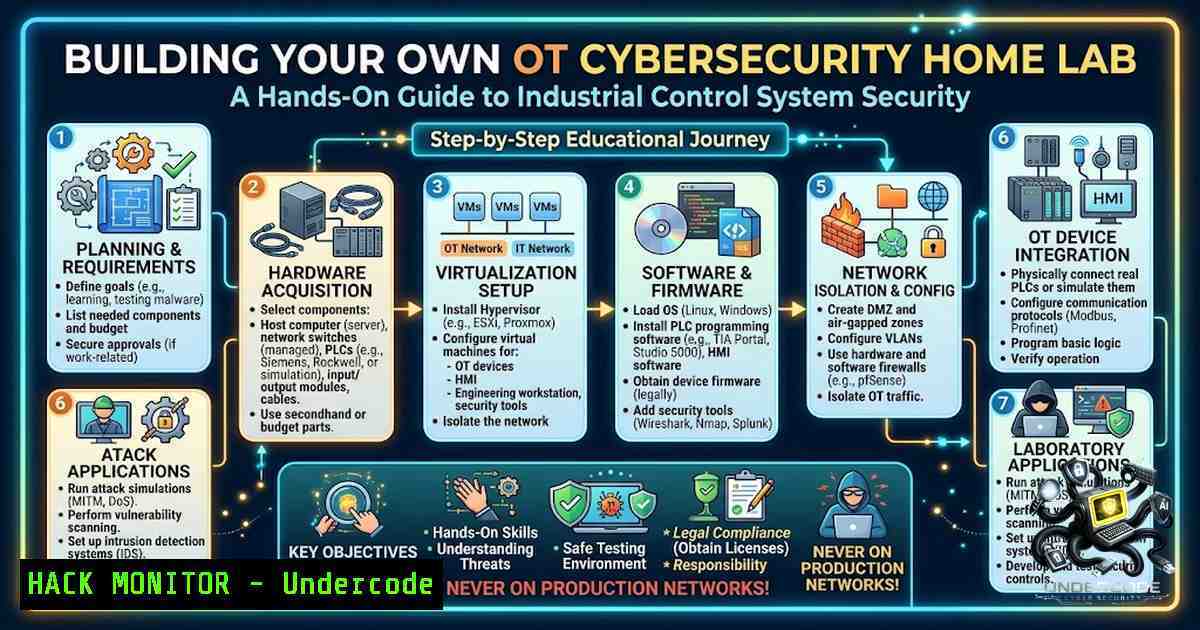
Introduction:
Operational Technology (OT) environments—the backbone of critical infrastructure like power grids, water treatment plants, and manufacturing facilities—face escalating cyber threats as IT and OT networks increasingly converge. Unlike traditional IT systems, OT prioritizes availability and safety over confidentiality, making security testing in production environments dangerously impractical. Building a dedicated OT home lab provides security professionals the freedom to hack, break, attack, rebuild, and learn with confidence—without risking real-world consequences. This article delivers a comprehensive, step-by-step guide to constructing your own OT cybersecurity home lab using open-source tools, covering everything from network architecture to protocol exploitation and AI-driven anomaly detection.
Learning Objectives:
- Understand the Purdue Enterprise Reference Architecture and how OT network segmentation differs from IT environments
- Deploy a fully functional ICS/OT lab using Docker, VirtualBox, and open-source PLC simulators
- Master OT protocol enumeration, scanning, and vulnerability assessment using Nmap, Modbus, and Siemens S7 tools
- Implement ICS honeypots (Conpot) and threat intelligence platforms for attack detection and analysis
- Apply AI and machine learning techniques for anomaly detection in OT network traffic
You Should Know:
1. Architecting Your OT Home Lab: The Foundation
A realistic OT lab mirrors the Purdue Model, separating enterprise IT (Level 4–5), industrial DMZ (Level 3.5), manufacturing operations (Level 3), and control systems (Levels 0–2). Start with virtualization as your foundation—VirtualBox remains the most accessible platform for beginners.
Step-by-Step Setup:
1. Install VirtualBox on your host machine (Windows/Linux/macOS).
- Deploy a Kali Linux VM as your attacking machine.
- Set up a Windows 10/11 evaluation VM for testing Windows-based OT tools and interfaces.
- Install Docker on your host or a dedicated Linux VM:
sudo apt update && sudo apt install -y docker.io docker-compose. - Configure VirtualBox networking: Go to Tools → Network Manager and create a host-only network (e.g., 192.168.56.0/24) for isolated lab communication.
- Deploy GRFICSv3—a fully containerized OT security lab with 3D process simulation:
docker compose pull && docker compose up -d.
Alternative Platforms:
- LabShock: A free Dockerized OT testing platform providing quick-start environments.
- GNS3: For advanced network simulation with Docker container integration.
- OpenPLC + FUXA: Build a professional-grade ICS lab from scratch using open-source tools.
2. OT Protocol Enumeration and Scanning
Industrial environments communicate using specialized protocols often lacking modern security controls. Understanding how to enumerate these protocols is fundamental to OT security testing.
Key OT Ports and Protocols:
| Port | Protocol | Nmap Script |
||-|-|
| 102/TCP | Siemens S7 | `s7-info.nse` |
| 502/TCP | Modbus TCP | modbus-discover.nse, `modicon-info.nse` |
| 161/UDP | SNMP | Standard SNMP enumeration |
| 4840/TCP | OPC UA | Custom scanners |
Step-by-Step Enumeration:
1. Modbus Slave ID Discovery (Linux):
nmap -Pn -sT -p 502 --script modbus-discover <target_IP>
This enumerates all accessible Modbus Slave IDs and reads device information.
2. Siemens S7 Information Gathering:
nmap --script s7-info.nse -p 102 <target_IP>
Retrieves PLC model, firmware version, and module information.
- Comprehensive OT Scan (Windows – Run as Administrator):
nmap -p 102,502,161,4840 --script "default or safe" <target_range>
Scan multiple OT protocols in a single pass.
- OTScan—A dedicated OT network security scanner supporting 13 industrial protocols including OPC UA, IEC 60870-5-104, and CODESYS:
git clone https://github.com/sundi133/otscan
cd otscan && python3 otscan.py -t <target_IP>
3. Deploying ICS Honeypots for Threat Intelligence
Honeypots simulate vulnerable OT devices to attract attackers, collect intelligence, and understand adversary techniques. Conpot is the industry-standard open-source ICS honeypot.
Step-by-Step Conpot Deployment:
1. Pull the Conpot Docker image:
docker pull honeynet/conpot
2. Run Conpot with exposed industrial ports:
docker run -it -p 80:80 -p 102:102 -p 502:502 -p 161:161/udp --1etwork=bridge honeynet/conpot:latest /bin/sh
3. Start Conpot with default template:
conpot -f --template default
- Verify deployment: Navigate to `http://MY_IP_ADDRESS` to confirm the web interface.
-
Customize deception profiles: Conpot supports multiple templates mimicking different ICS devices—Siemens S7, Modbus, and SNMP.
Alternative Honeypots:
- T-Pot: Multi-honeypot platform with ICS/OT versions.
- Custom honeypots: Build targeted deception using Python and Scapy for specific protocol emulation.
4. AI-Powered Anomaly Detection in OT Networks
Machine learning is transforming OT security by identifying deviations from normal operational behavior—crucial for detecting zero-day attacks and subtle APT activity.
Implementation Strategy:
- Collect baseline network traffic: Use `tcpdump` or Wireshark to capture normal OT protocol communications over 7–14 days.
-
Deploy a SIEM with ML capabilities: Implement Wazuh + TheHive + MISP—a complete SOC stack for OT environments:
git clone https://github.com/Ashwatha4502/tangedco-ot-security
cd tangedco-ot-security
docker-compose up -d
-
Train autoencoder-based anomaly detection models on operational data to identify subtle protocol deviations.
-
Implement digital twin technology: Create a replica of your OT environment to safely train AI/ML models on both normal and attack signatures.
-
Leverage LLMs for threat hunting: Use large language models to summarize integrated IT/OT anomaly logs into human-readable insights.
Key AI/ML Techniques for OT:
- Autoencoders: Detect anomalies in control equipment operational data
- Automated feature extraction: Reduce manual data labeling efforts
- Adversarial machine learning: Test model robustness against evasive attacks
5. Threat Intelligence and Attack Simulation
Understanding real-world OT threats is essential for building effective defenses. Historical malware campaigns provide invaluable lessons.
Notable OT Malware:
- Stuxnet (2010): Targeted Iranian nuclear centrifuges
- Industroyer/CrashOverride (2016, 2022): First malware designed specifically for power grids, exploiting IEC-104 protocol
- Triton/Trisis (2017): Targeted safety instrumented systems
- Industroyer2: Sandworm-deployed malware manipulating substation operations
Threat Intelligence Platform Setup:
- Deploy MISP (Malware Information Sharing Platform) for threat intelligence sharing.
-
Integrate Shodan for OSINT: Search for exposed ICS devices using `tag:ics` filter:
– Modbus: `port:502 modbus`
– Siemens S7: `port:102 “Siemens”`
– Schneider Electric: `”Schneider Electric”`
3. Simulate attacks using GRFICSv3: Practice realistic attack scenarios in a 3D process simulation environment.
- Build an OT/ICS threat intelligence lab using Docker Compose for firmware vulnerability research.
6. OT Protocol Security Assessments
OPC UA Security Assessment:
OPC UA is increasingly prevalent in industrial environments but introduces new attack surfaces. Use dedicated frameworks for assessment:
1. Clone the OPC UA Security Assessment Framework:
git clone https://github.com/ridpath/SCADA-OT-CheatSheet-Advanced-ICS-Hacking-Playbook
2. Key assessment capabilities:
- Certificate validation bypass
- Subscription manipulation
- Node enumeration and discovery
- Session hijacking
- Fuzzing implementation
- Use OpalOPC—OPC Foundation’s official vulnerability scanner for OPC UA applications.
-
ANSSI’s Fuzzysully: Open-source OPC UA fuzzer for evaluating protocol implementation security.
What Undercode Say:
-
“Understanding how to protect OT starts with understanding how it can be broken.” This philosophy drives the entire home lab approach—safe, controlled experimentation is the only path to true expertise.
-
“While everyone is busy using AI to generate images, I’m busy using AI to explore where the holes are in OT environments.” The application of AI to OT security represents a paradigm shift—moving from reactive patching to proactive anomaly detection and predictive defense.
Analysis:
The convergence of IT and OT has created unprecedented cybersecurity challenges. Traditional IT security tools and approaches often fail in OT environments due to legacy systems, proprietary protocols, and the criticality of continuous availability. Building a home lab bridges this gap by providing a sandbox for experimentation without production risks. The rise of AI-powered anomaly detection offers particular promise—autoencoder-based models can identify subtle deviations in control system behavior that rule-based SIEMs miss. However, adversaries are equally leveraging AI, creating an arms race in OT security. The 64% increase in OT ransomware attacks in 2025 underscores the urgency. Practitioners must develop hands-on skills across protocol enumeration, honeypot deployment, threat intelligence, and AI-driven defense—all of which are accessible through a well-designed home lab environment.
Prediction:
- +1 AI-driven anomaly detection will become standard in OT security stacks by 2027, with autoencoder and digital twin technologies reducing false positive rates by over 60% compared to rule-based systems.
-
+1 Open-source OT security tools (GRFICSv3, Conpot, LabShock) will see exponential adoption, democratizing ICS security training and creating a new generation of OT security professionals.
-
-1 The proliferation of exposed ICS devices on Shodan (974 vulnerable devices identified in recent studies) will continue to enable sophisticated attacks targeting critical infrastructure.
-
-1 OT ransomware attacks, which increased 64% in 2025, will escalate further as criminal groups develop specialized ICS-targeting malware capable of manipulating physical processes.
-
+1 Regulatory frameworks like NIS2 and IEC 62443 will drive mandatory OT security testing, creating sustained demand for home lab expertise and certified professionals.
▶️ Related Video (78% Match):
https://www.youtube.com/watch?v=79zE7PLbR3k
🎯Let’s Practice For Free:
🎓 Live Courses & Certifications:
Join Undercode Academy for Verified Certifications
🚀 Request a Custom Project:
Secure, high-velocity infrastructure and disruptive technological engineering. Contact our engineering team for high-tier development and proprietary systems:
[email protected]
💎 Smart Architecture | 🛡️ Secure by Design | ⭐ Trusted by Thousands
IT/Security Reporter URL:
Reported By: https://lnkd.in/p/e7NVGZSx – Hackers Feeds
Extra Hub: Undercode MoN
Basic Verification: Pass ✅


