Listen to this Post
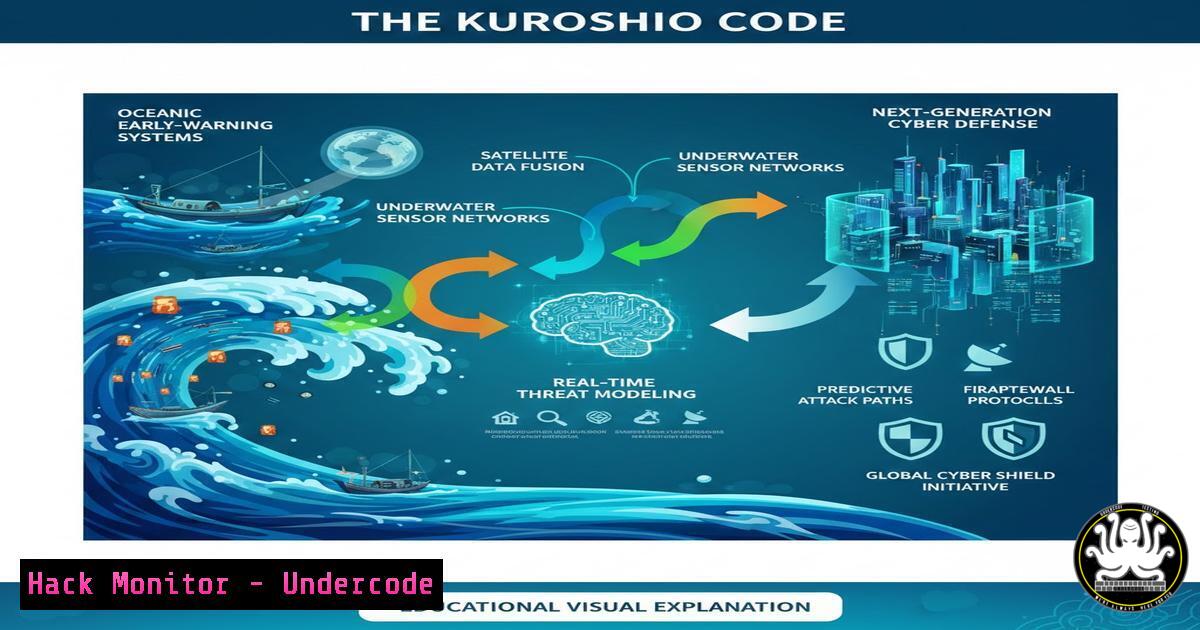
Introduction:
In a revelation mirroring modern cybersecurity challenges, Japan’s sea levels are moving in opposing directions due to shifts in the Kuroshio current system, turning routine storms into amplified threats. This “dynamic sea level” phenomenon, where environmental baselines are being rewritten, provides a profound analogy for the evolving digital landscape, where systemic IT shifts redefine normal operations and turn minor vulnerabilities into major breaches. Just as fisheries act as early-warning sensors for oceanic systemic change, sophisticated monitoring and AI-driven analytics in IT infrastructure are becoming the critical sensors for detecting systemic cyber threats before they escalate.
Learning Objectives:
- Understand how the concept of “dynamic baselines” in climate science directly applies to modern, fluid attack surfaces in cybersecurity.
- Learn to implement continuous monitoring and anomaly detection systems that act as “digital fisheries” for early threat warnings.
- Master the governance and technical integration required to manage volatility as the new operating condition in both climate and cyber realms.
You Should Know:
1. Building Your Digital Early-Warning Sensor Network
Just as changing catch patterns warn fishermen of systemic oceanic change, anomalous network traffic and log data warn SOC analysts of impending attacks. The core principle is establishing a dynamic baseline—what is “normal” is constantly recalculated—and then detecting deviations.
Step‑by‑step guide:
- Deploy a SIEM (Security Information and Event Management) Aggregator: Tools like the Elastic Stack (ELK) or Splunk ingest logs from all systems.
On a Linux logging server, install Elasticsearch and Filebeat:Ubuntu/Debian Example wget -qO - https://artifacts.elastic.co/GPG-KEY-elasticsearch | sudo apt-key add - sudo apt-get install apt-transport-https echo "deb https://artifacts.elastic.co/packages/7.x/apt stable main" | sudo tee /etc/apt/sources.list.d/elastic-7.x.list sudo apt-get update && sudo apt-get install elasticsearch kibana sudo systemctl start elasticsearch && sudo systemctl enable elasticsearch
- Configure Anomaly Detection Rules: Use machine learning jobs within your SIEM or a dedicated tool like Wazuh to model normal behavior.
In Wazuh, you can enable active responses and compile decoders for custom log formats to improve detection. - Establish Alerting Thresholds: Set alerts not for static values (e.g., “CPU > 90%”) but for statistical deviations from a rolling baseline (e.g., “CPU usage 3 standard deviations above the 4-hour mean”).
-
Hardening Your “Coastal Infrastructure”: API and Cloud Security
The “amplified coastal events” analogy fits perfectly with APIs and cloud interfaces—once minor entry points, now major attack vectors due to architectural shifts. Securing them requires a zero-trust, constantly verified approach.
Step‑by‑step guide:
- Implement API Gateway Security: Use a gateway like Kong or AWS API Gateway to enforce authentication, rate limiting, and request validation.
Example Kong command to add a rate-limiting plugin to a service:curl -X POST http://localhost:8001/services/{service-name}/plugins \ --data "name=rate-limiting" \ --data "config.minute=5" \ --data "config.policy=local" - Apply Cloud-Specific Hardening: For AWS, ensure S3 buckets are not publicly readable, use IAM roles with least privilege, and enable GuardDuty.
AWS CLI command to check for publicly accessible S3 buckets:aws s3api list-buckets --query "Buckets[].Name" | xargs -I {} aws s3api get-bucket-acl --bucket {} - Adopt a Service Mesh for Microservices: For containerized environments, a service mesh like Istio provides mTLS encryption between services, creating a resilient “sea floor” even if the surface (ingress) is turbulent.
3. Governing the Volatile Operating Condition with DevSecOps
The post identifies governance as a core problem. In IT, this translates to integrating security (Sec) into the entire DevOps lifecycle, making security a shared responsibility and enabling rapid response to change.
Step‑by‑step guide:
- Shift Left with SAST/SCA: Integrate Static Application Security Testing (SAST) and Software Composition Analysis (SCA) tools like SonarQube or Snyk directly into the CI/CD pipeline (e.g., GitHub Actions, GitLab CI).
Example GitHub Actions snippet for Snyk:
- name: Run Snyk to check for vulnerabilities
uses: snyk/actions/node@master
env:
SNYK_TOKEN: ${{ secrets.SNYK_TOKEN }}
2. Automate Compliance as Code: Use tools like HashiCorp Sentinel, AWS Config Rules, or Open Policy Agent (OPA) to codify security policies. Infrastructure is then automatically evaluated against these policies before deployment.
3. Conduct Regular Chaos Engineering Drills: Proactively test system resilience by injecting failures (using tools like Chaos Monkey) in a controlled staging environment. This simulates “marine heatwaves” to ensure your architecture can withstand disruption.
4. Exploiting and Mitigating the “Dynamic Baseline” Vulnerability
Attackers exploit systems that have not updated their perception of “normal.” A classic example is using low-and-slow attacks that stay just under outdated static thresholds.
Step‑by‑step guide (For Ethical Testing / Understanding):
- Simulate a Slow HTTP POST Attack: This attack keeps connections open for long periods, exhausting server resources without triggering typical volumetric alerts.
Using a tool like `slowhttptest`:
slowhttptest -c 1000 -H -g -o slow_read -i 10 -r 200 -t GET -u http://target.com -x 24 -p 3
2. Mitigation via Dynamic Timeout and Connection Limits: Configure web servers (like Nginx) with dynamic limits based on real-time health.
Nginx configuration example:
http {
 Limit the number of connections per IP
limit_conn_zone $binary_remote_addr zone=addr:10m;
server {
location / {
limit_conn addr 10;  Allow only 10 concurrent connections per IP
 Timeout settings
client_body_timeout 10s;
client_header_timeout 10s;
send_timeout 10s;
}
}
}
5. AI as the Predictive Current Model
Just as scientists model the Kuroshio to predict sea-level changes, AI/ML models can predict attack trajectories and identify novel threats (Zero-Days) by analyzing massive datasets of network behavior and malware signatures.
Step‑by‑step guide:
- Feed Curated Data to ML Models: Use historical alert data, firewall logs, and threat intelligence feeds to train supervised learning models for classification (e.g., benign vs. malicious traffic).
- Deploy Behavioral User and Entity Analytics (UEBA): Tools like Microsoft Azure Sentinel UEBA or Splunk UBA use unsupervised learning to cluster similar user behaviors and flag outliers—the “changing catch pattern” of your digital users.
- Automate Threat Intelligence Correlation: Use an open-source platform like MISP (Malware Information Sharing Platform) to share and correlate Indicators of Compromise (IoCs), creating a community-driven “oceanic sensor network.”
What Undercode Say:
- Key Takeaway 1: The future of cyber defense is not about building higher static walls, but about deploying adaptive, intelligent sensor networks. The baseline is dead; long live the dynamic, learning baseline. Resilience is measured by the speed of detection and response, not just prevention.
- Key Takeaway 2: The greatest vulnerability is organizational silos. Just as climate change is a cross-disciplinary governance crisis, cybersecurity is a cross-departmental business risk. The integration of security into every stage of development and operations (DevSecOps) is the only governance model suited for volatile conditions.
The Kuroshio analogy is potent because it moves the discussion from isolated incidents to systemic flux. In cybersecurity, we are no longer defending a static shoreline but a coastline that is itself moving, rising, and falling. The attacks and the terrain are co-evolving. Victory will belong to those who best instrument their environment, interpret the signals from their “digital fisheries,” and possess the agile governance to act before the routine storm becomes a catastrophic breach.
Prediction:
Within the next 3-5 years, we will see the rise of “Cyber Climate Models.” These will be large-scale, AI-driven simulations of enterprise networks and the broader threat landscape, fed by global sensor networks (like honeypots and threat intel). These models will predict not just if you will be attacked, but the probable vector, timing, and evolution of an attack based on your unique digital “currents” and “sea levels.” Security teams will run “weather forecasts” to pre-harden systems against predicted threat “fronts,” moving from reactive compliance to predictive resilience. The governance gap will close as CTOs, CISOs, and CFOs jointly manage “cyber climate risk” as a fundamental, board-level financial imperative.
▶️ Related Video (80% Match):
🎯Let’s Practice For Free:
IT/Security Reporter URL:
Reported By: Ivan Savov – Hackers Feeds
Extra Hub: Undercode MoN
Basic Verification: Pass ✅


